Contents:
- Option: Essence and Operating Principles
- Options: Understanding Through a Practical Example
- Understanding Call and Put Options: Basics and Possibilities
- Variety of Option Classifications
- Effective Options Trading Strategies
- Basic Facts About Options: What You Should Know
- How to Deepen Your Knowledge of Investing and Trading
4 professions in internet marketing: free Mini-course
Learn moreOption: essence and principles of operation
An option is an important financial instrument that gives the buyer the right, but not the obligation, to buy or sell a specific asset at a predetermined price, called the strike price, within a set period. The seller of the option is obligated to execute the transaction if the buyer decides to exercise their right. Such contracts can be concluded on an exchange, similar to stocks and other financial instruments. Options are used to hedge risks and speculate in financial markets, making them a popular choice among investors.
Selling options is associated with high risks. If the asset price changes sharply, the seller may be forced to sell at an unfavorable price. Therefore, novice traders should consider buying options. This will help reduce risks and gain a deeper understanding of the mechanisms of options trading. Understanding the basics and specifics of options trading will enable beginners to make more informed decisions and effectively manage their investment portfolio.
A wide range of assets can serve as the underlying asset for an option, including stocks, currencies, and futures contracts. The key point is that it is the underlying asset that determines the option's characteristics and value. Choosing the right underlying asset is essential for successful options trading and risk analysis.
The period during which the buyer has the right to exercise their obligations is called the expiration date. This period can range from one week to several months. The last day of this period is designated as the expiration date, at which the transaction can be completed. A proper understanding of the expiration date is key to effective investment and risk management.
When purchasing an option, the buyer pays the seller a premium. This amount remains with the seller regardless of whether the buyer exercises their right or not. This mechanism makes options an attractive tool for investors, as they provide the opportunity to generate income even if the buyer does not exercise the option.
Options act as an insurance tool for investors. If the buyer's forecast is incorrect, their losses are limited to the premium paid and the transaction commission. If the forecast is correct, the investor has the opportunity to significantly increase their profit. This makes options an attractive option for active investing, allowing you to minimize risks and increase potential returns. Using options requires a deep understanding of the market and strategies, making them an ideal choice for experienced traders looking to optimize their investment portfolios.
In options trading, risks remain under control, while the profit potential can be limitless. In the next section, we will present a practical example that will help you better understand the mechanisms of options trading and their impact on financial results.

If you want to dive into the world of investing and master options trading, pay attention to the courses from Skillbox. These training programs will help you develop the key skills and knowledge needed to successfully trade in the financial markets. The training materials cover various aspects of options trading and provide practical recommendations, making the training effective and accessible. Don't miss the opportunity to improve your financial skills with high-quality educational content from Skillbox.
- The "Trading" course — training in trading in financial markets, risk management, and decision-making strategies.
- The "Investment Valuation" course — company valuation methods to substantiate investment decisions.
- The "Financial Literacy" course — understanding personal finance management, including savings and investments.
Options: Understanding Through a Practical Example
Company X's shares are currently trading at 1,000 rubles per share. An investor expects the stock price to rise over the next two weeks and decides to buy a call option. For this right, the investor pays a premium of 300 rubles. This allows the investor to lock in the current price and take advantage of the opportunity to profit from future increases in the stock price. It is important to keep in mind that successful options trading requires market analysis and risk assessment.
If the stock loses value, the investor has the option to forego the option, resulting in a loss equal to the premium and commission paid. This highlights the need for careful market analysis before purchasing options. Properly assessing market trends and factors affecting share prices can significantly reduce risks and improve the effectiveness of investment decisions.
If a company's share price rises, for example, to 2,000 rubles, the option becomes a profitable instrument for the investor. To reduce costs, the investor can sell the option, profiting from the price difference. This allows for the efficient use of financial instruments and optimized investments.
If there are no buyers in the market or an investor is seeking higher profits, they can exercise an option. This involves purchasing shares at 1,000 rubles, which is called exercising the option. The investor then makes a significant profit by selling the shares for 2,000 rubles. However, it's worth emphasizing that actual delivery of the asset is quite rare. In most cases, investors prefer to close their positions, profiting from the price difference, rather than physically delivering the shares.
Investors should be aware that both rising and falling asset prices are possible in the financial market. This circumstance opens a wide range of opportunities for using various types of options, including call options (to buy) and put options (to sell). Flexibility in choosing options allows you to adapt to changing market conditions and optimize your investment strategies. Effective use of options can significantly increase returns and reduce risks in volatile market conditions. Understanding Call and Put Options: Basics and Potential Call and put options are the main types of financial instruments used in stock market trading. Call options, or call options, give investors the right to purchase an asset at a predetermined price in the future. Put options, or sell options, provide the opportunity to sell an asset at a specified price in the future. These instruments allow investors to effectively hedge risks and create strategies for profit. Using call and put options can significantly increase portfolio returns and protect assets in volatile market conditions. Investors who master these financial instruments are able to make more informed decisions and optimize their investment strategies.
A call option, also known as a put option, gives the buyer the right to purchase an asset at a predetermined price. Investors use call options in anticipation of an asset's price rising. For example, if a stock's current price is 1,000 rubles, an investor could purchase a call option for a premium of 300 rubles and lock in the stock's buyback price at 1,000 rubles in two weeks. This instrument allows for potential profit in the event of an asset's price increase while minimizing the risk of capital loss.
After the two-week period, the stock price may change. Possible outcomes: the first is for the stock's price to rise to 2,000 rubles, the second is for it to fall to 800 rubles, and the third is for it to remain at 1,200 rubles. Considering these scenarios is important for analyzing investment risks and portfolio management strategies. Put options give investors the right to sell an asset at a predetermined price, making them an effective tool for hedging market risks. These financial instruments are often used to protect against potential losses or for speculative strategies in a declining market. When purchasing a put option, an investor pays a premium of, for example, 300 rubles, which allows them to enter into a contract to sell a stock at a price of 1,000 rubles within two weeks. Using put options can significantly reduce financial losses and provide flexibility in investment portfolio management. Put options offer a variety of scenarios for investors. Possible outcomes include a decline in the stock price to 600 rubles, an increase to 2,000 rubles, or a price that remains at 700 rubles. These scenarios help traders assess risks and make informed decisions in the financial markets. Understanding the behavior of put options allows you to optimize your investment strategies and increase your chances of success.
The mechanics of options can vary significantly depending on the option type and current market conditions. Investors have a variety of strategies at their disposal to optimize profits and mitigate risks. Properly understanding these mechanisms and applying appropriate strategies are key to successful options trading. It is important to study the different types of options and their features to effectively use them in your investment decisions.
Variety of Option Classifications
Options can be classified by various criteria, such as the underlying asset, settlement method, and contract execution method. Knowing these classifications is important for traders, as it allows for more effective investment management. Classifying options helps identify their features and risks, which in turn facilitates informed investment decisions. Options on stocks, currencies, and commodities each have their own unique characteristics that are important to consider when trading. Understanding the different methods of option settlement and execution also provides traders with additional tools to optimize their strategies.

Options are classified by underlying asset into several main categories. These include stock options, commodity options, currency options, and financial index options. Each of these option types has its own characteristics and features that influence their use in trading strategies and investment decisions. Stock options allow investors to buy or sell company shares at a predetermined price, while commodity options allow trading in physical assets such as oil or gold. Currency options, in turn, offer protection against exchange rate fluctuations, and financial index options allow investing in entire markets or economic sectors. Understanding the different categories of options on an underlying asset is important for traders and investors seeking to effectively manage their risks and maximize returns.
- Stock options – these are related to the shares of companies such as Gazprom, Mechel, and Severstal.
- Commodity options – these are based on commodities, including oil, gold, and other raw materials.
- Currency options – these provide the right to buy or sell a currency at a set rate.
- Interest rate options – these relate to interest rates, such as on loans or deposits.
- Cash commodity options – a rare type, covering physical assets such as real estate or lots of electronics.
Options are classified based on their settlement method into several categories. The main types of options include American and European. American options can be exercised at any time before expiration, giving their holders greater flexibility. European options, on the other hand, can only be exercised at a specific time – the day of expiration. These differences in settlement methods impact trading strategies and investor risk management. Understanding these categories allows for a more effective approach to options trading and portfolio management.
- Premium options - imply a one-time payment of the full premium.
- Margin-based options - do not require a premium payment, but imply the locking of collateral. Resettlement occurs daily, resulting in the parties gaining or losing funds depending on the price fluctuations of the underlying asset.
The execution method of the contract is an important factor in the classification of options. There are several types of execution, which affect the characteristics and application of options in financial markets. The main execution methods include European and American options. European options can only be exercised on the expiration date, while American options allow exercise at any time before expiration. Understanding these methods helps investors choose the most appropriate instruments for their strategies. Choosing the right options based on the execution method can significantly improve trading efficiency and risk management.
- European option - execution is possible only at contract expiration.
- American option - allows execution at any time before expiration.
- Quasi-American option - execution is possible only on specific dates specified in the contract.
On the Russian financial market, European and American-style margined options occupy leading positions. They are most often associated with futures on currency pairs, including RUB/USD, as well as the RTS index. These instruments allow traders to use leverage to increase potential profits. Margined options provide flexibility and the ability to hedge risks, making them attractive to market participants. Investors can effectively manage their positions and use various strategies to adapt to changes in the market environment.
Effective Options Trading Strategies
Options trading can be a profitable endeavor if you understand the basic mechanics of this strategy. To profit from options, you have several options: you can buy and sell an option, exercise it under appropriate conditions, or leave it unexercised if it is not profitable by the expiration date. Understanding the risks and rewards associated with options trading will help you make more informed decisions and maximize your potential profits.
To successfully start trading, you need to follow several important steps. First, it is important to conduct research and choose the right market to trade. Next, it is worth defining your strategy, which will include your goals and acceptable risk level. It is also necessary to open a trading account with a reputable broker that provides secure trading and access to the necessary tools. After this, it is recommended to study the basic analytical tools and methods that will help you make informed decisions. It is important to remember the need for constant learning and adaptation to market changes, which will help increase your chances of success in trading.
- Choose a reliable broker. It is important to pay attention to the terms of option execution, as some brokers may require freezing funds in the account several days before expiration or may not provide the ability to deliver the underlying asset.
- Open a brokerage account. This is a necessary step for trading on the exchange. Details on the importance of a broker and a brokerage account can be found in our article.
- Develop a trading strategy. Start by choosing the underlying asset and predict how its price will change.
- Choose a suitable option. You can view available options on the Moscow Exchange platform or in your broker's app.
- Purchase an option. This can be done through the mobile app or your broker's personal account.
When choosing an option, it is important to carefully study its description. It provides information about the contract type, premium amount, strike price, and other key parameters that can impact your potential profit. For example, the description of a Sber option includes information about the collateral amount, current quotes, and strike price. This will help you make an informed choice and assess the risks associated with options trading.
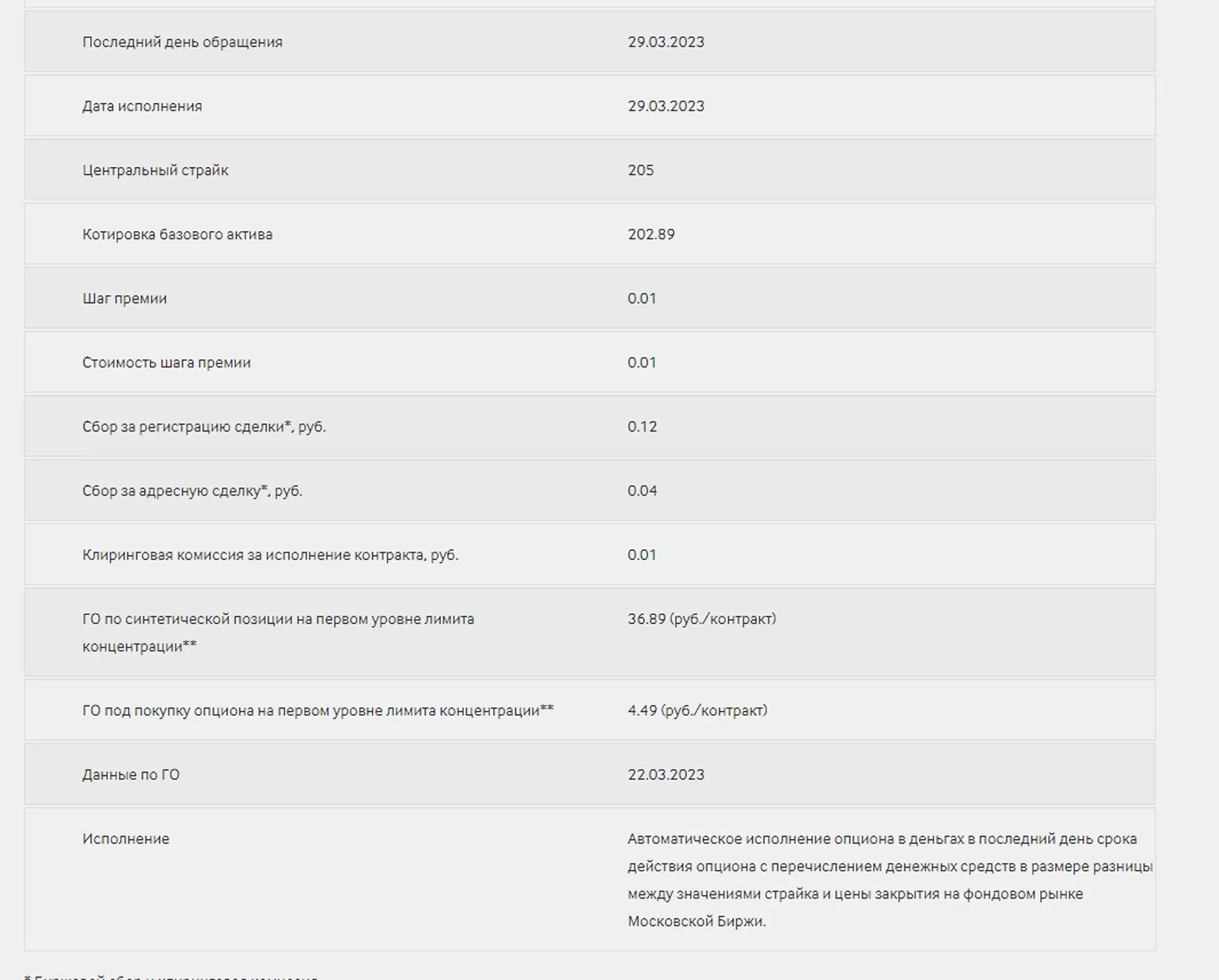
When you purchase an option, your account will be The transaction commission and the option premium are deducted. If a margined option is selected, the premium will not be debited, but the funds required to secure the transaction will be blocked in your account. This is important to consider when planning your financial transactions in the options market.
Option execution occurs through the exchange, which decides whether to exercise the buyer's right. If the execution is profitable, the option is executed automatically, and the funds are credited to the buyer's brokerage account. If the option is unprofitable, the investor automatically renounces their right to exercise it. This mechanism ensures effective investment management and minimizes losses.
You can significantly influence the execution of an option by using various methods. Effective option management requires an understanding of market conditions, volatility analysis, and time value assessment. Using strategies such as hedging, you can minimize risks and optimize your investments. It is also important to monitor economic news and events that may affect asset prices. Using these techniques will help you manage your options more effectively and achieve your financial goals.
Exercising an option before the expiration date is only possible for American-style options. To do this, you must contact your broker. If the asset price changes faster than you expected, exercising the option gives you the opportunity to lock in your profit immediately, without waiting until the expiration date. This can be especially useful in volatile markets, when a quick reaction to price changes can significantly impact your income.
Selling an option to another market participant is possible and quite simple. You can place an order to sell an option through the app or your broker's personal account, while setting the price for your commodity yourself. This gives you the flexibility to manage your assets and respond to changing market conditions.
If no buyer is found for the option, the contract will remain yours, and the broker will automatically execute it. It is important to note that getting rid of an option can be very difficult. If the asset price moves in an undesirable direction, you will not be able to sell the option and will be forced to wait until the expiration date. This highlights the importance of carefully analyzing the market and making informed decisions before purchasing options to minimize risk and maximize profit opportunities.
Options Basics: What You Should Know
- An option is a financial contract that gives the buyer the right, but not the obligation, to buy or sell an underlying asset at a predetermined price before a specified date. The seller, in turn, agrees to fulfill the terms of the contract.
- Options are often compared to insurance: the buyer can exercise their right or leave it unused. If unused, losses are limited to the premium paid, while potential profits can be unlimited.
- There are two main types of options: call options, which grant the right to buy an asset, and put options, which grant the right to sell it. Additionally, options can be classified by various criteria, such as the type of underlying asset, the settlement method, and the execution method. These classifications determine how exactly options can be used in trading.
- Options can be purchased on various stock exchanges, including the Moscow Exchange. When purchasing options, it is important to understand that if you take no action, they will be executed automatically. If the execution is favorable, funds will be credited to your account, and if the trade is unprofitable, you will only lose the premium and commissions paid.
How to Deepen Your Knowledge of Investing and Trading
In the ever-changing financial markets, it is crucial to stay up to date with modern tools and strategies for successful investing. In this context, it is useful to refer to a number of resources and recommendations that will help you both begin and improve your skills in the field of investing and trading. Familiarization with current analytical methods, understanding risks, and using advanced technologies can significantly improve your market performance. Selecting the right investment instruments and developing a sound strategy will help you achieve your goals and minimize losses. For those looking to minimize risks, OFZs (federal loan bonds) are worth considering. These securities are government debt obligations that guarantee the return of investments with interest. Learn more about how OFZs work in our detailed article. Risk diversification is the key to successful investing. Investing in multiple assets simultaneously allows you to reduce overall risks. One convenient tool for this is mutual funds (mutual investment funds). In our guide to mutual funds, you will find information about the potential profit and advantages of this instrument compared to stocks. Cryptocurrencies remain a hot topic of discussion. If you're wondering whether investing in digital assets is worth it, we recommend reading our article on cryptocurrencies, which covers the main aspects and risks. Professional traders earn money in the market by making multiple trades. They can earn up to 30% per annum on their capital, and in large companies, their income can reach 100,000 rubles per month. To learn more about the trader profession, read our review. If you aspire to professional trading, we recommend the Skillbox "Trading" course. It will teach you how to manage risks, make smart trading decisions, and develop your own strategies. These skills will help you successfully invest or find a job at a brokerage or investment company. Additional Skillbox Media resources that will be useful for your education include a variety of courses, webinars, and articles covering current topics in media production and digital technologies. These materials will help you deepen your knowledge and develop the skills necessary for a successful career in the media industry. Explore Skillbox Media's available resources to stay on top of the latest trends and improve your professional skills.
- Long and short: which should a beginning trader choose?
- Financial literacy: how to improve your knowledge?
- What to do with money during economic upheaval? Expert advice.
- Digital ruble: what is it and why is it needed?
- How do ETFs work and what are the pros and cons of this investment instrument?
Starting a business in 2025: 5 steps to success
Want to learn how to start a successful business in Russia? Read the article for 5 key steps to get started!
Find out more