
Contents:

Philosophy of Artificial Intelligence: 5 Key Aspects
Learn MoreVirtual Makeup: The Future of the Beauty Industry
From the Beginning In the 2000s, virtual makeup technology began to rapidly develop. In 2006, the Canadian company ModiFace introduced an innovative augmented reality solution that revolutionized the beauty industry. This solution allowed users to select cosmetics without having to test them on their skin, significantly simplifying the selection and purchasing process. Virtual makeup has become a convenient tool for consumers wanting to experiment with different looks and shades without leaving home. Virtual makeup technology continues to improve, offering new opportunities for users and brands seeking to improve customer engagement and enhance service. Smart mirrors that integrate online catalogs from popular brands such as MAC and L'Oreal have begun to appear in Europe. These innovative devices allow users to create their ideal look by combining various cosmetics. Smart mirrors offer virtual makeup options, making the cosmetics selection process more convenient and engaging. Users can easily experiment with different products and find the perfect shade, significantly simplifying the cosmetics shopping process.
Beauty mirrors with artificial intelligence from HiMirror and Amorepacific have hit the market. These innovative devices use algorithms to analyze skin condition, enabling the development of personalized skincare programs. Thanks to such technologies, users can more effectively care for their skin, taking into account its individual characteristics and needs.
Smart mirrors are equipped with cameras that scan the face and analyze its condition using Big Data technologies. These devices are capable of detecting wrinkles, pigmentation, and other skin problems. Based on the data received, smart mirrors provide the user with personalized skincare recommendations, which can improve the appearance and health of the skin. Innovative solutions in data analysis and processing make smart mirrors an indispensable assistant in the daily beauty routine.
Modern beauty mirrors can sync with mobile apps. These apps remind users to moisturize their skin and regularly apply sunscreen. With these technologies, users can take more effective care of their skin by receiving personalized recommendations and reminders.
According to a report by MarketsandMarkets, the smart mirror market is expected to reach $4.4 billion by 2023. This figure demonstrates the growing interest in innovative interactive mirror technologies. Smart mirrors are becoming increasingly popular due to their functionality and ease of use, making them an integral part of modern interiors. The growing smart mirror market offers new opportunities for manufacturers and consumers, highlighting the importance of technology in everyday life.
Currently, devices are available on the market that not only facilitate the makeup selection process but also act as personal fitness trainers. These gadgets can also play music while you shower, providing comfort and convenience in your daily life. Such innovative technologies are becoming indispensable assistants, combining style and functionality for their users.
Yulia Galliamova, a professor of dermatovenereology and cosmetology, emphasizes that smart mirrors have not yet gained widespread popularity among medical professionals. She notes that individualized skin care requires careful analysis of many factors, such as the patient's age and lifestyle. This underscores the importance of a professional approach in dermatology, where technologies such as smart mirrors can play a supporting role but cannot replace consultations with a qualified physician.
Gallyamova notes that these devices could potentially be widely used in telemedicine, allowing doctors to quickly obtain information about their patients' conditions. This is especially relevant for high-traffic clinics, where speed of data collection is critical for effective diagnosis and treatment. The use of such technologies will significantly improve the quality of medical services and enhance the efficiency of medical staff.
Modern mobile apps offer convenient opportunities for experimenting with makeup and hair color without leaving home. Users can easily change their look using a variety of tools and filters. These services allow users to visualize new shades and styles, making the selection process more fun and safe. Thanks to these apps, everyone can find the perfect look that highlights their individuality and style.
Cosmetics brands, including Armani Beauty, are offering innovative solutions like virtual makeup artists. These tools allow users to upload their photos and create the perfect look tailored to their individual needs. L'Oreal offers skin diagnostics to help determine skin needs, but it's important to note that the results are not a medical diagnosis. Using such technologies helps customers better understand their preferences and choose the right cosmetic products.
The Future of Fashion: The Virtual Fitting Room
In recent decades, the clothing shopping process has changed significantly. In the 1990s, Russians primarily purchased clothes at markets, where fittings took place behind cardboard screens. Since the early 2000s, shopping centers offering convenient fitting rooms have begun to open across the country, making shopping more comfortable. By the late 2010s, online shopping had become commonplace, and people began picking up their orders from pickup locations, significantly simplifying the process of selecting and purchasing clothing. These changes in shopping habits reflect not only the evolution of retail but also consumers' adaptation to new technologies and service forms.
The traditional model of trying on clothes has undergone significant changes with the advent of virtual fitting rooms. This innovation first appeared on the Russian market in 2011, when artificial intelligence began to be used to select clothes based on customers' individual body measurements. Although the technology at the time was not perfect, it allowed shoppers to evaluate which style best suited their body type. Virtual fitting rooms continue to evolve, offering increasingly accurate solutions to improve the shopping experience and increase customer satisfaction.
Since 2014, social networks, including VKontakte and Facebook, have begun integrating online store aggregators with online fitting features. Users were able to enter their measurements and see how clothes would look on a virtual mannequin, significantly simplifying the selection process. The one-button payment feature also contributed to increased interest in online shopping, making it more convenient and accessible. This approach not only improved the user experience but also contributed to the growth of e-commerce sales.
In 2015, a 3D scanner was introduced to the Russian market that scanned the customer's body. The device included a podium with cameras ensuring highly accurate measurements. This allowed customers to find clothes that perfectly matched their size and body type, while also taking into account parameters such as hair and eye color. Thanks to this innovative solution, the clothing selection process became more personalized and convenient, significantly improving the shopping experience for customers.
Over time, bulky devices have given way to compact widgets that are easily integrated into websites. Modern systems can process 98 body types, allowing users to upload their photos and specify the necessary parameters. A neural network automatically generates recommendations and demonstrates how clothing will look on the customer. Such innovative technologies are actively used by well-known brands such as Marks & Spencer and s.Oliver. This significantly simplifies the clothing selection process and makes it more personalized, which increases customer satisfaction and drives sales.
Today, artificial intelligence is actively used to determine customers' anthropometric data. Neural networks can "dress" the user based on their photo. To obtain the most accurate results, it is recommended to take photos in tight-fitting clothing. This allows the algorithms to more accurately analyze the figure and suggest the most suitable clothing options. Integrating such technologies into online stores and apps improves the user experience and contributes to increased sales, as customers can see how clothes will fit before making a purchase.
According to Alexander Abramov, Senior Innovation Manager at the startup Texel, virtual fitting rooms offer significant benefits for both customers and retailers. He noted that the average return rate among the company's partners has decreased to 40%, while sales among users of digital fitting rooms have tripled. Virtual fitting rooms help improve the shopping experience, reducing uncertainty when choosing clothes and increasing customer satisfaction.
Analytics from the Internet Initiatives Development Fund indicate that the virtual fitting room market could grow to more than $7.5 billion by 2025. This growth demonstrates the growing interest in virtual fitting room technology, which is becoming an important tool in e-commerce, improving the shopping experience and increasing conversion. Virtual fitting rooms allow users to try on clothes and accessories without leaving home, which is especially relevant given today's shopping behavior.
Digital Fashion: The Future of Virtual Clothing
In 2019, Dutch startup The Fabricant made a breakthrough in the fashion industry by offering the world's first digital dress, which sold at auction for $9,500. This event was a significant milestone, demonstrating that clothing that exists exclusively in digital format can achieve significant value. The advent of digital fashion opens new horizons for designers and buyers, rethinking traditional notions of the fashion industry and its future.
Virtual clothing is gaining popularity, and platforms already exist that allow users to try on outfits without using physical materials. Virtual fashion not only provides entertainment but also opens up new horizons for designers, allowing them to experiment with innovative collections. This trend is changing the perception of fashion and shopping, creating a unique user experience and expanding the boundaries of creativity in the industry. Virtual fitting rooms and 3D avatars are becoming the standard, allowing everyone to find their style without leaving home.
To create your own digital outfit, simply select your favorite model and upload a photo of yourself. A neural network processes the image, identifying key points on the body, and superimposes the selected garment onto the photo. The result can be easily shared on social media, making the process more interesting and engaging. This innovative approach allows every user to experiment with fashion and find unique stylistic solutions.
There is a Telegram bot that offers users virtual clothing options. However, the service currently offers uniform outfits without taking into account individual characteristics such as age or body type. For example, the bot may recommend identical styles for people as diverse as Kim Kardashian and Queen Elizabeth II. This limitation reduces the personalization of recommendations, which could negatively impact user experience and reduce the service's appeal. Developing more adaptive algorithms that take into account individual preferences and characteristics could significantly improve the bot's functionality and its popularity among users.
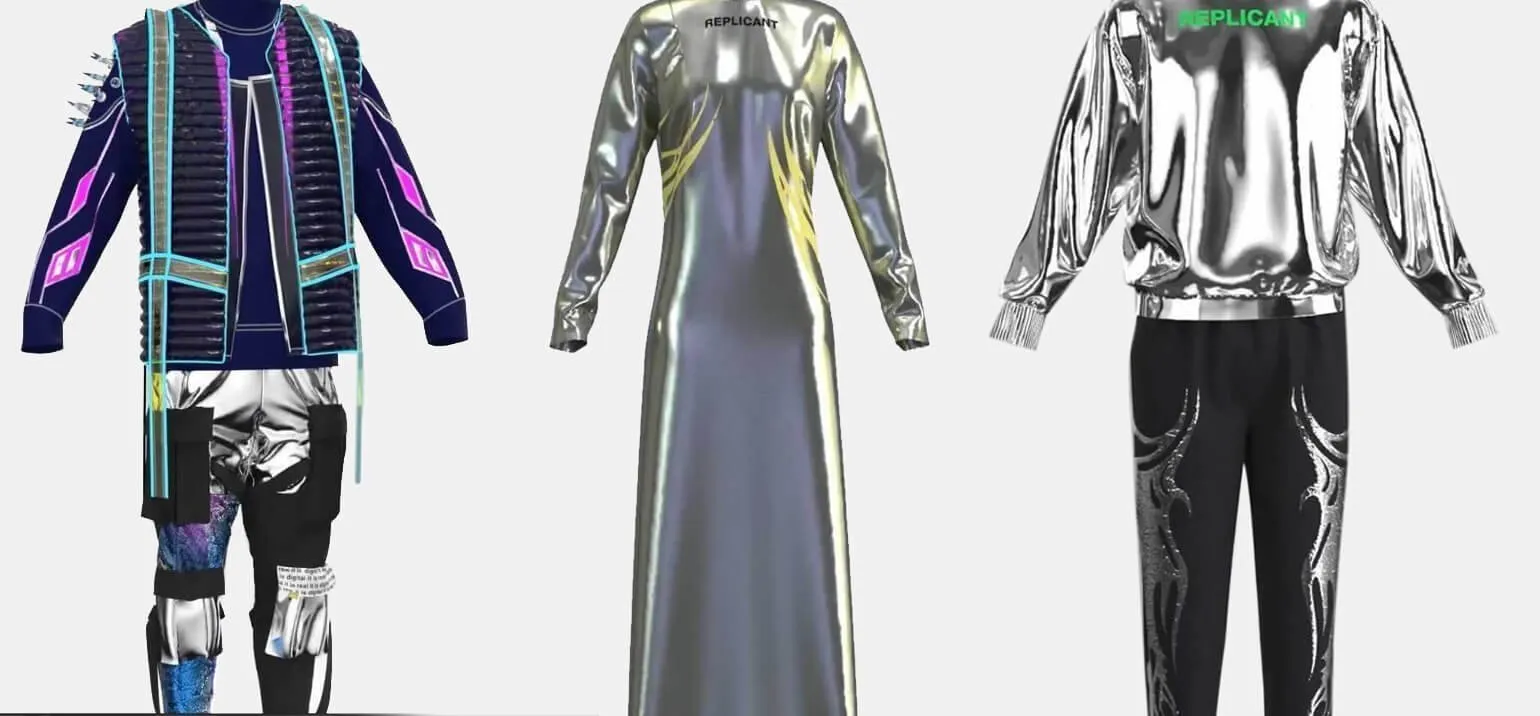
Regina Turbina, founder of the replicant.fashion brand, emphasizes that virtual clothing is created not only for entertainment, but also for solving practical problems. Designers have the opportunity to test new collections digitally, which helps minimize the waste of fabrics and resources. This innovative trend in the fashion industry promotes sustainable development and environmental responsibility, allowing brands to use their resources efficiently. Virtual fashion is becoming an important tool for streamlining development processes and implementing new ideas, making it an integral part of contemporary design.
Digital fashion is developed according to the same principles as traditional fashion. Designers use specialized programs to select fabric textures, upload patterns, and create virtual models. This allows them to experiment with designs and materials without the need for physical production. Such technologies open new horizons for the fashion industry, reducing costs and increasing creativity.
Digital Fashion Designer: A New Look at Fashion
A new specialty—digital fashion designer—has been introduced in Russian educational institutions. These specialists differ from traditional designers in that they develop clothing collections in a virtual environment. The use of modern technology significantly reduces the number of fittings and eliminates the need for physical mock-ups. Digital fashion designers use 3D modeling and computer programs to visualize their ideas, making the development process more efficient and cost-effective. This specialty opens up new horizons in the fashion world and contributes to the sustainable development of the industry by minimizing resources and waste associated with clothing production.
Digital fashion designers use 3D scanners to develop patterns and designs, significantly simplifying the clothing creation process. Using users' anthropometric data, which is uploaded to specialized programs, it is possible to precisely design clothing on digital avatars. This not only improves fit accuracy but also reduces the time required to develop new collections. As a result, digital modeling is becoming an essential tool in the fashion industry, ensuring a personalized approach to each client.
Anna Kostyuchenko, a fashion designer, notes that modern technology is not a universal solution to all problems in the fashion industry. However, in 90% of cases, it significantly reduces the number of errors in the initial stages of development. The use of technology allows for process optimization, resulting in savings in time and materials, which is especially important in the custom-made industry. The implementation of innovative solutions improves the quality and efficiency of fashion designers, which ultimately impacts the final product and customer satisfaction.
Technology allows for pattern changes to be made before the fabric is cut, creating realistic visualizations. This assertion was made by Kostyuchenko in an interview with Skillbox Media. The ability to quickly edit patterns significantly simplifies the development and production of textiles, ensuring a higher degree of accuracy and reducing preparation time.
Artificial intelligence is rapidly developing in the fashion industry, providing new opportunities for real-time fabric simulation and virtual fashion shows. In 2020, the Hanifa brand held a first-of-its-kind virtual fashion show, featuring digital models presenting their looks on an innovative digital catwalk. This approach not only changes the perception of fashion but also opens up new horizons for designers and consumers, allowing for the creation of unique and interactive experiences without the traditional limitations of physical space.
Irina Loginova, manager of the Mira Lemar atelier, emphasizes the importance of manual pattern creation. Currently, software is unable to account for all individual body features, including stoop. Even a small error of 1% can lead to serious problems with the fit of the finished garment. A manual approach ensures a more precise fit and quality, which is especially important for making custom clothing.
The digital fashion designer is becoming an important participant in the fashion industry, who not only creates designs, but also implements innovative solutions that help improve the quality of the final product. In the current market, where technology plays a decisive role, the role of the digital fashion designer is becoming increasingly significant, providing competitive advantages and new opportunities for brands.
The Future of the Fashion Industry: Digital Transformation
Digital fashion, despite its roots in traditional tailoring, is actively developing on the international arena. The introduction of specialized platforms for selling virtual clothing creates new opportunities for designers and buyers. These innovative solutions not only expand the boundaries of the fashion industry but also offer a unique digital clothing experience. Virtual fashion is becoming a major trend, capable of changing the perception of clothing and lifestyle. Designers can experiment with shapes and textures, and consumers gain access to exclusive collections without leaving home. Fashion Factory School founder Lyudmila Norsosyan asserts that physical clothing will remain in demand. However, with the development of technologies such as interactive avatars, a digital wardrobe can become a significant addition to our style. She discussed this in an interview with Skillbox Media. Digital fashion opens up new opportunities for self-expression and allows us to adapt our looks to various situations, making it an important element of the modern fashion world. Tatyana Rumyantseva, designer of digital clothing for the Kai Kai brand, emphasizes that it is too early to talk about a significant reduction in the production of physical clothing in favor of digital. She notes that this trend is only just beginning to develop, and many aspects of digital clothing cannot yet fully replace traditional methods. With the fashion industry's transition to digital technologies, interest in virtual clothing has grown, but traditional clothing continues to hold an important place in the market. The transition to digital solutions takes time, and physical clothing will not lose its relevance in the near future. She noted that digital clothing should be viewed not only as a product, but also as an innovative way to interact between brands and their target audience, as well as between social media users and their followers. This new format allows for unique connections and opens new horizons for self-expression in the digital space. Rumyantseva emphasizes that more and more brands are actively integrating augmented reality (AR) and 3D technologies into their online presentations. Creating the most realistic online experience for interacting with clothing will be key to attracting customers. Brands that can offer innovative virtual shopping solutions will have a competitive advantage in the market. AR and 3D technologies allow users to not only visualize clothing but also evaluate its fit, significantly improving the overall shopping experience and increasing customer satisfaction. In an increasingly competitive environment, it's important to consider that delivering a unique and interactive experience can be the key to success for brands in the future.
Artificial Intelligence: Philosophy and Machine Thinking
Want to understand the philosophy of AI? Learn about machine thinking and how it differs from natural intelligence!
Learn more