Contents:

Learn for free: "Neural Networks. A Practical Course"
Learn moreSeveral years ago, the launch of a new open-source language model caused a significant stir in the IT community. Today, however, this process has become commonplace. Dozens of new open-source models are developed every month, and their number reaches hundreds annually. Open language models continue to evolve, introducing new capabilities and improving the quality of natural language processing.
To make it easier to navigate the variety of available neural networks, we have prepared a detailed guide presenting the current open-source models. This resource will help you quickly find the right tools and technologies in the field of artificial intelligence.
Optimizing text for SEO requires not only changing the structure but also focusing on keywords and phrases that can attract the target audience. The content should be informative, relevant, and easy to understand.
Below is the revised text:
Content is an important part of any content, as it helps users quickly navigate the material. Properly formatted text with clear and logical content improves the user experience and contributes to higher rankings in search engines. Using keywords in headings and subheadings not only facilitates navigation but also makes the text more accessible to search engines. Furthermore, the relevance and uniqueness of the content play a key role in attracting and retaining readers. Creating high-quality content with clear content helps build trust in the resource and increases its authority in the eyes of users and search engines.
Thus, content not only structures information, but also becomes the basis for a successful SEO strategy.
- Where do open source models come from?
- How do they develop?
- What are their advantages and disadvantages?
- What types of open LLMs are there?
- What types of open-source licenses are they published under?
- How to identify the best LLMs?
- What popular open source models are worth paying attention to?
- What else to read about open and proprietary LLMs?
Where do open models come from?
There are many open source neural networks. However, most of them are not independent projects, but are created on the basis of several large language models (LLM), known as foundation models. These base models serve as the foundation for developing new artificial intelligence and machine learning solutions, enabling researchers and developers to create more specialized applications and tools.
Creating and training AI models requires significant financial resources and powerful computing power. Therefore, this work is primarily available to large research teams and IT companies, such as Google and OpenAI. For example, training the GPT-3 model cost the developers almost $5 million. The high cost of training such models is due to the need to process large volumes of data and use modern technologies, making the process unaffordable for all organizations.
A base model is an artificial neural network trained on a large amount of data. It can be adapted to solve a variety of problems, making it a versatile tool in machine learning. Tuning the base model can improve its efficiency and accuracy in specific tasks, such as natural language processing, image recognition, and other applications. Using base models opens up new possibilities for developing intelligent systems and improving the quality of analytics.
Once development is complete, a new model can be released under a proprietary or open source license. With an open license, other companies and independent developers have the opportunity to refine and adapt the model to solve specific problems. This fosters innovation and improves product quality, as the community can contribute improvements and optimizations. Open licenses also facilitate the wider dissemination of technologies and their integration into various solutions.
Using open-source LLMs does not require significant financial investment or computing power. This is why startups often choose such solutions. Modified versions of models created from the source code are commonly called forks (from the English word fork). This allows developers to adapt technologies to their needs, optimizing them for specific tasks and improving performance.
Popular base models that form the basis of open LLMs include:
- Zuckerberg's LLaMA and LLaMA 2, the latter of which was developed jointly with Microsoft.
- BLOOM (BigScience large open-science open-access multilingual language model) from the BigScience project, created with the participation of Hugging Face.
- GPT-2, published by OpenAI several years ago, when the company planned to develop only open-source solutions.
- Falcon is the latest development from the Institute of Technological Innovation (TII) from Abu Dhabi (UAE).
- The T5 family of models from Google.
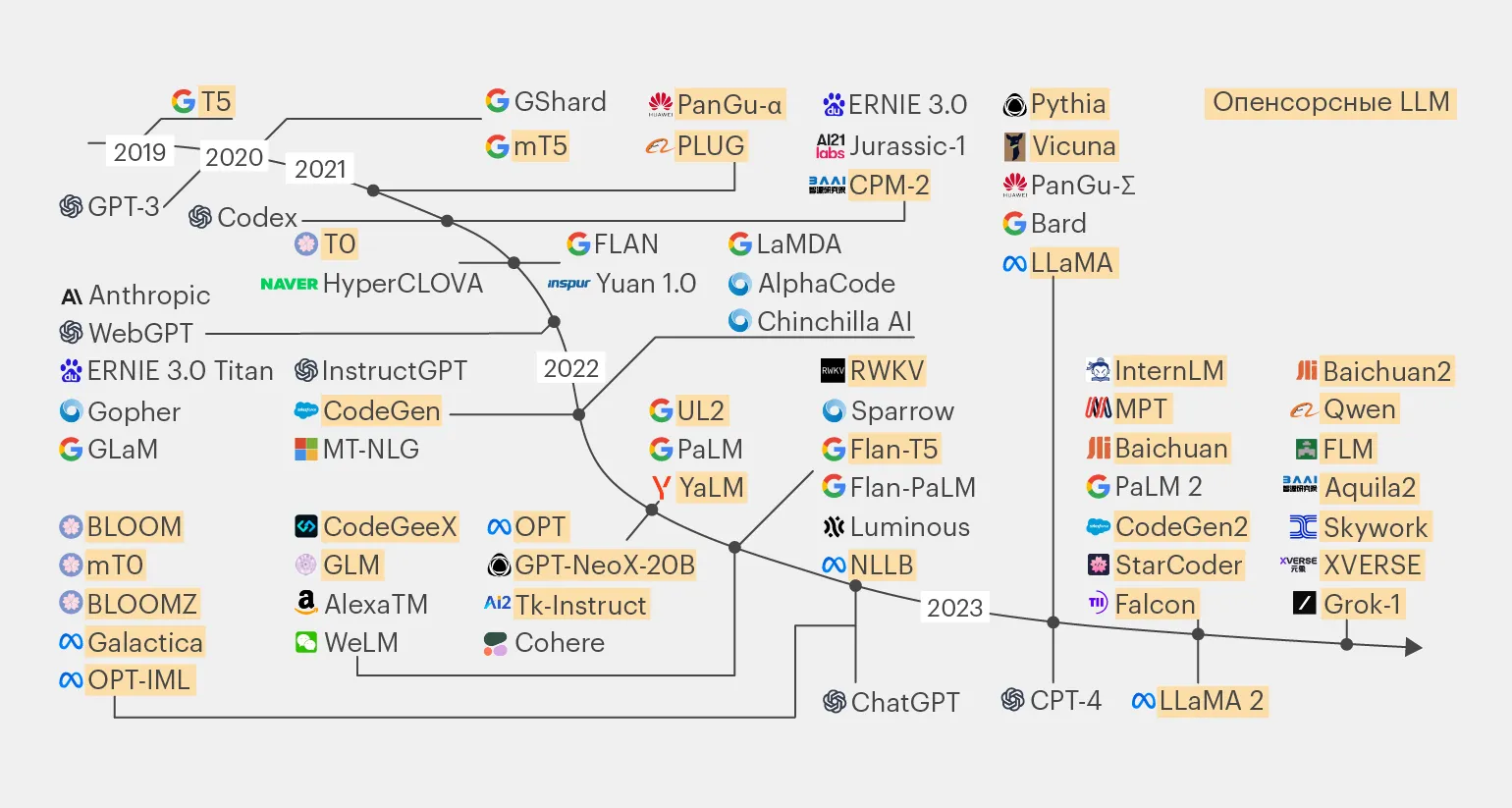
Modern LLM models can be represented in the form of a family tree that illustrates their evolution and Interrelations. These language models, based on deep neural networks, evolve every year, demonstrating increasingly complex architectures and improved algorithms. From the first simple models to today's powerful systems like GPT and BERT, one can trace how each new version has built on previous achievements, integrating new methods of natural language processing and learning. The evolution of LLM models not only enriches their functionality but also expands their application in various fields, such as automatic translation, content creation, and data analysis. This makes understanding the genealogy of LLM models important for researchers and developers looking to leverage their capabilities in their projects.
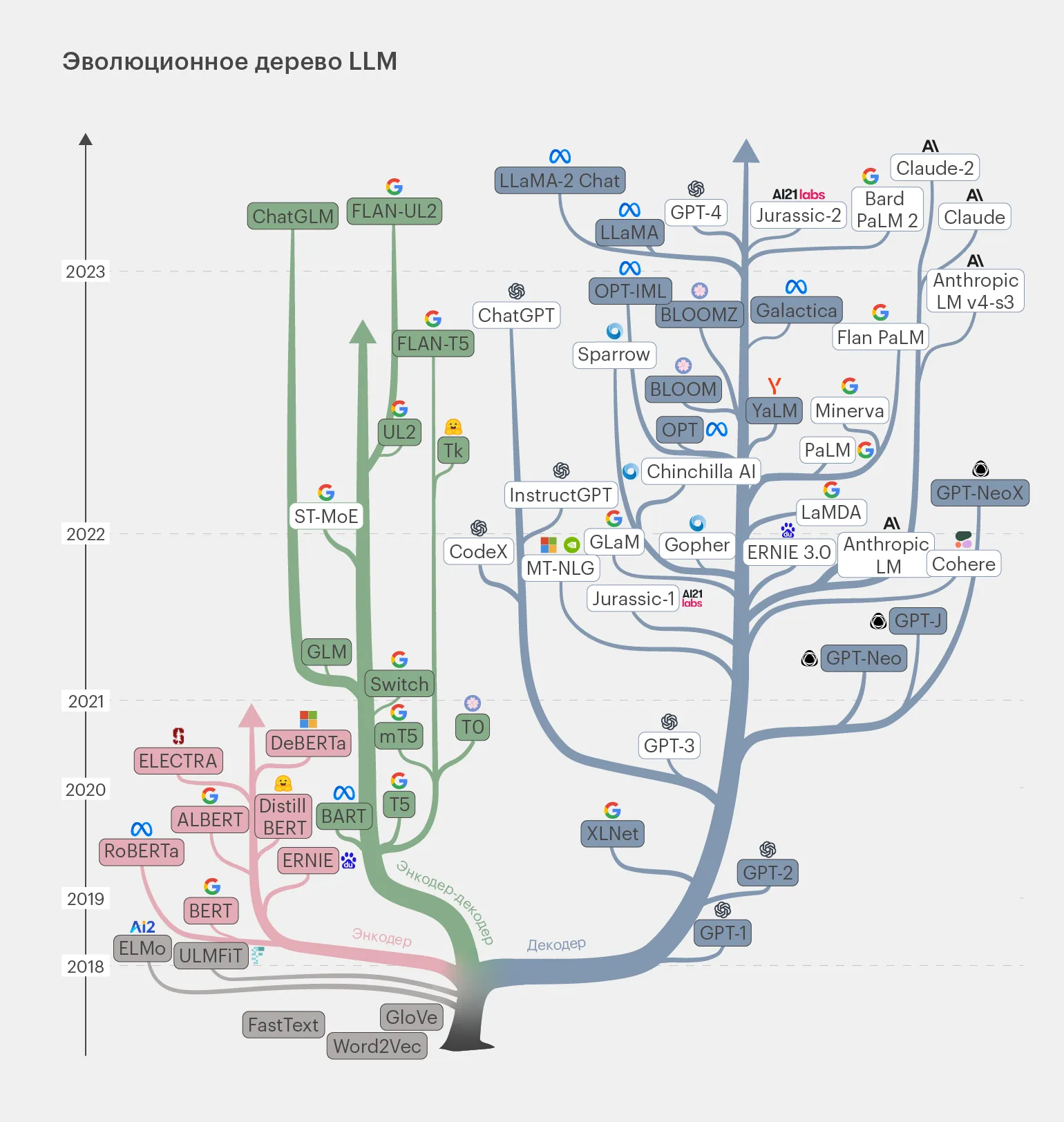
This diagram focuses on the models represented in the filled rectangles. These models represent the open-source solutions we will discuss today. We will consider their main characteristics and the evolution achieved by 2023.
How Open-Source Models Evolve
Open-licensed LLMs exhibit the same problems as proprietary neural networks, including frequent hallucinations, limitations in the length of the context window, and the need to process information from different modalities. These aspects determine the similarity of their development directions. Thus, both open and closed models face similar challenges, highlighting the importance of further research and improvements in this area.
Reducing Hallucinations in Language Models. Language models such as LLM can generate erroneous data that appears plausible. These errors are called hallucinations. To date, it has not been possible to completely eliminate such inaccuracies in neural network responses. While algorithms and training methods continue to be improved, the task of minimizing hallucinations remains a pressing issue for developers.
The leader in the fight against hallucinations is the closed model GPT-4, demonstrating an error rate of only 3% of the time. However, in terms of accuracy, it is close to the open-source model LLaMA 2 70B, which is comparable in performance to the well-known proprietary model Gemini from Google DeepMind. Both solutions represent cutting-edge technologies in the field of natural language processing, and their efficiency makes them valuable tools for a variety of applications.
Increasing the context window length is an important factor affecting the performance and response quality of language models (LLM). The larger the volume of text a model can process, the more informed and accurate the responses it can generate. This is because expanding the context window significantly increases the amount of data available for analysis, which, in turn, improves contextual understanding and reduces the likelihood of errors. Therefore, increasing the context window length is a key step in improving the efficiency of LLM and enhancing the user experience.
Closed-source models GPT-4 and Claude 100K demonstrate the ability to process over 100,000 tokens simultaneously, significantly expanding their functionality. At the same time, open-source neural networks are actively developing, striving to achieve similar results in the field of information processing. These achievements open new horizons for the application of artificial intelligence in various fields, including data analysis, content creation, and process automation. Interest in improving open-source models is growing, driving global progress in neural network development.
The base Mistral 7B model processes 8,000 tokens, while its modern fork, Nous-Yarn-Mistral-7B-128k, from Nous Research, significantly expands its capabilities, supporting a context window of up to 128,000 tokens. This significant improvement allows models to more efficiently process and analyze large volumes of text data, opening new horizons in natural language processing and machine learning.
Processing data from various modalities. Modern neural networks can effectively process not only text data but also images, video, and audio. This functionality has already been implemented in several open-source LLMs, expanding their applicability in various fields, such as computer vision, speech recognition, and multimedia analysis. Thanks to the multi-domain approach, neural networks can analyze and integrate data from different sources, which significantly increases their functionality and accuracy.
- the Nous-Hermes-2-Vision-Alpha visual-language model;
- the Qwen-VL multimodal neural network from the Chinese company Alibaba Cloud;
- a multimodal version of LLaMA called LLaVA-13B.

Reducing the cost of LLM development. One of the main problems associated with neural networks is the high cost of creating basic models. However, thanks to the fact that some of them are available under open licenses, the costs of further training and implementation are significantly reduced. For example, the refinement and launch of the open-source Alpaca and Vicuna-13B models, based on LLaMA, cost the developers only $600 and $300, respectively. This makes neural networks more accessible to developers and promotes their wider application in various fields.
One effective way to reduce costs is to use neural networks to generate synthetic training data and evaluate the performance of new models. This method is known as RLAIF (Reinforcement Learning with AI Feedback) and allows for the optimization of the training process, improving results and reducing development time. Using RLAIF increases efficiency and reduces the risk of errors, making it an important tool in modern machine learning technologies.
Running language models on low-end hardware is becoming increasingly accessible. Most open-source language models have fewer parameters than their closed-source counterparts. This allows such models to be effectively used on devices with limited resources, including home computers. Users can easily integrate and test these neural networks, opening up new opportunities for development and experimentation in the field of natural language processing.
Mistral 7B has a significantly smaller number of parameters compared to GPT-3.5, accounting for only 25% of its volume. This results in lower computing requirements: Mistral 7B requires approximately 187 times less processing power than GPT-4 and nine times less than GPT-3.5. This makes Mistral 7B a more accessible solution for developers and companies looking to harness the power of artificial intelligence without incurring significant computing costs.

A research fellow in the Computational Semantics group at the AIRI Institute of Artificial Intelligence, he conducts research in the field of natural language processing and the development of methods, enabling machines to understand and interpret the meaning of texts. The focus is on creating algorithms that can analyze the semantic relationships between words and phrases, a key aspect in the development of intelligent systems. Work in this group contributes to the implementation of advanced technologies in various fields, such as automatic translation, question and answer systems, and data analysis.
Open-source models provide businesses with the opportunity to use LLM with minimal restrictions. Open solutions allow companies to fully control how they process user data, adapt it to specific requirements, and significantly reduce risks by using their own infrastructure. This makes open-source technologies attractive to enterprises seeking to improve the security and efficiency of data management.
The emergence of open-source models has been a significant factor in increasing the level of competence in the academic community in the field of working with language models (LLM). Today, no one is surprised by a chatbot like ChatGPT, which can be launched on a laptop by an enthusiast. Just two years ago, this seemed impossible. Advances in technology and the availability of tools open up new opportunities for research and development in artificial intelligence, spurring the interest and activity of both specialists and amateurs.
Improving existing and developing new neural network architectures is a pressing issue in the field of artificial intelligence. One of the key problems with large-scale language models (LLM) is the limitations of the transformer architecture, which leads to various shortcomings in their operation. Solutions to this problem are expected from startups that develop open-source models and actively experiment with their internal structure. Innovations in neural network architectures can significantly improve the efficiency and performance of models, which in turn will expand their application in various fields.
The Mixture of Experts (MoE) architecture may be a solution for improving the performance of models like GPT-4. This architecture includes eight expert neural networks, each specializing in specific tasks. The open-source Mixtral 8x7B model, developed by the French company Mistral AI, demonstrates a six-fold increase in response speed compared to the original LLaMA 2 70B model. Using MoE significantly optimizes the performance and adaptability of neural networks, which is especially important for creating high-quality content and improving the user experience. Building multi-agent systems based on language models (LLM) is an innovative approach to improving the performance of neural networks. Rather than redesigning the architecture, this method focuses on creating systems consisting of multiple independent agents that can interact and negotiate with each other. This approach enables effective solution of complex user problems by leveraging the collective intelligence of multiple neural networks. Multi-agent systems are capable of adapting to various scenarios, making them particularly useful in natural language processing and other areas that require flexibility and dynamic problem solving. Open-source LLMs, which do not require significant computational resources, are ideal candidates for use in such systems. Projects such as AutoGPT, GPT-Engineer, LangChain, and GPTeam are already successfully implementing these technologies. Open LLMs provide accessibility and flexibility in development, allowing users to effectively leverage the power of artificial intelligence without the need for expensive hardware. Building large language models (LLMs) for languages other than English is a complex task. Neural networks most often use English, as it is the basis for a significant portion of their training data. This puts other languages, spoken by tens and hundreds of millions of people, at a disadvantage. Training models to work with such languages requires significant effort in finding and creating high-quality datasets, which in turn requires additional resources and time. Therefore, developing LLMs for various languages is becoming an important task that will require attention and investment to achieve parity in language data processing.
Despite the power of modern neural networks such as GPT-4, they support only a few hundred languages out of more than 7,000 existing ones. Experts believe that a solution to this problem can be found in open-source language models (LLM). The development of accessible and multilingual LLMs can significantly expand language capabilities, allowing more people to access advanced natural language processing technologies.
In 2023, a new model, Jais, developed in the UAE, was presented, which can communicate in Arabic. A variant of LLaMA adapted for the Portuguese language was also announced. In Russia, Yandex and Sber have released the YaLM 100B and ruGPT-3.5 13B neural networks, focused on the Russian language. These developments highlight the active development of artificial intelligence technologies and their adaptation to various languages, which opens up new opportunities for users around the world.
Work on rare languages continues. In 2023, the Massively Multilingual Speech (MMS) project was launched, aiming to create datasets for 1,100 previously under-covered languages. This project aims to expand speech processing capabilities and improve automatic speech recognition technologies for many languages, which will significantly increase the availability of information and services for native speakers of these languages.

Read also:
Tiger and Dragon: China's Projects and Prospects in Generative AI
China China is actively developing generative artificial intelligence technologies, striving to take a leading position in this rapidly developing industry. The synergy of powerful computing resources and rich data allows the country to develop innovative solutions that are changing the approach to artificial intelligence.
Chinese companies and research institutions are working to create advanced models capable of generating text, images, and even music. These developments open new horizons for various sectors of the economy, including education, healthcare, and entertainment.
Government support and investment in startups play a key role in accelerating the industry's growth. Chinese enterprises actively collaborate with international partners, facilitating the exchange of knowledge and technology.
The prospects for generative AI in China appear promising, from creating personalized solutions for users to automating business processes. The country is expected to make a significant contribution to the global artificial intelligence ecosystem in the coming years.

A research fellow in the Computational Semantics group at the AIRI Artificial Intelligence Institute researches and develops algorithms that enable computers to understand and process natural language. The main goal of this work is to create models capable of analyzing the semantic meaning of text, which opens new horizons for the application of artificial intelligence in various fields, such as automatic translation, data processing, and human-computer interaction. Specialists in this field actively participate in interdisciplinary projects that contribute to the development of technologies and improve the quality of interaction with information systems. Open-source models open new opportunities for business, allowing the effective use of LLM without significant restrictions. Open-source solutions provide companies with complete control over the processing of user data, facilitating their adaptation to specific business needs. This not only increases flexibility but also significantly reduces risks, as companies can use their own infrastructure for processing and storing information. Thus, open-source technologies are becoming an important tool for ensuring security and optimizing data management in modern business. The emergence of open-source models has significantly increased the level of competence in the academic community in the field of working with large language models (LLM). Nowadays, chatbots similar to ChatGPT, developed by enthusiasts on ordinary laptops, are no longer surprising. This achievement, which was considered science fiction just two years ago, testifies to the rapid progress of technology and the availability of tools for developers and researchers.
Advantages and Disadvantages of Open-Source LLMs
Companies choose open-source neural networks due to their numerous advantages over proprietary models. Firstly, open-source solutions provide greater flexibility and customization, allowing them to adapt models to specific business needs. Secondly, they help reduce costs, as they do not require licensing or additional fees for use. Thirdly, the availability of the source code allows developers to make changes and improvements, as well as easily integrate neural networks into existing systems. Furthermore, the developer community actively supports such projects, facilitating rapid problem resolution and knowledge sharing. Finally, open-source neural networks provide a high level of transparency, allowing companies to better control the processes and results of their models. Therefore, choosing open-source neural networks is becoming increasingly justified for organizations seeking innovation and process optimization.
- Data security and privacy. Open-source LLMs can be deployed on your own infrastructure without sending information to third-party servers. This gives users complete control over the data processed by the neural network.
- Cost savings. Open-source LLMs can be used without subscription fees or regular developer contract payments. This makes them popular with startups and companies with limited budgets.
- Reduced dependence on IT service providers. Users can choose the most suitable neural network option from hundreds of open-source LLMs. This way, a company isn't tied to a single AI solution provider and can choose the best models or even combine them.
- Transparency of the LLMs used. Open-source models can be examined internally to understand how exactly they process data. This helps identify and prevent sending information to third-party servers.
- Open-source projects are supported by teams of developers and experts. This ensures that any bugs and issues that arise are quickly resolved, and the documentation describes in detail the nuances of using the neural network. This is typical for most open-source models, but there are some notable exceptions.
- Unconventional solutions and approaches. Open LLMs allow for experimentation with AI, building on new foundational models. Even small startups can creatively rework such neural networks and use them as a basis for their own unique developments.

The CEO of Avatar Machine, the developer of the Sabina Ai psychologist chatbot and the co-author of the FractalGPT project, is A technology and artificial intelligence professional. Under his leadership, the company has achieved significant success in creating innovative solutions aimed at supporting and developing emotional intelligence using modern digital tools. The Sabina Ai chatbot offers users access to psychological support and consultations using advanced natural language processing algorithms. The FractalGPT project, in turn, demonstrates the capabilities of deep learning and text generation, opening new horizons in the field of human-machine interaction.
The widespread emergence and proliferation of large, open-source language models is driven by the global trend toward increasing productivity and reducing LLM costs. Consumers are currently seeking to abandon closed, proprietary solutions that create dependence on foreign suppliers and political instability. These factors are driving a shift away from solutions from renowned foreign IT giants like OpenAI. Open language models provide users with greater flexibility and control, making them increasingly attractive in the face of modern challenges.
Open-source LLMs have their drawbacks. First, such models may suffer from data quality limitations. They are often trained on less diverse and lower-quality datasets, which can negatively impact their performance and accuracy. Second, the lack of commercial support can create challenges with updates and bug fixes, potentially introducing vulnerabilities. Also, open-source LLMs may be less optimized and customized than proprietary solutions, which may limit their use in specific tasks. Finally, using open-source LLMs requires technical skills for configuration and integration, which may be a barrier for some users. Implementation and maintenance may require more time and technical expertise than proprietary models, which are typically ready to use out of the box. Developments from little-known teams may be trained on incomplete or low-quality data. This reduces the accuracy of neural network responses and increases the frequency of hallucinations.

CEO of A-Ya Expert LLC, a company specializing in the development of artificial intelligence systems. We focus on creating innovative AI solutions that help businesses optimize processes and increase efficiency. Our team of experts develops cutting-edge technologies that facilitate automation and data analytics. We strive to be leaders in the AI industry, offering our clients unique and high-quality products.
Open-source LLMs must be open not only in terms of the model source code but also in terms of the data on which they are trained. This is key, as the problem of "data poisoning" remains relevant. It is important to ensure the cleanliness and transparency of data to guarantee the reliability and security of models. Modern developments will focus on addressing these issues, which will increase user trust and improve the quality of the results obtained from LLMs.
Engineers, scientists, and government organizations face questions of data trust when using solutions based on open-source AI models. For the successful integration of open-source models into the relevant market segment, openness and high-quality datasets on which neural networks are trained are essential. This will increase the level of trust in technologies and ensure their wider application in various industries.
Read also:
Open and free software (Open Source) attracts attention due to its accessibility and transparency. However, behind its advantages lie certain risks. One of the main dangers is the possibility of introducing malicious code. Since the source code is publicly available, attackers can exploit vulnerabilities to create exploits. Furthermore, the lack of centralized support can lead to security issues, as updates and patches are not always released in a timely manner.
Compatibility and dependency issues should also be considered. Using open-source software can cause conflicts between different libraries, complicating the development and support process. A lack of professional support can leave users without the necessary resources to resolve issues, negatively impacting business processes.
Legal aspects should also be considered. Open-source licenses may contain conditions that restrict its use for commercial purposes, which can lead to legal consequences for organizations.
Therefore, despite the attractiveness of open-source and free software, it is important to carefully assess the associated risks and take measures to minimize them. Make sure you understand the licensing terms, keep your code secure, and are prepared for potential support issues.

CEO of Avatar Machine, developer of the Sabina Ai psychologist chatbot, and co-author of the FractalGPT project. A leading expert in artificial intelligence and automation, with experience creating innovative solutions to support mental health. He is strategically focused on developing technologies that help improve users' quality of life through accessible and effective tools. The widespread adoption and distribution of large, open-source language models is driven by the global trend toward increasing productivity and reducing LLM costs. Modern consumers are seeking to abandon closed, proprietary solutions, as these create dependence on foreign vendors and political factors. These circumstances are driving users to seek alternatives to popular solutions from international IT giants, such as OpenAI. Open language models help avoid the risks associated with external threats and provide greater flexibility in the use of natural language processing technologies.

The CEO of A-Ya Expert LLC, a company specializing in the development of artificial intelligence systems, plays a key role in the creation of innovative solutions in this field. Under his leadership, the company develops cutting-edge technologies that help optimize business processes and improve the efficiency of various organizations. The company's AI systems are used in various industries, including finance, healthcare, and manufacturing, confirming their versatility and market demand. Open-source LLMs must be open-source, both in terms of their source code and the data they are trained on. This is especially important in light of the ongoing problem of "data poisoning." The emphasis is currently shifting to ensuring data purity and transparency, which is key to increasing trust in models. Openness in these areas not only improves the quality of training but also reduces the risks associated with the use of incorrect information. Engineers, scientists, and government agencies face important questions of data trust when using solutions based on open-source AI models. For open-source models to find their niche in the market, a high degree of openness and high-quality datasets on which neural networks are trained are necessary. This will increase the level of trust in the results of such models and ensure their competitiveness in various fields.
What are open-source LLMs?
Open-source models are classified by several parameters, including the degree of training, size, and support for various languages. Let's consider each of these aspects in more detail.
Developers often publish only pre-trained versions of their neural networks, known as "pretrains." For example, Sber specialists made the domestic ruGPT-3.5 model available, and Mark Zuckerberg did the same with the original LLaMA model. These solutions allow researchers and developers to use existing solutions for further experimentation and refinement, which facilitates the development of artificial intelligence technologies and expands their applicability across various fields.
Before publication, language models undergo a lengthy training process on vast amounts of unlabeled text data. This process requires significant computational resources and financial investment. As a result, neural networks develop a shared understanding of language, allowing them to effectively process and generate text.
Using "pretraining" for specific tasks can be challenging. It is primarily designed to generate continuations of text sequences entered by the user. For example, the system can easily complete a sentence beginning with the definition: "Machine learning is..." However, more complex tasks require additional configuration and adaptation.
If a user attempts to initiate a dialogue with the neural network or instruct it to perform actions, the network may generate inappropriate or meaningless responses instead of providing useful information. This can lead to misunderstandings and decreased trust in the technology, highlighting the importance of further development and training of neural networks to improve user experience.
The popularity of modern language models is due not to pretraining, but to base models that have undergone additional fine-tuning. These LLMs typically include the word "Chat" in their names if the network has been fine-tuned to handle conversations, or "Instruct" if it can execute instructions using a method similar to the RLHF method used to train ChatGPT. Fine-tuning significantly improves user experience and expands the functionality of models, making them more suitable for various applications related to natural language processing.
More specialized fine-tuning options also exist. For example, the MPT-7B model is available in a StoryWriter version, which is focused on creating fictional stories with long contexts. It's also worth noting the many language models that generate program code. The word "Code" is often found in the names of such neural networks, as in the cases of StableCode, CodeGeneX, and other similar solutions. These models demonstrate high efficiency in automating programming and simplifying software development.
According to this criterion, LLMs (Large Language Models) can be divided into three main categories.
- English-language;
- supporting one local language, such as Russian;
- multilingual, which can handle several languages other than English simultaneously.
When using neural networks in Russia, it is important to consider support for the Russian language, as this significantly improves user interaction with the technology. However, the primary language for most models remains English, which may create certain difficulties for Russian-speaking users. Successful integration of neural networks into the Russian market requires the development and adaptation of models capable of working effectively with the Russian language and accounting for cultural peculiarities.
This is due to the fact that the largest amount of data necessary for training neural networks is available in this language. Other languages require additional training and architectural modifications to achieve comparable results. Since data diversity is critical for effective model training, using this language provides a significant advantage in developing and optimizing neural networks.
Almost all open-source models are capable of processing the Russian language. However, the main problem is that most popular language models (LLM) were developed with English, or at least the Latin alphabet, in mind. This means that Cyrillic texts take up more token space, which, in turn, significantly reduces the context of model use. Optimizing Cyrillic tokenizers could improve the quality of Russian language processing in open-source models.
Mikhail Salnikov is a name associated with professionalism and a high level of expertise in his field. With many years of experience, Mikhail has become a recognized specialist capable of solving complex problems and finding effective solutions. His approach is based on deep analysis and attention to detail, which allows him to achieve excellent results. Mikhail actively shares his knowledge and experience, helping others develop and succeed in their field.
Modern trends in neural networks show that model size does not always determine its effectiveness. Open-source neural networks, even those of small size, are capable of delivering results comparable to large proprietary systems. When choosing a language model (LLM), it is important to focus on the balance between size and performance - the model must be compact enough to solve specific problems, while providing the necessary functionality and quality.
Each model can be evaluated using regularly updated quality metrics, known as benchmarks. Based on these metrics, all LLMs (Large Language Models) can be classified into two main categories.
- Models that demonstrate results close to a certain "cutoff quality". As a rule, ChatGPT (GPT-3.5-Turbo) is considered the baseline.
- Models that do not satisfy the price-performance ratio. These are either overly large LLMs, the cost of which is off the charts, or very small, containing less than 7 billion parameters. The latter usually have gaps in performance, which are detected using individual benchmarks related to language understanding."
Viktor Nosko is a renowned professional in his field. He has significant experience and deep knowledge, which allows him to effectively solve complex problems. His approach to work is always based on high standards of quality and attention to detail. Victor actively shares his knowledge with colleagues and young professionals, contributing to the development of the professional community. His desire for continuous learning and self-improvement makes him a valuable asset to any team. Thanks to his dedication and high qualifications, Victor Nosko has established himself as a reliable partner and expert in his field.
The second important parameter related to the model size is the LLM type: full or quantized. Quantizing a neural network significantly reduces the requirements for computing power and RAM. However, it is worth noting that this reduces the accuracy of the language model. The choice between the full and quantized versions depends on the problems to be solved and the available resources. Full LLMs provide higher accuracy and processing quality, while quantized versions are suitable for applications with limited computing resources.
Of course, I am happy to help with text editing. Please provide the text itself to be reworked.
Model hosting costs are often reduced through quantization. This allows the model to run even on standard home graphics cards, such as NVIDIA's GTX or RTX 3070–3090. However, it's worth noting that this approach can reduce model performance by 5–15% compared to the original version. In some cases, this reduction in quality is acceptable to users.
Victor Nosko is a name that has become a symbol of professionalism and quality in his field. He has established himself as an expert offering unique solutions and ideas. Thanks to his experience and skills, Victor Nosko attracts the attention of not only clients but also industry colleagues.
In his work, Victor Nosko emphasizes innovation and efficiency, which allows him to achieve high results. A key aspect of his approach is a constant desire for self-development and learning, which makes him a sought-after specialist.
Viktor Nosko actively shares his knowledge and experience by conducting master classes and seminars. This allows him not only to strengthen his position in the market, but also to create a community of professionals ready to exchange ideas and experience.
Viktor Nosko's success is due not only to his high professionalism, but also to his ability to find a common language with clients, which contributes to long-term partnerships. His work is focused on results and customer satisfaction, which is the key to success in a competitive environment.
Viktor Nosko is not just a name, but a brand associated with reliability and quality.
Main types of open-source licenses
Not all open-source models are equally accessible. The degree of openness depends on the license chosen by the developer. Some licenses provide complete freedom of use and modification, while others may impose restrictions. It is important to carefully review the license terms to understand the capabilities and limitations of a particular open source model.
Partially open models have a number of significant restrictions on their use. For example, the developers of LLaMA 2 require users to accept an agreement with an extensive list of conditions and prohibitions before downloading. One of the main requirements is a ban on using the neural network in projects with more than 700 million monthly users. Moreover, the results of LLaMA 2 cannot be used to train other language models, with the exception of LLaMA itself and its derivatives. This emphasizes the importance of complying with license terms when working with neural networks.
Most large language models (LLM) are distributed under free software licenses. The main ones include the following types of licenses:
- Apache 2.0 allows using the models for any purpose, modifying them, and distributing them in accordance with the license terms, without paying royalties to the developer. The vast majority of open-source LLMs were created under this license: T5, Mistral 7B, and others.
- The MIT License was developed by the Massachusetts Institute of Technology (MIT). It is largely identical to Apache 2.0, but allows the reuse of open-source code within proprietary software. For example, this license is used for the Phi-2 model from Microsoft.
- Open RAIL-M v1 is supported by the BigCode community, created by Hugging Face. The license provides for free access to models, the ability to modify their source code, and the sharing of LLMs and their variants. It contains a number of restrictions related to the prohibition of use in unethical or illegal activities. The BLOOM model is distributed under this license.
- CC BY-SA 4.0 is supported by the international non-profit organization Creative Commons. It allows copying and distributing LLMs, modifying and supplementing them for any purpose, including commercial use. But in the latter case, new models should be distributed under the same license as the original. The MPT-7B-Chat model is licensed under this license.
- BSD-3-Clause. A free software license with minimal restrictions on the use and distribution of neural networks. Allows unlimited copying for any purpose, provided the copyright disclaimer and warranty disclaimer are included. Rarely used. We managed to find one popular LLM with a similar license - CodeT5+.
To improve visibility in search engines, it is important to optimize the text while preserving its main content. We invite you to familiarize yourself with up-to-date information on the topic of interest to you. Make sure your content is engaging and useful to readers, which will help increase traffic to your site.
Constantly updating and adding to your materials will help maintain audience interest and improve your search engine rankings. Don't forget to keep up with current trends and changes in the subject matter to stay ahead.
Read also:
BSD and MIT Licenses: Key Differences and Applications
The BSD and MIT licenses are popular open source licenses used in software development. Both licenses allow users to freely use, modify, and distribute software. However, there are some key differences between them that may influence the choice of license for your project.
The BSD license, originally developed at UC Berkeley, comes in several variants, including 2-clause and 3-clause versions. The basic provisions of both versions allow users to use the code however they wish, as long as the copyright notice and disclaimer are preserved. The 3-clause version adds a requirement that the project name cannot be used for advertising without permission.
The MIT license, on the other hand, is more concise and simple. It permits any use of the code, provided that the copyright notice and license are preserved on copies of the software. MIT is generally considered easier to understand and use, making it popular among developers.
Both licenses are widely used in various projects, from small libraries to large software suites. For example, projects on GitHub often choose MIT for its simplicity, while larger projects like FreeBSD and OpenBSD use BSD for greater flexibility.
Choosing between the BSD and MIT licenses depends on the specifics of your project and its licensing requirements. When making a decision, it's important to consider both legal considerations and the developer community's preferences.
How to Find the Best LLM
To determine the most effective open source language model (LLM), experts have developed virtual testing arenas known as leaderboards. On these platforms, language models compete against each other, allowing them to evaluate their performance and identify their strengths and weaknesses.
On platforms dedicated to evaluating neural networks, each model is analyzed against a number of quality metrics known as benchmarks. It's important to note that there is no ideal language model that excels in all metrics. A model may perform well in one criterion but underperform in others. This highlights the need for a holistic approach to evaluating neural networks to gain a full understanding of their capabilities and limitations.
When choosing an LLM, it's important to focus on the metrics that best suit the task at hand. Most testing arenas offer a user-friendly interface that allows you to sort available models by the parameters you're interested in. This allows you to quickly find optimal solutions and effectively leverage the capabilities of each model.
We recommend checking out several popular leaderboards. These will help you choose the most suitable option and evaluate the positions of various participants in a given field. Leaderboards are an excellent tool for analysis and comparison, allowing you to identify the best in your segment. Choosing the right leaderboard can significantly improve your strategy and increase your efficiency.
- Open LLM Leaderboard. A platform from Hugging Face designed to track, rank, and automatically evaluate the latest LLMs and chatbots presented on the website of the same name. Uses the original EleutherAI language model evaluation system, based on the calculation of seven benchmarks.
- Chatbot Arena Leaderboard. Another open platform for LLM evaluation on the Hugging Face website. It operates on a crowdsourcing model. It has collected over 200,000 reviews from real users, allowing you to evaluate language models using the Elo ranking system, similar to the rating used to calculate the skill of chess players.
The main concept of Chatbot Arena Leaderboard is a pairwise comparison of the quality of model responses carried out by human assessors using the Elo rating. There are so-called "cheating" methods that allow models to demonstrate high results in benchmarks that do not always reflect their true quality. In this situation, manual evaluation based on simple comparison helps partially address this issue, providing a more accurate representation of the models' true capabilities.
Viktor Nosko is a name associated with various achievements and projects. He is known for his expertise in specific fields, making him a sought-after specialist. Viktor is actively involved in public life and shares his knowledge through various platforms. His work and initiatives are aimed at developing and supporting young people, which highlights his commitment to improving society. Importantly, Viktor Nosko's contribution to his profession and society as a whole creates a positive effect and inspires others to take action.
- AlpacaEval Leaderboard. An automatic evaluation system for language models belonging to the Instruct class. Based on the AlpacaFarm methodology, which tests the ability of LLMs to follow general user instructions, it uses an AI based on the GPT-4 model as a "judge" and a source of reference responses.
- Chatbot Arena. Developed by LMSYS Org (Large Model Systems Organization) at the University of California, Berkeley, which created the Vicuna-13B model. It's important to note that the leaderboard hasn't been updated since May 2023.
- Big Code Models Leaderboard. A system for evaluating LLMs designed for generating software code. Another development by Hugging Face. The leaderboard hasn't been updated since November 2023 and may contain outdated data.
The Hugging Face platform is a leader in machine learning and natural language processing. It offers a comprehensive set of benchmarks, known as The Big Benchmarks Collection. This allows users to easily customize rankings and select the optimal models for specific tasks, such as coding. Hugging Face provides user-friendly tools that simplify the process of selecting and testing models, making it an ideal solution for developers and researchers in the field of AI.
It's not just specialized companies that are active in this field. Various open-source communities are also striving to develop a universal evaluation system that would combine the best features of all existing leaderboards. An example of this approach is the LLM-Leaderboard project, initiated by Ludwig Stumpp from Germany. This project aims to create a unified platform for evaluating and comparing language models, which could significantly facilitate researchers and developers in choosing the optimal solutions for their problems.
Open-source machine learning models show results close to proprietary ones in most tasks. For example, in tasks related to question answering or text simplification, users may not notice a significant difference between LLaMA 2 70B and ChatGPT. Furthermore, the performance gap between closed and open models continues to narrow, making open solutions increasingly competitive.
Mikhail Salnikov is a professional in his field, possessing significant experience and knowledge. His work covers many aspects, making him a valuable specialist. Mikhail constantly improves his skills, monitors new trends, and actively applies them in his practice. His approach is based on attention to detail and a commitment to high quality. Salnikov also shares his knowledge with colleagues, which contributes to team development and improves overall work efficiency.
Mikhail Salnikov is a name associated with reliability and professionalism. His achievements in this field inspire many, and his experience serves as a role model.

Reading is an important part of our lives, providing us with the opportunity to expand our horizons, gain new knowledge, and develop our thinking. This hobby not only entertains but also enriches us, opening up access to different cultures and ideas. Regular reading helps improve your vocabulary, develop analytical skills, and enhance your concentration. Whether you prefer fiction, academic articles, or business books, each genre offers unique benefits. Make time to read every day, and you'll notice positive changes in your worldview and intelligence.
Neural networks are becoming increasingly popular and relevant in various areas of life and business. In this context, we present 30 powerful neural networks that can be useful for solving a variety of problems. These tools cover a wide range of applications, from natural language processing to image generation and data analysis. Using neural networks can significantly improve work efficiency, automate processes, and gain valuable insights from large volumes of data. Explore our recommendations to choose the right neural network for your needs and optimize your workflows.
Examples of Popular Open Source Models
Most open-source LLMs are based on a few key models. Let's consider the main ones.
The LLaMA model was introduced in February 2023 and offers various variants with 7, 13, 33, and 65 billion parameters. A distinctive feature of the first two versions is the ability to run them on a single GPU, which caused a real sensation at the time of release. These characteristics make the LLaMA model accessible to a wide range of users and developers, contributing to its popularity in the fields of artificial intelligence and natural language processing.
In July 2023, an updated version of LLaMA 2, created in partnership with Microsoft, was introduced. This language model (LLM) offers three variants with 7, 13, and 70 billion parameters. Improvements in LLaMA 2 are aimed at increasing the efficiency of text processing and generation, making it suitable for a variety of applications, from automation to content creation.
The LLaMA model was used as the basis for the open-source version OpenLLaMA, which has become the basis for numerous projects. These projects aim to develop the model through architectural experiments, as well as various fine-tuning and training methods. OpenLLaMA provides researchers and developers with the ability to improve and adapt the model for specific tasks, thereby expanding its applicability across a variety of fields.
LLaMA 2 70B is a conditionally open-source model, available with source code and weights. However, its commercial use is limited: once the number of users exceeds 700 million per month, it becomes unacceptable. This model occupies a significant place in the market and is one of the most well-known after closed-source solutions such as ChatGPT and Claude 2. LLaMA 2 70B demonstrates high performance and quality, making it attractive to developers and researchers in the field of artificial intelligence.
Mikhail Salnikov is a well-known figure in his field. His achievements and experience attract interest and respect. Salnikov is actively engaged in his professional work, making significant contributions to the development of the industry. His approach to work and innovative ideas inspire many colleagues. Mikhail Salnikov is a name associated with quality and reliability, and his work continues to influence numerous projects and initiatives.
In 2023, the LLaMA model provided a significant breakthrough in the widespread use of open-source neural networks. Dozens of new models were developed based on it, including Mistral, Zephyr, Alpaca, Phi-2, Qwen, Yi, and many others. These developments contribute to the expansion of neural network applications in various fields, including natural language processing, artificial intelligence, and machine learning. Importantly, the open source nature of these models allows researchers and developers to leverage and improve these technologies, fueling rapid progress in artificial intelligence.
Victor Nosko is a renowned figure in his field. He has established himself as an expert with deep knowledge and experience. In his work, Victor Nosko focuses on current problems and offers effective solutions. His approach is unique and innovative, allowing him to stand out among other specialists. Through his achievements, Victor Nosko has become an authority and a source of inspiration for many. His work and ideas contribute to the development and improvement of practices in this field, making his contribution invaluable.
In this article, we collect expert opinions on popular open-source language models (LLMs) from the LLaMA family. They highlighted the most interesting models, providing brief characteristics and features of each.
Check out the following open-source LLMs (language models) that can be useful for a variety of tasks. These models provide access to cutting-edge natural language processing technologies and can be effectively used in scientific research, software development, and content creation. Open-source LLMs offer users the ability to customize and adapt the models to their needs, making them versatile tools for solving a variety of problems in the field of artificial intelligence and machine learning. Consider integrating these models into your projects to improve their efficiency and quality.
- Vicuna-13B from LMSYS Org is one of the first models to support the Russian language, while showing good results in other benchmarks.
- Mistral is a model from a French startup of the same name that outperforms LLaMA 2 13B in all benchmarks. As of the end of September 2023, it was the best LLM with a size of 7 billion parameters.
- Zephyr-7B is a version of Mistral that has been fine-tuned using Direct Preference Optimization (DPO). It has a 90.6% win rate against other neural networks in the AlpacaEval Leaderboard.
- OpenChat is an open-source library of language models. It is estimated to achieve the quality of ChatGPT (as of the March 2023 version) and also outperform Elon Musk's chatbot Grok. It supports the Russian language. OpenChat 7B is based on Mistral 7B, but unlike it, it passes the famous "banana test," which is formulated as a question to the LLM: "I am in the kitchen, I put a plate on a banana. Then I take the plate to the bedroom. Where is the banana now?
- Xwin-LM-70B-V0.1 is a model based on LLaMA 2. According to the developers, this is the first model that outperformed GPT-4 in the AlpacaEval benchmark. However, its size is quite large - 70 billion parameters."
Viktor Nosko is a name that deserves attention in his field. He is known for his achievements and contribution to the development of various projects. Thanks to his experience and professional approach, Viktor Nosko has become an authority in his field. His work reflects high quality standards and a commitment to continuous improvement. If you are looking for a reliable expert or partner, Viktor Nosko is someone you can rely on.
Mistral 7B attracts attention because, with only 7 billion parameters, it demonstrates higher results compared to LLaMA 2, which has 13 billion parameters. This makes the model accessible for use on most modern laptops, expanding its applicability to a variety of tasks.
I recommend checking out the Dolly model from the American company Databricks. Although it is not related to LLaMA and is based on the EleutherAI Pythia family, its openness offers unique capabilities. The model is fully accessible for use in various purposes, which is its key advantage. This makes Dolly an attractive choice for developers and researchers seeking to apply powerful tools to their projects.
Mikhail Salnikov is a name that has become well-known in certain circles due to his achievements and contributions to his field. He has established himself as a professional with deep knowledge and experience. Salnikov is actively involved in various projects, which allows him to remain at the forefront of his field. His work is marked by high quality and innovative approaches, which makes him a valuable specialist. It is important to note that Mikhail constantly strives for self-improvement and learning new trends, which allows him to be competitive in the market. Salnikov exemplifies how success can be achieved through persistence and professionalism.
Russia is actively developing its own language learning models (LLM), specifically adapted for working with the Russian language. These technologies are aimed at improving user interaction and enhancing the quality of processing Russian text information. The creation of such models will enable significant advances in artificial intelligence and machine learning, as well as support for local needs and language specifics.
Among Russian artificial intelligence developments, ruGPT-3.5, which forms the basis for Sberbank's GigaChat, is worth noting. Only a pre-trained version is publicly available, meaning independent further training is necessary to achieve optimal results.
Sberbank's development faces competition from Yandex's YaGPT 2 model, which is not yet available to the general public. In 2022, Yandex introduced this model's predecessor, YaLM 100B, which was released under the Apache 2.0 license. This model has already attracted the attention of artificial intelligence specialists and researchers due to its impressive characteristics and capabilities. The competition between Sber and Yandex in AI technologies highlights the growing interest in developing innovative solutions capable of transforming various areas of business and everyday life. Among Russian LLMs, the Saiga 2 model, developed by machine learning engineer Ilya Gusev, stands out. This model is positioned as a "Russian chatbot", based on the LLaMA 2 and Mistral architectures. Saiga 2 offers unique capabilities for interacting with users, ensuring high-quality responses and adaptability to various requests. Interest in such models is growing, as they contribute to the development of natural language processing technologies in Russia.
The main domestic development in the field of artificial intelligence is ruGPT-3.5, which was used to create GigaChat. This solution is currently one of the best for Russian-language content. YandexGPT is also worth noting, as it also demonstrates high efficiency in working with the Russian language. However, the developers have not yet provided open access to the YandexGPT model, which limits its use.
Mikhail Salnikov is a name that attracts interest in various fields. It is important to note that Mikhail Salnikov can be associated with several fields, including art, science, and business. If you are looking for information about Mikhail Salnikov, you should consider his achievements and contributions to his chosen field. This name can be associated with creativity, innovation, or entrepreneurship. Depending on the context, Mikhail Salnikov is a figure who has left a noticeable mark.
In the field of large language models (LLM), there is a prominent area devoted to training neural networks to write software code. Currently, there are several popular open-source models that are actively used for this purpose. These models allow developers to automate the coding process, improving productivity and reducing development time. Software optimization using neural networks opens new horizons in programming, making it more accessible and efficient.
- StableCode by StabilityAI, creators of Stable Diffusion. Can program in Python, Java, Go, JavaScript, C, and C++.
- StarCoder is a set of models with 15.5 billion parameters trained in more than 80 programming languages.
- SantaCoder is a series of models with a size of 1.1 billion parameters built on GPT-2. Trained to generate code in Python, Java, and JavaScript.
- CodeGeeX and CodeGeeX2 from Chinese specialists. The first version of the neural network with 13 billion parameters was trained on 20 programming languages, the second - with a size of 6 billion - can code in 100 languages. Among them are Python, Java, C++, C#, JavaScript, PHP, and Go. It can be connected as a plugin to popular IDEs: Visual Studio Code, IntelliJ IDEA, and Android Studio.
- Replit Code is a language model with a size of 2.7 billion parameters, trained for code completion. Trained on datasets containing 20 languages, including Java, JavaScript, Python, and PHP.
- CodeT5 and CodeT5+. A family of models from the American company Salesforce Research. As the name suggests, LLM is based on the basic open T5 model. There are variants with 220 million, 770 million, 2 billion, 6 billion, and 16 billion parameters. Capable of coding in Ruby, JavaScript, Python, Java, PHP, C, C++, C#.
- CodeGen2 and CodeGen2.5 are another family of open-source LLMs with standard sizes of 1, 3.7, 7, and 16 billion parameters from the same Salesforce Research.
- DeciCoder 1B is a modest model with 1 billion parameters that can complete fragments of program code suggested by humans. It is trained in Python, Java, and JavaScript. At the same time, according to the developers, it "delivers a 3.5x increase in performance, increased accuracy in the HumanEval test, and lower memory usage compared to widely used LLMs for code generation, such as SantaCoder."
- Code LLaMA is a version of LLaMA 2 that has been retrained to work with program code. It has variants for 7, 13, and 34 billion parameters. Handles Python, C++, Java, PHP, C#, and TypeScript.

Read also:
Modern neural networks are becoming indispensable tools for programmers, allowing them to significantly speed up the process of writing code and improve its quality. In this article, we'll look at seven of the most popular neural networks that can help developers in their work. Using these technologies not only simplifies routine tasks but also helps improve code through automated verification and optimization.
With neural networks, programmers can generate code, fix errors, and propose better solutions for various tasks. These tools are capable of analyzing huge amounts of data, enabling them to find optimal algorithms and approaches. Integrating neural networks into their workflow helps developers focus on the more creative aspects of programming, leaving routine tasks to artificial intelligence.
By using neural networks, programmers can not only increase their productivity but also improve the quality of the final product. As a result, development becomes more efficient, and the final solutions are more reliable and optimal. Thus, neural networks open new horizons for programmers, allowing them to achieve better results in less time.
What else to read
This article provides an overview of the broad topic of open-source language models. If you want to delve deeper into the world of open-source and proprietary language models (LLM), we recommend checking out two research papers published on arxiv.org. These papers provide valuable data and analysis that will help you better understand current trends and technologies in the field of language models.
- A Survey of Large Language Models.
- Harnessing the Power of LLMs in Practice: A Survey on ChatGPT and Beyond.
You can follow the latest updates in the world of open-source LLMs on the GitHub platform and other specialized resources. Regular collections and updates will help you stay informed about new developments and improvements in the field of open-source language models. This will allow you not only to track trends but also to participate in the community, share experiences, and receive up-to-date information on LLM use cases.
- List of open-source LLMs available for commercial use.
- Collection of open-source and proprietary LLMs.
- List of large language models.
- Collection of open-source Chinese models.
- A quick guide to datasets for fine-tuning models.
We will inform you about key news in the field of artificial intelligence and events related to the open source community in our Telegram channel. Subscribe to stay up to date with the latest trends and technologies in these dynamically developing areas.
Reworked text:
Explore additional materials:
- 10 myths about free software
- You are here: 2023 results in the field of AI
- What awaits IT specialists in the new 2024: forecasts and wishes from the best neural networks
The court decided to ban the activities of Meta Platforms Inc. in the Russian Federation regarding the implementation of social networks Facebook and Instagram. This decision was made based on accusations of extremist activity.