
Table of Contents:

Learn: Algorithms and data structures for developers
Learn more
Software engineer specializing in the development of urban infrastructure management systems for megacities around the world. The main areas of work include server-side development and database design. She actively shares her experiences and new ideas on Twitter under the handle @ValeriiZhyla.
Links play a key role in web content, providing navigation and access to additional information. They help users navigate the site and find the resources they need. Effective use of links improves the user experience and contributes to search engine optimization. It is important to consider both internal and external links. Internal links connect the pages of your site, which helps search engines index the content. External links pointing to authoritative sources increase the trust of your site. Optimizing anchor text is also important: it should be informative and relevant. Including links in content helps increase its value and improves visibility in search engines. Proper link placement and number of links can significantly impact your site's ranking.
In this article, we will discuss sorting algorithms: Bubble Sort, Insertion Sort, and Selection Sort. You will learn how each of these algorithms works, as well as their advantages and disadvantages. We'll walk through each algorithm step by step, reviewing basic implementations and suggesting potential improvements. These algorithms provide a foundation for understanding more complex sorting methods and will help you gain a deeper understanding of algorithmic efficiency.
This text assumes you're familiar with terms such as "the worst-case time complexity of an algorithm is O(n^2)." From here on, I'll use the abbreviations Time Complexity and Space Complexity. Understanding these concepts is an important aspect of algorithms and their efficiency analysis.
If you're just beginning to study algorithm theory, it's recommended that you first read Valery's article on Big O Notation. It provides a clear explanation of algorithmic complexity and how to calculate it correctly. Understanding Big O Notation is an important step in mastering algorithms and improving your programming skills.
What Questions Should You Answer Before Sorting an Array?When preparing to sort the elements of an array, a programmer should consider several key questions. First, what sorting algorithm will be used? There are many algorithms, such as quicksort, mergesort, or bubblesort, and the choice of the appropriate one depends on the characteristics of the problem and the amount of data. Second, what type of data does the array contain? Sorting numbers, strings, or objects may require different approaches. It is also important to determine whether the sorting should be performed in ascending or descending order. Another important consideration is the efficiency of the algorithm: how quickly can it process the array as its size increases? Finally, it is worth considering the need to preserve the original array: do you need to create a new array with the sorted elements, or is it sufficient to modify the existing one? Answers to these questions will help a programmer choose the optimal approach to sorting an array.
Original sort is a method in which the original data array is modified during the sorting process. The main drawback of this approach is the loss of the original array state, which can be critical in some cases. The value of the original array depends on the specific task and context of use. It should be noted that this approach can lead to undesirable side effects, which makes it less preferable in situations where preserving the original data is necessary.
Using an approach without creating a copy of the array allows for significant optimization of memory consumption. In this case, Space Complexity remains at O(1), which is an efficient solution. Moreover, the absence of the need to copy the array leads to time savings, reducing Time Complexity by O(n). This makes the algorithm more performant and economical.
Copy sort (out-of-place) is a method in which the original array is not modified. In this case, there are no side effects, but the algorithm's complexity in both time and memory increases to O(n). It's worth noting that the additional O(n) time spent on copying is not as critical compared to the time required for the sorting itself, which can be significantly greater. However, the additional O(n) memory is a serious limitation for using out-of-place algorithms, especially under limited resources.

Let's write a function that effectively swaps two elements based on their indices:
The swap() function takes an array and two indices. First, it stores the value of the element with index first_idx in the variable temp. Then, the value of the element with index snd_idx is assigned to the element with index first_idx. At this point, the contents of both elements become identical, and the original value from first_idx is stored in the variable temp. Finally, we assign this value to the element with index snd_idx. Thus, the swap() function effectively swaps the values of the two elements in the array.
The identifiers mentioned above are widely used in programming. Temporary values are usually stored in the variable temp, which is short for the word "temporary". The abbreviations fst and snd stand for "first" and "second," respectively. The word "index" is also often represented as idx, as programmers tend to use letters sparingly.
Let's start by saying that comparing array elements is an important step in sorting data. But what do you do after you've compared them? That's right, swap the elements. This process can significantly improve the order in an array and reduce clutter. Proper data sorting is the key to efficiently working with arrays and quickly accessing the information you need. Comparing and swapping elements will help you achieve the desired result and optimize your data structure.
This article is based on a discussion Valery had on Twitter. This thread discusses important aspects related to current trends and issues in a particular area. It focuses on key issues that concern society, as well as possible solutions. Valery shares his thoughts and analysis, allowing readers to gain a deeper understanding of the situation. The Twitter discussion is becoming a platform for exchanging opinions and shaping public opinion. This article complements the thread, providing a more detailed overview and analysis of the topics raised.
Comparing array elements with adjacent indices is the main step in sorting. If the value of the element with index i is greater than the value of the element with index i + 1, then they should be swapped. This approach allows you to gradually sort the array. Let's consider the implementation of this algorithm in code.
«`python
for i in range(len(array) — 1):
if array[i] > array[i + 1]:
array[i], array[i + 1] = array[i + 1], array[i]
«`
This code sequentially compares the elements of the array and swaps them if necessary. This method can be used as part of more complex sorting algorithms, such as bubble sort.
This code is an excellent basis for implementing sorting an array from smallest to largest element. However, it needs to be improved to achieve optimal performance and efficiency.
First, we apply the specified commands to all elements of the array except the last one. This is necessary to avoid array out of bounds and, as a result, an error. That's why we use n — 1.
This code is not intended to sort the array, but it will help to organize its elements. Here's an example of how it works:
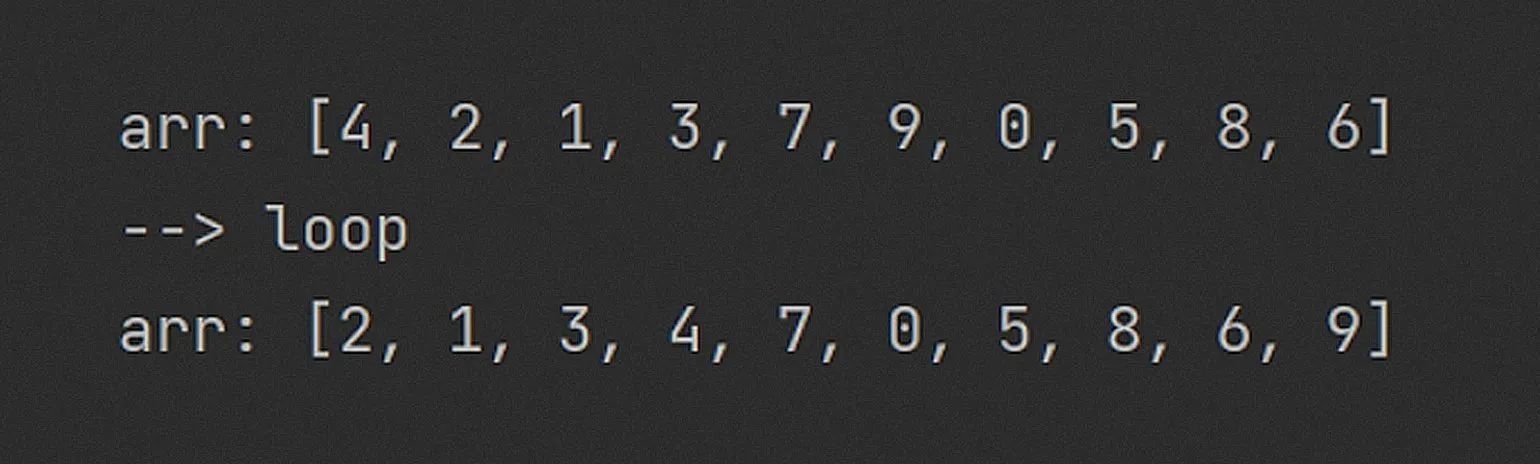
Note: almost all the elements of the array have moved in the right direction, and the largest element (9) ended up in the rightmost cell. At each iteration, it swapped places with its neighbor to the right, causing it to "float to the surface." This process illustrates the principle of sorting, where the largest element gradually rises to its final place in the sorted array.
Let's run our code a few more times.
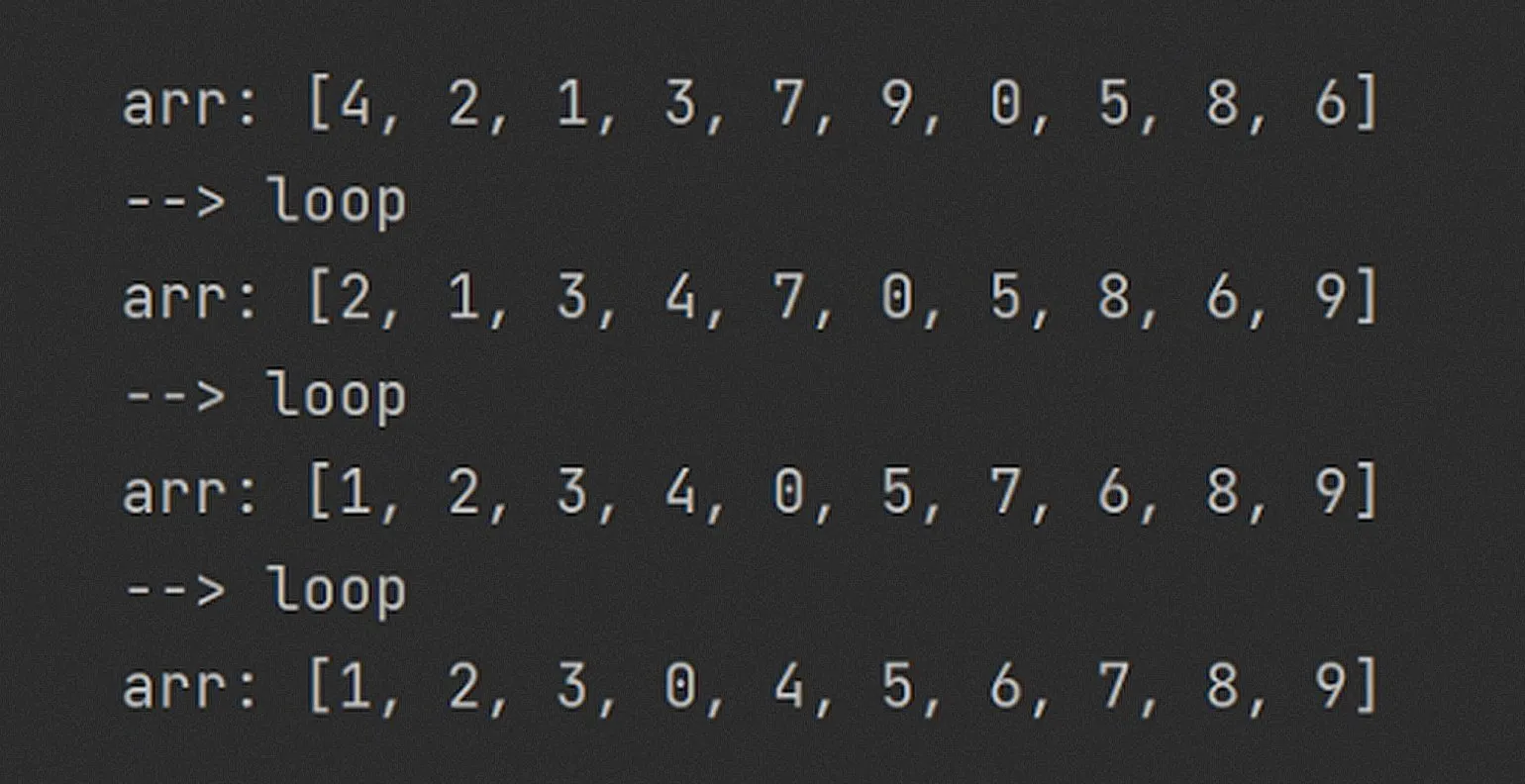
After three passes, the data has become significantly more organized. Each round of the algorithm ensures the correct placement of one of the elements: in the first step, the number 9 took its place, in the second - the number 8, and then, thanks to a lucky coincidence, four elements were placed correctly at once. This approach allows us to effectively organize the data and optimize the sorting process.
To guarantee sorting of the array, it is necessary to perform a certain number of permutations. Considering that in each pass the algorithm pushes at least one element to its final position, then completely sorting the array will require at least n passes. However, n — 1 passes are sufficient, since in the final pass there will be only one placement option for the rightmost element. This makes the sorting algorithm efficient, especially when the number of elements in the array is large.
We present to you the first sorting algorithm - bubble sort, or Bubble Sort. This method works by moving larger elements to the top and smaller elements to the bottom in each iteration. The algorithm's name is inspired by the analogy of air bubbles rising in water. Bubble sort is a simple yet intuitive way to organize data, making it a popular method for teaching the fundamentals of algorithms and data structures.
How Bubble Sort Works
Our implementation of the bubble sort algorithm is simple: its best- and worst-case time complexity is O(n^2). While this approach is quite robust, there are more efficient sorting algorithms that can significantly improve performance. We can consider alternative methods, such as merge sort or quicksort, which offer lower time complexity and optimized resource usage.
Each execution of the inner loop effectively moves one right element to its correct position. This allows each new value of j to reduce the range of the inner loop by one. Thus, there is no need to process elements that are already in their places. This optimizes the sorting process and increases its efficiency.
In line 3, it is necessary to add the offset j. This will allow you to correctly adjust the positioning of elements and improve the readability of the code. It is important to keep in mind that a correctly specified offset helps optimize the program and increase its efficiency. Make sure that the changes you make correspond to the overall logic of the algorithm and do not cause errors in further calculations.
The program has improved, but it still performs many unnecessary operations. Several elements may “pop up” at once in one iteration. How can we ensure that the program stops when the array is completely sorted? This can be done as follows:
The first step is to add a check whether at least one permutation was performed during the iteration. If no permutations occurred, then the array is sorted, and the program can terminate. This will significantly reduce the number of iterations and improve the efficiency of the sorting algorithm.
You can also use a flag that will indicate the need to continue sorting. If there are no changes during the current iteration, the program will terminate. This way, you can optimize the sorting process and improve the performance of your program.
In our development, a new variable was added, which is initialized to false at the beginning of the outer loop. After each exchange (swap), this variable changes its value to true. This allows you to effectively track changes during the execution of the algorithm. Using this variable helps optimize the code and improve its performance.
If the inner loop does not perform a single exchange (swap), the variable will remain false, which will lead to the termination of the outer loop. Thus, in the best case, the time complexity of the algorithm is O(n).
If the algorithm works with an already sorted array, one pass of the inner loop is enough to detect the absence of permutations, which allows you to terminate the outer loop. This solution resembles a bubble sort method that you can safely present in an interview.
Let's wrap the code in a function and continue developing our idea. This will allow us to structure the code, increasing its readability and reusability. Functions simplify the development process as they provide modularity and ease of debugging. Let's focus on creating efficient and understandable code that will be easy to adapt to new problems.
The table presents the time complexity values for various scenarios: best, average, and worst cases of input data, as well as the space complexity values (Space Complexity). These metrics are key to evaluating the effectiveness of algorithms and help developers choose optimal solutions for data processing. A proper understanding of time and space complexity allows you to improve application performance and optimize resource usage.
How Selection Sort Works
Bubble sort is based on comparing adjacent elements of an array. However, there are other methods for sorting arrays. Let's consider several alternative approaches. For example, quicksort, which divides the array into subarrays and sorts them recursively. Another popular method is merge sort, where the array is divided into two halves, each of which is sorted separately, and then combined into a sorted array. There are also other algorithms, such as insertion sort and selection sort, each of which has its own advantages and disadvantages. The choice of sorting method depends on specific conditions, such as the size of the array and its pre-sorting state.
Cards with numbers are scattered on a table in front of a boy (or girl). The task is to arrange these numbers in ascending order. First, they find the card with the smallest number and put it on a neighboring table. Then, they return to the shuffled cards and find the next smallest number. After taking this card, they place it on a second table located to the right of the first. This method allows us to efficiently organize numbers in ascending order.
The boy will create a sequence of numbers step by step. It's easy to guess that this array will be sorted in ascending order: the smallest number will be on the left, and the largest on the right. This is how naive selection sorting, known as Selection Sort, works. Let's consider how this algorithm can be implemented in code.
To efficiently find the index of the smallest element in an array, we can use a specialized function. This function will iterate through the array elements, determine which one has the smallest value, and return the corresponding index. This approach allows for optimal data processing and simplifies further manipulation of the array. It is important to keep in mind that when implementing this function, you should account for possible errors, such as empty arrays. Proper handling of these cases will ensure the stability of the algorithm and its correctness in various scenarios.
The current_min_value variable could have been omitted, but I prefer to leave it for better understanding of the code. This variable helps us visually track the minimum value, which can be useful for further data analysis or debugging.
The find_min() function has a simple purpose: it finds the minimum value in an array. We start by setting the current minimum as the first element of the array. We then sequentially compare this element with the others. If we encounter a value that is less than the current minimum, we update the current_min_value variable. Thus, the function allows us to efficiently determine the smallest element of an array using a simple comparison algorithm.
We assume that the arr array contains at least one element and that all its cells are filled with numeric values. Otherwise, the find_min() function may be even more complex and difficult to understand.
To implement a function that removes an element from an array, we can use a simple approach. This function will take two parameters: the original array and the element to be removed. The function will return a new array in which the specified element is excluded. This method allows us to preserve the original array and improves the readability of the code. An example implementation might look like this:
«`javascript
function removeElement(arr, element) {
return arr.filter(item => item !== element);
}
«`
This function uses the `filter` method, which creates a new array that includes only those elements that are not equal to the passed value. This gives us clean and understandable code that efficiently removes an element from an array.
The preparations are complete, and now we are ready to sort. We will gradually reduce the original array, forming the result in a new array. To begin, we will create an empty array with the same size as the original.
In the next step, we will implement the steps of our thought experiment in the form of program code. This will allow us to clearly see how the theoretical concepts can be applied in practice. The software code will reflect the main principles we have discussed and demonstrate their functionality. This way, we will be able to analyze the results and draw conclusions based on the obtained data. The approach to writing the code will be systematic and consistent, which will ensure its understandability and ease of use in the future.
The following remarks may arise regarding the algorithm:
1. Efficiency: The algorithm may exhibit poor performance when processing large amounts of data, which may negatively affect the speed of task execution.
2. Complexity: The complexity of the algorithm may make it difficult to understand and implement, especially for users with limited knowledge in this area.
3. Flexibility: The algorithm may not take into account all possible scenarios or use cases, which limits its applicability to various conditions.
4. Scalability: As the load increases, the algorithm may not adapt to new conditions, which makes it less reliable in the long term.
5. Accuracy: Calculation errors or incorrect results are possible, which can lead to incorrect conclusions and decisions.
These comments require careful analysis and revision of the algorithm to improve its efficiency and reliability.
- It eats up too much memory. We create a separate array for the result and get O(n) memory.
- Holes appear in the original array. The delete_element() function creates empty cells in arr, which find_min() will stumble over.
- High Time Complexity. The algorithm clearly does not shine in terms of execution speed - O(n^2) in both the worst and best cases.
A natural question arises: what to do in this situation? At first it may seem confusing, but I assure you, everything will soon become clear and logical.
Here is the optimized code for the Selection Sort algorithm. This algorithm sorts the elements directly in the original array arr, without creating an additional array. Selection Sort is a simple yet effective way to organize data in small collections. Its main advantage is that it operates with a minimal memory footprint, since it does not require additional structures to store the sorted data.
«`python
def selection_sort(arr):
n = len(arr)
for i in range(n):
min_idx = i
for j in range(i + 1, n):
if arr[j] < arr[min_idx]:
min_idx = j
arr[i], arr[min_idx] = arr[min_idx], arr[i]
return arr
«`
This code implements selection sort by finding the minimum element in the unsorted part of the array and moving it to the beginning. This allows you to efficiently sort the array with minimal memory usage, making the algorithm suitable for working with small amounts of data.
I developed the find_min_between(array, start_idx, end_idx) function, which performs the same task as find_min(array), but is limited to a certain range of indices from start_idx to end_idx. This allows you to more efficiently find the minimum value in a given section of the array. The swap(array, i, j) function also remains unchanged and requires no further explanation.
Now let's look at how the improved version of selection sort works. We'll start with an array arr containing ten numbers. Improved selection sort optimizes the process by reducing the number of element swaps and improving the overall efficiency of the sort. Instead of performing swaps at each step, the algorithm first finds the minimum element in the remaining array and then performs a single swap to move that element to the correct position. This reduces the number of operations, especially when working with large arrays. Using advanced selection sort can significantly improve performance compared to the classical method, especially in tasks where data processing speed is important.

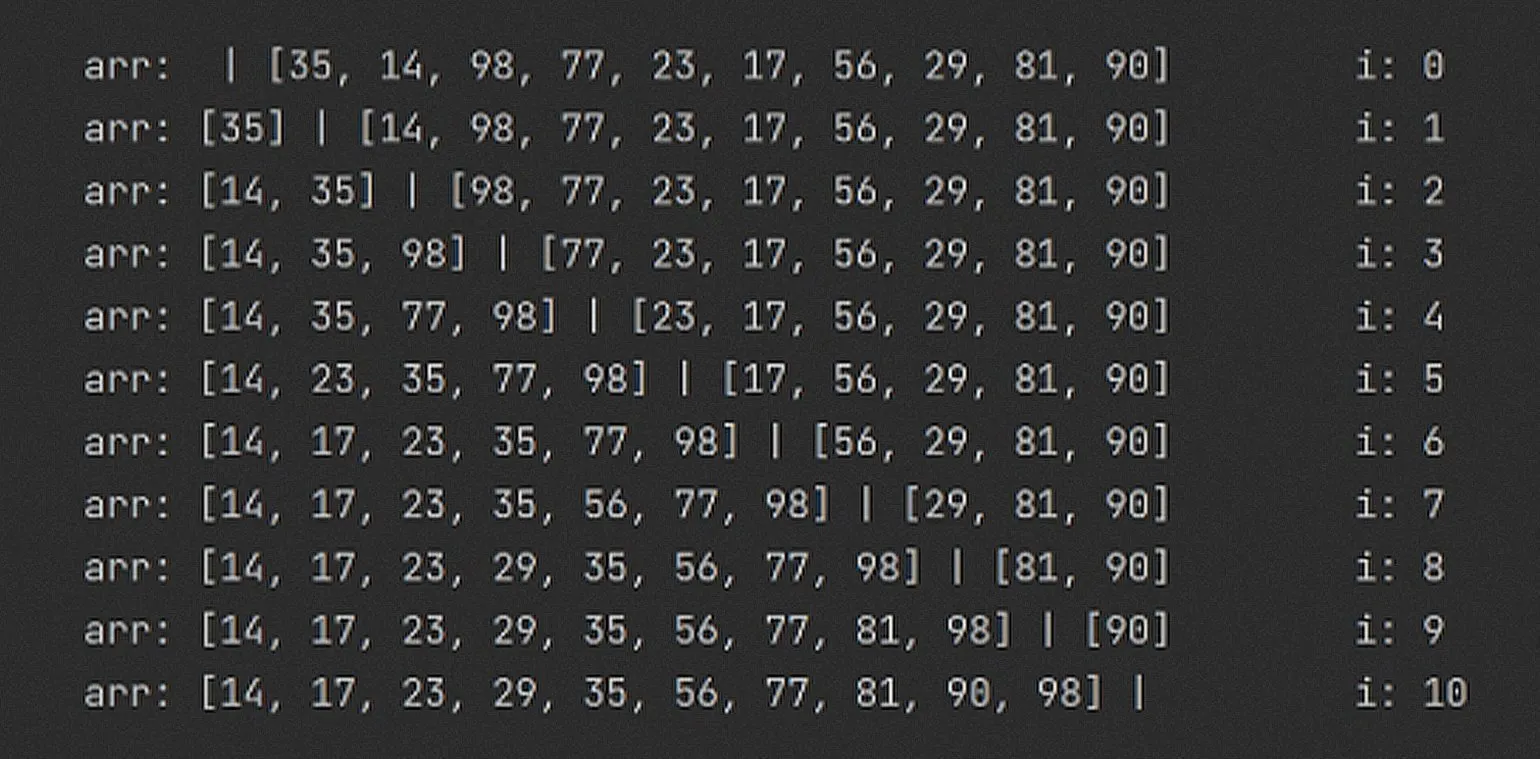
In In this example, we will iterate through the array several times using the selection sort algorithm and analyze the state of the array arr at each step. The results of the algorithm's execution will allow us to see how sorting occurs and how the order of elements in the array changes.
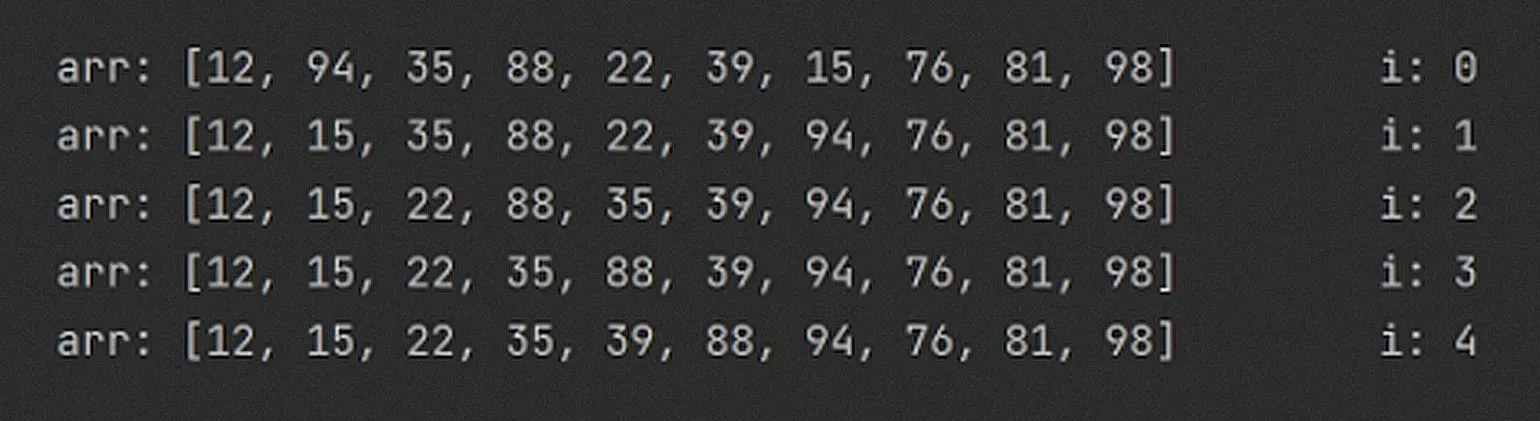
The algorithm maintains the order of elements on the left side of the arr array, using a barrier between the sorted and unsorted parts. This barrier is located between elements with indices i and (i + 1). This approach ensures efficient data distribution and maintains its order, which helps optimize the sorting and improve the algorithm's performance.
In each iteration, the algorithm finds the minimum value in the right-hand side of the array, starting from index i + 1 and continuing to the end, and swaps this value with the element at index i. Thus, for i = 1, the sorted portion of the array contains only one element, while for i = 2, there are two elements. This approach ensures consistent ordering of the array elements, making the algorithm efficient for sorting data.
The sorting process can be made more visually clear by adding a visual separator between the array elements on one side of the sorted portion and the unsorted portion on the other. This approach will help better understand how the sorting process occurs, which elements are already sorted, and which still require processing. This visual representation will make it easier to follow the process and quickly grasp the sorting algorithms.
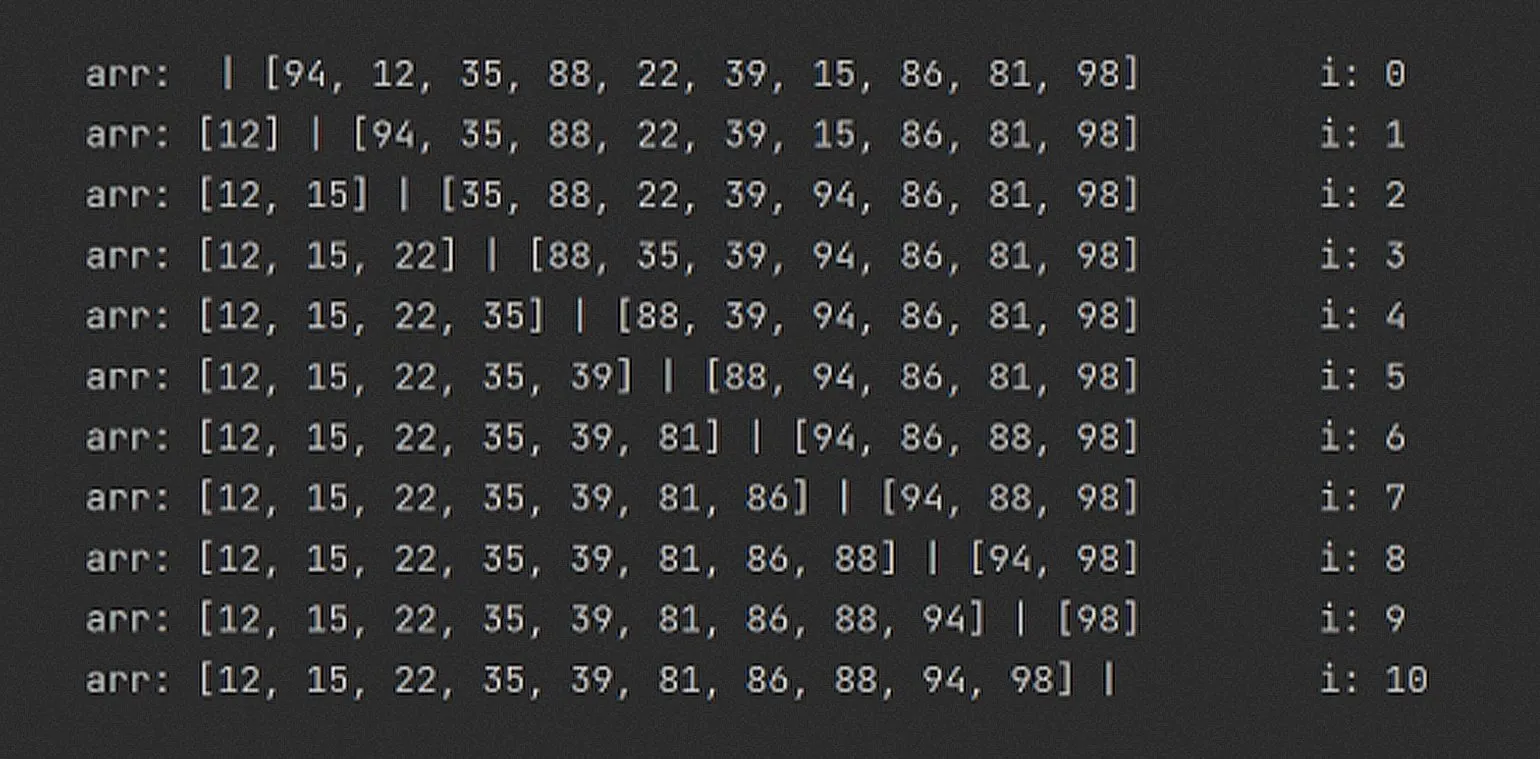
Keep in mind that the state The array arr is displayed at the end of each iteration. The first row corresponds to i = 0, the second row to i = 1, and so on.
The idea behind the Selection Sort algorithm is now clear and logical. Let's consider its main characteristics. The Selection Sort algorithm sequentially finds the minimum element in the unsorted part of the array and moves it to the beginning. This allows for efficient data sorting. Selection Sort has O(n²) time complexity, which makes it less efficient for large arrays. However, its simplicity and clarity make it a good choice for educational purposes and small amounts of data. Now let's discuss its features and applications in more detail.
This implementation has advantages in terms of memory usage, achieving O(1) complexity by working with the left side of the array. However, finding the minimum element requires O(n) time and is performed in each loop, resulting in an overall execution time of O(n^2) in both the worst and best cases. This makes this implementation inefficient for large arrays, as the execution time increases significantly. Optimizing the algorithm can significantly improve its performance and make it more suitable for working with large volumes of data.
At first glance, it may seem that Bubble Sort is faster than Selection Sort, thanks to its better time complexity of O(n) at best. However, as the saying goes, there are nuances. In this article, we will also consider aspects not covered by O-notation and discuss why it is important to consider not only theoretical complexity but also the practical execution time of these algorithms in various situations.
We will update the specifications table with new data and clarifications. This will help better understand the product's features and increase its appeal to potential buyers. The updated table will contain up-to-date information about the characteristics, which will improve SEO optimization and increase the visibility of the page in search engines.
How Insertion Sort Works
Insertion sort, also known as Insertion Sort, has much in common with Selection Sort. In fact, it can be called "reverse selection sort" since it uses the opposite approach to organizing data. Unlike Selection Sort, which finds the smallest element and places it at the beginning, Insertion Sort gradually builds a sorted array, inserting elements one by one. This algorithm is effective for small data sets and can achieve good results with partially sorted collections. Insertion sort is a simple and intuitive method, making it a popular choice for teaching the basics of sorting algorithms.
In Selection Sort, we find the smallest element on the right side of the array and move it to the end of the left side. The process continues until the entire array is sorted. The most expensive operation in this algorithm is finding the smallest element, which can affect overall performance. The efficiency of Selection Sort decreases when working with large amounts of data due to its time complexity of O(n^2), making it less preferable compared to other sorting algorithms such as Quick Sort or Merge Sort. However, Selection Sort is easy to implement and can be useful for small arrays or for educational purposes to understand the basics of sorting.
Insertion Sort preserves the ordered elements in the original array. In this algorithm, we take the first element from the unordered right-hand side and insert it into the correct position in the ordered left-hand side. This process is repeated until the entire array is sorted. The algorithm is efficient for small amounts of data and runs with O(n^2) time complexity in the worst case.
The left-hand side of the array always remains sorted. This means that to add a new element, we only need to find the correct insertion position. After that, we shift all elements on the right one position to the right and insert the new element into the vacated space. This approach ensures efficient updating of the array without requiring a complete reorganization of its structure.
The Insertion Sort algorithm can be compared to a crush on public transport. When a heavyweight boxer enters a crowded tram, his appearance causes all passengers to move, pushing them half a step away from the exit. In the insertion sort algorithm, array elements are compared and moved one by one to restore order. This method works effectively on small amounts of data and demonstrates its effectiveness with partially sorted arrays, making it useful in certain situations.
Let's consider an example of inserting a number into a sorted array. We have a sorted array of eight numbers with an empty cell at the end. The task is to insert the number 5 in the correct position, preserving the sort order. The insertion algorithm will be as follows: first, we need to iterate through the array elements, comparing them with the number 5. When an element greater than 5 is found, we move all subsequent elements one position to the right and insert 5 into the found position. Thus, the array will remain sorted.
Let's begin moving numbers greater than 5 to the right. This action can be useful for simplifying data analysis, visualization, or organizing information. Moving numbers to the side positions allows them to be highlighted and easier to perceive. This approach is often used in various contexts, including processing arrays and data structures. Continuing, we can consider how such methods affect the efficiency of working with information and improve usability.
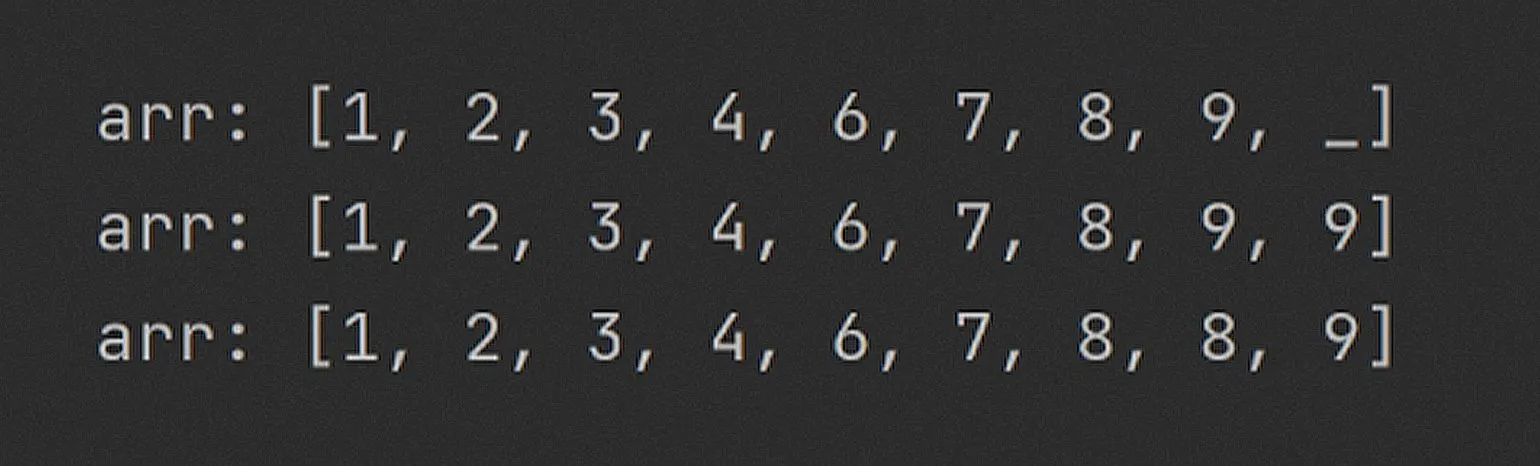
When you move a number, a copy of it appears on the right, while the original is replaced by the adjacent value on the left in the next step.
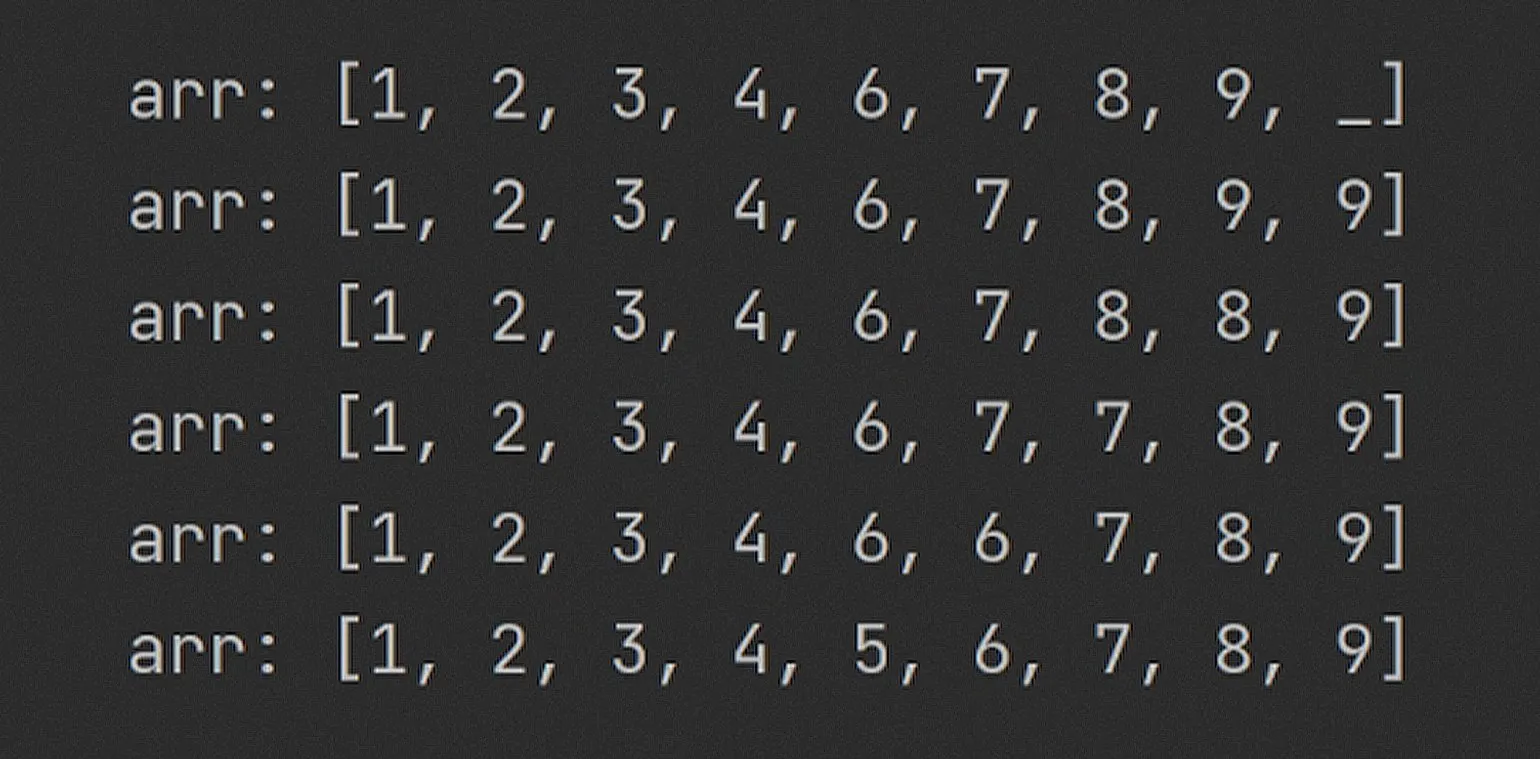
After performing all the shifts, the array will look like this:
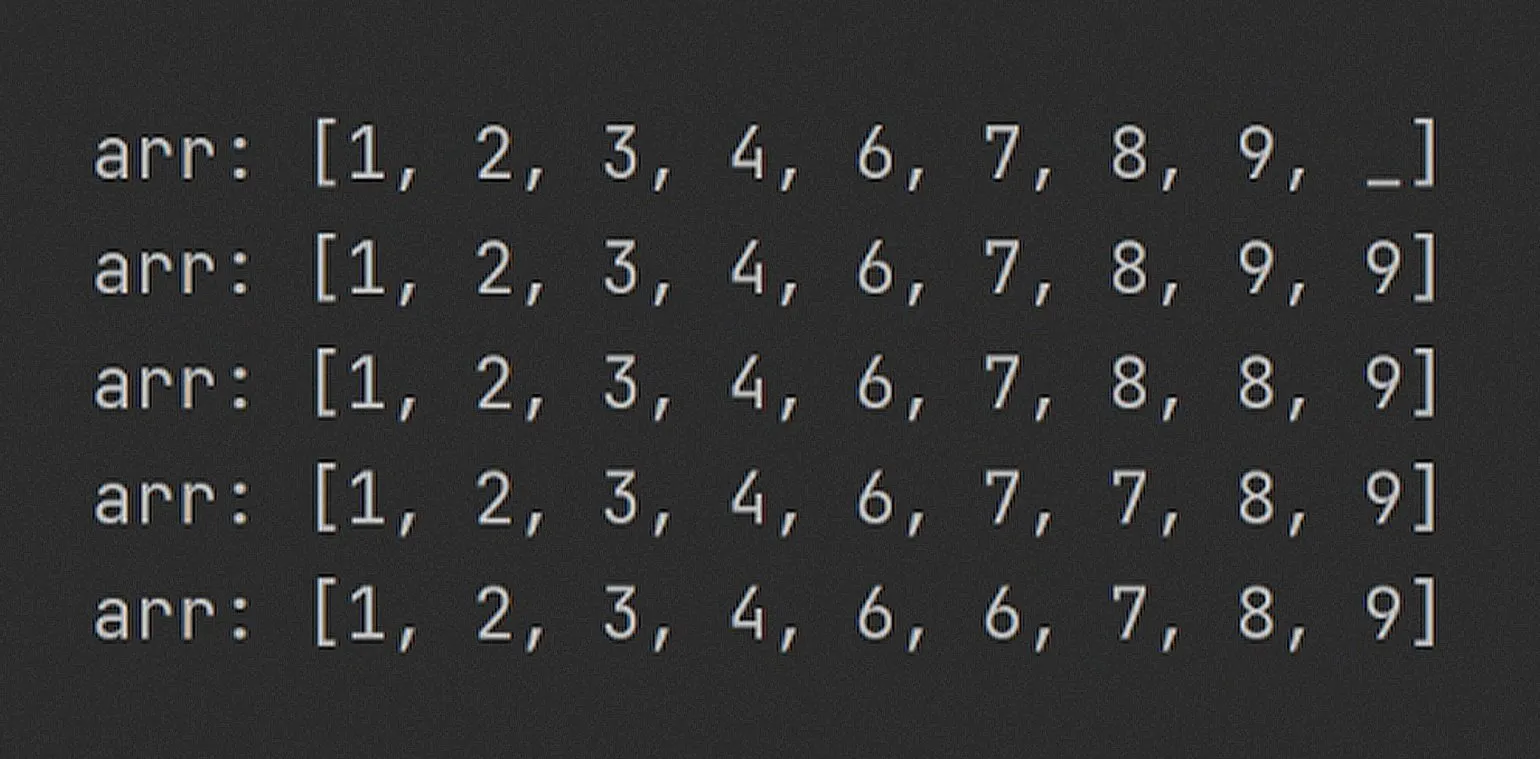
When the loop reaches the value 4, it will finish executing and replace the "garbage" number 6 with 5.
Now let's look at the algorithm Insertion Sort. This method is simple yet effective for sorting small arrays. The algorithm traverses the array, gradually increasing the sorted portion. Each element is inserted into the correct position among the already sorted data. Insertion Sort is well suited for nearly sorted arrays and demonstrates good performance in such cases. The main advantage of this algorithm is its simplicity and ease of implementation, making it ideal for educational purposes and small sorting problems. In the next section, we will look at the code implementation for the Insertion Sort algorithm to understand its operation in practice.
Recall the barrier used in the Selection Sort algorithm. Since the Insertion Sort algorithm has similar operating principles, let's apply a similar technique to it. Insertion Sort, like Selection Sort, is designed for sorting arrays, but it works on a different principle. Instead of finding the minimum element, this algorithm sequentially moves elements and inserts them into the correct positions. By using a barrier, the process can be optimized, which will increase the efficiency of sorting. Using this approach can improve the performance of Insertion Sort in certain scenarios, especially when working with partially sorted arrays.
The lower bound on sorting performance is important. If the array is already sorted, no shifts are required. In this case, the complexity is O(n) at best, making this sort particularly efficient for sorted data. Optimizing sorting algorithms can significantly improve performance when working with large arrays, which has practical implications in various fields, including data processing and algorithmic programming.
We've covered the "Great Three Sorts" that everyone who studies algorithms encounters. Congratulations on taking this important step in understanding the fundamentals of algorithmic sorting. These algorithms are key tools in programming and contribute to optimizing work with data.
What is Sorting Stability?
A stable sorting algorithm, also known as a stable sorting algorithm, preserves the order of elements with the same keys relative to each other. This means that when sorting objects with identical attribute values, their original order will be preserved. When sorting numbers, stability is unimportant, but when working with objects where the original order is important, stable sorting algorithms become critical. Stable algorithms help prevent information loss and preserve data context.
To sort an array of customer records by age, you can use a simple notation format like [age : name]. This approach allows you to effectively organize the data and quickly find the records you need. Sorting by age allows you to organize your customers, which can be useful for analysis and business decision-making. It is important to consider that proper data sorting helps you better understand your audience and optimize customer interactions. Using this format, you can easily process and analyze information about customer ages, which in turn will improve the quality of service and increase the effectiveness of marketing strategies.
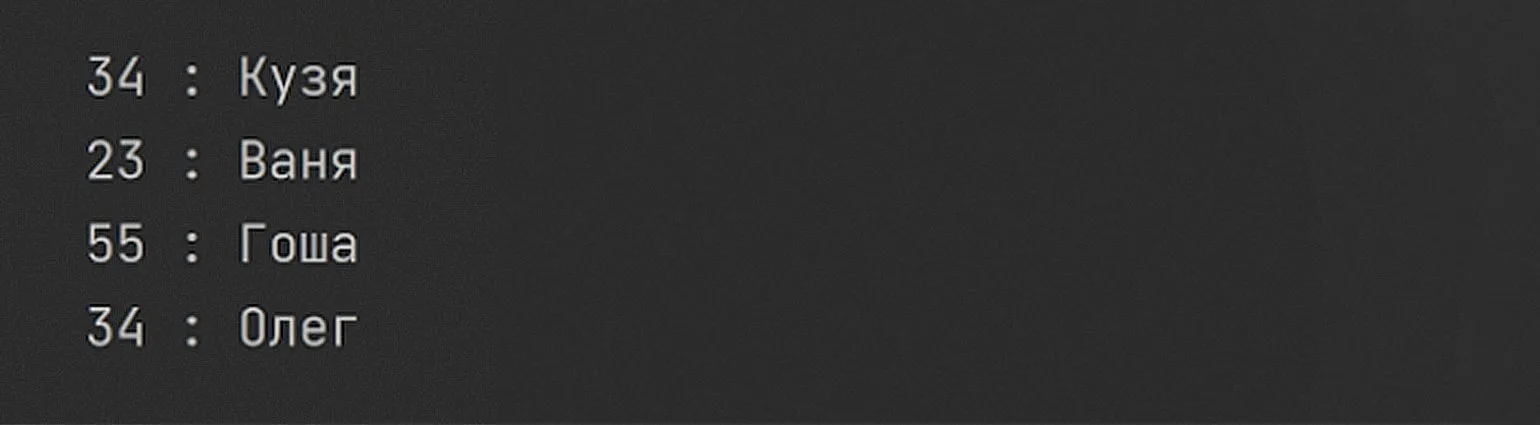
After performing a stable sorting, the Kuzya element will be above the Oleg element. This is because a stable sort preserves the order of elements with the same keys, as in the original data. Thus, when sorting, Kuzya will be guaranteed to be in front of Oleg.
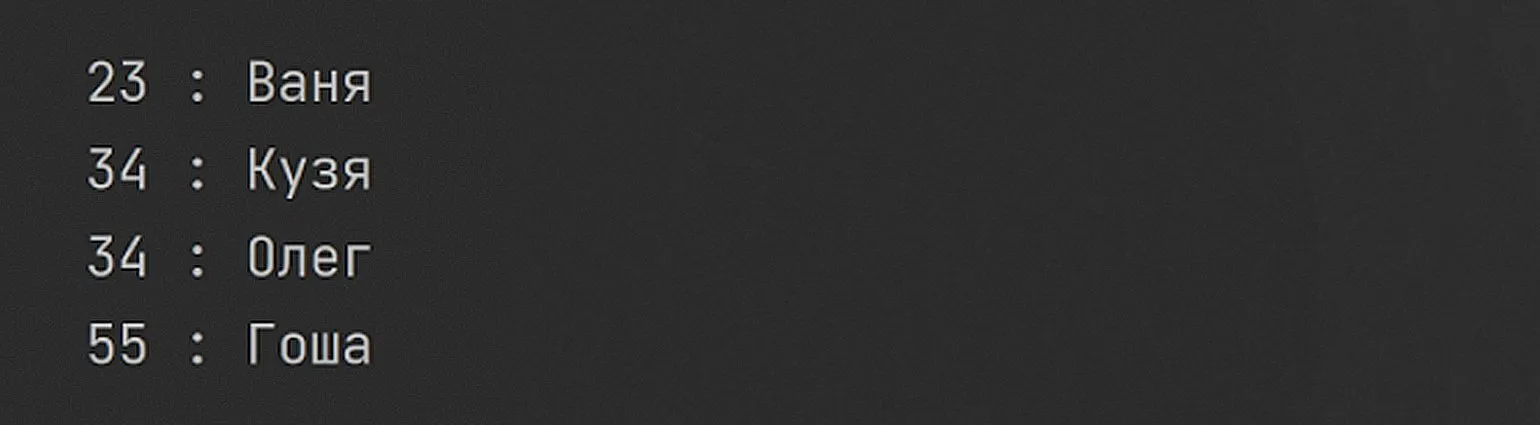
In conditions of instability, a second scenario.
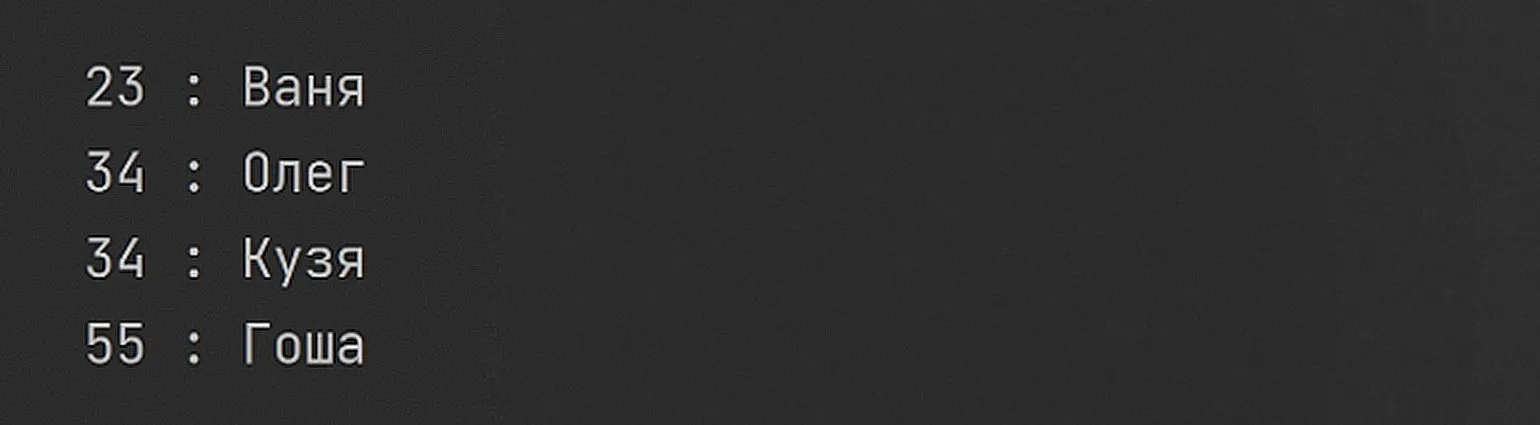
Stability is a key factor when sorting arrays of objects by multiple criteria. For example, if we sort data first by age, then by bank account size, and finally by home square footage, an unstable algorithm may produce unpredictable results. In such cases, it is important to use stable sorting algorithms to ensure that objects with identical values for the first criterion maintain their original order. This is especially true in applications where data accuracy and predictability are critical. Choosing a stable sorting algorithm will help avoid confusion and ensure more accurate and logical output.
In our group of sorting algorithms, two methods, Bubble Sort and Insertion Sort, demonstrate stable performance, while Selection Sort is prone to shuffling elements. Stable sorting algorithms preserve the order of equal values, making them preferable for certain tasks. Bubble Sort and Insertion Sort provide this type of stability, which can be critical in data processing. At the same time, Selection Sort doesn't guarantee order preservation, which limits its use in some scenarios.
Let's add characteristics of the Selection Sort algorithm, including information on stability, to our table. This will allow us to more fully evaluate its efficiency and applicability in various scenarios.
What O(n) doesn't account for
I promised to cover aspects that O-notation doesn't account for. Now it's time to analyze the shortcomings and features of popular algorithms.
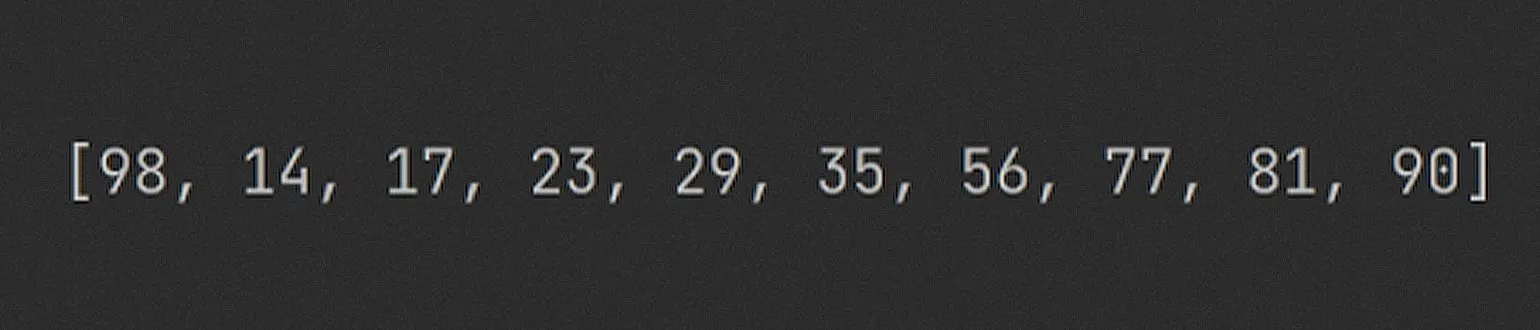
Consider an array that is almost perfectly sorted. Almost - because the largest element comes first.
Algorithms used in various fields will adapt to Algorithms are designed to meet changing conditions and requirements. They are capable of analyzing and processing large volumes of data, taking into account numerous factors, such as user behavior, market trends, and technological advancements. Algorithms are expected to become even more efficient in the near future, improving the quality of services provided and increasing the level of personalization. They will take into account not only user habits but also their preferences, resulting in more intuitive interfaces and solutions. Furthermore, an important trend will be an emphasis on algorithmic transparency, helping users better understand how decisions are made and the data they are based on. Thus, algorithms will not only be a tool for data analysis but also an important element of user interaction, contributing to a better overall user experience.
- Bubble Sort will work brilliantly. After n permutations, the largest element will "float" to the top.
- Insertion Sort is also good at this.
- Selection Sort will terribly wastefully sift through the entire array and yield O(n^2) time.
If the data is almost sorted, then sorting algorithms such as Bubble Sort and Insertion Sort become the most efficient tools. These methods demonstrate excellent results when working with almost sorted arrays, providing fast sorting with minimal resource expenditure. The choice between them depends on the specific conditions and requirements of the problem, but both algorithms can significantly speed up data processing in such cases.
Now let's consider the cost of operations. Although this aspect is not discussed in O-notation, it is important to understand that different operations require different amounts of computer resources. The efficiency of operations can vary significantly depending on the complexity of the algorithm and the volume of data being processed. Understanding these nuances helps developers optimize code and choose the most efficient solutions for specific tasks.
Reading a value from an array cell is a simple task. However, overwriting a cell may seem straightforward, but in practice, complexities arise due to multithreading, updating values in the CPU cache, and other real-world factors. Thus, the swap() operation turns out to be more complex than one might initially assume.
In this section, we will look at the number of swaps that have been performed. This is an important metric that allows us to assess platform activity and the level of user interest in various assets. By analyzing swap data, we can identify trends and preferences, which will help us further optimize our market offerings. Make sure you stay up-to-date with the latest changes and updates in the swap space to make informed decisions.
- Bubble Sort is a monster that swaps nonstop. The number of writes is off the charts here.
- Insertion Sort is no picnic either – constantly shifting elements to the right will do no good.
- Selection Sort is a gem! Only n swaps in the worst case. A very efficient algorithm.
If your goal is to optimize the cost of writes, then Selection Sort is the most suitable option. This algorithm is efficient in terms of reducing the number of writes, which makes it ideal for use in resource-constrained environments or when minimizing memory wear is necessary.
All three algorithms demonstrate similar efficiency in memory use. They operate in-place, which allows them to use O(1) memory.
Sorting algorithms can always be improved, especially when using specialized data structures. For example, Insertion Sort can be optimized by doubling its speed and reducing the number of swaps to a level comparable to Bubble Sort by using a linked list instead of an array. In addition, the Selection Sort algorithm can be modified to behave like a stable one. This opens up new possibilities for improving the efficiency of data sorting and expands the applicability of various algorithms depending on specific problems.
What to read and watch
On the website geeksforgeeks.org, you can find sorting code implemented in various programming languages, as well as videos demonstrating visualizations of these algorithms. The resource offers a wide selection of examples, which allows you to better understand the principles of sorting and their application to real-world problems.
- Bubble Sort
- Selection Sort
- Insertion Sort
There are many visualizations of sorting algorithms on YouTube, but I would like to draw your attention to one video that stands out among the rest. This video demonstrates in detail various sorting algorithms, their principles of operation and efficiency. This is an excellent resource for those who want to gain a deeper understanding of how different algorithms can impact data processing. Comparing visual representations helps you better understand the material and choose the optimal approach to solving sorting problems.
Hungarian dances are a unique cultural phenomenon that combines elements of tradition and entertainment. These dances are not only entertaining but also educational, allowing for a deeper understanding of Hungarian culture and its musical characteristics. Their energetic movements and colorful costumes attract attention and create an atmosphere of fun. Hungarian dances have become popular not only in Hungary but also abroad, winning the hearts of people around the world.
At this point, we have concluded our discussion of simple sorts. I hope the information was presented clearly and understandably. In future articles on sorting algorithms, I'll explore methods like Merge Sort and Quick Sort in more detail, delving into their features and applications.
Reading is an important aspect of personal growth and development. It helps broaden your horizons, improve your vocabulary, and develop critical thinking. Regular reading not only enriches your knowledge but also helps you cope with stress, improving your overall well-being. Choose a variety of genres and topics to make your reading experience more engaging and rewarding. Explore new authors and books, and don't forget to share your experiences with others. Reading is the key to new opportunities and a deeper understanding of the world around us.
- Big O Notation: What is it and how to calculate it
- GNU Emacs: How a text editor from the 1980s teaches programmers to value free software
- Expecto Pythonum: 15 spells in snake language
Algorithms and Data Structures for Developers
You will gain fundamental knowledge and learn how to solve real-world problems using algorithms. You will be able to get a job in any company and participate in complex, highly-paid projects.
Find out more