
Contents:

Free Python course ➞ A mini-course for both beginners and experienced coders. 4 cool projects in the portfolio, live communication with the speaker. Click and find out what you can learn in the course.
Learn moreBefore moving on to the discussion, let's refresh our knowledge and solve a few typical problems.
- What is log3 81?
- And lg 2 × lb 10?
- And the sum of log2 16 2 + log2 16 3?
If you easily solved all three examples in your head, without resorting to a calculator, you can safely move on to the final part. And for those who are not quite confident in their knowledge or have slightly forgotten the material from the school curriculum, we offer a brief review of the main concepts. It will only take five minutes and will help you regain confidence in your math skills.
What is a logarithm
A logarithm can be thought of as the inverse operation of raising to a power. For example, in the expression 2^3 = 8, 2 is the base, 3 is the exponent, and the result of raising to a power is 8. The logarithm allows us to determine what exponent is needed to get a given number, in this case 8. Thus, the logarithm of 8 to the base 2 is 3. Understanding logarithms is essential in mathematics and is widely used in various fields such as physics, economics, and computer science.
- 2 is the base;
- 3 is the exponent;
- 8 is the result of raising to a power.
Raising to a power has two inverse processes. The first is root extraction, which finds the base. The second is logarithm, which determines the exponent. These operations play an important role in mathematics and are used in a variety of fields, including algebra, analysis, and applied science. Understanding these concepts is essential for solving more complex problems and working with exponential functions.
The expression 23 = 8 can be converted to logarithmic form, giving log2 8 = 3. This indicates that 2 to the power of 3 is equal to 8. Logarithms are an important tool in mathematics because they allow us to simplify complex calculations and analyze exponential functions.
A logarithm is a mathematical function that determines the power to which a base (in this case, 2) must be raised to obtain a given number (in this case, 8). In the context of logarithms, if we're talking about the logarithm of 8 to the base 2, we're looking for a value that, when raised to the power of 2, yields 8. In this example, the logarithm of 8 to the base 2 is 3, since 2 to the power of 3 is 8. Understanding logarithms is an important aspect of mathematics used in a variety of fields, including science, engineering, and economics. The notation can be unintuitive, and beginning users often find it difficult to distinguish between the base and the power. To simplify the memorization process, we recommend using a simple rule: the base is always written on the bottom, and the power on the top. This will help avoid confusion and simplify working with mathematical expressions. Proper understanding and use of this diagram will greatly facilitate the study and application of powers in various problems.
The base of the logarithm, similar to the base of the power, is located at the bottom of the logarithmic expression.
To improve your understanding of the structure of the notation, familiarize yourself with the expressions provided and try to grasp their meaning. This will help you better remember and apply the information in the future. Pay attention to key elements and the relationships between them to make it easier to remember and absorb the material.
- log3 9 = 2
- log4 64 = 3
- log5 625 = 4
- log7 343 = 3
- log10 100 = 2
- log2 128 = 7
- log2 0.25 = −2
- log625 125 = 0.75
The entry logAB is interpreted as the logarithm of B to the base A. Logarithms are an important tool in mathematics and are used to solve various equations and analyze data. Understanding logarithms and their properties allows you to effectively work with exponential functions and simplify complex calculations.
What is a natural logarithm?
The base of the logarithm is a key element in logarithmic functions. Having a common base for different logarithms allows you to perform operations between them, which greatly simplifies solving mathematical problems. Understanding this aspect of logarithms plays a key role in their application in algebra, data analysis, and other fields of science.
Euler's number (e) is the base of the natural logarithm. It is an irrational number that is approximately equal to 2.71828. In mathematics and various applied sciences, the number e plays a key role, especially in limit theory, differential equations, and financial calculations. Understanding Euler's number and its properties is essential for a thorough study of logarithmic and exponential functions, making it an important element in mathematical analysis. Irrational numbers are numerical values that cannot be expressed as simple fractions where the numerator and denominator are integers. Importantly, the denominator in this fraction cannot be zero. Irrational numbers include familiar values such as √2, π, and e, and play a key role in various areas of mathematics, including geometry and analysis. These numbers are the opposite of rational numbers, which can be represented as fractions. Understanding irrational numbers is essential for a thorough study of number systems and their properties. The number 0.333… is rational because it can be expressed as the fraction 1/3. In contrast, numbers such as pi and the square root of 2 are irrational because they cannot be represented as simple fractions. Rational numbers can be represented as finite or infinite recurring decimal fractions, while irrational numbers have infinite non-recurring decimal representations. This distinction is important in mathematics and helps to better understand the properties of numbers.
Natural logarithms play an important role in mathematics and many other sciences. There is a special way to denote them: ln x. This notation is equivalent to loge x, where e is the base of the natural logarithm, approximately equal to 2.71828. Using ln x simplifies mathematical expressions and makes them easier to analyze. Understanding this notation is key to solving problems related to exponential growth and other mathematical concepts.
Imagine a crystal with an initial weight of 1 kg that increases its mass by 100% per year. At first glance, one might assume that after a year its weight will be 2 kg. However, this statement requires clarification, since crystal growth does not always occur linearly. In fact, if the crystal continues to grow at the same rate, its weight after a year will be 2 kg, but further growth will have its own characteristics. This is due to the fact that with a constant percentage increase in mass, the weight of the crystal will double every year. Thus, after two years, its weight will reach 4 kg, and after three years - 8 kg. This is an example of exponential growth, which illustrates how quickly the sizes of objects can increase with a constant percentage increase.
Each new part of the crystal begins to develop its own mass. When the mass of the crystal reaches 1.1 kg, its growth is 1.1 kg per year, and with a mass of 1.5 kg, the growth increases to 1.5 kg per year. Mathematical research shows that after a year, the mass of the crystal can be e, which is approximately equal to 2.71828 kg. This demonstrates the exponential growth of crystals, which is of interest for study in various fields of science.
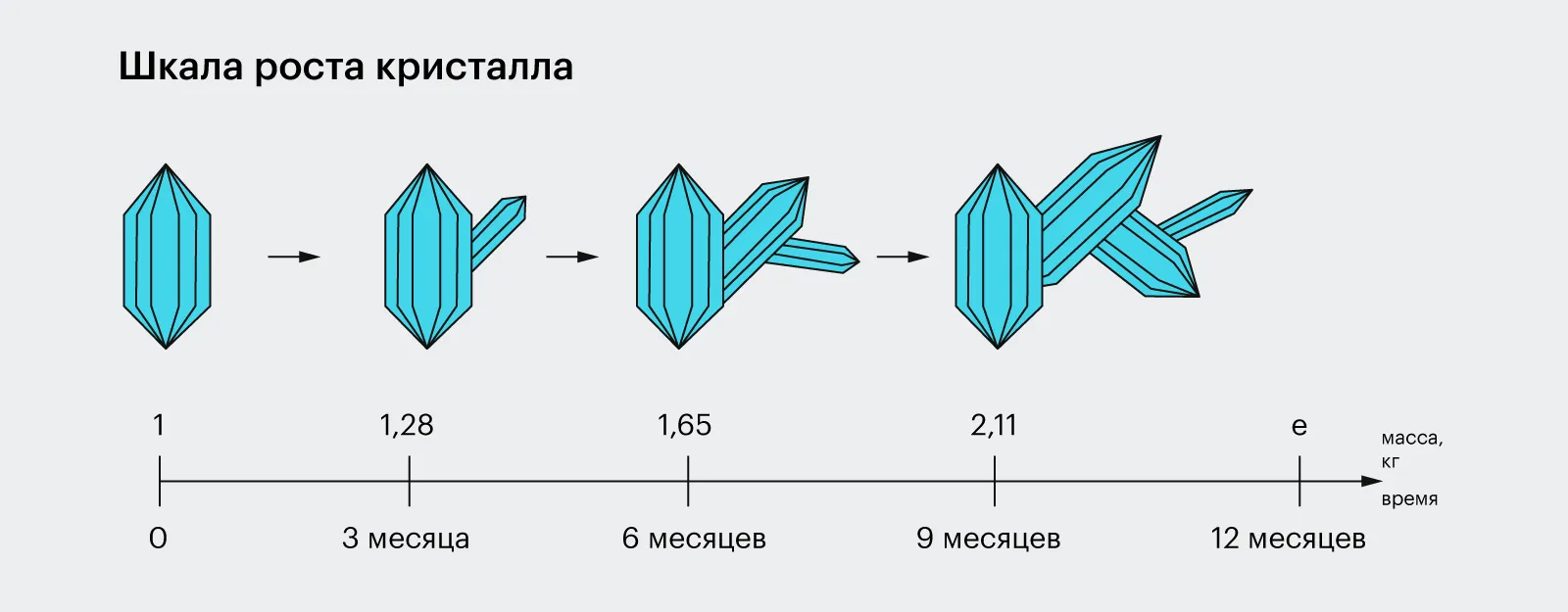
Exponential growth is observed in various processes, such as bacterial reproduction, population growth, income growth, snowball accumulation, radioactive decay, and beverage cooling. This type of growth is characterized by rapid increases, with each new value becoming significantly greater than the previous one. Exponential processes are important in biology, economics, and physics because they allow us to predict the behavior of systems under conditions where resources or time are limited. Understanding exponential growth aids in the analysis and prediction of various phenomena in nature and society.
To determine the mass of a crystal after three, five, or ten years, e is raised to the appropriate power. This mathematical approach allows for an accurate estimate of the change in a crystal's mass over time.
e3 is approximately 20.0855 kilograms. This value is important for calculations in a variety of fields, including physics and engineering. Understanding and correctly using units of measurement such as kilograms is essential for accuracy in scientific research and practical applications.
e5 is approximately 148.4132 kilograms. This value can be important in a variety of contexts, such as physics calculations, athletic performance, or when measuring weight for scientific research. Correctly understanding and using units of measurement such as kilograms plays a key role in the accuracy of the results and the interpretation of the data.
e10 is approximately 22,026.47 kg.
To determine when a crystal will reach a weight of one ton, an equation must be set up. To do this, we must consider initial parameters such as the initial mass of the crystal, its growth rate, and factors affecting mass increase. We will consider all the necessary variables and their relationships to obtain a precise equation. This will allow us to accurately predict the moment when the crystal's mass reaches one ton. Exponential growth is a process in which a quantity increases over time, proportional to its current value. This principle is often observed in finance, biology, and technology. In economics, exponential growth can be illustrated by increasing investment, where income grows at a constant percentage. In biology, exponential growth is manifested in population growth, where the number of individuals increases with each generation. In technology, exponential growth is observed in the increase in computing power, for example, according to Moore's Law. Understanding exponential growth is critical for predicting future trends, managing resources, and developing development strategies. This concept also emphasizes the importance of a sustainable approach to prevent the negative consequences of rapid increases in population or resource consumption.
To find the exponent, knowing the base and the result of raising to a power, we can use the concept of a logarithm. This means that if the base is e and the result is 1000, then we can write the equation x = loge 1000. In a more familiar form, this would look like x = ln 1000. Logarithms play a key role in mathematics and are used in various fields, including science and finance, to simplify calculations and solve equations.
Plugging the data into a calculator, we get that x ≈ 6.9. This means that it would take the crystal approximately 6.9 years to reach a mass of one ton.
What other types of logarithms are there: decimal and binary
The decimal logarithm, the base of which is 10, is denoted as lg x. This type of logarithm is widely used due to its simplicity in calculations, especially when working with round numbers. The common logarithm finds application in various fields such as mathematics, physics, and economics due to its ability to simplify complex calculations.

The binary logarithm is the logarithm with base 2, which is denoted as lb x. It is widely used in programming and computer science, as computers operate on the binary number system. Understanding the binary logarithm is essential for optimizing algorithms and analyzing their complexity. For example, in areas such as data processing and systems programming, knowledge of the properties of the binary logarithm allows developers to manage resources more efficiently and improve application performance.

Properties and Formulas Logarithms
Logarithmic operations have their limitations, but if you master them and remember the basic rules, solving logarithmic problems will become a simple and quick process. Knowing how to work with logarithms will significantly simplify solving mathematical problems and increase your confidence in this area of mathematics.
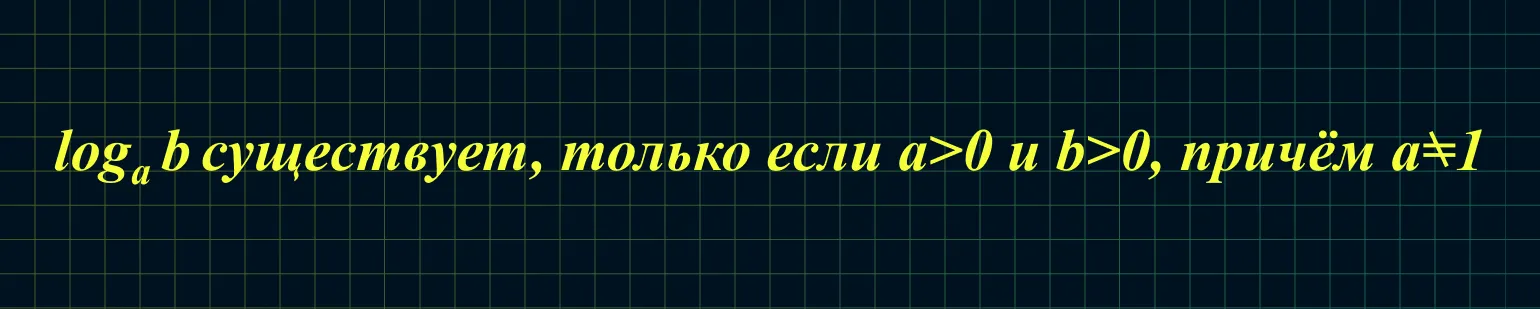
Logarithms have certain limitations. The base and argument of the logarithm must be positive numbers. Furthermore, the base must not be equal to one. In mathematical notation, this is expressed as follows:
Let's consider the properties of logarithms. These properties act in both directions, which allows them to be used from left to right as well as from right to left. Logarithmic operations are important tools in mathematics, allowing us to simplify complex expressions and solve equations. Understanding these properties will help you better navigate mathematical problems and effectively use logarithms in various contexts.
The logarithm of one to any base is always zero. This is an important property of logarithms, which can simplify many mathematical problems. For any positive number a, where a is not equal to 1, the logarithm of one to the base a is formally written as log_a(1) = 0. This follows from the definition of the logarithm, since a to the power 0 is always equal to 1. Understanding this property is the basis for solving more complex logarithmic equations and inequalities.

Of course, I am ready to help you with text revision. Please provide the source text to be edited.
The logarithm to the base 17 of 1 is 0. This statement is based on the properties of logarithms. The logarithm of a number denotes the power to which the base must be raised to obtain that number. Since any number raised to the zero power is 1, the logarithm of 1 to any positive base is always 0. Thus, log17 1 = 0 is a true mathematical statement.
The logarithm in which the number and the base coincide is always equal to one. This is an important property of the logarithmic function, which is used in various mathematical problems and applications. Understanding this rule makes it easier to solve equations and analyze functions. For example, if you have a logarithm with base 5 and the number 5, the result will be 1. This property can be applied in various fields, including algebra and data analysis.

log17 17 = 1 is an example of a logarithmic equation, where The logarithm of 17 to the base 17 is 1. This property of logarithms is explained by the fact that any number raised to the power of 1 gives itself. The logarithmic function is widely used in mathematics, physics, and engineering to solve a variety of problems. Understanding the basics of logarithms, such as this equation, helps one better master more complex topics, including exponential functions and their applications. Logarithms also play an important role in data analysis and statistics, where they aid in the transformation and interpretation of large numbers.
The fundamental logarithmic identity is an important principle in mathematics that describes the properties of logarithms. This identity states that the logarithm of the product of two numbers is equal to the sum of the logarithms of these numbers. Formally, this can be written as log_a(b * c) = log_a(b) + log_a(c), where a is the base of the logarithm and b and c are positive numbers. This identity is often used to simplify calculations and transform expressions in algebra. Understanding the basic logarithmic identity is important for solving complex mathematical problems and analyzing exponential processes. Practical application of this identity is helpful in various fields, such as economics, physics, and computer science, where logarithms play a key role in data modeling and analysis.

The logarithm of 17 to the base 5 is 175.
The logarithm of the product of numbers is equal to the sum of their logarithms. This is an important property of logarithms, which allows us to simplify calculations and data analysis. If a and b are positive numbers, then the logarithm of their product can be expressed as follows: log(ab) = log(a) + log(b). This rule is useful in various fields, such as mathematics, physics, and economics, where it is necessary to work with large numbers or complex calculations. Using this property of logarithms greatly simplifies the process of solving equations and performing mathematical operations.

Example: log5 12.5 + log5 10 = log5 (12.5 × 10) = log5 125 = 3. In this In this expression, we see how the properties of logarithms are applied. The sum of logarithms with the same base is equal to the logarithm of the product of the arguments. This important property allows us to simplify calculations and solve complex equations involving logarithms. When using this rule, it's important to remember that the base of the logarithm must be the same for all logarithms in the expression. In this case, we're dealing with a logarithm to the base 5. Applying these properties of logarithms significantly simplifies the process of working with mathematical problems and makes them more understandable.
The logarithm of a fraction is defined as the difference between the logarithms of the numerator and denominator. This property of logarithms allows us to simplify calculations and transformations in mathematics. If you have a fraction consisting of a numerator and a denominator, then the logarithm of that fraction can be expressed as follows: the logarithm of A/B is equal to the logarithm of A minus the logarithm of B. This rule is fundamental in algebra and is often used in various fields of science and engineering to analyze data and solve equations. Understanding this property helps you better navigate logarithmic functions and simplifies the process of working with them.
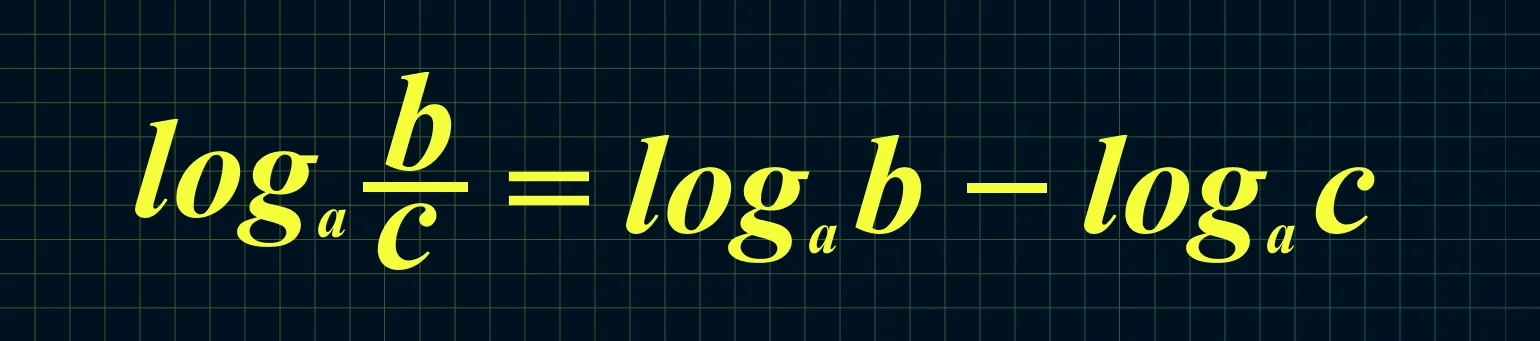
Let's consider an example of transforming a logarithmic expression: log3 63 − log3 7. First, we use the property of logarithms, which allows us to subtract Logarithms with the same base. This gives us: log3 (63/7). We further simplify the fraction: 63/7 is 9. Thus, we can express this as log3 9. Since 9 is 3 squared, we can write the result as log3 (3^2). According to the basic property of logarithms, this simplifies to 2. Thus, the final answer is 2.
When raising the base or argument to a power, it can be conveniently moved before the logarithm. This property of logarithms allows us to simplify calculations and make expressions easier to analyze. For example, if you have a logarithm with base a and argument b raised to the power n, this can be written as n times the logarithm of a of b. Using this property greatly simplifies working with logarithmic equations and inequalities. Correct application of these properties helps in solving complex mathematical problems and improves understanding of logarithmic functions.
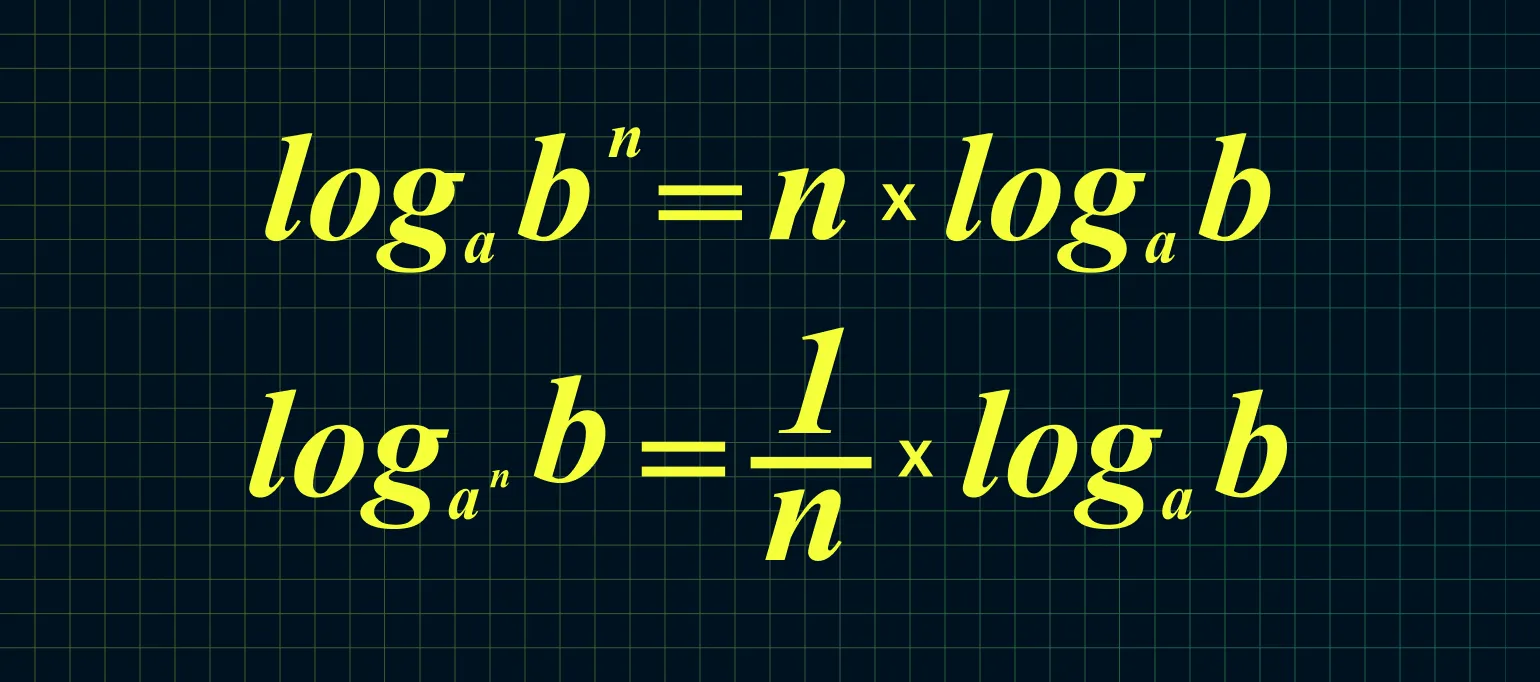
From these two formulas, we can draw the following conclusions.
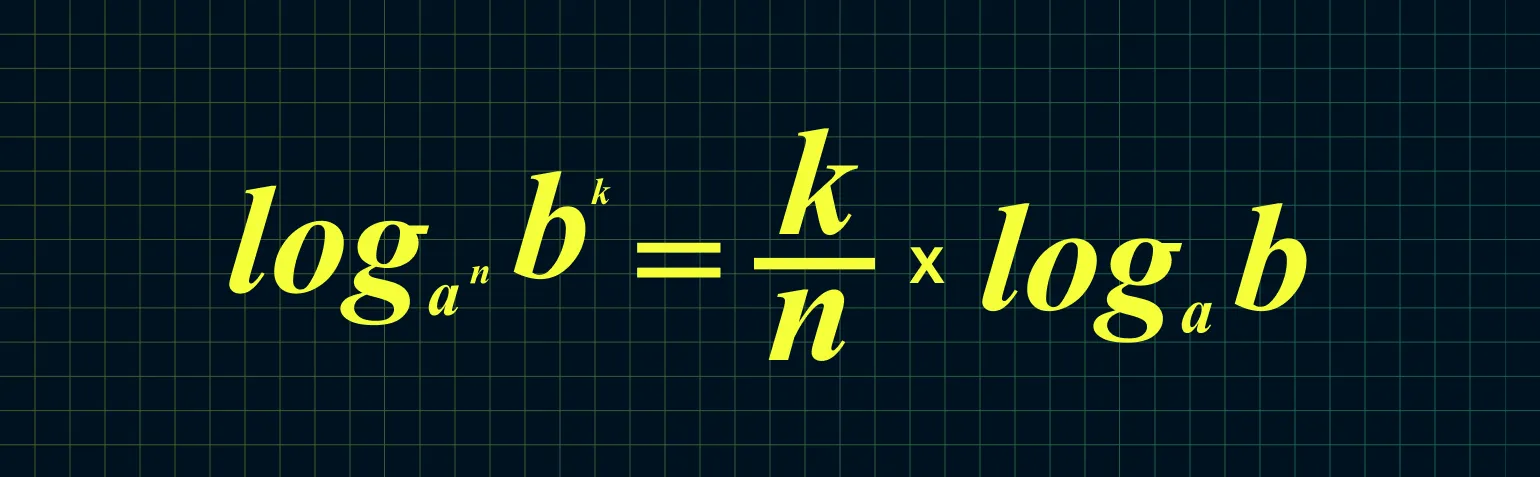
Example: log23 49 = (9/3) × log2 4 = 3 × 2 = 6. This demonstrates the use of properties of logarithms to simplify expressions. Logarithms allow you to transform complex calculations into simpler ones, which makes them an indispensable tool in mathematics and related fields. Understanding these properties is important for solving equations and analyzing functions.
If the chosen logarithm base proves inconvenient, it can be easily changed. Changing the logarithm base allows you to adapt the calculation to the specific conditions of the problem. For example, to simplify calculations, you can use the logarithm base change formula, which allows you to convert the logarithm from one base to another. This is especially useful in mathematics and related fields that require working with different number systems or units of measurement.
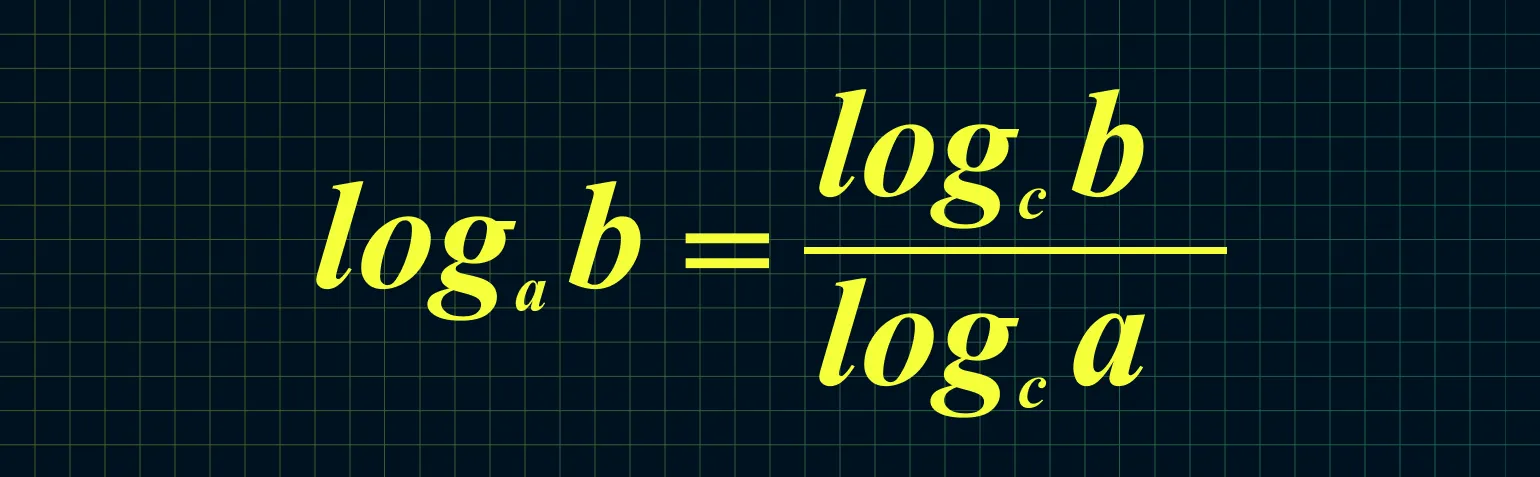
To calculate the logarithm to the base 25 of 125, you can use the property of logarithms. We apply the following relationship: log25 125 = log5 125 / log5 25. After doing the calculation, we get log5 125 = 3, since 5 to the power of 3 is 125, and log5 25 = 2, since 5 to the power of 2 is 25. After dividing, we get 3 / 2, which is 1.5. Thus, log25 125 is 1.5.
According to this formula, we can swap the base and argument, which allows us to write it as follows:
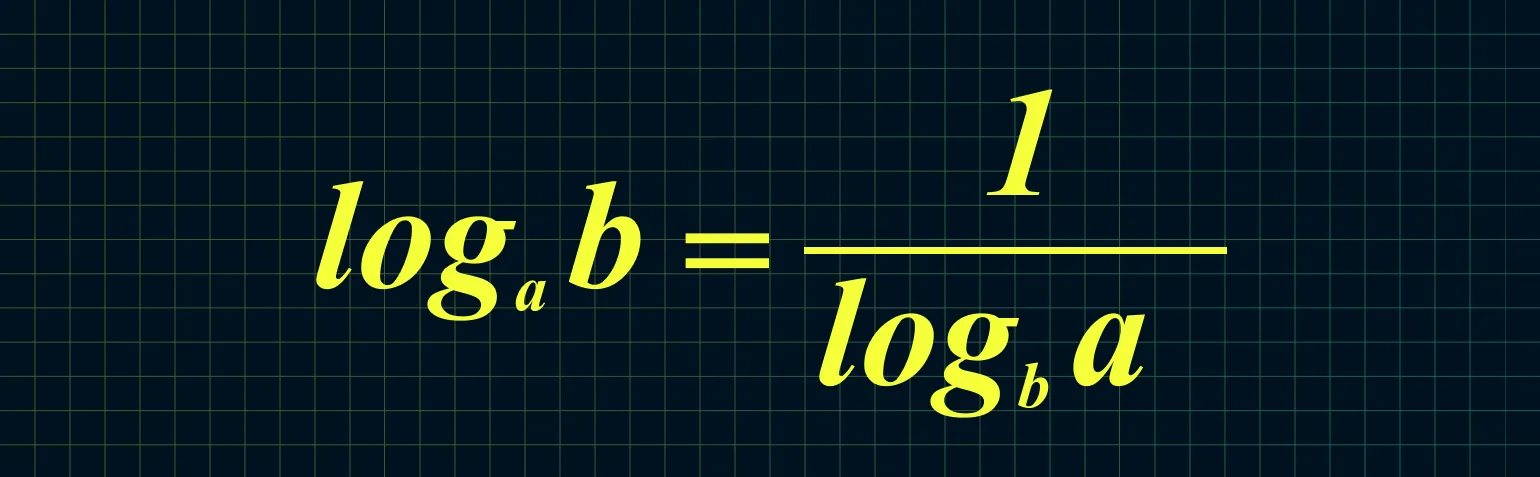
Example of calculating the logarithm: log16 4 is equal to 1/log4 16, which in turn simplifies to 1/2, which is 0.5. Logarithms are an important tool in mathematics, allowing us to solve equations involving exponential functions. Understanding the properties of logarithms, such as base changes and the relationships between logarithms, contributes to a deeper understanding of algebra and analysis. Using logarithmic functions in scientific and engineering calculations can simplify complex calculations and data analysis.
How to Solve Logarithms: Try It Yourself
Now let's return to the problems posed at the beginning of the article. We will discuss them in more detail and analyze how they can be solved effectively. Each problem requires special attention and approach, which will allow you to achieve the best results. Let's explore key aspects and possible strategies for achieving these goals to ensure maximum efficiency and effectiveness.
Example 1:
In today's rapidly evolving technology world, creating high-quality content is becoming one of the most important tasks for businesses. High-quality content not only attracts potential customers but also helps improve a website's ranking in search engines. It's important that the text is not only informative but also optimized for SEO. This means using topic-relevant keywords and maintaining a well-structured and readable text.
Optimized content helps improve website visibility, which in turn leads to increased traffic and conversions. Effective SEO strategies include choosing the right keywords, creating unique and engaging content, and regularly updating the website. As a result, high-quality content becomes a powerful tool for achieving business goals and increasing competitiveness in the market.
Remember that 81 is equal to 92, and 9 is equal to 32. Based on this, we can draw conclusions about the relationships between these numbers. Understanding such relationships can be useful in various mathematical problems and studies. Use these connections to more deeply analyze numerical values and apply them to practical situations.
log3 81 equals log3 92, which can also be expressed as log3 (32 + 2) and simplifies to log3 34. This equality demonstrates the properties of logarithms, allowing us to work with them more effectively. Logarithms are an important tool in mathematics, especially in algebra and analytic geometry. By simplifying expressions with logarithms, we can more easily solve equations and analyze functions.
The logarithm no longer causes us difficulties. Using the properties of powers, we can factor out the number four.
The logarithm to the base 3 of 34 can be expressed as the logarithm to the same base of 3. This looks like this: log3 34 is 4 multiplied by log3 3. Since log3 3 is 1, we get: 4 multiplied by 1, which ultimately equals 4. Thus, log3 34 = 4.
Example 2 is an important element for understanding a specific topic. It illustrates key aspects and serves as a visual example that helps better assimilate the material. Using Example 2 allows you to deepen your knowledge and improve your perception of information. It is important to keep in mind that examples are an effective tool for explaining complex concepts. They make the material more accessible and understandable for the audience. Using Example 2 in the teaching process promotes active learning and the development of critical thinking. This approach helps reinforce the material being studied and improve its comprehension. We translate abbreviations and shorthand into their full spellings to ensure clarity and comprehension. This will help the reader better perceive the information and avoid misunderstandings. Fully expanding abbreviations also improves SEO, as search engines better index text containing full formulations. Properly formatted and structured content improves its accessibility and user experience. The formula lg 2 × lb 10 = log10 2 × log2 10 shows the relationship between various logarithmic functions. Here, lg denotes the common logarithm, and lb denotes the binary logarithm. It is important to understand that logarithms allow you to transform sets of numbers into a more manageable format, which is especially useful in calculus and computer science. Studying logarithms helps you better understand the relationships between quantities and their scales. This formula illustrates how different logarithm bases can be related to each other. Understanding these relationships is critical for solving complex problems in mathematics and other sciences.
To convert both logarithms to the same base, you need to use the properties of logarithms. Logarithms can be converted to a common base using the change-of-base formula. This will simplify the expression and make subsequent calculations more convenient. It is important to choose the appropriate base that will provide the best solution to the problem.
The equation log10 2 × log2 10 is equal to 1. This can be explained as follows: log10 2 multiplied by log2 10, which is equivalent to 1, since log10 2 can be represented as 1/log2 10. Multiplying log2 10 by 1/log2 10, we get log2 10/log2 10, which is equal to 1. Thus, this equation demonstrates the relationship between logarithms in different bases and their properties. Understanding these properties of logarithms is important for solving problems in mathematics and related fields.
Example 3 presents an important aspect that is worth examining in more detail. This example illustrates key points and provides useful information that can be applied to a variety of situations. It demonstrates how to approach problem solving correctly and also emphasizes the importance of attention to detail. Each element in this example plays a role and contributes to the overall understanding of the topic. It is important to consider these aspects when analyzing and applying information in practice.
Using the sum property to solve problems. This property allows you to combine elements into a single whole, simplifying the analysis and processing of data. Applying the sum property helps in various fields, such as mathematics, statistics, and economics, allowing you to more effectively manage information and draw conclusions based on the collected data. Let's look at examples of its application to achieve the best results in solving specific problems.
The equation log216 2 + log216 3 is equal to log216 (2 × 3), which can be simplified to log216 6. This demonstrates one of the properties of logarithms: the sum of logarithms with the same base is equal to the logarithm of the product of the arguments. This property is a useful tool in mathematics, especially when solving equations and simplifying expressions.
Consider the number 216 and represent it as a power of 6 using the properties of powers. This will allow us to simplify the expression and better understand how numbers interact with each other in the context of mathematical operations. The power representation of the number 216 will be useful for further calculations and analysis.
log216 6 is equal to log63 6 and is equal to 1/3 multiplied by log6 6, which in turn is equal to 1/3 multiplied by 1, which is 1/3. Thus, we can state that the logarithm of 6 to the base 216 is 1/3. This property of logarithms demonstrates how expressions can be transformed using the rules of logarithmic arithmetic.
Answer: 0.33.
How to Calculate Logarithms in Python
To work with logarithmic expressions in Python, you must first import the math module. This module provides functions for performing mathematical operations, including calculating logarithms. To use logarithms, simply call the math.log() function, which calculates the logarithm of a number to the base e, but you can also specify any other base. Using the math module greatly simplifies working with mathematical expressions and ensures the accuracy of calculations.
To calculate log2 8 using the math.log method, you need to apply the following approach. The math.log function allows you to calculate logarithms with various bases, including base 2. In this case, to find log2 8, we can use the formula log2 8 = math.log(8, 2). The result of this calculation is 3, since 2 to the power of 3 is 8. Thus, using the math.log method to calculate logarithms is a simple and effective way to analyze exponential relationships.
Note two key points. First, in our function, we first pass the argument, and then the base. Second, the function always returns a value in float format, even if the final result is an integer. This is important to keep in mind when working with the function to avoid unexpected errors later.
If the function does not receive a base, the logarithm is automatically assumed to be a natural number.
Specific methods are used to calculate the common and binary logarithms. The common logarithm, denoted as log₁₀, is based on the number 10 and is widely used in science and engineering. Calculators or logarithmic tables can be used to calculate it.
The binary logarithm, denoted as log₂, is based on the number 2 and is used in computer science, particularly in algorithms and information theory. Specialized calculators and software are also available for calculating it.
Understanding methods for calculating logarithms is important for solving various mathematical problems and data analysis, as logarithms help simplify complex calculations and present values in a more convenient form.
Python has a unique method that increments the passed argument by one and calculates the natural logarithm of the resulting value. This method is especially useful when working with mathematical and statistical calculations that require the use of logarithmic functions. Using this method allows you to easily and quickly perform the necessary calculations, making it a valuable tool for developers and data analysts.
When the value of x approaches zero, this method provides more accurate results compared to using the math.log(1+x) function. This avoids accuracy issues that can arise when calculating logarithms for small values. Compare the results to see the benefits of this approach.
Basic Tools for Working with Logarithms in Python. Python provides powerful libraries and functions for handling logarithms, making it an ideal programming language for mathematical calculations. Using the built-in math module, you can easily calculate logarithms of various bases. Additional libraries, such as NumPy, are also available, expanding your capabilities for working with data arrays and enabling more complex mathematical operations. Knowing these tools will allow you to effectively solve problems related to logarithms in your Python projects.
Reworked text:
Also study:
- Math for juniors: what you need to review before a data science interview
- Test: how well do you know how the internet works?
- ML developer: who they are, what they do, and how much they earn