
Contents:

How to quickly make money in IT in 2025 Try yourself in different directions IT and take the first step towards a new remote career!
Learn moreNumbers truly play a key role in our lives, as Pythagoras claimed. However, it is important to understand which numbers we use in different situations. For example, natural numbers are not suitable for describing a negative balance on a bank card or for accurately calculating the speed of light. In such cases, more complex mathematical tools are needed, such as rational numbers. Rational numbers allow us to work with fractions and negative values, making them indispensable in various fields of science and everyday life. Therefore, to accurately describe reality, it is important to choose the right number systems.
Today we will consider what rational numbers are, their purpose, and their origin. This material will be useful not only for students preparing for exams but also for those new to the field of information technology. We'll conclude this article by discussing how to work with rational numbers in Python.
This article will introduce you to the basic aspects and key points that will help you better understand the topic. We'll cover important details, provide helpful tips and recommendations, and answer frequently asked questions. This information will be useful for both beginners and experienced users. Read on to deepen your knowledge and gain practical skills.
- What are rational numbers?
- How are they different from other numbers?
- What properties do they have?
- How to work with rational numbers in Python?
- Summary: What you need to remember.
What are rational numbers?
Rational numbers are numbers that can be expressed as a fraction m/n, where m is an integer and n is a natural number. The set of rational numbers is denoted by the Latin letter Q. These numbers include both positive and negative values, as well as zero. Rational numbers play an important role in mathematics and everyday life, as they allow you to perform various arithmetic operations and are the basis for more complex numbers, such as real and complex numbers.
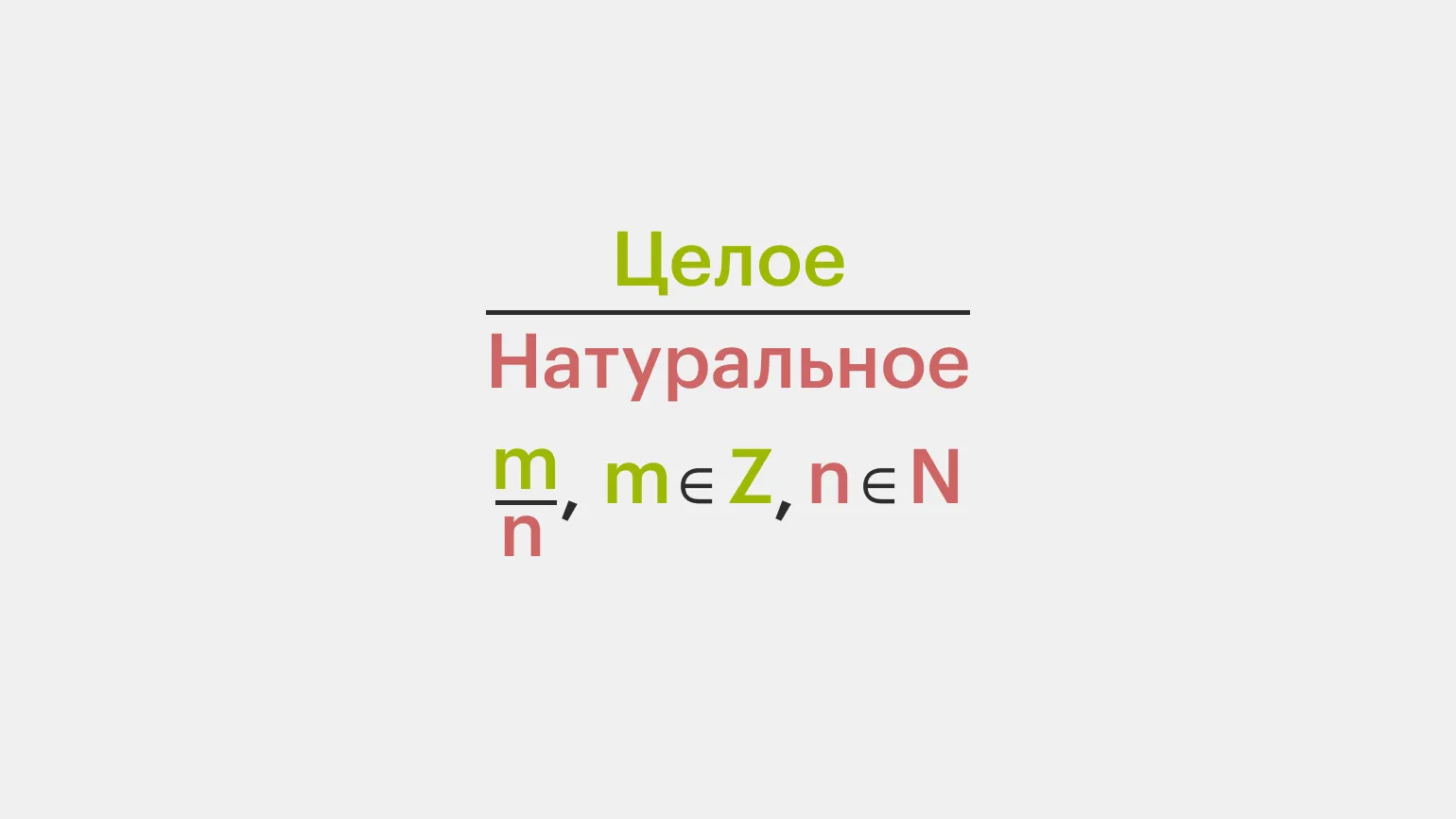
Number 0.5 can be expressed as a fraction, such as 5/10 or ½, confirming its classification as a rational number. In mathematical notation, this is denoted as 0.5 ∈ Q. Rational numbers include all numbers that can be represented as a fraction, where the numerator and denominator are integers and the denominator is nonzero.
Any integer can be classified as a rational number because it can be represented as a fraction. For example, the number 5 can be written as 5/1. In this case, it is no different from dividing 5 by 1, which also results in the same result—five. Thus, all integers are rational numbers, since they can be expressed as a fraction, where the numerator and denominator are integers, and the denominator is not zero.

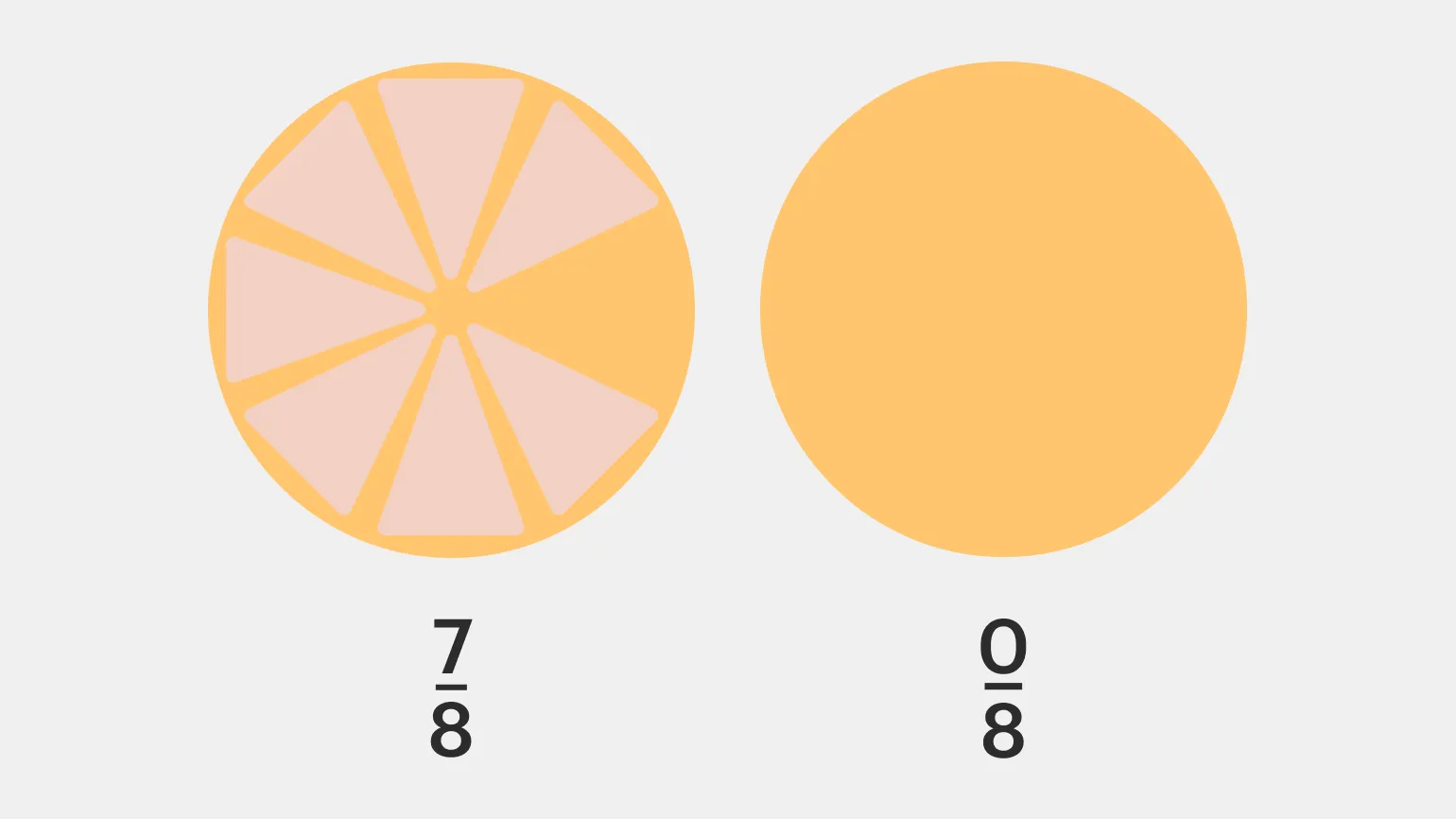
Zero is considered a rational number because it can be expressed as a fraction. However, division by zero is mathematically incorrect, so the denominator in a fraction representing zero must be at least one. To illustrate, consider the following example: if we have 7 of 8 pizza slices, this can be written as the fraction 7/8. After all the slices are eaten, we are left with 0 of 8, which corresponds to the fraction 0/8. This example shows how zero fits into the concept of rational numbers and illustrates its significance in mathematics.
Infinite recurring fractions are part of rational numbers. Consider the fraction 1/7. Dividing 1 by 7 yields 0.14285714285714…, where the sequence 142857 repeats infinitely. This means that 1/7 can be expressed as a repeating fraction. The inverse transformation, returning us to the fraction 1/7, confirms that such numbers belong to the rational set. Thus, infinite repeating fractions play an important role in number theory and are an example of rational numbers in mathematics.
If a fraction has no repeating sequence after the decimal point, such a number is considered irrational. An example of an irrational number is √2, which is approximately equal to 1.41421356237… Another well-known example is the number π (pi), which is approximately equal to 3.1415926535… Irrational numbers play an important role in mathematics and are used in a variety of fields, including geometry, physics, and engineering. Their unique properties make them interesting to study and apply in scientific research.
Rational numbers are numbers that can be represented as a fraction where the numerator and denominator are whole numbers and the denominator is nonzero. For example, the numbers 1/2, -3/4, and 7 are rational. Any whole number can be considered rational if it is represented as a fraction with a denominator of 1. Also, rational numbers include numbers such as 0.75 and -2.5, which can be expressed as fractions 3/4 and -5/2, respectively. It is important to note that rational numbers can be either positive or negative, and they have an infinite number of decimal places when represented in decimal form, but they always end or start repeating. Rational numbers play an important role in mathematics and are used in various fields such as economics, physics, and engineering.
- The positive natural number 1 is 1/1.
- The integer 0 is 0/1.
- The negative integer -5 is -5/1.
- The decimal fraction 0.25 is 25/100.
- The negative decimal fraction -0.75 is -75/100.
- The mixed number 3.25 is 13/4.
- The infinite repeating fraction 0.333… is 1/3.
How are rational numbers different from
Rational numbers are an important category of numbers in mathematics that are worth exploring in detail. A rational number is a ratio of two integers where the divisor is nonzero. This means that any rational number can be written as a fraction, such as 1/2 or -3/4.
Rational numbers include both positive and negative values, as well as zero. They form a set denoted by the symbol Q. It is important to note that rational numbers can be represented as finite or recurring decimal fractions. For example, 0.25 is a finite fraction, while 0.333 is recurring.
Understanding rational numbers is the foundation for learning more advanced mathematical concepts, such as irrational numbers, real numbers, and complex numbers. These numbers play a key role in various areas of mathematics and its real-life applications. Knowing about rational numbers will help you better navigate mathematics and use them in practical problems.
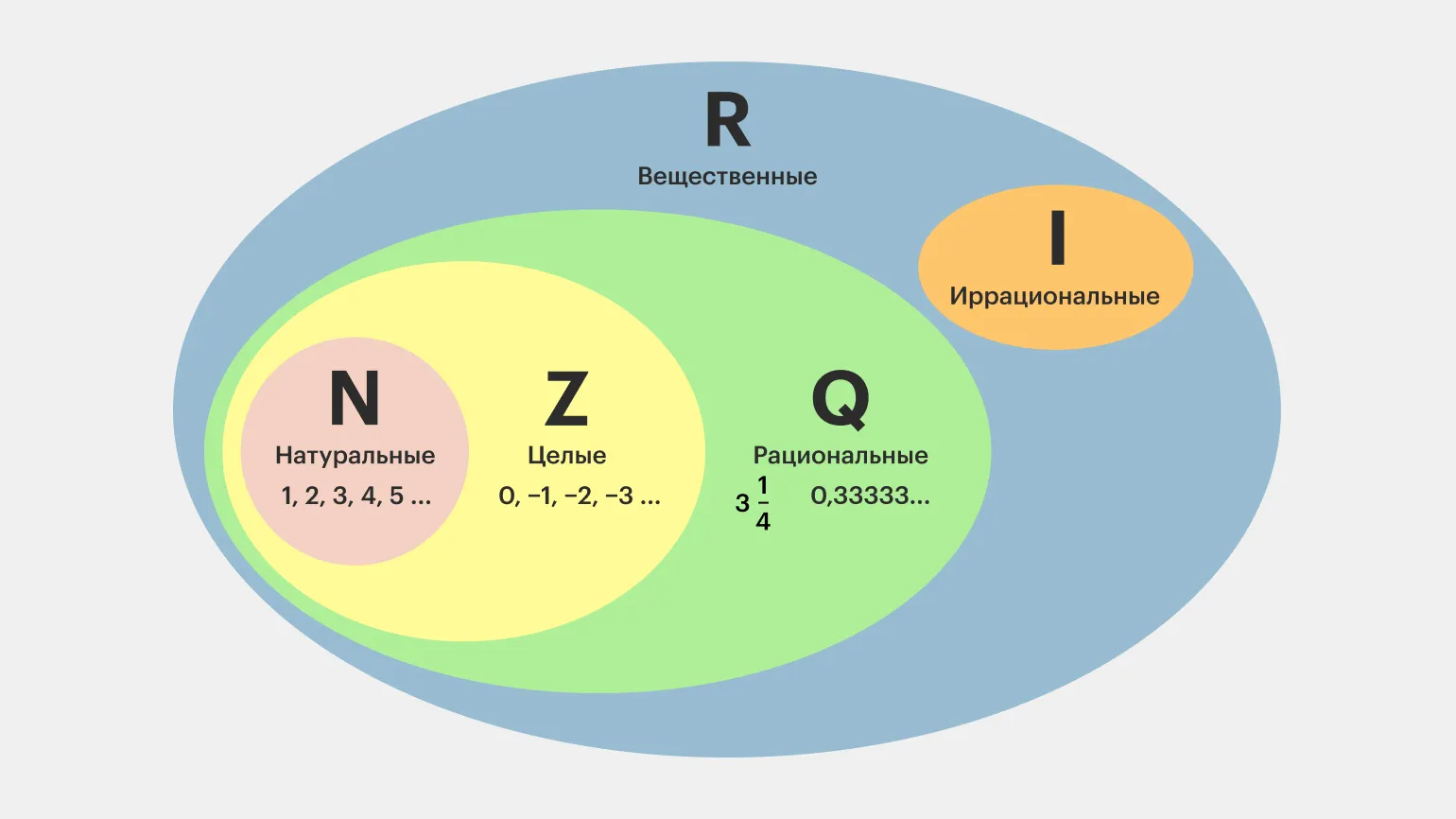
Natural numbers represent all positive integers, starting with 1 and continuing to infinity. It is important to note that zero is not included in this set. Natural numbers are widely used in everyday life to count material objects, such as one coin, two felt-tip pens, or five cars. This type of number is one of the most ancient, having been used for calculations since prehistoric times. Natural numbers form the basis for more complex mathematical concepts and remain relevant in a variety of fields, including economics, statistics, and science.
Integers include all natural numbers, their negative counterparts, and zero. Historically, the use of integers began in ancient China and ancient India, where they were used to represent debts and calculations. Integers play an important role in mathematics, being used in a variety of fields, from arithmetic to algebra and number theory. Understanding integers and their properties is the foundation for learning more complex mathematical concepts.
Rational numbers are a set that includes natural numbers, whole numbers, and fractions. Fractions can be common, finite decimal, and infinite periodic. Fractions in which one or more digits after the decimal point repeat, for example, 0.161616, are called recurring fractions. If such periodicity is absent, the number is classified as irrational. Rational numbers play a key role in mathematics and are used in various fields, including economics, physics, and engineering. Irrational and rational numbers form a new set—the real numbers. This set includes all numbers that can be represented on a number line. Rational numbers can be expressed as a fraction where the numerator and denominator are integers, while irrational numbers cannot be represented in this form. Examples of irrational numbers include the square root of 2 and pi. Real numbers play a key role in mathematics and other sciences, as they are used to describe continuous quantities and provide the basis for analyzing and modeling various processes.
Properties of rational
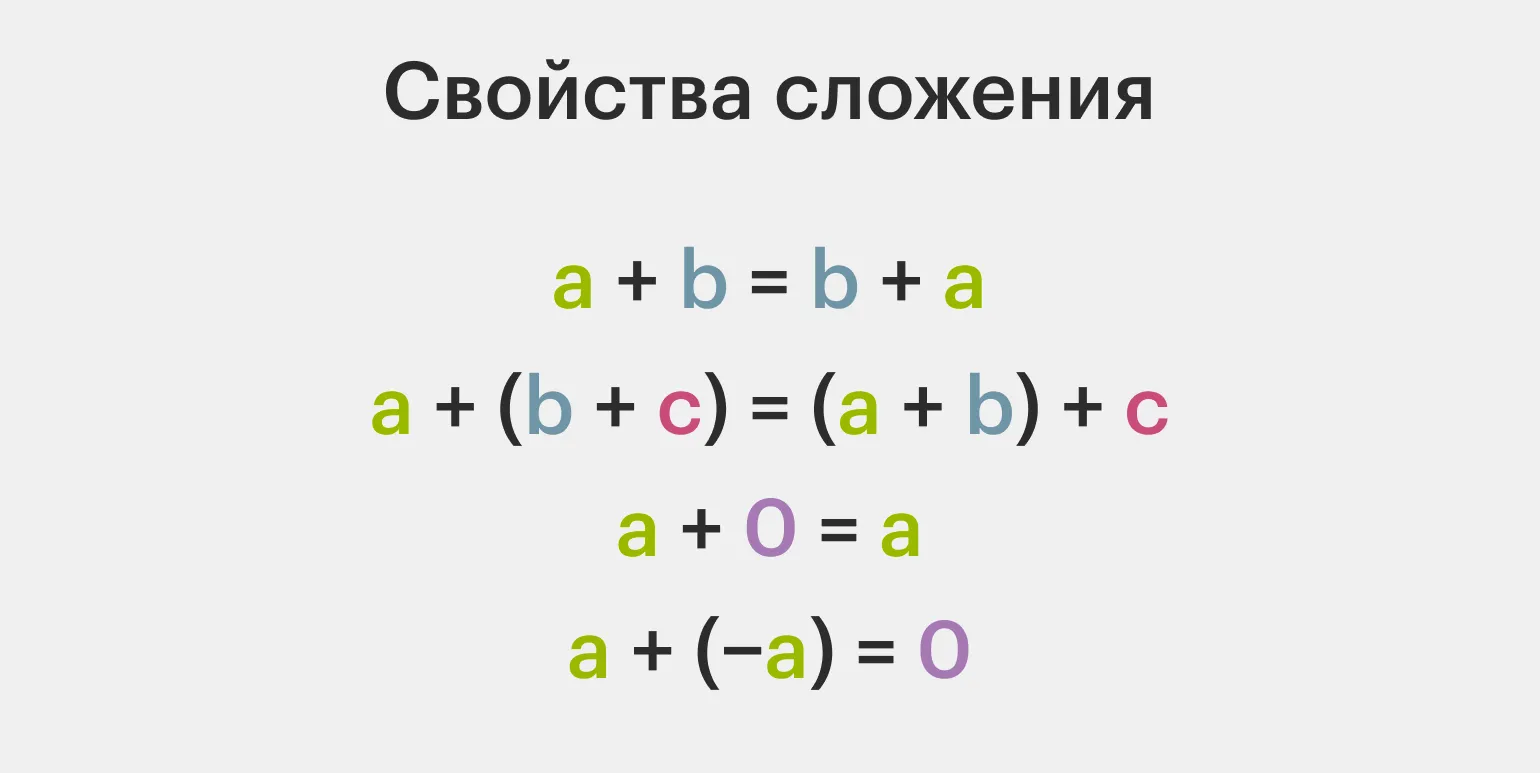
Rational numbers, like other mathematical objects, have certain properties. In the examples below, a, b, and c represent rational numbers. These properties play an important role in various mathematical operations and theorems. Understanding the properties of rational numbers helps in solving mathematical problems and in learning more complex concepts.
The commutative property states that the sum does not change when the terms are rearranged. This is a fundamental property of arithmetic, allowing us to confidently manipulate numbers. Regardless of the order in which we add the numbers, the final sum will always remain the same. This property is fundamental to more complex mathematical operations and simplifies calculations in various problems. A proper understanding of the commutative property is important for successful learning of mathematics and its application in real life.

The commutative property states that in order to add the sum of two other numbers to a rational number, you must first add one to that number. of terms, and then add the second term. This property is fundamental in arithmetic and allows for simplified calculations while providing flexibility in the order of operations. It is important to remember that using the associative property helps to avoid errors and speeds up the process of solving mathematical problems.

Zero is a neutral element in arithmetic operations. When zero is added to any rational number, the result remains unchanged. This property makes zero an important element in mathematics, allowing numbers to retain their value when performing operations.

Every rational number has its opposite. When you add a rational number and its opposite, you get zero. This property plays an important role in mathematics, since zero is the neutral element for the addition operation. Opposite numbers help to better understand the structure of numbers and their relationships.

To better remember these properties, use the following cheat sheet. This reminder will help you quickly recall key characteristics and features, which will make studying the material more effective. Use a cheat sheet as a tool for reviewing and consolidating knowledge, which will help you better navigate the topic and improve your level of preparation.
Here everything is almost the same.
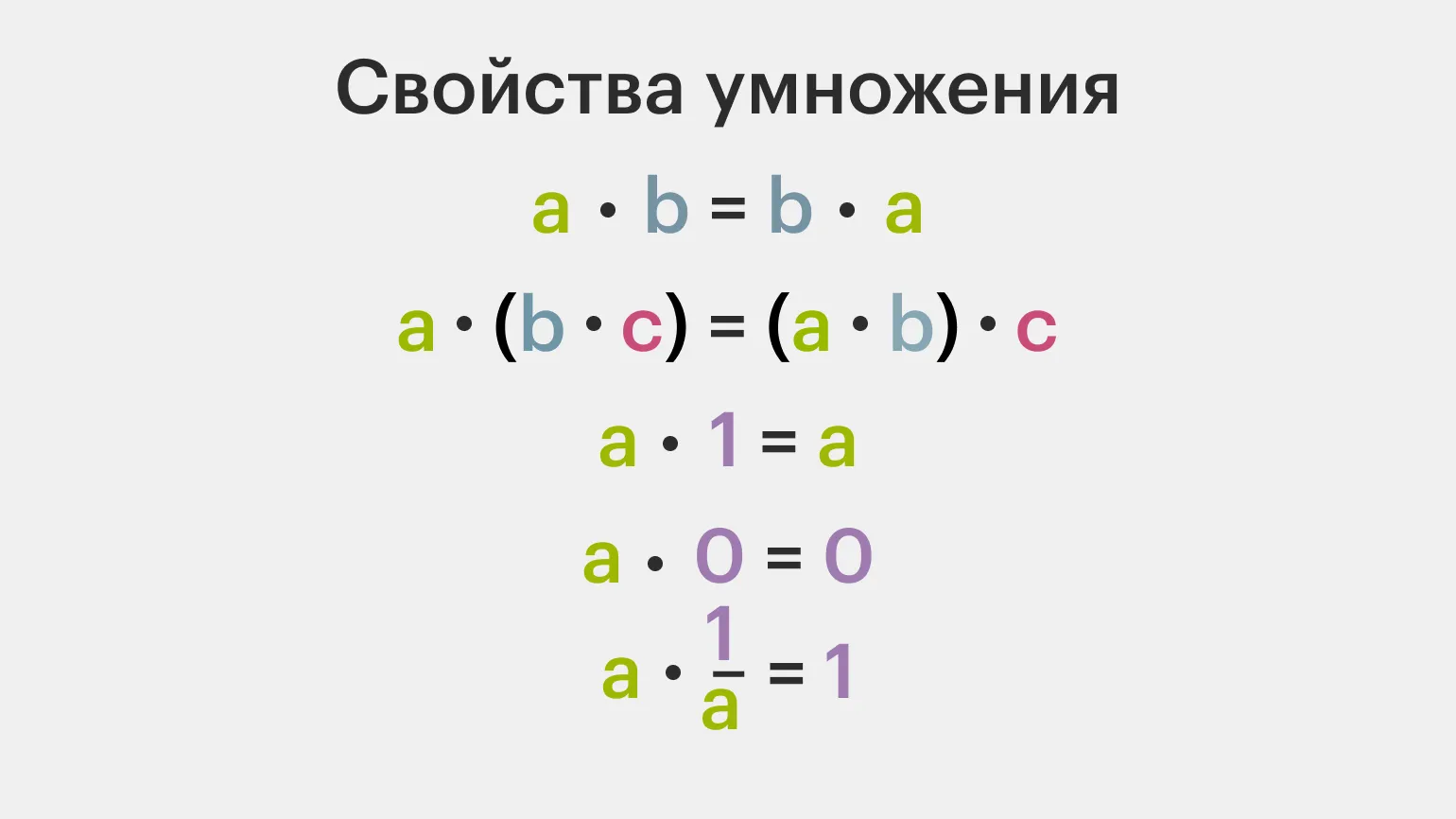
The commutative property says that When multiplying factors, their order does not affect the result. This means you can rearrange the factors, and the product will remain unchanged. For example, if we multiply 2 by 3, the result will be 6, just as if we multiply 3 by 2. This property is fundamental in arithmetic and helps simplify calculations. Understanding the commutative property promotes a deeper understanding of mathematical concepts and improves problem-solving skills.

The associative property of multiplication states that to multiply a rational number by the product of two factors, it is sufficient to first multiply this number by the first factor, and then multiply the resulting number by the second Multiplier. This property allows you to simplify calculations and better organize the process of multiplication in mathematics.

Property of multiplication by 1. By multiplying a rational number by 1, we preserve its value. This property is fundamental in mathematics, as it shows that 1 is the neutral element for the operation of multiplication. For example, if we multiply the number 5 by 1, the result is 5. This rule applies to all rational numbers, including fractions and negative values. Understanding this property helps in solving various mathematical problems and simplifies calculations.

The property of multiplication by zero states that any rational number multiplied by zero is always zero. This is a basic mathematical rule used in various fields of mathematics and science. Regardless of the value of the multiplier, the result of multiplication by zero remains the same and equals zero. This property is important to consider when solving equations and simplifying mathematical expressions.

Property of multiplication by a fraction. When multiplying a rational number by a fraction where the numerator is 1 and the denominator is the same rational number, the result is 1. This property illustrates the basic concept of reciprocals in mathematics and highlights the importance of fractions in calculations. Multiplication by a fraction can simplify many math problems and is a fundamental element in learning algebra and rational expressions.

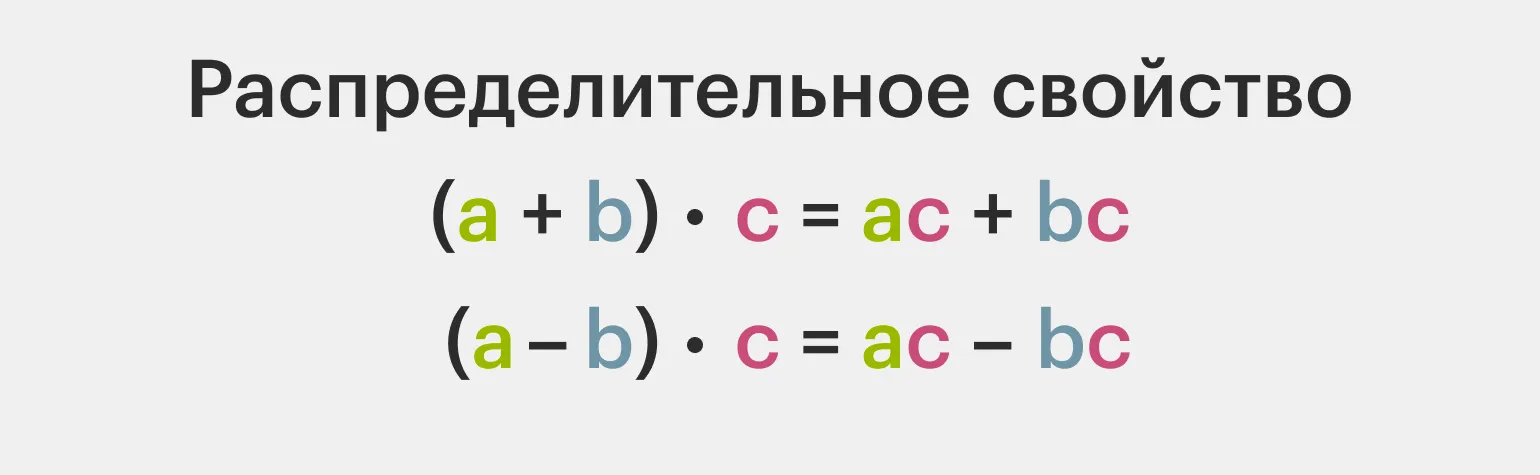
The distributive property states that when multiplying a sum by a rational number, you can multiply that number by each term separately and then add the results. This rule also applies to subtraction. So, if you have an expression like a + b, and you multiply it by a number c, you can represent it as c * (a + b) = c * a + c * b. Similarly, for subtraction: c * (a & b) = c * a & c * b. The distributive property is an important tool in algebra, allowing you to simplify calculations and solve equations more efficiently.
Multiplication of numbers with different signs has its own characteristics. If an operation involves at least one negative number, the result of the product will always be negative. This rule is based on the fact that multiplying a positive number by a negative number produces a negative value, and multiplying a negative number by a positive number also produces a negative result. Thus, it is important to remember that when multiplying numbers with different signs, the final value will always be negative.

Multiplication of negative numbers is important in mathematics. When we multiply two negative numbers, the result will always be positive. This is because multiplying a negative number by another negative number cancels the negative sign. Thus, minus times minus equals plus. Understanding this concept is the foundation for working with numbers in various mathematical problems and equations.


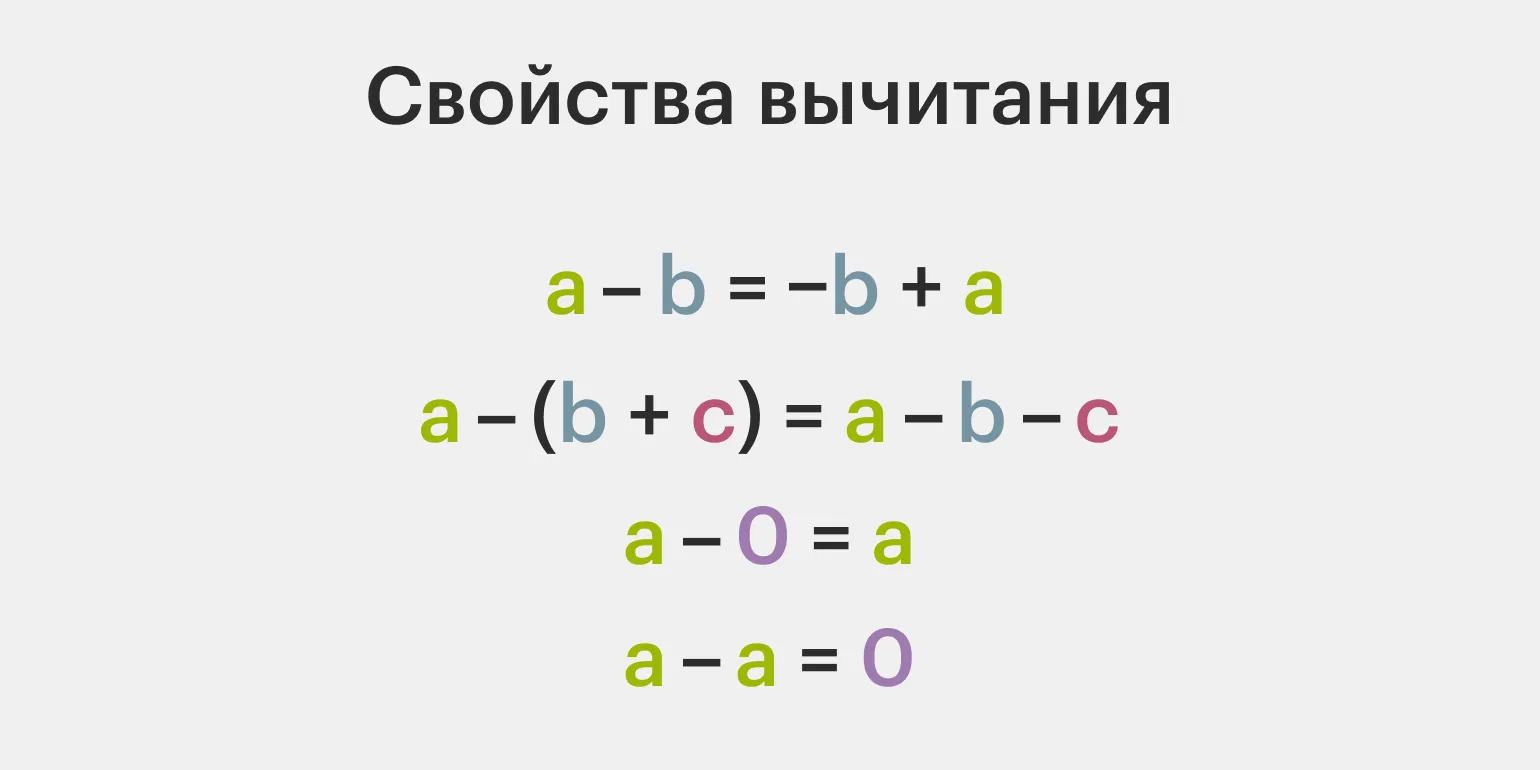
The properties of subtraction of rational numbers can be explained similarly to the properties of addition, but it is important to take into account the signs correctly. For example, subtraction can be represented as: a − b = −b + a. This formula emphasizes that subtraction can be converted to addition with a negative number, which greatly simplifies operations with rational numbers. A proper understanding of the properties of subtraction will help you avoid mistakes and improve your number-handling skills in mathematics.
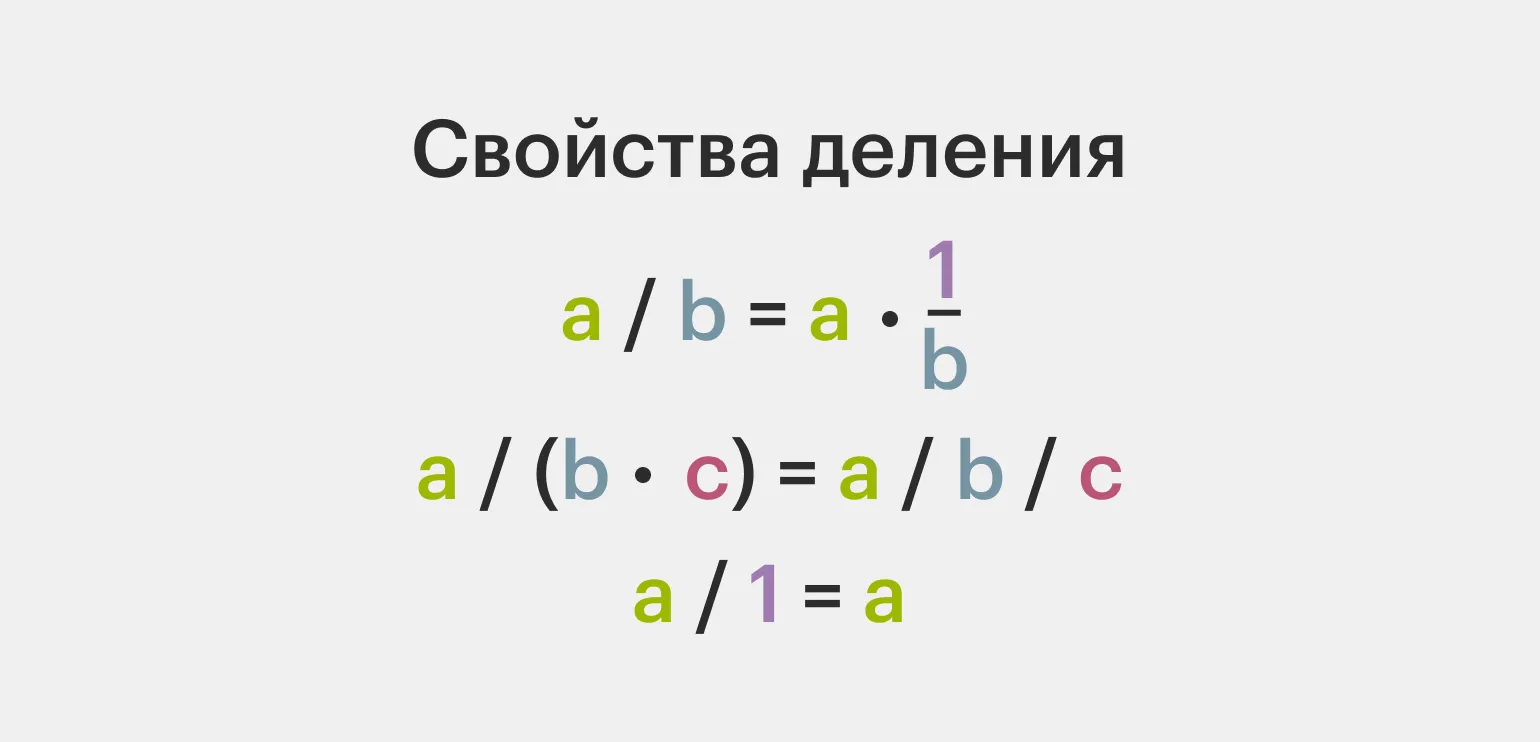
The properties of division of rational numbers are opposite to the properties of multiplication. This means that division operations have their own unique rules and characteristics that are important to consider when working with rational numbers. For example, division by zero is impossible and results in uncertainty, while multiplication by zero always results in zero. Furthermore, division of rational numbers also follows the rules associated with dividing positive and negative numbers, which affects the sign of the result. Understanding these properties is key in mathematics, especially when solving problems involving fractions and rational expressions.
Rational Numbers in Python
In this article, we will consider the concept of rational numbers and their properties using the Python programming language. Python has a special fractions module that makes working with rational numbers easier. This module implements the Fraction class, which allows you to effectively represent fractional values and perform various arithmetic operations with them. Using this class ensures the accuracy of calculations and simplifies working with fractions in programs. Let's start by importing the Fraction class from the fractions module, which will allow us to work with fractions. This will give us the ability to perform various mathematical operations with fractional numbers, ensuring accuracy and convenience in calculations. By importing the class, we can easily create fraction objects and use them in further calculations. Now let's look at how the Fraction class works. When creating an object of this class, you can pass values that define a fraction to the constructor. This allows you to conveniently and efficiently manage fractional numbers, providing the ability to perform arithmetic operations, comparisons, and other actions. The main goal of the class is to simplify working with fractions, providing developers with flexible tools for mathematical calculations. Therefore, it is important to use this class correctly to avoid errors and get accurate results.
- two values, where the first is the numerator and the second is the denominator (variable a);
- a fractional value as a string (variable b);
- a real value (variable c);
- another Fraction, since Fraction is the implementation of a rational fractional value (variable d).
The Fraction variable displays the fractional representation of the rational number 0.5. When converting the value ½ to float, we get its real representation. This demonstrates how different data types can affect the formatting and display of numbers in programming. Understanding these differences is important for properly working with mathematical operations and their results in code.
Let's change the values of variables and examine the properties of rational numbers, using negative -¾, the fraction 2/3 with an infinite period, and the integer 10 as examples. Analyzing these numbers allows us to better understand their characteristics and relationships. We'll start with negative -¾, which indicates a value less than zero. Next, the fraction 2/3 with an infinite period demonstrates how rational numbers can take a form where the decimal representation continues indefinitely. Finally, the integer 10 serves as an excellent example of a positive rational number. Exploring these values helps deepen our understanding of rational numbers and their properties in mathematics.
Let's examine the associative property of addition, using the formula (a + b) + c = a + (b + c). This allows us to confirm the equality of the values. We'll also convert the fractions to floating-point format to simplify calculations.
When analyzing the data, you'll notice that the values are identical, but when represented in real format, they produce a number with an infinite period of 6. As mentioned earlier, such numbers are also classified as rational.
Let's consider an application of the distributive property of multiplication. We'll perform a similar operation to illustrate this property in action. The distributive property of multiplication allows us to multiply the sum of numbers by a number, which simplifies calculations and makes them more understandable. This technique is widely used in mathematics to solve various problems. Now let's apply this property in practice.
The resulting values are equal, but there's a violation of the periodicity of the rational number when converted to real form: 3 is rounded to 4 at the end. This is due to the specific features of calculations in the Python language. If you divide 5 by 6 on paper, you get 0.8333, where 3 repeats infinitely.
In conclusion, let's look at dividing rational numbers using the commutative property. We'll start by dividing a by b. Then we'll swap the operands and analyze the result. To do this, we multiply a by the fraction 1/b using the Fraction class, which is responsible for implementing fractions. This gives us a new result.
Summary: Let's review what we've learned
In this article, we examined the concept of rational numbers, their distinctive features compared to other types of numbers, and their basic properties. Now let's briefly summarize the key points for a better understanding of the topic.
- A rational number is a number that can be represented as a fraction, where the numerator is an integer and the denominator is a natural number.
- Rational numbers include all natural and integer numbers, as well as fractions: ordinary fractions, finite decimal fractions, and infinite recurring fractions.
- Infinite recurring fractions are fractions that have a repeating sequence after the decimal point. For example, 1.16161616... If the fraction is infinite, and there is no such sequence, the number is called irrational.
- Rational numbers have mathematical properties: commutative, associative, distributive, and so on.
- Any mathematical operations can be performed with rational numbers, such as addition, subtraction, division, multiplication, and others.
Learn more about coding and programming in our Telegram channel. Subscribe to stay up-to-date with interesting materials and useful tips!
To optimize text for SEO, it is important to use keywords and phrases that are relevant to the topic. Here is the revised text:
Explore additional materials:
Your recommendations for choosing literature and resources will help deepen your knowledge and broaden your horizons. Reading useful articles, publications, and books contributes to the development of skills and an understanding of current trends. Don't miss the opportunity to get acquainted with current research and new ideas that can be useful in your work. Pay attention to authoritative sources that will provide you with high-quality information and up-to-date data.
- Binary number system: what it is and how to use it
- Test: what do you know about John McCarthy, the author of the term "AI" and the Lisp language?
- 30 powerful neural networks for any task
Learn more about coding and programming in our Telegram channel. Subscribe to stay up-to-date with exciting content and helpful tips!