Contents:
Briefly about the data architect
The world is drowning in data. Millions of users create information using smartphones, computers, and smart devices. This information is needed for more than just checking the weather forecast or ordering food online. Data is the foundation for making decisions in business.

This is where a data architect comes into play - a person who organizes and manages information. The specialist's task is to make information accessible and easy to use. He helps companies extract valuable data from the chaos of numbers and use it to make informed decisions.
💡 For example, a company stores sales information in one database, seasonal data in a second, and promotional information in a third. A data architect will design the system so that all data is connected and easily accessible. As a result of analytics, the business will be able to quickly get a picture and make a forecast. For example, find out by what percentage the demand for a product will increase in the next quarter. Provided that a new advertising campaign is launched this year.
What does
Imagine a huge warehouse where all the company's data is stored: from customer information to sales reports. A data architect is the person who plans and organizes the warehouse. And here are the responsibilities he performs every day to achieve these two goals:
- Develops database architecture.It's like a warehouse layout: you need to decide where to store what so that the information you need is easy to find. For example, if a company sells products online, you need to store information about orders, payments, delivery, and data about the products themselves. The architect determines how best to store information so that the service quickly provides the client with data about their latest purchases;
- Manages data flows.The data architect thinks through how information will be received in the warehouse, processed, and transmitted to departments. For example, sales information should be passed on to the marketing department to analyze purchasing activity;
- Ensures data quality.It is important that the data is accurate and up-to-date. The data architect is responsible for ensuring that information is not lost or distorted;
- Responsible for data security.There are many hackers in the digital world who want to steal data. For example, passwords to user accounts. The data architect builds protection against unauthorized access.

Build a successful career, learn to write and maintain code on Skillbox courses.
Learn moreWhat they can do
To cope with their responsibilities, a data architect must have hard and soft skills:
Hard skills
- Programming languages. A specialist must be able to "speak" the language of computers to create programs for data processing. For example, Python, Java, SQL are languages that help work with databases;
- Databases. An architect should know different types of databases: relational and non-relational;
💡 Relational databasesare systems where data is organized into tables similar to Excel. Each table consists of rows and columns. A special query language, SQL, is used to establish relationships between tables. Relational databases include MS SQL and PostgreSQL.
💡 Non-relational databasesare flexible systems that are not limited by a rigid table structure. An example of a non-relational database is MongoDB.
- Data Tools.The architect should know how to use Apache Spark, Hadoop, and Tableau;
💡 Apache Spark is a platform for real-time data processing.
💡 Hadoop is a tool for storing and processing large amounts of data.
💡 Tableau is a data visualization tool that helps you easily create reports and dashboards.
- Cloud technologies. An architect must be able to work with Amazon Web Services, Google Cloud Platform, Microsoft Azure - "virtual storage" of information.
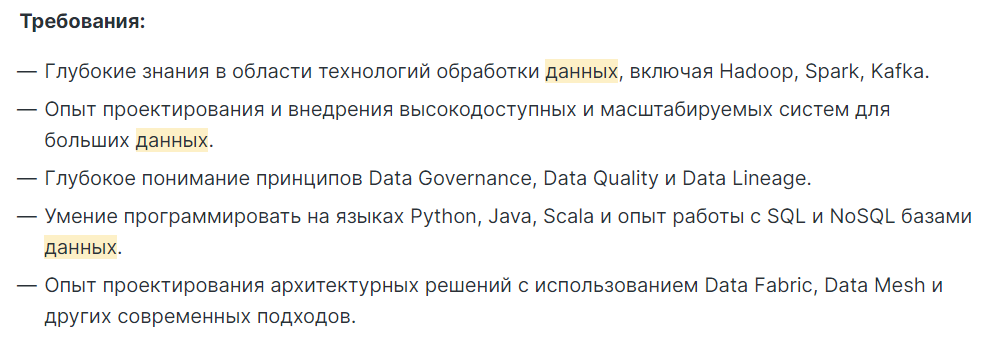
Here, for example, Requirements for a candidate for the position of data architect with 6 years of experience. Knowledge of programming languages, data tools, and theoretical knowledge is required.
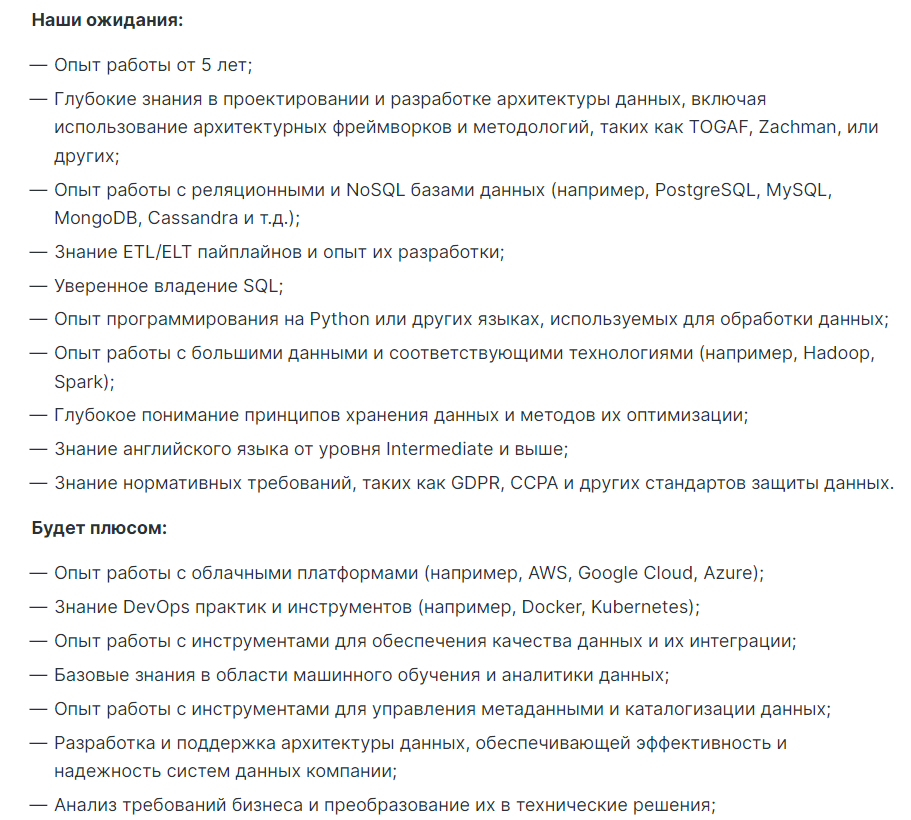
Let's look at another vacancy. This one requires experience with different types of databases, programming skills, and knowledge of theory. Experience with cloud platforms will be a plus.
Soft skills
- Analytical thinking. Data architects understand complex processes and uncover hidden relationships in data. Imagine a company experiences a sudden data system failure. Such a specialist will quickly analyze the situation, find out the cause of the problem, and restore the correct data storage;
- Communication and teamwork.An architect must be able to communicate with developers and business managers. This way, they can explain technical nuances in simple language and ensure that the data is used effectively;
- Understanding business processes.A specialist must know how data is related to the business. This will help make the best decisions for the company. For example, if an architect understands that sharing analytics with the marketing department would improve promotion strategies, they might suggest this idea.
How to become one
There are three ways to become a data architect:
- Higher education.If you want to delve deeper into the topic, you can get a higher education in IT, mathematics or statistics. For example, BSTUtrains programmers in four areas;
- Self-education.You can study books, articles and videos on your own. This is an accessible, but the most difficult way. Without a mentor, it's easy to get stuck on your mistakes and not get the results you need from your training.
💡 Attending conferences, reading professional literature, and completing certification programs will help you stay up to date with the latest trends. For example, you can independently complete Microsoft certification.
- Courses. Courses are a middle ground between higher education and self-study. They are not as long as studying at a university and not as difficult as self-study. In a year of courses, you can master current technologies, practice on real projects, and find a job.
In addition to gaining knowledge, you need to gain practical experience. Typically, a data architect's career begins in junior positions working with data. Here is an approximate path that many specialists take:
| 1 | Data Analyst | Collects and analyzes data. |
| 2 | Data Engineer | Develops and maintains infrastructure for storing, processing, and transmitting data. |
| 3 | Data Architect | Designs and implements data architecture for the company. |
Why a data architect is important for business
A competent data architecture is the foundation of a successful business.Let's take Netflix as an example. Thanks to a well-thought-out data structure, the service analyzes user preferences and makes recommendations.

This not only improved the customer experience, but also increased user retention. But that's not all, a competent data architecture performs other tasks:
- Improves business processes. Properly organized data helps track performance, identify bottlenecks, and optimize processes. For example, when sales data is structured and available in real time, it allows you to see that plan fulfillment for the last quarter has decreased due to delivery delays;
- Improves operational efficiency.Imagine a company accumulating a huge array of order data: which cities and regions receive the most orders, what time of day orders peak, which products are often bought together. A data architect identifies patterns by analyzing the information;
💡 For example, it turns out that in certain areas, demand for a category of goods increases on Wednesdays and Fridays. Knowing this, the company can optimize warehouse and courier operations by delivering needed goods in advance. This way, customers will receive their orders faster, and the company will save on logistics and reduce the number of unclaimed deliveries.
- Helps make decisions.Access to up-to-date data allows businesses to analyze the situation and make decisions. For example, when a product is in high demand on Mondays, a manager orders more goods for the beginning of the week.
A data architect can also help with the following tasks:
✅ Innovation Helps in creating new products and services based on data analysis;
✅ Competitiveness.Organized data gives an advantage in the market and allows you to quickly respond to its changes;
✅ Strategic development.A data architect determines the direction of the company's development by analyzing trends and tendencies.
What is the future of the profession?
The role of a data architect in business has changed due to the emergence of new technologies and the importance of data for work. We've compiled a list of trends that are impacting the profession:
- Transition to cloud technologies. Many companies are switching to cloud platforms for data storage. This reduces infrastructure costs, increases flexibility, and opens the door to new features. An architect needs to be able to work with cloud services and know how to use them to create a reliable and scalable architecture;
- Artificial intelligence. AI is used to analyze data and automate tasks. A data architect needs to understand how these technologies work. Thus, a specialist will be able to create architectures that support the use of the tool;
- The growing importance of data.Companies use information to improve customer service, optimize operations, and create new products and services. A data architect is responsible for creating systems that extract valuable information from data.
Useful materials from the editors of Skillbox.by
We have collected useful materials for those who want to try their hand at data architecture:
Telegram chats:
- DBA - Russian-speaking community— a chat dedicated to databases;
- MySQL— a chat where you can discuss MySQL.
Literature:
- "Introduction to Database Systems" by Christopher Date is a book that examines the concepts and principles of database systems;
- "Big Data: A Practical Guide" by Maile Uvozy and Tom White — the authors share their experiences and give advice on using tools and technologies for analyzing, storing and processing large volumes of data.
Master the profession of "Software Architect" with Skillbox
You will get acquainted with the tools and best practices for building software architecture. Learn how to choose an architectural style for a specific business task, create scalable, fault-tolerant applications, and increase your income.
Take access