
Contents:

Learn: Profession Methodist from scratch to PRO
Learn moreWhy a new model in corporate training is needed
Nick Shackleton-Jones clearly distinguishes between natural learning and traditional education, which includes school, university, and corporate training. The expert believes that modern education has become overloaded with information and has turned into a factory for issuing diplomas and certificates, often for meaningless hours spent in classrooms. Students are forced to memorize huge amounts of facts, daunting them with tests and exams, while ignoring their real needs and interests. This leads to a decrease in the quality of education and the formation in students of a feeling of futility of the knowledge they are receiving. An approach is needed that would take into account the individual needs of students and promote their true development.
Nick developed the theory of affective context to explain how effective learning occurs. According to him, learning and remembering represent changes in an individual's behavior or competence. These changes arise from an affective response to a meaningful experience that is meaningful to the individual. The significance of an experience is shaped by two triggers: "pull"—when a person is interested and strives for knowledge—and "push"—when external interest motivates them to learn. This theory emphasizes the importance of emotional perception in the educational process and can be useful for creating more effective teaching methods.
A simple example illustrates how interest influences learning. When a person is fascinated by dinosaurs, they don't need to be forced to study the topic—they will happily read books, visit museums, and remember the information much better than someone indifferent to ancient reptiles. In contrast, a boring safety course fails to generate the desired interest. Reading lengthy instructions is perceived as a routine chore. However, it is possible to artificially create interest in such a program by using emotional significance. For example, you could create a video about the consequences of workplace accidents, which would attract attention and increase the level of engagement among participants. This approach promotes better assimilation of information and increases safety in the workplace.

The theory of affective context formed The 5Di model is based on this model, which, according to the author, can be applied to organizing the educational process in various fields, including secondary and higher education. However, the main focus of this model is on the corporate sector, and further in the article we will provide examples from this area.
How is design organized according to the 5Di model?
The 5Di model is an iterative design model that consists of six key stages. The name of the model is an acronym reflecting each of these stages, which allows for organizing the development process and improving the quality of the final product. An iterative approach allows for changes and improvements at each stage of design, providing a more flexible response to changing customer requirements and preferences. The 5Di model is widely used in various design fields, making it a versatile tool for professionals.
- Define — formulating learning outcomes.
- Discover — audience research.
- Design — designing learning materials or experiences.
- Develop — designing experiences and cues (learning materials).
- Deploy — deploying learning.
- Iterate — repeating the cycle.
The 5Di model has much in common with other similar models, but it also has unique features. Let's take a closer look at each of the six stages of this model to understand its advantages and differences from other approaches.
Stage 1: Project Preparation
The first stage is important to define the goals and objectives of the project. You need to analyze the current situation, identify the needs of the target audience, and collect all the necessary data. This will help you form a clear idea of what you want to achieve and what steps are required to achieve it. It's also worth developing an action plan that includes key deadlines and who is responsible for completing tasks. Effective preparation at this stage will lay the foundation for successful project implementation.
The first step is to define learning outcomes. It's important to focus not only on the traditional educational achievements of the course, but also on significant changes in the behavior, thinking, and emotional state of participants. This approach helps create a deeper connection between training and real-life situations, which in turn increases the effectiveness of the educational process. Meaningful learning outcomes promote the development of personal responsibility and autonomy, which is key to achieving successful change.
Learning objectives are often formed based on the opinions of key stakeholders, who determine the knowledge and skills employees need. However, according to Nick, this approach can be ineffective. A more productive approach is to ask two important questions: what changes in people's behavior, thinking, and feelings are needed, and how the effectiveness of the training can be measured. To collect data, Nick recommends conducting a series of interviews and focus groups to gain a deeper understanding of employee needs and expectations. This approach promotes more targeted and effective training that aligns with real business needs.
The developer of this model has created a comprehensive set of tools for various stages, including the "Thoughts, Actions, Feelings" chart, which is recommended as a first step. If a company needs to improve its communication skills, it's important to learn how to avoid toxicity in correspondence and face-to-face interactions, as well as how to listen attentively to colleagues and create a positive atmosphere within teams. In this context, the chart can help structure thoughts and actions, promoting effective communication.
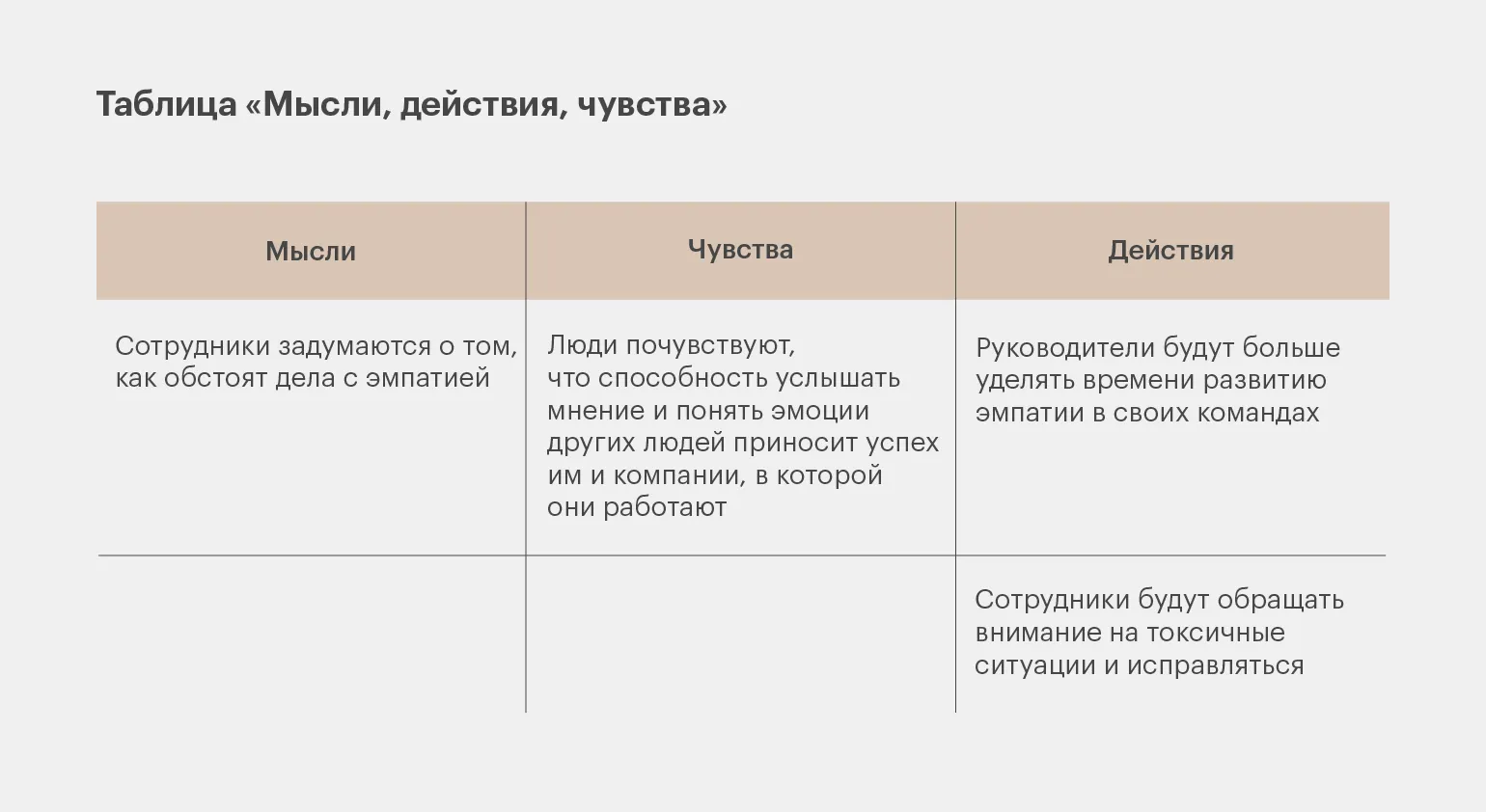
Stage 2 is an important part of the process, where key transformations and achievements occur. At this stage, the obtained data is analyzed, which helps identify the strengths and weaknesses of the current strategy. In addition, resources are optimized, which contributes to increased efficiency. At this stage, new goals and objectives are also formed based on the analysis results. This allows for a more precise determination of further action areas and increases the chances of successful project completion. Stage 2 plays a key role in achieving the desired results and preparing for the next stage.
The second stage of audience research differs from a traditional needs analysis. Nick Shackleton-Jones suggests focusing on the concerns of potential listeners and how their daily workflow is organized. To achieve this goal, he recommends using two tools:
- Concerns and Actions List.
Research participants identify ten key concerns related to the topic under study, as well as ten daily actions they perform. They can either independently identify their needs or rank them in order of importance on the prepared list. This allows for a more precise understanding of what aspects of the experience cause them the most concern and how they cope with these issues in their daily lives.
- Emotion Graph.
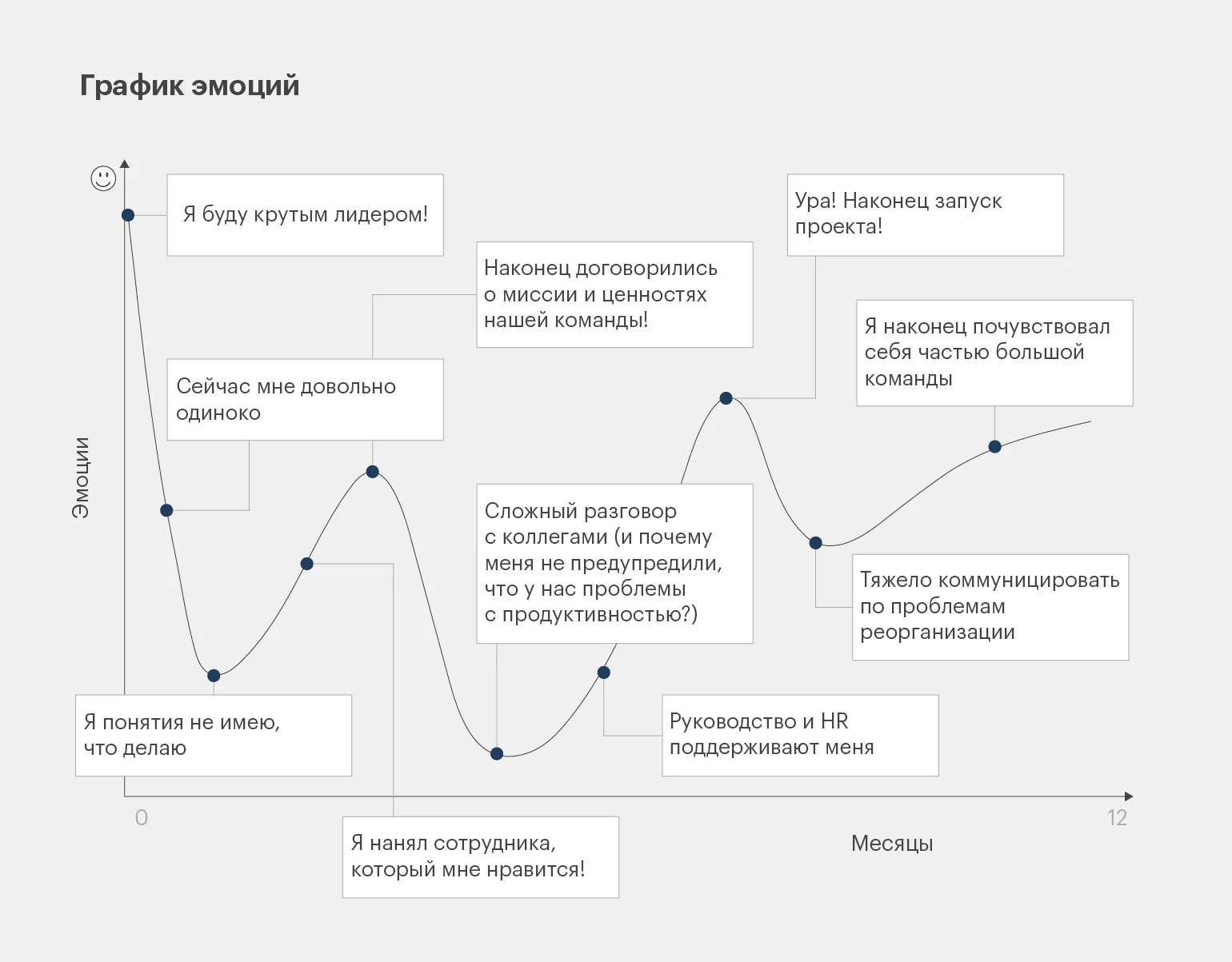
Respondents track their emotions on a graph over a specific period, which can range from a week to several months. This graph should include significant events that were memorable to the user and evoked a strong emotional response, such as difficult conversations with management or a long-awaited project launch. Milestones, which represent commonly accepted time markers, such as the end of the first week, first month, and the end of the probationary period, should also be included. This approach helps better understand the emotional state and dynamics of experiences, which is important for analysis and self-reflection.
During workshops and meetings, participants share the results of their experiments and personal stories, which allows training specialists to accurately identify employees' real concerns and tasks. This tool is especially useful during challenging moments, such as onboarding or transitioning to management positions. Discussing employee experiences helps create more effective training programs tailored to the team's needs.
Stage 3 represents a key phase in the process of achieving set goals. At this stage, it is important to focus on implementing the strategies and tactics developed in the previous stages. Success at this stage depends on careful planning and meticulous execution of planned actions. It is necessary to consider all factors that may influence the outcome and make timely adjustments to the strategy. Stage 3 is critical to achieving the final result, as this is where ideas are put into practice and their effectiveness is evaluated. Understanding the importance of this stage will help you move more confidently towards your goal and achieve the desired results.
Stage 3 involves the creation of two types of training materials. The focus is on cue resources that help simplify the performance of specific tasks, whether work-related or personal. These resources can range from complete programs to individual materials, such as maps or GPS navigators for navigation, as well as instructions, for example, on brewing coffee next to a coffee machine. Although these resources are not traditional training materials, Shackleton-Jones is of the opinion that they do not have to fit this definition. Why memorize a route when you have a map at hand? Resource cues ensure that information is available at the right moment, making the learning process more effective and practical.
This perspective reflects the approach of the author of the 5Di model to the tasks of corporate training specialists. The main goal of such specialists is to provide employees with the necessary tools to effectively perform their duties. In some cases, a short and clear instruction on a single sheet of paper proves more useful than a lengthy and complex course.
The second type is an emotional experience that leaves a lasting impression on the target audience. There is no universal recipe for creating such events; it is important to consider what is meaningful to your audience. An emotional event can be associated with a mistake and the accompanying feeling of shame, a status situation such as a speech by a famous person or a CEO report, an engaging game, an impressive story, a simulation, or observing something meaningful. Creating such occasions requires a deep understanding of the needs and expectations of your audience.

In his model of instructional design maturity, Nick gave an example, illustrating the importance of emotional experience in training. One company was struggling to break employees of dangerous behaviors involving inserting their hands into machinery. The problem was solved by asking workers to wrap their "active" hand in a red bag for a day. This caused physical and psychological discomfort, which became a catalyst for profound changes in safety perceptions. This approach demonstrates how emotional experience can serve as a powerful tool in training and shaping responsible behavior.
Nick argues that if you carefully process the findings and research stages, design ideas will emerge naturally, and all that remains is to structure them. The CTRE matrix can help with this process. This name stands for:
- Concern — care;
- Task — action;
- Resources — resource cues;
- Experiences — emotional experience.
The matrix is a table in which the first column indicates the key concerns and actions of employees identified at the initial stage. The second column contains ideas for cues and emotional experiences. If you find that training program participants are not showing interest in a certain point of the matrix, you should introduce a new emotional experience into the program to increase engagement. If interest is already present, it is necessary to support the training with additional resources. As an example, consider the matrix used in the onboarding and adaptation process for new employees.
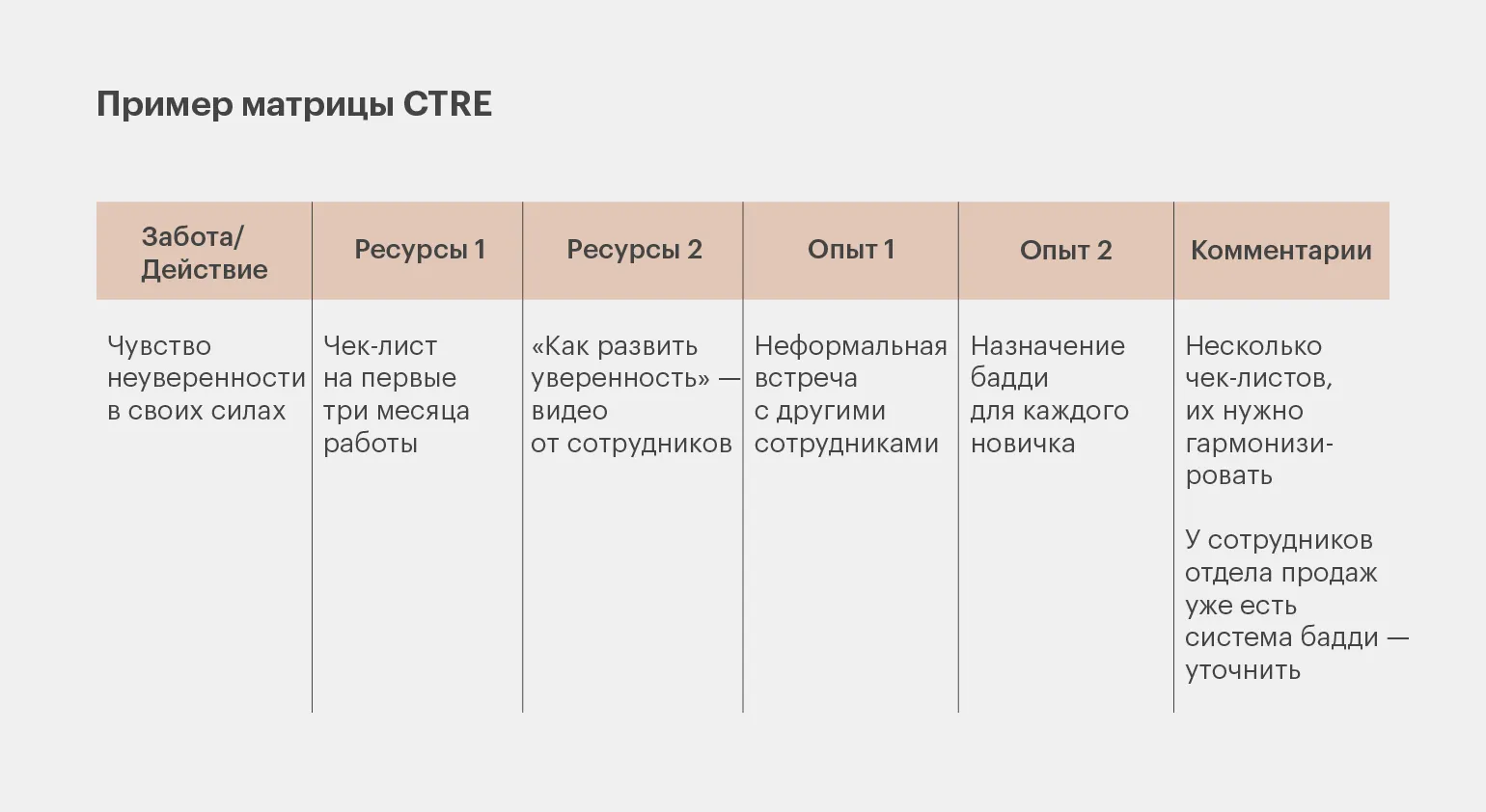
The author of the model emphasizes that one should not immediately try to determine the optimal formats of resources and experience. Instead, it is recommended to move iteratively, collecting feedback and making adjustments to the program. This approach allows for more effective adaptation to user needs and improves the quality of the final product.
Stage 4 is a key part of the process that requires special attention and careful consideration. At this stage, it is important to focus on implementing the set objectives and achieving the planned results. Correct execution of this stage affects the success of the entire project. It is necessary to pay attention to detail, analyze previous steps, and make any necessary adjustments. It is also important to ensure effective team collaboration to achieve maximum productivity. Stage 4 is the moment when ideas turn into real actions, and it is on this stage that the further development of the project depends.
In the fourth stage, the process of creating hints and creating new learning experiences is divided between specialized teams or individuals. This allows for the optimization of work processes and the improvement of the quality of educational content. Each team focuses on its own area, which facilitates more effective knowledge sharing and a better understanding of user needs. This approach ensures the integrity and relevance of the created materials, which in turn improves the overall educational experience.
Nick Shackleton-Jones emphasizes two important aspects in the pedagogical process. First, it is necessary to avoid excessive detail in instructional design, which can lead to redundant instructions or lengthy video lectures. To avoid this, he suggests two effective approaches. These approaches will help focus on the essence of learning and make it more effective.
- Involve marketing specialists, actors and event organizers, psychologists, and coaches in the creation of training materials. According to the author of the model, they are better at understanding the needs of the audience.
- Restrict implementers to templates and clear tasks. For example, instructions should not be longer than one page.
It is important to remember that focusing on the needs of your audience does not mean unconditionally fulfilling all their requests. For example, if new hires request a personal mentor 24/7 during the onboarding process, you're not obligated to accommodate this request. Instead, consider alternative support methods, such as creating a channel for feedback or organizing weekly meetings with HR or your manager. These approaches will help provide the necessary support without overloading the company's resources.

Check out other materials:
Seven key insights about employee needs for corporate training
Corporate training has become an integral part of employee and company development as a whole. However, it's important to understand that not all training programs are equally effective. Let's consider what employees really want from such programs.
Employees seek a personalized approach to learning. They want training courses tailored to their specific needs and professional goals. It's important to consider each employee's level of knowledge and skills to ensure the training is as useful as possible.
Practical application of knowledge is a key request. Employees prefer when theory is supported by practical tasks that can be used in their daily work. This helps them quickly absorb information and apply it in practice.
Flexibility in training is also important. Many employees value the opportunity to learn at their own pace and at a convenient time. Online formats and access to materials at any time make the learning process more comfortable and effective.
Employees expect feedback and assessment of learning results. Regular discussions of achievements and recommendations for improvement help increase motivation and engagement in the process.
It is also important to consider modern trends and technologies. Employees want training that covers relevant topics and utilizes modern tools, such as virtual reality or interactive platforms.
Finally, employees are seeking career advancement opportunities through training. Programs that help develop the necessary skills for promotion are becoming more attractive and in demand.
With these insights in mind, companies can create more effective and targeted corporate training programs, resulting in increased employee satisfaction and overall productivity.
Stage 5 is a key point in the process that requires special attention. At this stage, it is important to focus on completing assigned tasks and achieving the intended goals. Ensure that all necessary resources and materials are prepared to avoid delays. It is also worth analyzing previous stages to identify potential errors and improve future actions. Effective planning and a clear assignment of tasks will help ensure the successful completion of this stage and a smooth transition to the next. Don't forget the importance of team communication, as this will significantly improve productivity and work quality.
The penultimate stage of the development process is deployment, also known as implementation, which involves launching the training. An important aspect is the model author's suggestion to start with a pilot version or minimum viable product (MVP). This approach reduces the time and cost of preparation and also provides an opportunity to improve the course based on feedback. This methodical approach promotes more effective and high-quality training.
When launching a new training, it is critical to ensure its visibility to the target audience to avoid it getting lost in the learning management system (LMS). Effective marketing strategies based on knowledge of user needs and preferences will help with this. For example, for some employees, a letter from head office will be sufficient, while others may be interested in seeing an advertising poster near the coffee machine. By approaching training promotion with the specific needs of your audience in mind, you can significantly improve its engagement and effectiveness.
Stage 6 is a key stage in the process, where important changes and achievements occur. This stage involves reviewing previous steps and evaluating the results. Participants should carefully consider all aspects to determine what worked and what did not. It is also important to identify potential problems and develop strategies to address them.
At this stage, the focus should be on optimizing processes to ensure maximum effectiveness going forward. This includes reviewing goals, adjusting work methods, and introducing new approaches. Stage 6 serves as the foundation for the next step, and its successful completion is crucial to achieving the final results.
It is important to remember that the high-quality execution of Stage 6 directly affects the success of the entire project. Therefore, it is worth devoting sufficient time and resources to this stage.
After launching the MVP version of a course, the model's author strongly recommends monitoring the usefulness of the materials for students and regularly collecting feedback. Identified defects are classified as major, which can be corrected every six months, and minor, requiring correction within a month. This allows for improving the quality of the course and increasing student satisfaction. Regularly analyzing feedback helps identify the strengths and weaknesses of the program, which facilitates its further development and adaptation to learner needs.
According to Nick Shackleton-Jones, learning and development (L&D) specialists need to transition to the role of product owners. They must continually improve learning materials and courses based on user feedback. This approach involves regularly updating content until it becomes outdated and is replaced by more modern solutions. This will ensure high-quality training and meet the needs of employees.

Find out more:
The Improvement Loop: How to Effectively Improve an Existing Online Course
Creating an online course is only the first step towards its successful implementation. After launch, it's important to continually analyze and improve the content to ensure maximum benefit for students. Key aspects to consider for course improvement include participant feedback, performance analysis, and updating materials. Regular feedback allows you to identify weaknesses and tailor the course to student needs.
Systematic student performance analysis helps track their progress and identify learning difficulties. This may include revising tests, assignments, and even the presentation format. Updating learning materials and implementing new technologies also play a crucial role in maintaining the course's relevance.
By using the improvement loop, you can not only improve the quality of your online course but also increase its appeal to new students, which will ultimately lead to audience growth and an improved reputation for your educational project.
What do the professional community think about the 5Di model and what are its criticisms?
The 5Di model has not yet been widely adopted in practice, but it is well known among corporate training specialists. Nick Shackleton-Jones's theory is used primarily in European countries and is often included in professional community ratings. However, it should be noted that there is no real evidence of the effectiveness of this model, nor studies confirming its results. This raises questions about its applicability and the need for further study in the context of corporate training.
Critics note that this model has both advantages and disadvantages. In this regard, one can agree with the opinion of Nick Shackleton-Jones.
- L&D specialists really need to restructure: replace long courses with useful tips, support specific professional tasks with training. In general, strive for minimalism and real help.
- Before designing training, it is important to assess its possible impact on business metrics and understand the real problem and its causes, rather than follow the lead of customers.
- It is important to create interest and emotional significance for successful training and use marketing techniques to popularize training in an era when the amount of content around us is growing exponentially.
Criticism of the 5Di model mainly focuses on several key aspects. Many users note insufficient performance in certain operating conditions. Comments are also made about the quality of the materials used in the design. Some experts point to the need for improved functionality and usability. Finally, there are concerns about the high cost, which may not justify the proposed features.
- This model is not unique in its proposal to create resource tips to support professional activity, but Shackleton-Jones does not mention those models that offer a similar approach (for example, just-in-time practice in 4C/ID, learning in the process).
- None of the generally accepted design models says that "content dumping" is normal. So in this sense, 5Di is also not unique. And the process in each specific company depends on the patterns that have developed there and on the value approach held by the management.
- Interest and significance are equally important in the product-based approach to learning, which has become common in EdTech and is quite popular in corporate training.
The key criticism of affective learning theory and the 5Di model is that meaningful learning cannot be based solely on an emotional response. This point of view was expressed by Clark Quinn, a scientist and expert in the field of educational technology, and CEO of the agency Quinnovation. Quinn emphasizes that successful learning requires a comprehensive approach that includes not only emotional but also cognitive aspects. Thus, to achieve effective educational results, it is necessary to consider the various factors influencing the learning process.
There is an important aspect: although the 5Di model appears constructivist, it is apparently based on behaviorism. This model emphasizes the emotional experience and needs of people, but the primary goal of learning is to change behavior. This change, although it can be initiated by an emotional stimulus, is still aimed at forming new behavioral patterns.
The 5Di model raises questions about its appropriateness in educational institutions such as schools and universities. However, for corporate training specialists, it can be a useful tool. The model encourages professionals to rethink their activities and develop resources that facilitate the daily work of employees. It should be noted that 5Di is more relevant for experienced methodologists and methodologists who will be able to extract valuable ideas from it, adapting them to their needs, without following it blindly and taking into account the diversity of opinions about its creator.
Revised text:
Be sure to read additional information:
- 3 models of corporate training maturity in different companies
- How to speak the same language with the training customer
- The "70:20:10" model - a serious theory or just a popular myth?
- UGC content in corporate training: how to organize its production
The Profession of Methodologist from Scratch to PRO
You will improve your skills in developing curricula for online and offline courses. Master modern teaching practices, structure your experience, and become a more sought-after specialist.
Find out more