
Virtual reality technologies are actively being introduced into the educational process at all levels, from primary school to corporate training. With their help, students can immerse themselves in various historical eras, explore other planets, conduct chemical and physical experiments, and practice professional skills such as surgery or welding. The advantages of using virtual reality in education are obvious: the effect of presence significantly increases student engagement, and practical classes remain safe. Virtual reality opens up new horizons for training, making it more interactive and effective. Not every course requires students to undergo extreme conditions like trips to Mars, repairing explosive devices, or performing open-heart surgery. However, it's worth considering how effective virtual reality (VR) can be in teaching traditional topics, such as developing soft skills. The importance of VR in corporate training is becoming increasingly clear, as this approach allows for the creation of interactive and immersive environments for practicing communication, conflict management, and other critical skills. Research shows that VR can increase engagement and improve retention, making it a valuable tool for employee training. Thus, using VR to develop soft skills in a corporate environment can significantly improve the quality of training and employee preparedness for real-world challenges.
PwC Experience: One Material, Three Approaches
PwC conducted a study on the potential of VR soft skills training. As part of the pilot project, a module was developed for new managers focusing on inclusive management principles. The goal of this training is to help participants make future management decisions based on objective criteria rather than preconceived notions related to age, ethnicity, gender, or health status. This approach helps create an inclusive work environment and improve team performance.
PwC has previously offered training for aspiring managers, but at the end of 2019, 1,600 employees in 12 US offices were given the option to choose from three course formats: in-person, online, or virtual reality. This approach allows for the learning process to be tailored to the individual preferences and schedule of each participant, which improves learning and promotes professional skill development.
The purpose of this study was to answer two key questions.
- Is soft skills training in VR more effective than in-person or remote learning?
- Is soft skills training in VR more cost-effective than traditional formats?
In-person and remote learning are delivered in traditional formats, each with its own unique characteristics. The table presents the key characteristics of these formats. In-person learning requires students to attend classes in person, which facilitates more active interaction with instructors and other students. Distance learning, on the other hand, offers flexibility and the opportunity to study at a convenient time and place, which is especially relevant for busy individuals. Both formats have their advantages and disadvantages, and the choice between them depends on individual preferences and learning goals.
Preparing the VR training module was the most challenging stage of the project. Creating effective organizational and technical conditions for the study required a significant amount of time, comparable to the course development process itself.
- Wireless VR headsets were purchased for the training—six for each office where the training was planned.
- A separate room had to be allocated for the VR module in the offices: training in a VR headset is not the same as quietly listening to an online course on a laptop (during VR training, a person can talk and move).
- The headsets need to be disinfected after each user, as they come into close contact with the skin while being worn.
- Between training sessions, the VR headsets need to be stored somewhere and charged regularly.
- Each training participant must also log in to the system as an individual user, and their personal data and training data must be transmitted and stored securely. This requires high network bandwidth in the office: in the PwC study, the training content was immediately installed on the device, but an internet connection was required to recognize the user's voice responses and transmit the data for further analysis.
PwC spent approximately three months developing the content for the VR training. As a result, the participant was immersed in the company's virtual office, where their virtual subordinates were located. As a manager, they had to make decisions in three scenarios: selecting job candidates, assigning employees to projects, and evaluating their performance. This approach effectively develops management skills and improves teamwork in a realistic environment.
The participant did not have complete freedom of action, as the scenario offered a choice of several phrases at each stage. To create more realistic dialogues, the participant was required to fully pronounce the selected phrase. The virtual characters responded to the "boss's" choice, and in the event of a significant error, the participant could face criticism. The user had the opportunity to return to the completed scenario: the system showed at which steps and for what reasons it was worth choosing alternative wording. This approach helps improve communication skills and increase confidence in decision-making.
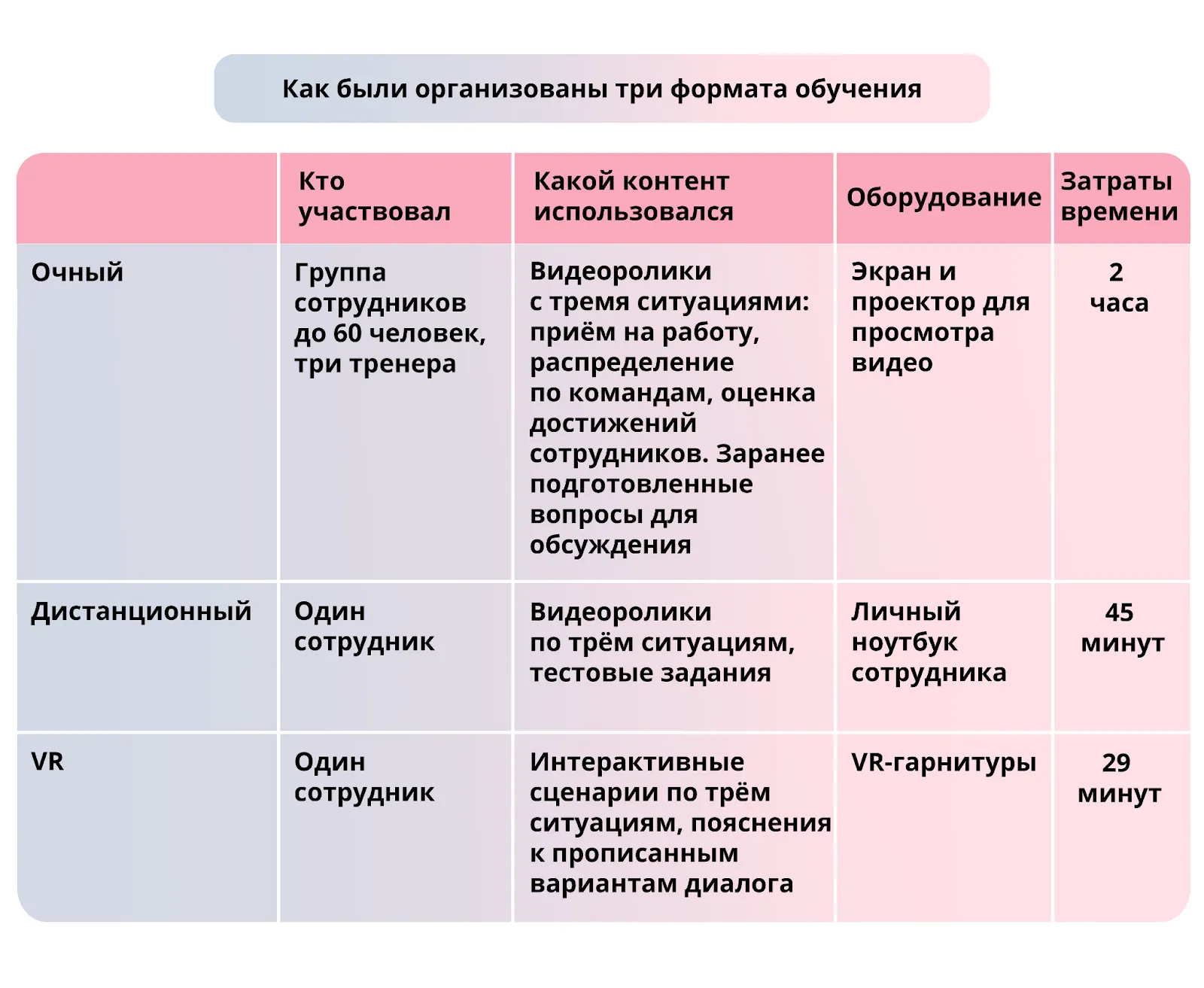
PwC specialists conducted a comparative analysis of three types of training and came to the following conclusions. Each type of learning has its own unique characteristics that impact the effectiveness of learning. It's important to remember that the choice of learning method depends on specific goals and objectives, as well as learner preferences. The study revealed that a combined approach, which combines elements of all three types, can deliver the best learning outcomes. This allows the process to be tailored to the needs of each individual learner and increases overall learning productivity. VR learning was four times faster than in-person learning and one and a half times faster than distance learning. VR technology increases learners' confidence in the knowledge they've acquired. Participants in the VR module's confidence in their ability to correctly apply equal opportunity principles in their work increased almost threefold. For other groups, it doubled. VR learning is more engaging. Participants in the VR module reported emotional engagement in the training 2.3 times more often than those who completed the distance learning course and 3.75 times more often than those who completed the in-person training.
The PwC study results do not answer the key question: how did the new training format affect knowledge acquisition? This information was not obtained. It turned out that study participants already had a good understanding of the topic before the training, and their knowledge level assessments before and after the course remained virtually unchanged. This underscores the need for a more in-depth analysis of the effectiveness of new training formats and their impact on actual material acquisition.
PwC specialists assessed the first experience of using virtual reality (VR) technologies for soft skills training as successful. Important aspects of interpersonal skills include self-confidence and emotional engagement. In this context, the VR module demonstrated advantages over traditional training formats, providing users with unique opportunities to practice and develop the necessary competencies.
The company answered affirmatively to both questions posed before the experiment: soft skills training in virtual reality (VR) proved more effective and cost-effective than other formats. However, the PwC study's authors do not recommend a complete switch to VR. The study's conclusion emphasizes the importance of combining all three training formats to achieve the best results. This allows for the benefits of each to be leveraged and the learning process to be tailored to employee needs.
Virtual reality is an excellent tool for dynamically mastering new material in a safe environment. It allows students to immerse themselves in the learning process and effectively apply their acquired knowledge in practice. E-learning, in turn, is becoming indispensable for learning software and during short training cycles. In-class training remains relevant when collaboration and group discussion are required. Thus, combining these teaching methods can significantly improve the effectiveness of the educational process.
VR in the Practice of Russian Companies
According to experts in the Russian AR/VR technology market in education, there has been a steady increase in demand for VR training formats aimed at developing soft skills over the past two to three years. This trend is particularly pronounced in sectors such as banking and retail, where employees need to regularly improve their customer interaction skills. The use of VR technologies in training can significantly increase the effectiveness of training and improve the quality of specialist training, which is especially relevant in a dynamically changing market.
At the AVRA Days business forum, Alexey Krylov, Head of Digital Training at the Perekrestok chain, presented one of the most significant Russian examples of introducing virtual reality (VR) into employee training. The virtual training was conducted for salespeople working in areas where customers cannot independently select a product and are forced to contact an employee. Sales success and customer satisfaction largely depend on the quality of communication between salespeople and customers. Using VR technology in training significantly improves the effectiveness of employee training, which in turn improves customer service and increases sales.
As part of a pilot VR training project, salespeople developed their communication skills using a dialogue simulator, interacting with virtual customers. To achieve high results, they had to properly greet the customer, consult with them, offer additional products, complete the purchase, and say goodbye. After implementing VR training in one hundred supermarkets, sales increased by 8.2% compared to stores using traditional training methods. This confirms the effectiveness of using virtual reality to enhance salespeople's skills and improve customer service.
The success of the pilot attracted the company's attention, and now, according to Alexey Krylov, all supermarkets in the chain have installed virtual reality headsets. These devices not only help train employees working behind the counter but also promote empathy skills in cashiers. Training is conducted in 360° video format using real actors, creating a more immersive and realistic learning experience. Incorporating virtual reality into the training process improves service quality and helps create a friendlier atmosphere for customers.
During its virtual reality experiments, Perekrestok successfully implemented this technology among employees of various age groups. Regardless of whether they are 20 or 60, everyone can successfully learn using a VR simulator, although older workers may initially be skeptical about this technology. Krylov noted that the key factor is the content of the training, and virtual reality serves only as a means of delivery. The use of VR in training helps increase engagement and information retention, making this approach relevant for modern educational processes.
In corporate training, virtual formats for developing soft skills are becoming increasingly popular. At the AVRA Days forum, Dmitry Kirillov, President of Modum Lab, shared his opinion on the reasons behind this trend. He noted that it's not just the appeal of new technology and the novelty factor. Virtual training solutions developed for companies like Perekrestok provide effective tools for developing important skills needed in modern business. The use of VR technology allows for the creation of an interactive and engaging environment where employees can practice and hone their skills in a safe environment, significantly improving the quality of training and its outcomes.
Virtual reality (VR) training demonstrates high engagement and effectiveness, making it attractive to organizations seeking to scale. Unlike traditional training, where each trainer interprets the material differently, VR simulators ensure consistency and standardization of information delivery methods. This allows all participants to gain the same level of knowledge and skills, which is especially important for large companies and educational institutions. Thus, the introduction of VR into training not only improves the quality of education but also optimizes training processes.
The benefits of virtual reality (VR) are becoming increasingly relevant in corporate training, according to Modum Lab. In particular, VR technologies are effectively used for onboarding new employees and conducting dialogue simulations, allowing them to practice communication skills with clients. Various solutions for public speaking training help improve employee confidence and proficiency. VR programs for executives, including training for conducting committees and meetings, also continue to develop. These areas highlight the importance of VR in modern corporate training, helping to improve employee efficiency and performance.
Modum Lab developed a VR simulator for Gazprom Neft, consisting of several modules designed to practice meeting skills. Participants are immersed in a virtual environment where they can interact with characters using voice. During the training, the program provides feedback, helping to improve communication skills. Initial tests showed that employees enjoyed the VR training and followed the development of the simulation with interest. However, to evaluate the effectiveness of this tool, its full implementation in the corporate environment will be necessary. VR simulators can be an important step in improving professional skills and enhancing teamwork.
Moscow Government University is presenting a series of VR simulators. Sergey Zhurikhin, the university's Vice Rector for Advanced Studies, shared information about these innovative solutions at the AVRA Days forum. These VR simulators are aimed at improving the educational process and enhancing the skills of specialists in various fields. They allow for the creation of realistic simulations, which significantly enhances student learning and practical skills. Similar to Perekrestok, the university uses two VR content formats: 3D simulations and 360° video. One of the most popular developments is a public speaking simulator. This tool allows for the customization of a virtual audience, creating an atmosphere in which they can distract the speaker. Furthermore, the trainer can remotely connect to the simulator so that virtual audiences can ask the speaker complex and unexpected questions, which helps improve public speaking skills and boost confidence. In recent years, there has been growing interest in innovative solutions for employee training, especially in institutions such as multifunctional centers (MFCs) and healthcare facilities. Simulators aimed at developing a customer- and patient-centered approach are one effective tool. For example, a wedding ceremony simulator, specially developed for civil registry office workers, allows them to practice complex situations in virtual reality. This training helps employees prepare in advance for potential conflicts, such as arguments between ex-partners during a real marriage ceremony. As a result, trained workers will be able to handle such situations with less stress and conduct ceremonies with confidence. The implementation of such simulators helps to improve the quality of service and improve interaction with clients.
Training and Development Manager
You will learn how to build corporate employee training programs and evaluate their effectiveness. You will be able to start a career in the HR department and implement a working personnel development system in the company.
Find out more