
Contents:
Why Beta Test
Beta testing provides a number of significant benefits for developers and users. Firstly, it allows you to identify errors and flaws in the product before its official release, which helps improve the quality of the final product. Secondly, beta testing provides an opportunity to receive feedback from real users, which helps understand how well the product meets the expectations and needs of the target audience. Furthermore, user participation in testing creates a sense of engagement and brand loyalty, which can positively impact its reputation. Furthermore, beta testing helps optimize functionality and interface, ultimately leading to an improved user experience. Thus, beta testing is an important development stage that contributes to the creation of a successful and in-demand product. Beta testing is an essential element of a customer-centric approach to educational program development. It is justified in cases where courses are created not simply to fulfill formal requirements, but to provide participants with truly useful and informative knowledge. Learners will feel more comfortable and confident knowing that the course was developed taking into account their opinions and wishes, as well as the opinions of their colleagues who face similar challenges in their work. This approach helps improve the quality of training and make it more targeted and effective.
In corporate training, the importance of customer-centricity is often overlooked, assuming that employees will attend training anyway. Our team understands that a customer-centric approach is relevant for both external client training and internal employee training. While we care about our clients, we must also pay attention to our employees. In addition, a client-centric approach directly impacts our work, increasing its value and volume.

You have developed a training program for clients their use of a specific product of your company. During testing, you determined the optimal content delivery formats, identified areas where more detail was needed, as well as areas with redundant information. The improved version of the program significantly reduces the workload and costs of technical support, as users can independently resolve most issues with just two clicks. A similar situation is observed with internal courses, which also require revision to increase the effectiveness of training. Beta testing gives the training department the opportunity to test their hypotheses and identify areas for improvement. This applies not only to specific courses, but to work processes in general. A pre-tested course requires fewer revisions in the future, which contributes to achieving high metrics from the outset—such as participant satisfaction and engagement. While these metrics are primarily important for the training department, they also serve as indicators of the quality of the department's work and the level of employee interest in the offered programs. Beta testing does not require significant time or extensive resources for preparation. Let's look at an example of how long this process takes, how it works, and what you can expect from its results. Beta testing allows you to identify product flaws at early stages, improve its functionality and enhance quality, which ultimately contributes to a successful market launch.

Reading is an integral part of our lives. It enriches our inner world, expands horizons and develops critical thinking. Immersing ourselves in books, articles, and other sources of information allows us to gain new knowledge and ideas. It's important to choose quality content to maximize its benefits. Regular reading also improves concentration and memory, and can also serve as an excellent way to relax and relieve stress. Don't miss the opportunity to enrich your experience by reading a variety of materials. Corporate training often faces the question of the effectiveness of using various metrics to evaluate results. One controversial aspect is so-called "vanity metrics," which, despite their criticism, can play an important role in employee training. These metrics, such as the number of courses completed, trainings completed, and certificates earned, can serve as indicators of participant engagement and motivation. Using vanity metrics not only allows you to track employee progress but also identify areas requiring additional attention. They create transparency in the learning process and foster a culture of continuous improvement. Metrics based on quantitative data can form the basis for further evaluation of the quality and relevance of training programs.
Furthermore, such metrics can contribute to increasing the competitiveness of the company. Employees, seeing their achievements, can feel greater confidence in their abilities and the desire to reach new heights. It is important to remember that vanity metrics should not replace more in-depth and qualitative assessments, but rather serve as a supplement to them.
Therefore, corporate training should not abandon the use of vanity metrics. These metrics can be an important tool in creating an effective learning environment that promotes employee development and the achievement of company goals.
Example of beta testing of a course
An example is the beta testing process of a course on Cloud.ru products, which I developed for company employees. This course is mandatory, and completing it as part of beta testing takes approximately two hours, and taking into account filling out questionnaires, about three hours. While the company already had existing product training programs, I created this course from scratch to consolidate all the information into a single, relevant, and comprehensive resource.
During the course development process, I conducted two stages of beta testing. The first stage was aimed at determining the optimal content format that would most effectively convey the program's content. Since the course contained a lot of technical aspects and theoretical information, it was important to determine which format would be most user-friendly for learners—video, slides, or long-form text. I developed three course prototypes, each representing one of the proposed formats. I then selected 30 employees and divided them into three groups, each of which completed the course in one of the proposed formats. As a result of the research, I concluded that the mixed format, combining long-form text and video, demonstrated the best results. This approach received more positive feedback and ensured better absorption of the material.
The second beta testing took place once the course was finalized. We joined forces with a colleague who was developing a short slide-based course on cybersecurity. Thus, during the testing process, we evaluated two courses: mine and hers. This allowed us to gain a more complete understanding of the quality of the materials and identify potential improvements for both programs.
In the second beta testing, I will cover the key aspects and features of the process. This stage is important for identifying shortcomings and improving product functionality. During testing, users will be able to evaluate the performance, interface, and stability of the application. We expect to receive valuable feedback that will help us make the necessary changes before the final release. Participants in the second beta testing will play a significant role in improving our product, and their opinions will be taken into account at all stages of development.
At the initial stage, it is necessary to carefully design the beta testing process, including the selection of participants and analysis of the results. For our project, we have defined the following framework, which will allow us to effectively organize testing and obtain valuable data for product improvement.
- Public announcement of participant recruitment and registration for beta testing. I will share the exact notification method later, but for now I will talk about the deadline and motivation. We gave employees four days to complete the application for participation, after which the form was closed. To further motivate our colleagues, we organized a giveaway for testers (branded power banks). Only those who completed at least one of the two courses could receive the prize.
- Two-week beta testing. Initially, we wanted to give employees ten days to complete the two courses, but we decided that this might not be enough time, since people would be testing them during work hours. So, we extended the test drive period to two weeks. After this time, access to the courses was automatically closed. Shortly before the end of the period, users received a reminder on the iSpring platform, where our courses were published, that access would soon be closed and asked to complete the training.
- Feedback collection during and after the courses. We offered participants detailed questionnaires to obtain as much information as possible.
- Analysis of results. We tracked not only direct feedback from testers but also additional metrics. For example, we monitored time spent metrics—how exactly people completed the course, where they lingered, and where, on the contrary, they completed it too quickly.
- A prize drawing among participants was held live, with winners chosen using a randomizer among those who completed one or both courses.
- Financing the courses and the final release.
My colleague and I created a shared plan document that is always available for reference.
The most challenging part of beta testing is formulating questions. They should be formulated to extract maximum information from testers and encourage them to share their thoughts and impressions. A simple "What do you think of the course?" won't produce the desired results. It's important to ask open-ended and focused questions that stimulate discussion and in-depth analysis. This will help obtain valuable feedback that will subsequently help improve the product.
In this case, the questionnaires included several key sections. Each of these sections was carefully designed to obtain the most accurate information possible. They covered various aspects, allowing for a deeper understanding of the topic under study and the identification of important trends. This approach ensured a comprehensive examination of the issues, which in turn facilitated better data analysis and informed decision-making.
- Usefulness — we measured NPS, the usefulness of the acquired knowledge, and its applicability to work.
- Interaction with the platform — questions about the technical aspects of the course. For example, was the information difficult or easy to digest, was the font too large (or, conversely, too small), and did the video work well.
- Interaction with the content — emotional and behavioral responses. For example, what feelings did a person have when they first opened the course and saw the first page?
- Knowledge check — was it difficult to pass the tests after the training, was there enough theory to cope with it well?
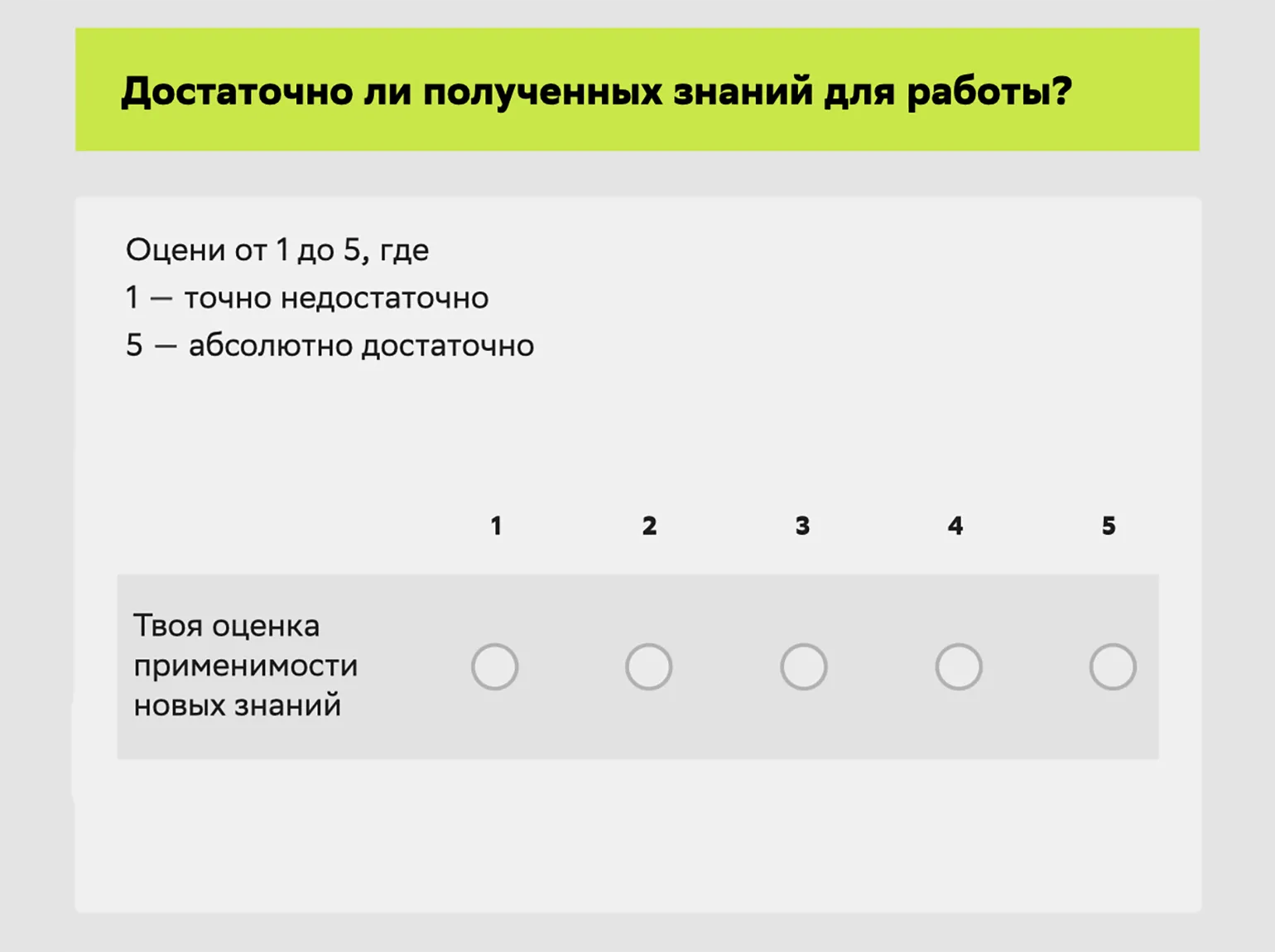
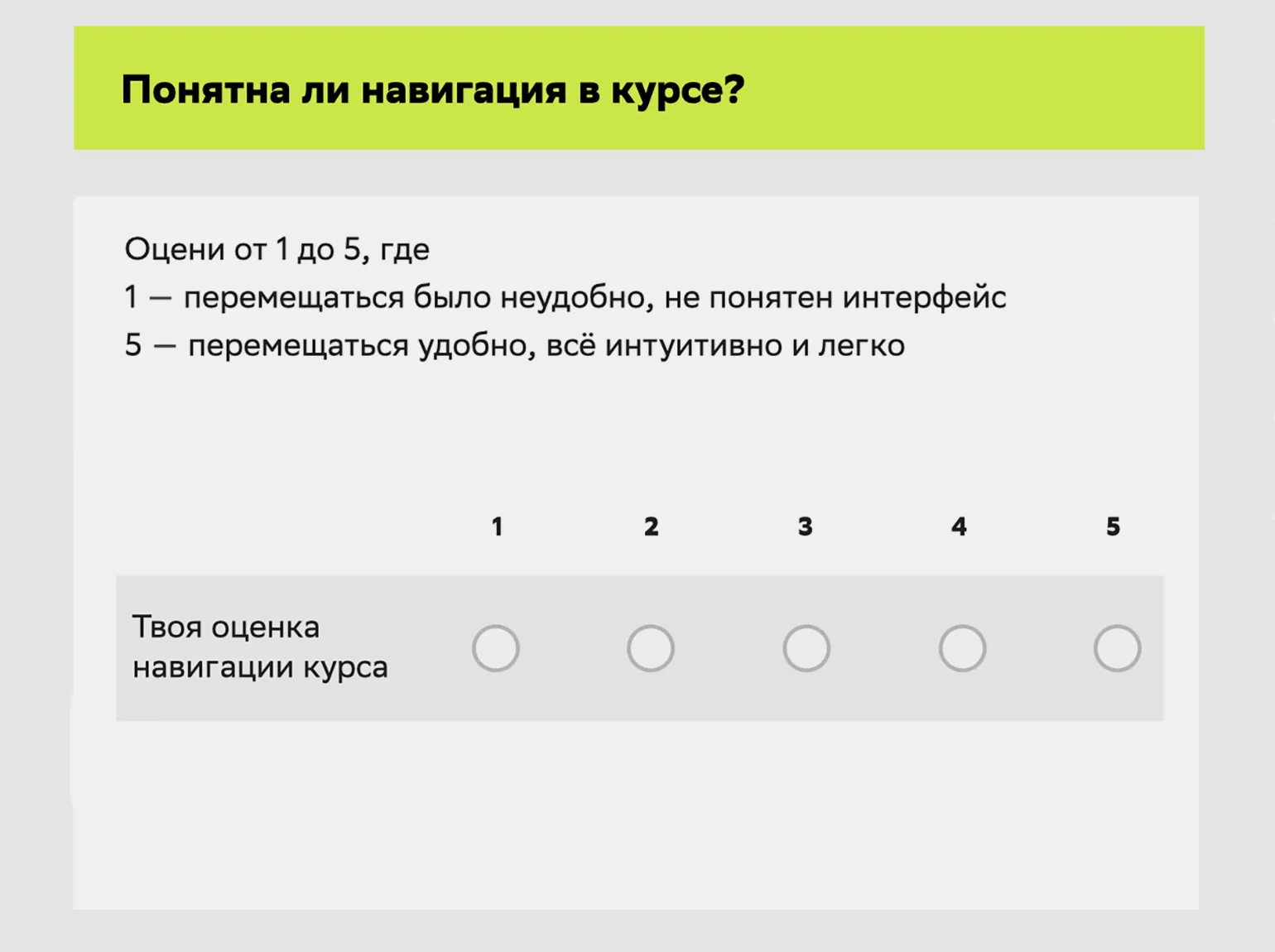
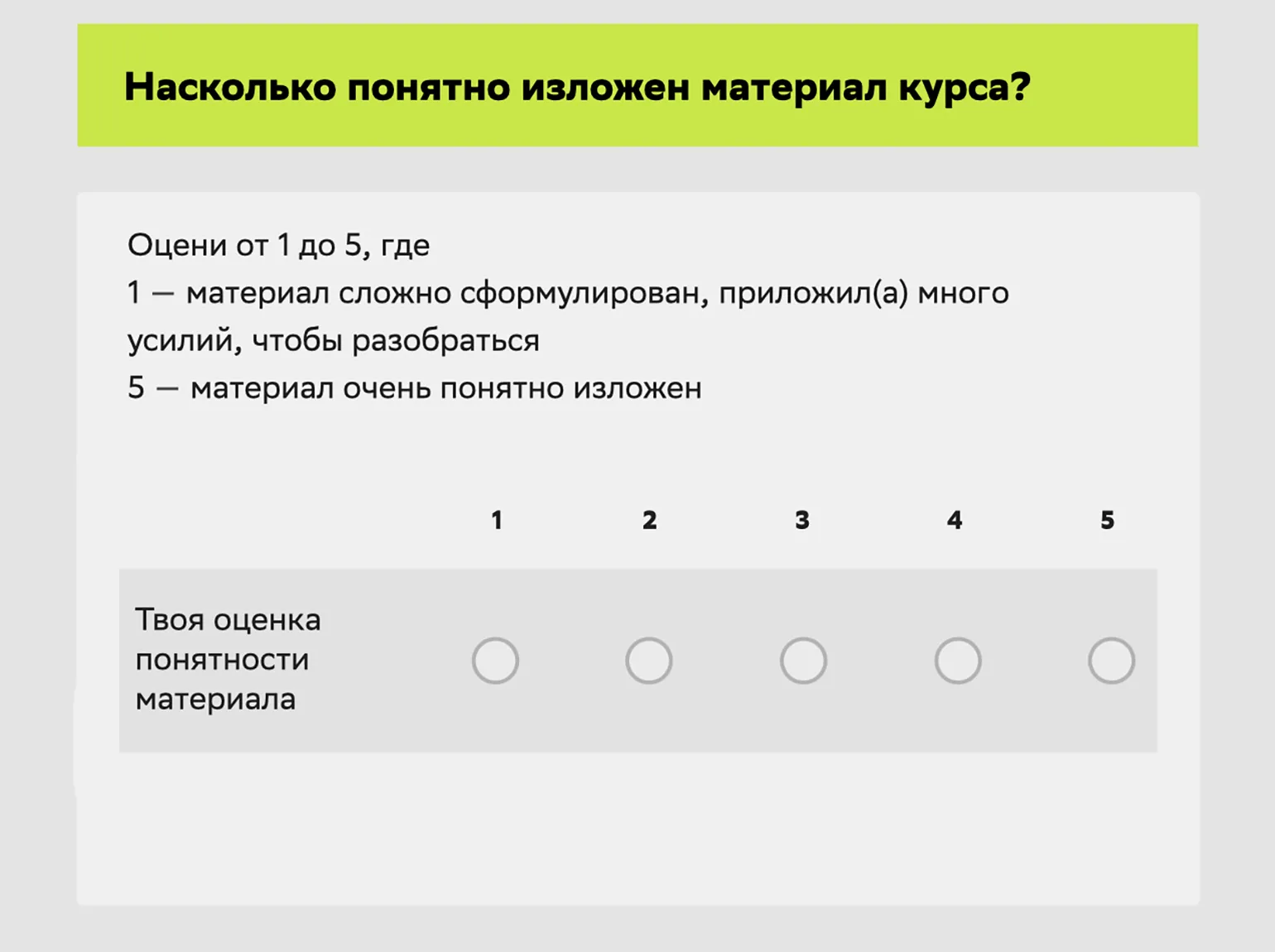
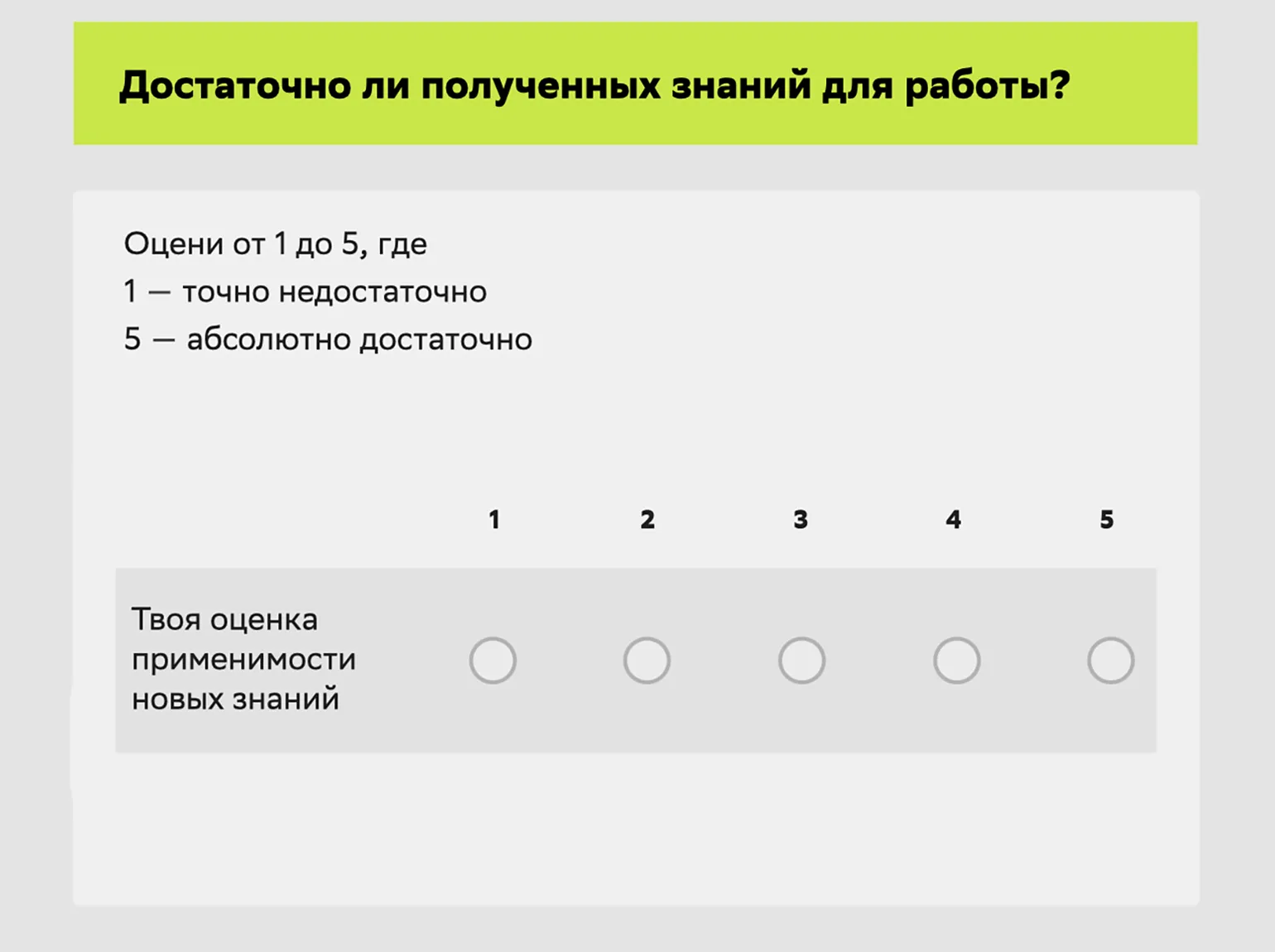

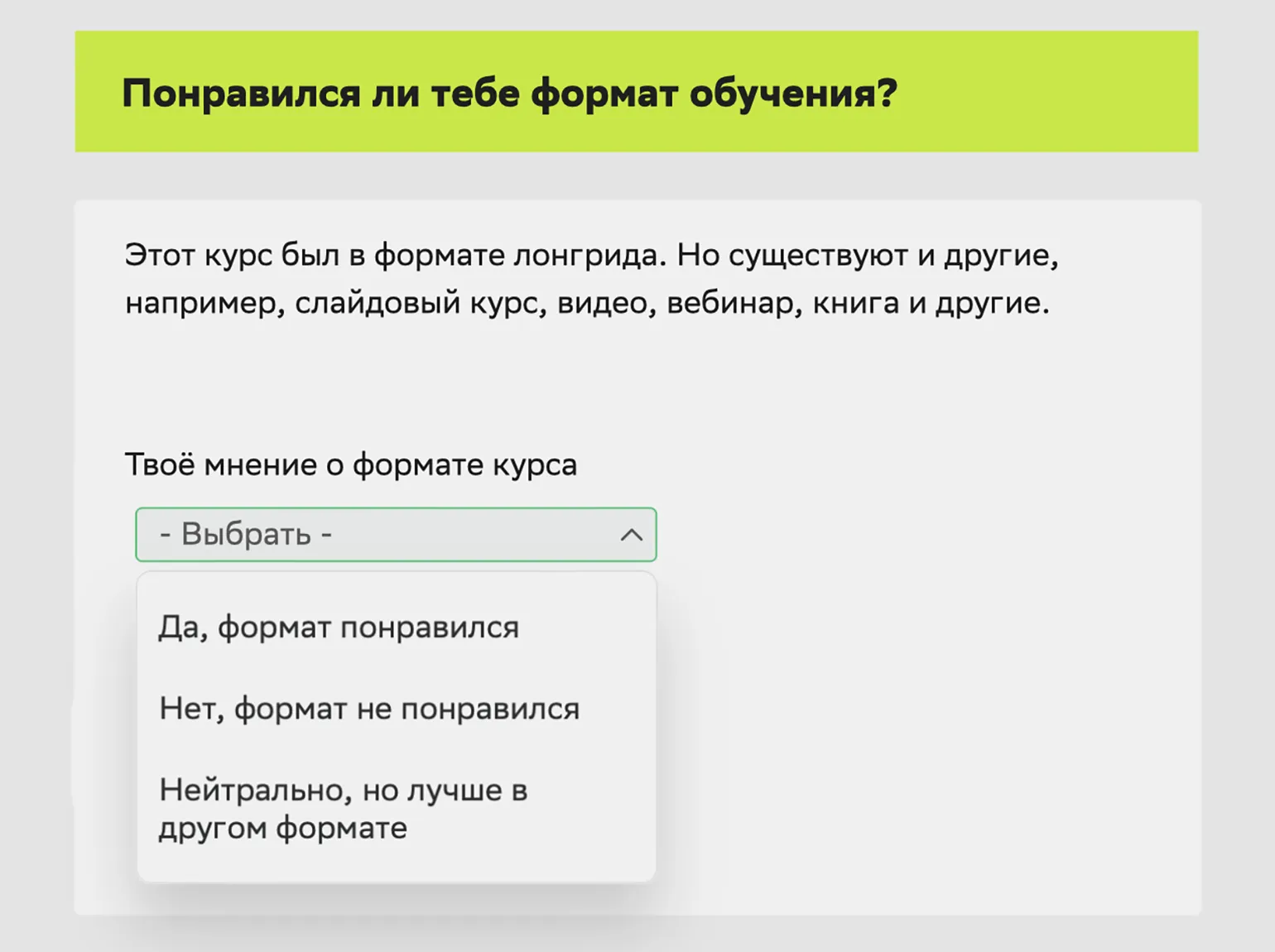
The questionnaires included both closed and open-ended questions. Special fields were also provided to allow employees to share their impressions in free form. This provides a more in-depth analysis of employee opinions and suggestions, which contributes to an improved internal atmosphere and increased staff satisfaction.
The product training course was organized into four sections, after each of which participants completed a survey on the iSpring platform. A final survey with overall impressions was required upon completion of the training. An internal survey service was used for this. This approach allowed us to effectively collect feedback and assess participant satisfaction.
After receiving feedback from three testers, I conducted individual interviews. I selected those who were clearly willing to share their thoughts and felt compelled to speak up—this is usually evident in their comments. We discussed their comments, and I asked clarifying questions as needed. For example, I asked them to compare our course with the one they took at the online school and find out what successful approaches, in their opinion, we should adapt.

Read also:
Improving a ready-made training course: analysis of real
Optimizing a course is an important process that can increase its effectiveness and relevance. In this context, we will look at a specific example to identify key aspects that can improve the educational material.
The first step in improving a course is analyzing student feedback. Their feedback helps identify weaknesses and areas that need improvement. It is important not only to take into account general comments but also to explore specific aspects that students found difficult.
The next step is to review the course content. The materials should be updated with relevant data and examples that reflect the latest trends in the field. This makes the course more engaging and useful for students and helps improve their knowledge.
Using a variety of teaching methods is also an important aspect. Including interactive elements such as tests, assignments, and group projects promotes deeper learning and maintains student interest.
Attention should also be paid to the structure of the course. A logical and consistent presentation of the material plays a key role in the perception of information. Students should clearly understand which section follows which and how they are interconnected.
Finally, improving a course is a process that requires regular analysis and updating. Implementing the acquired knowledge and recommendations allows us to create a more effective educational product that meets student needs and current market demands.
To attract beta testing participants, we secured support from employees in the internal communications and marketing departments in advance. This allowed us to effectively communicate this information to company employees. An announcement about recruiting those interested in participating in beta testing was posted on the corporate social media channel and also sent via newsletter. This approach ensured maximum audience reach and interest in the project.
In this message, we present information about our services and news. Our goal is to provide you with relevant updates and useful resources. We strive to make your interaction with us as convenient and productive as possible. We'd love to hear your opinions and suggestions.
- We briefly described the courses to be tested.
- We explained why this testing is important: it's important for us to take our colleagues' opinions into account and make learning comfortable and engaging for them.
- We promised to take all comments and feedback into account—meaning that test participants will definitely see the results of their work and become involved in an important project.
- We told them about the prize draw and explained the terms of participation.
During the beta courses, we notified participants in advance that there might be some bugs, errors, and technical difficulties, as this is not a final product. Testers were able to report such issues through the platform functionality where the course was hosted, and could also contact us directly using the contact information provided.
What We Learned from Beta Testing
The course development process, from concept to release, took approximately a month and a half. 130 people participated in the beta testing of the course on the company's products, of which 25 completed the training. The cybersecurity course attracted 101 participants, 41 of whom successfully completed the program.
The participation rate of the course participants was lower than expected. We initially did not set high goals and expected at least ten people to participate. It is worth noting that this course is experimental and represents testing of a "rough version", which may have affected the level of interest.
Two key factors also influenced the results. Firstly, during the testing process, the company was actively preparing for the launch of a major product, which distracted many teams. Secondly, some employees genuinely didn't have enough time to complete both courses. Some of them requested extended access to the training programs, returning a few weeks later and sending us separate files with detailed comments and feedback, as the feedback forms had already been closed.
Based on the analysis of survey results and interviews, my colleague and I made changes to our courses.
It's important to note that it's impossible to please everyone. If several people report feeling tired after seven minutes of a video, this is a clear sign that it needs to be shortened. However, if only one employee expresses this feeling, while others don't experience discomfort, this may indicate an individual perception. It's important to consider the group's opinions, but it's also important to remember that content perception can vary greatly among individuals.
After beta testing, I made several significant changes to my course on the company's products. These changes are aimed at improving the training and making it more effective. I adjusted the content, added new examples and practical tasks to help participants better absorb the material. The updated course structure is now more logically organized, which facilitates better comprehension of the information. I also took into account participant feedback, which allowed me to eliminate shortcomings and make the course more interactive and engaging. This allows students not only to gain theoretical knowledge but also to develop the practical skills necessary to successfully use the company's products.
- I made some changes to the structure. It turned out that not everyone understood the logic of the presentation, so some course blocks had to be rearranged and additional introductions added in places. Furthermore, based on tracking how people completed the course, I made the blocks more evenly distributed in duration and adjusted the workload for students – it was clear that at certain points they were slipping and simply becoming tired.
- I supplemented the course with new information. Not all terms and concepts that seemed familiar to employees turned out to be so. Beta testing revealed where clarification was needed. I supplemented a number of blocks with highly detailed examples for clarity.
- I included more infographics and illustrations to liven up the material a bit.
- I expanded the testing system – unexpectedly, I discovered that employees didn't have enough difficult questions in the tests, and in general, they wanted more questions. It was important for them to make sure that they truly understood the material and could move on with peace of mind.
All of this was made possible by the simultaneous use of multiple tools: feedback, platform analytics, and in-depth interviews. The rebuilt course was presented to a group of colleagues from different departments who did not have access to the draft version and were unaware of the new cohort of participants. After this additional verification, the official launch of the course was organized.
Tips for beta testing
To get the most out of beta testing, it is necessary to prepare thoroughly. Key recommendations based on my experience will help you organize the process effectively.
First, define the purpose of beta testing. A clear understanding of the tasks will allow you to focus on key aspects and get valuable feedback. Then, select the target audience for testing. It is important that the participants reflect the profile of your users and can provide constructive feedback.
Create clear instructions for testers explaining exactly what to do and what aspects of the product should be evaluated. This will help avoid misunderstandings and improve the quality of the information received.
Don't forget to create a system for collecting feedback. Convenient feedback tools will help you quickly analyze data and make necessary changes.
Finally, provide support to test participants. A quick response to their questions and problems will increase the level of satisfaction and the quality of the information collected.
Following these recommendations, you can make beta testing more productive and obtain useful results for the further development of your product.
- Carefully think through your questions. The most difficult thing is to get honest feedback. To do this, you will have to seriously work on the wording - so that the person really wants to share their thoughts and emotions, and thoughtfully answer. Combine closed and open-ended questions, and be sure to leave room for comments.
- Provide multiple communication channels. Give participants more ways to contact you, not just through a survey—sometimes it's easier for people to PM you on a corporate social network and report a bug or technical issue directly.
- Convey the importance of beta testing. Employees should understand why they're participating in course testing. It's a good idea to remind them that they'll be helping not just you personally, but dozens, hundreds, or even thousands of other people (depending, of course, on the size of the audience and the company)—because the opinions of beta test participants will help make the training better, more effective, and more convenient for everyone.
- Motivate participation. Gifts, corporate badges, achievements, ratings—whatever you can, the main thing is to implement a system of additional motivation. Let's face it: enthusiasm alone won't get you very far; people don't want to waste their time, even if they know it will be beneficial.
- Choose the right time for beta testing. If employees are working on a huge project in a short timeframe, they're unlikely to write detailed comments and take on additional workload. Of course, there will always be workload, but it's best to choose the most convenient and stress-free time slot for everyone.
The main rule of beta testing is having a specific goal. Simply stating that a course is excellent isn't a goal in itself. What other goals might be used for beta testing? For example, it's important to determine whether learners' behavior has changed or whether they perform certain actions. The stated goal determines the choice of tools for collecting and analyzing feedback, as well as the approach to interpreting the feedback received. A clear goal allows you not only to more accurately evaluate the effectiveness of the course, but also to make the necessary improvements based on the data obtained.
The profession of Methodologist from scratch to PRO
You will improve your skills in developing curricula for online and offline courses. Master modern teaching practices, structure your experience, and become a more sought-after specialist.
Find out more