
Contents:

Daria Kalnitskaya holds the position of Head of Department at Oleg Zamyshlyaev's Workshop. In her role, she is responsible for strategic development and project management, which contributes to the successful implementation of the company's creative and business initiatives. Thanks to her experience and professionalism, Oleg Zamyshlyaev’s Workshop continues to strengthen its position in the market and expand its range of services.

Maria Sviridova is a specialist in the field of training program development at Oleg Zamyshlyaev’s Workshop. She creates effective educational courses aimed at developing skills and competencies. Maria uses modern teaching methods and technologies, which enables her to achieve high results. Her work focuses on an individual approach to each student, making her programs as useful and relevant as possible for participants. Oleg Zamyshlyaev's Workshop offers professional skills development services for employees and managers through in-person, blended, and distance learning formats. We help our clients reach new career heights and improve their performance. Subscribe to our Telegram channel, Future Learning, to stay up-to-date on current trends and new learning opportunities. This article is based on the webinar "Development Marathons and Blended Learning." The webinar covers key aspects of organizing marathons aimed at personal and professional development. The focus is on blended learning, which combines online and offline formats. This allows participants to approach their learning flexibly, adapting it to their needs. Development marathons are becoming increasingly popular due to their effectiveness and the opportunity to interact with experts. Participants gain valuable knowledge and skills that can be applied in various areas of life. The webinar offers practical tips for creating successful programs and organizing interaction between participants.
In this article, you will become familiar with the key aspects of the topic. We will look in detail at the main concepts, their application and impact on various areas. You will receive useful tips and recommendations that will help you better understand the subject of discussion and effectively use the knowledge gained. Read on to expand your horizons and deepen your understanding of the topic.
- What is a development marathon and what are its benefits;
- What does this training model look like;
- In what situations is a development marathon useful;
- What training formats are effective at different stages of the marathon;
- What problems may arise and how to solve them;
- How to develop a development marathon (detailed checklist).
Corporate training is aimed at changing employee behavior in order to achieve the company's strategic goals. However, this process can be more complex than expected. Learners often encounter various barriers, manifesting in certain thoughts and doubts. These obstacles can hinder the full absorption of information and the practical application of skills. It's important to understand that successful corporate training requires not only high-quality content but also support from management and the creation of a positive learning environment. Understanding and overcoming these barriers is a key step to effective employee development and, as a result, achieving business goals.
- "I don't understand why I need this training, I'm just wasting my time."
- "Everything seems clear, but I don't know what exactly to do."
- "We only train in the 'classroom,' but in reality everything is different."
- "No one monitors whether we use new tools or not."
- "There is no feedback on whether we are using new knowledge and skills correctly."
- "The theory doesn't fit into reality, but no one discusses it."
- "Everyone around me is doing it the old way, I'm the only one like a black sheep."
Overcoming all these obstacles is possible thanks to the development marathon format. This approach promotes effective learning and allows participants to delve deeper into the topics being studied, overcoming difficulties at every stage. The Development Marathon creates conditions for continuous growth and self-improvement, making it the ideal tool for achieving goals.
What is the Development Marathon?
The Development Marathon is a comprehensive educational program that combines various training formats, both online and offline. The marathon lasts up to two months and is open to an unlimited number of participants. This program is aimed at the comprehensive development of skills and knowledge, providing each participant with the opportunity to immerse themselves in a variety of topics and training formats.
The marathon is an effective tool for solving the company's current problems. It is ideal in situations where it is necessary to change employee behavior and teach them new knowledge and skills, especially in the context of launching new organizational processes or products. A systematic approach and deep immersion in the topic ensure stable and sustainable results, making the marathon a valuable resource for team development and improving overall business performance.
The effectiveness of development marathons is determined by a number of key features. Firstly, they provide a structured approach to learning, allowing participants to consistently master new skills and knowledge. Secondly, marathons foster a community of like-minded individuals, which increases motivation and engagement. Thirdly, the intensive format of such events allows participants to quickly apply their acquired knowledge in practice, significantly accelerating the learning process. Furthermore, regular feedback from experts helps tailor the learning process to each participant's individual needs, making the marathons more personalized and effective. As a result, development marathons become a powerful tool for achieving personal and professional goals.
- Engaging format. This is a long-term program, so participants should be interested throughout the marathon. For engagement, you can use, for example, case studies from top company executives, media channels, and the participation of industry stars.
- Variety of training formats. This is necessary for better development of specific skills: those that are ideally suited to the specific content and schedule of participants are selected from an extensive library of formats. In addition, the choice of format can be given to the participants themselves. Some people prefer listening, others - watching or reading.
- Portioned workload. For better assimilation, information is divided into thematic modules, which are designed, among other things, taking into account the current workload of the participants.
- Integration of training with real-world tasks. Participants not only gain new knowledge, but also immediately learn to apply it in their work tasks.
- Live support. Regular feedback with students is organized during the internship. Participants' actions are adjusted on the fly.
- Program adaptability. The key objective is to tailor the training to the needs of the participants and the results they desire. Therefore, the marathon team can adjust the program based on student feedback.
- Community building. The program is designed to encourage active communication between participants before, during, and after the marathon. They see that others around them are also striving for development and can always consult with each other or discuss relevant topics.
- Development of self-learning organizations. Internal tutors and experts can be brought in to run the marathon; they know how to adapt the theory to the realities of a specific company. Moreover, the extended learning format develops not only the target skill but also the habit of learning in participants.
What does the learning model look like in the development marathon format?
At Oleg Zamyshlyaev's Workshop, we have adapted Kolb's four-stage learning cycle for the development marathon. This method is widely known among professionals involved in educational program development. We strive to create an effective learning environment that promotes deep understanding and application of knowledge. Our adaptation of Kolb's cycle will allow marathon participants to go through all stages of learning: from concrete experience to reflection, theorizing, and active experimentation. This will ensure the comprehensive development of the skills and knowledge necessary for the successful achievement of personal and professional goals.
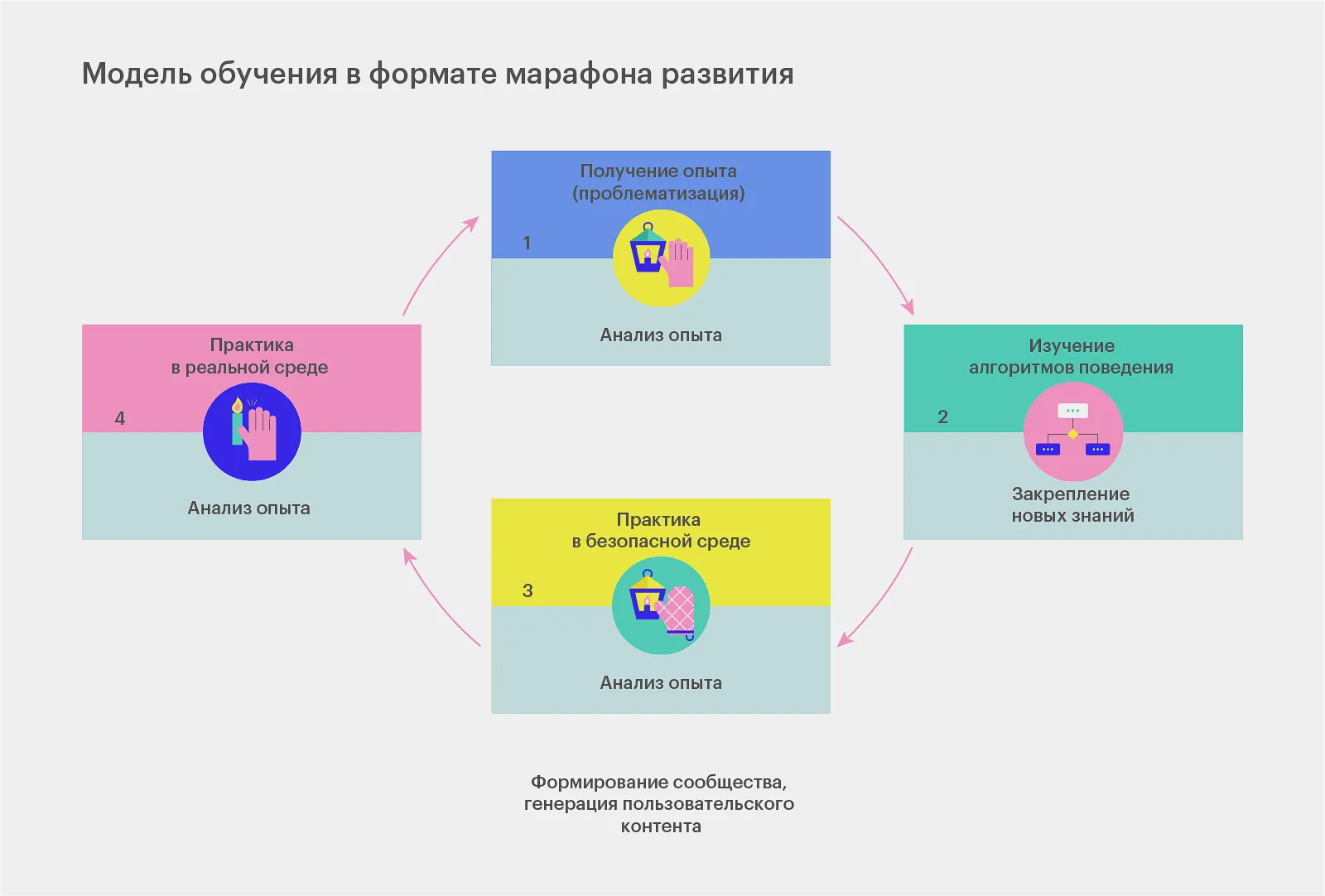
The marathon model, like the original theory, consists of four successive stages.
Organizing a marathon requires careful preparation and a well-thought-out strategy. The main steps include choosing a suitable date and location, as well as determining the route. It's important to consider the participants' characteristics, skill levels, and interests. Event promotion plays a key role, so it's worth using social media and specialized platforms to attract participants. Safety should also be ensured by providing medical assistance and monitoring for participants throughout the marathon. Finally, it's worth considering awards and certificates for participants, which will serve as an additional incentive for participation. Properly organizing a marathon will not only create a positive experience for participants but will also increase interest in future events.
This example successfully integrates synchronous and asynchronous learning formats. Meetings can be held both online and offline, allowing for a flexible approach to organizing the learning process. This approach promotes maximum participant engagement and effective learning.
The opening session is a crucial stage of any training. It allows you to gather participants and explain the significance of the upcoming process. The presence of a senior executive or expert at this session can significantly increase the interest and motivation of participants. They can share their stories and highlight the relevance of the knowledge to be presented. If the training program includes various levels of immersion, this is also an excellent time for participants to choose the format that best suits them. A well-organized opening session lays the foundation for successful learning and engagement for all participants.
After the introductory session, we begin the theoretical part, divided into modules covering various topics and competencies. Marathon participants access theoretical materials through an external or internal LMS. This allows us to focus meetings on practical exercises and group discussions, which facilitates deeper assimilation of the material and skill development.
After studying the theoretical foundations, the practical application of knowledge begins in a safe environment. Participants practice by completing various exercises and receive feedback from a tutor or partner, which promotes a deeper understanding of the material and improves skills.
This is followed by practical training in a real-world setting. As participants begin to apply new knowledge to their work tasks, they may have questions or difficulties. It is important to organize a meeting or chat discussion where participants can share experiences and resolve any issues that arise. It is recommended to hold such discussions after the completion of each module to consolidate the material and improve the effectiveness of learning. This stage is key to the successful acquisition of new skills and is marked with a flag in the diagram.
When studying each new topic, it is recommended to include practical tasks to consolidate the material. For example, if the goal is to develop communication skills, it is advisable to offer an assignment in which participants work in pairs and exchange feedback. This not only promotes better assimilation of information but also develops interaction skills, which are a key aspect of effective communication.
At the end of the marathon, the final session becomes a key moment. It plays an important emotional role, allowing participants to understand their path and the results achieved. In addition, this session contributes to the collection of user experience: we receive feedback and ideas, identify what worked and what did not, and analyze and structure this information. This helps not only improve future events but also create more effective strategies for participants.
One of the key elements of the marathon is the media channel. This is a chat where participants can communicate and ask questions throughout the program. Effective collaboration in this media channel improves communication within the group and fosters community. Having a common platform is especially important for learners who work in teams and share experiences and results at the end of the week. Creating such a space helps participants not only receive support but also be inspired by each other's successes.
The importance of the tutor's role must be taken into account. The tutor supports participants throughout the internship, providing feedback and acting as a moderator in sessions. They also inform participants via chat, share news, and organize quizzes and trivia. The tutor must be aware of what is happening in order to provide timely assistance, answer questions, and ensure a comfortable learning environment.
When is a Development Marathon effective?
>A Development Marathon is an effective tool for enhancing emotional intelligence and systems thinking. These skills are critical for managers and employees, as they promote a deeper understanding of the impact of decisions on the company's overall performance. By developing emotional intelligence, marathon participants learn to better manage their emotions and interact with colleagues, which contributes to a more productive work environment. Systems thinking allows them to see the interconnections between various aspects of the business, which helps make more informed and strategic decisions. Participation in a Development Marathon contributes not only to personal growth but also to the overall effectiveness of the organization.
This training format becomes especially important in situations where employees have diverse skill levels, or when the company has many newcomers. It is also necessary during periods of significant business change, when the acquisition of new skills, including change management, is required. This approach to training allows for the effective adaptation of staff to new conditions and requirements, enhancing the company's overall competitiveness.
If some employees have completed expensive external training, a development marathon will be an effective tool for transferring acquired knowledge and skills to the rest of the team. This program not only facilitates the exchange of experience but also significantly increases employee motivation and loyalty to the company. By investing in the development of its team, the organization strengthens the corporate culture and creates the conditions for further growth and success.
A development marathon is an effective tool for communicating key values to employees, implementing specific behavioral models, and increasing their engagement in the company's continuous improvement process. It fosters a proactive attitude among employees, which is especially important in a rapidly changing market. The marathon is also ideal for onboarding new employees, helping them quickly integrate into the corporate culture. Furthermore, it promotes improved cross-functional collaboration, which in turn impacts overall productivity and team effectiveness. Implementing a development marathon helps create a more cohesive team focused on achieving common goals and innovative development.
A development marathon is an effective tool for assessing employee potential, allowing you to observe their behavior in various tasks. Participation in the program will show whether employees will be able to complete it, as well as at what pace and with what level of engagement they will work. This will help identify the strengths and weaknesses of each participant, which in turn contributes to a more accurate analysis of their professional qualities and opportunities for further development.
Which training formats are especially effective in a development marathon
Development marathons are characterized by the use of various training formats, which significantly increases their effectiveness. Let's consider several formats that, according to our experience, provide the best results.
This method helps participants identify and understand their starting position. As part of the change management program, we asked participants to complete a questionnaire about barriers to change. We provided basic questions that participants adapted to their specific situations and developed a plan for analyzing the results. The trainees, who were company executives, conducted research, comparing employee responses with their own opinions. This allowed them to identify gaps, identify successes, and identify weaknesses requiring attention. This approach fosters a deeper understanding of current challenges and the development of effective strategies for overcoming them.
Research can be the final stage of training. The marathon is a long-term program that significantly influences the behavior of participants. The final results of the research will allow them to evaluate their successes and demonstrate the results they achieved during the program.
Pre-recorded interviews or in-studio meetings with guests are an effective learning tool. In such events, trainees can ask questions and receive answers from respected leaders or internal experts. Getting to know the participants creates an atmosphere of trust and engagement, which contributes to the successful implementation of the program. These formats help strengthen team bonds and increase interest in learning.
The expert shares valuable experience, including mistakes, problems, and advice that will be useful to participants. To more effectively present the material, we prepare a list of specific questions in advance that the speaker can answer within 20-30 minutes. This allows for a deeper understanding of the topic and a more productive discussion.
We conduct a preliminary analysis of typical training situations in a specific organization. Training on real-life cases is significantly more effective than on abstract scenarios. Participants understand their difficulties while being in a safe environment. This allows them to look at the problem from a different perspective and propose solutions that might otherwise go unnoticed or undeveloped in real-world circumstances. This approach not only promotes a deeper understanding of the material but also increases the likelihood of applying the acquired knowledge in practice.
In our practice, we once suggested to the head of one of our company's projects that he involve participants in a change management marathon. He agreed and, as a result, received positive feedback on the trainees' contribution. Participants analyzed the project, identified its weaknesses, and presented their recommendations. Ultimately, this assignment brought significant benefits to the business, improving its results and enhancing the team's performance. Involving specialists in such projects can be an important step toward successful change management and organizational development.
During a marathon dedicated to developing management skills, an important practical assignment can be conducting a real meeting. Equally important is the documented results of the assignment—for example, checklists completed by other participants or a video recording. By reviewing these materials with the tutor, the participant will have the opportunity to evaluate their achievements, identify areas requiring further development, and plan next steps to improve their effectiveness. This approach ensures not only the practical application of skills but also an in-depth understanding of management processes.
What are the most common problems and how to avoid them?
The marathon format for personal and skill development has many advantages, but, like any training, it can face certain difficulties. It is important to recognize these problems in advance and be prepared to overcome them. We will consider five common difficulties that marathon participants may face and offer effective strategies for overcoming them.
When planning a long, high-intensity marathon, it is important to consider the participants' time, as lack of time negatively affects their ability to complete the event. Effective organization and time management can significantly increase the completion rate and ensure successful participation.
If company management is unable to quickly redistribute the workload, it makes sense to organize a series of short marathons with breaks. You can also offer different levels of immersion so that participants can choose the intensity that suits them. This will allow for effective time management and increase employee engagement. This approach helps optimize the workflow and improve team dynamics.
Assessing participants' time resources is a key step in creating an effective training program that won't be overloaded with unnecessary tools and methods. For example, before one of our marathons aimed at improving work processes, we discovered that employees were significantly overloaded and would not be able to allocate sufficient time for training. As a result, we decided to start the program not with employees, but with their managers, training them in a specific skill: conducting meetings to plan improvements to work processes. We developed a detailed scenario for such a meeting and tested it with the managers. Afterwards, the manager held a meeting with his team, and we provided support throughout the process. This approach enabled the efficient use of time and resources, as well as increased employee engagement in improving work processes.
As a result, employees had to dedicate time exclusively to these meetings. However, such meetings contribute to the development of a culture of continuous improvement within the company. Effective interaction at such events enables the implementation of new ideas and improvements to work processes, which ultimately has a positive impact on the overall productivity and competitiveness of the organization.
Before offering participants a tool for delivering content or completing tasks, it is necessary to assess their level of proficiency with it. Before the pandemic and the transition to remote work, even such common platforms as Zoom were not used by some companies and presented difficulties for users. The effectiveness of using new technologies directly depends on the participants' readiness to master them. Therefore, it is important to conduct an analysis of user skills in advance and offer appropriate support in mastering the tools.
It is optimal to use an alternative platform that is convenient and familiar to all participants. However, if the required functions are only available in a specific tool, it is important to allocate time before the marathon for introductory training. This training requires installing the program with participants, demonstrating its functionality, and providing technical support. This approach will ensure comfortable and effective use of the tool during the event.
In this case, feedback for students will be formal and will not provide a clear understanding of what is being done successfully and what needs improvement. Effective feedback plays a key role in the learning process, as it helps identify strengths and weaknesses and facilitates the improvement of skills and knowledge. Without constructive feedback, students risk not understanding their successes and shortcomings, which can negatively impact their future development.
The optimal tutor workload is determined by their responsibilities both within and outside the marathon, especially if they are an internal tutor. It is recommended that tutors devote at least one hour per week to each participant. Therefore, one tutor should be assigned no more than 20 participants. If the number of participants is significantly larger—hundreds or even a thousand—it makes sense to divide them into teams and assign a separate tutor to each team. This will ensure more effective and high-quality interaction and increase the level of support for participants.
If engaging external tutors is not possible, it is recommended to turn to internal experts, such as the education department and management. It is important to standardize the tutors' work and clearly formulate common requirements for assessing participant work. This will help improve the quality of training and ensure a unified approach to the mentoring process.
Mentoring among participants is an effective way to support and learn. Participants can act as tutors for each other, sharing their experiences, listening, and helping to solve emerging problems. Organizing general meetings provides an excellent opportunity to discuss personal achievements and receive feedback. Such meetings help create a community where everyone can contribute to the development of others and improve the overall level of knowledge.
During one of the marathons, we decided to divide the participants into teams so that each group could focus on developing its own project. However, we encountered difficulties already at the captain selection stage—participants remained silent and showed no initiative.
Don't expect team members to self-organize. If a team has a tutor, their job is to actively encourage participants to take action. This includes setting clear deadlines, providing preliminary ratings, and generally creating a motivating atmosphere to accelerate the work process. Effective leadership and support help teams achieve better results and increase overall productivity.
When 50 people are present at an event, and only five are actively chatting, it's important to encourage interaction among all participants. Effective ways to do this include rewarding activity, asking provocative questions that encourage discussion, and creating two opposing camps of opinion and then merging them. These methods will help increase audience engagement and make communication more dynamic and productive.
One of our clients wanted to identify potential top managers through a marathon. We proposed a case championship, which proved an effective tool for achieving this goal. The company's management provided real-life situations they had encountered in their work, and based on these stories, we developed an engaging and challenging case. Participants were tasked with dividing into cross-functional teams to solve it. This solution proved successful: it generated excitement, as the task was complex and required collecting information piecemeal from representatives of various departments and actively collaborating with each other. This approach not only helped to identify leadership qualities but also strengthened team spirit among the participants.
Creativity plays a key role in attracting participants to the program. An effective PR campaign can generate interest and increase awareness of the event. Introducing ratings, using game metaphors, and innovative formats, such as online tours of production facilities, can significantly increase audience engagement. These methods help create a unique experience, which in turn encourages participants to actively participate in the program.
Read also:
- Where Corporate Training Is Headed
- How to Design Corporate Training Programs
- When Hiring and Retraining Is Better Than Looking for a Ready-Made Professional
- Andragogy: Why Adults Need to Be Taught Differently Than Children