Table of Contents:
How AI-powered chatbots will impact the learning experience
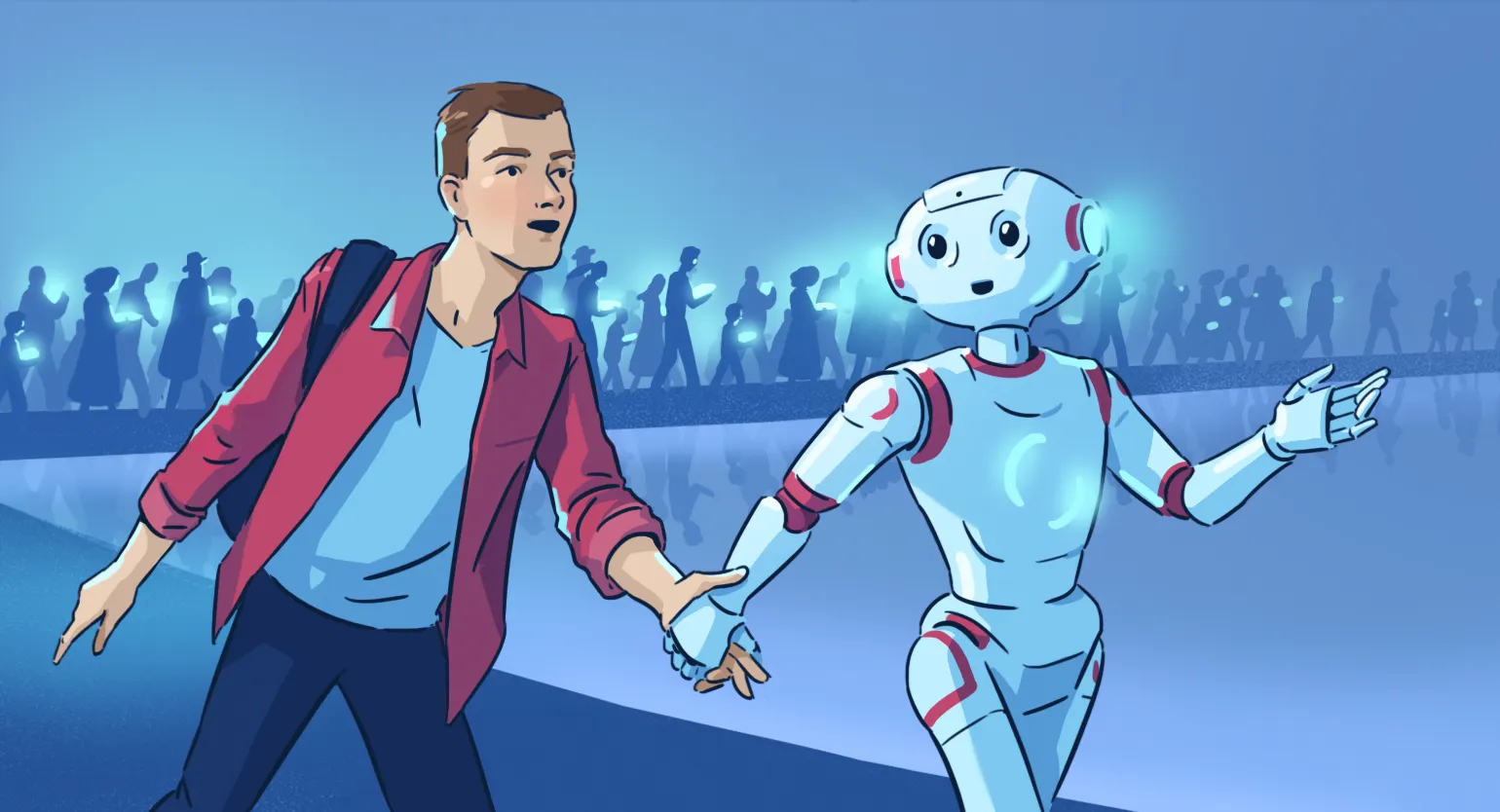
Generative neural networks have a unique ability to interact with users, which opens new horizons for corporate Training. Markus Bernhardt emphasizes that chatbots, as the primary interface for communication, will fundamentally change approaches to training in companies. Firstly, chatbots provide instant responses to queries, making them indispensable assistants in the training process. Secondly, they can present information in a more accessible and understandable form compared to standard search engines. This means users don't have to search for the necessary data themselves—an intelligent chatbot will automatically find and offer the necessary information. Using such technologies in corporate training can increase efficiency and improve the quality of learning. In the future, chatbots will be able to act as virtual assistants, providing the ability to explain various topics, conduct Socratic dialogues, and even act as opponents in debates. This will create conditions for training based on real work scenarios and cases, allowing people to practice in authentic situations without significant costs. This approach will ensure a deeper understanding of the material and improve user skills in a realistic environment.
In the long term, personal AI-powered tutors can significantly improve the learning process by using memorization techniques, spaced repetition, and topic rotation. Like human tutors, such systems are able to deeply understand each student's journey, track their progress, and consider long-term goals. AI retains information if it has access to previous lessons and user interaction history. Furthermore, AI-powered dialogue tools provide instant feedback and create a variety of interaction scenarios, encouraging regular practice and deepening learning.
The expert supports his thesis with an example: imagine a bot capable of simulating complex work processes, such as a meeting in which senior managers seek to reach a compromise on a pressing issue. In real life, only a few employees might witness such meetings. However, with a bot that can impersonate all participants, everyone has the opportunity to explore new challenges and decision-making processes in a safe environment. This opens new horizons for learning and skill development, allowing for a better understanding of team dynamics and approaches to solving complex problems.
Modern chatbots have advanced capabilities that go beyond simple textual communication. They can recognize and generate images in response to specific queries, opening up new horizons for learning. Learners can receive educational materials and feedback in a more interactive and visual form. This makes the learning process more engaging and effective, allowing content to be tailored to the individual needs of each student.
Chatbots continue to evolve, mastering human speech recognition and voice interaction with users, making learning more natural and intuitive. According to Markus Bernhardt, in the future, technology may reach a level where bots will be able to recognize and interpret human behavioral characteristics, such as facial expressions and body language. This will create the possibility of deeper and more meaningful communication between artificial intelligence and users, blurring the boundaries between the digital and physical worlds.
Markus Bernhardt describes the results of interaction with educational bots, emphasizing that, ideally, students should receive results from interactions with a bot teacher that are consistent with modern research in the field of learning and multimedia education. With the proper application of learning principles, along with a variety of content elements and delivery channels, it is possible to ensure the required level of complexity of the learning process, as well as meet the requirements for cognitive and emotional engagement. Additionally, by interacting with large numbers of students, AI-based systems can provide valuable data on student learning and progress, which can significantly improve the quality of the educational experience.
How AI Will Make Simulation an Accessible Tool
The article's author emphasizes that chatbots can significantly improve games and simulations. They provide training departments with new opportunities to develop training programs covering both hard-core skills and more flexible ones, such as leadership, problem-solving, and conflict resolution. While such opportunities already exist, the development of artificial intelligence will expand them even further. Creating games and simulations will become less expensive in both time and money, thanks to more accessible technologies. This opens up new horizons for training and development, making the process more effective and engaging.
As a result, L&D will be able to develop and visualize scenarios that significantly improve the training process and bring it closer to real-life situations. These scenarios can range from trying to calm a disgruntled customer to performing potentially dangerous tasks. A unifying element will be the opportunity for repeated repetition and the availability of various problem-solving options, allowing learners to develop skills and confidence in their actions. Applying multimedia learning principles to simulations significantly improves the educational process. This is achieved by aligning the learning material with visuals, providing immediate feedback, and creating an engaging learning experience. Furthermore, such simulations allow learners to practice in a safe environment, which promotes deeper acquisition of knowledge and skills. Markus Bernhardt emphasizes the importance of these aspects for effective learning. The next stage in the development of educational technologies will be the creation of immersive experiences that provide complete immersion in the learning process. This will be achieved using augmented reality (AR), virtual reality (VR), and innovative projects such as metaverses. These approaches will enable students to interact with the learning material on a new level, making learning more engaging and effective.
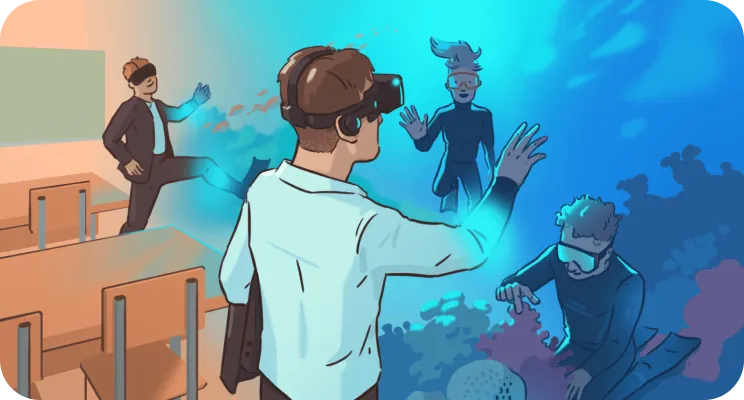
Designing collaborative learning in metaverses requires a careful approach and consideration of many factors. Metaverses offer unique opportunities for the educational process, enabling the creation of interactive and immersive learning environments. It is important to define learning goals and objectives, as well as select appropriate platforms and tools for implementation.
It is necessary to pay attention to the interaction of participants, creating an environment for active communication and collaboration. The use of gamification can increase motivation and engagement of learners. It is also worth considering the possibility of integrating various content formats: videos, 3D models, simulations, and virtual tours.
The key is to ensure accessibility and convenience for all participants, including taking into account different levels of training and technical skills. It is also important to provide feedback mechanisms so that participants can assess their progress and receive support.
Designing collaborative learning in metaverses opens new horizons for education, allowing for the creation of unique and adaptive learning spaces that meet modern needs and learner expectations.
What does the future hold for L&D?
Markus Bernhardt predicts that content will cease to be the "king of learning," and learning experiences will take its place. This transition has already begun, and in the future, education providers will be able to offer comprehensive, all-in-one solutions. Training will be delivered directly at the moment of need, making it more relevant and effective for users.
The duality of methods for transmitting information at various levels and the ways in which it is perceived will remain. On the one hand, interactive AI assistants will continue to exist, while games and simulations will exist on the other. However, over time, the boundaries between these tools will gradually blur. Digital learning is striving for a more holistic approach, integrating various forms of interaction and learning. This will create more effective and engaging methods of knowledge transfer.
Experts have been discussing the impact of neural networks on corporate training for over a year, but opinions on significant changes in this area differ. Objective data indicates that the rapid development of technology over the past ten years has not had a significant impact on employee training, which is due to a conservative approach in this area. While predictions about the potential changes brought about by artificial intelligence are intriguing, the question of how these predictions will actually be implemented remains open.