Contents:
According to a recent study of the corporate training market conducted by the Digital Learning community, over the past year the number of companies using artificial intelligence tools to create training content has increased from 3% to 13.5%. One example is the insurance company SOGAZ-Med, which a year ago began implementing neural networks in the process of developing online courses for its employees. This demonstrates the growing interest of businesses in technologies that can improve the quality and effectiveness of training. The introduction of AI into educational processes opens new horizons for the creation of personalized and interactive learning materials, which in turn contributes to the upskilling of employees and the enhancement of their professional skills.
Some companies use artificial intelligence technologies to develop customized educational products. One such organization is the WINbd Management Academy, which actively implements innovations, including digital speakers.
This article presents interesting case studies discussed at various online events by company representatives. We have collected unique examples that illustrate successful strategies and approaches in business. These cases will help you find inspiration and gain new ideas for application in your activities.
Automating the creation of visual content and the implementation of digital avatars
On June 24, the WINbd Management Academy, together with the Digital Learning community, held a webinar on the topic "Preparing for the New Reality: AI vs. L&D." During the event, Danila Drapeza, Head of the WINbd Center of Excellence for Artificial Intelligence and Neural Networks, shared his experience using generative neural networks to create individualized educational programs. The webinar was an important step in discussing the impact of technology on learning and development, as well as the opportunities that artificial intelligence offers for L&D. Automating the process of preparing educational content represents a significant step forward, allowing methodologists to reduce the time and effort previously spent on these tasks manually. The introduction of modern technologies simplifies the creation and updating of educational materials, which in turn improves their quality and relevance. Thus, automation not only increases the efficiency of methodologists but also facilitates a more rapid response to changes in educational standards and student needs. This is essential for creating a competitive educational product. Large-scale data processing. For example, AI analyzes uploaded questionnaires with feedback from program participants, formulating general conclusions and recommendations for improvement. Text processing. A course presentation is uploaded to ChatGPT, and the neural network uses it to create a glossary with key terms and their definitions. AI also helps quickly adapt content developed for one target audience to another. For example, if an expert needs to prepare a presentation for a schoolchildren, the neural network will edit the educational materials originally developed for specialists, making the style more informal and simplifying complex topics.
The most exciting cases of artificial intelligence application, which Danila Drapeza described as experimental, appear to be. These experiments open new horizons in technology, allowing for the exploration of innovative approaches and solutions. Interest in experimental projects stems from their potential to transform familiar processes and create new opportunities in various fields.
In 2022, WINbd launched a free online course on building a career in the 21st century. This course was created entirely using neural network technologies. ChatGPT suggested module topics and generated texts, which were then reviewed by experts for quality assurance. Other language models created illustrations and digital speakers who narrated the lessons. This project demonstrates how modern technologies can help in training and developing career skills.
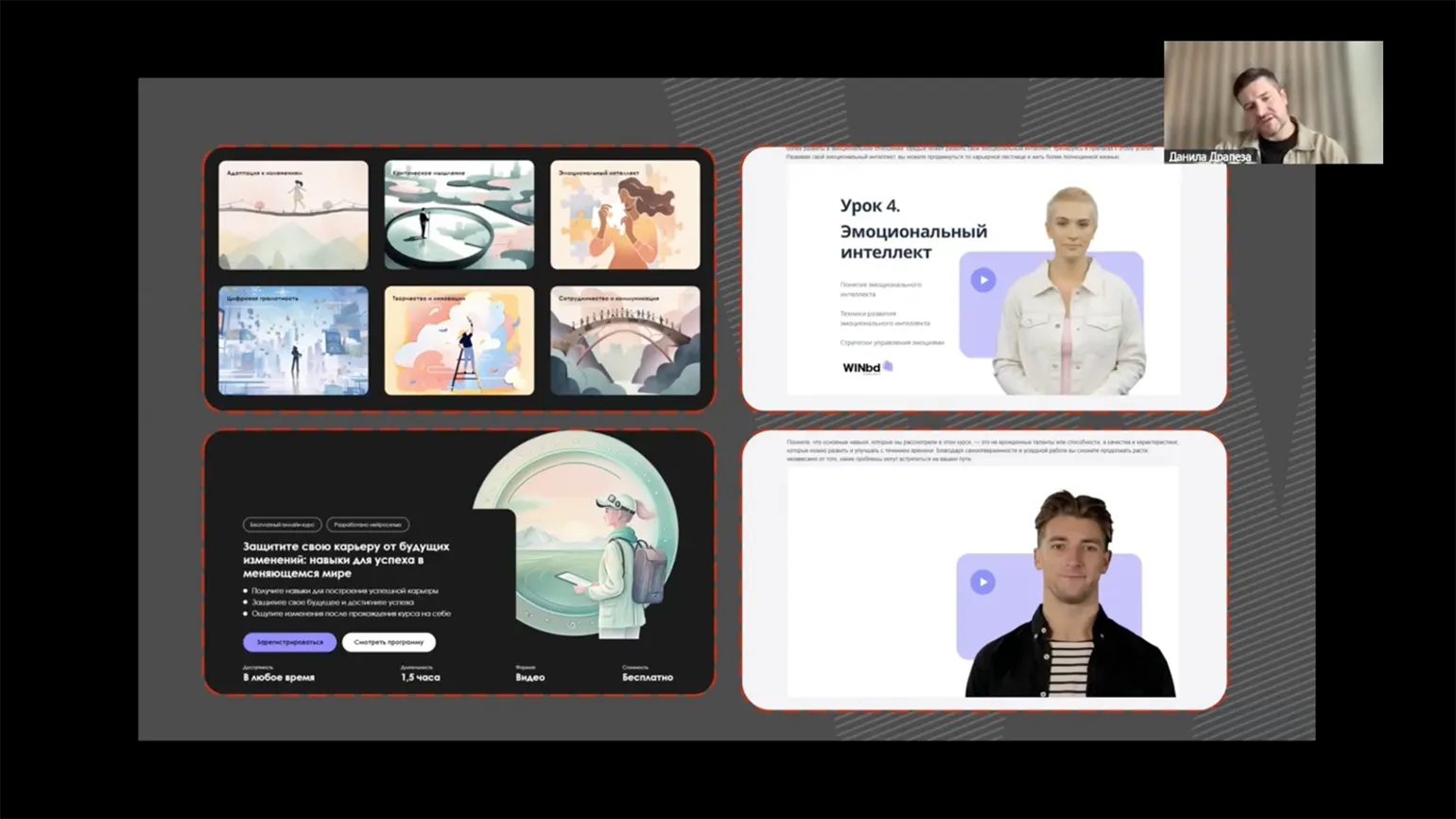
Surveys among course participants have shown that Most participants found the content interesting. However, opinions on the inclusion of digital speakers in the learning process were divided. This highlights the importance of choosing appropriate methods and interaction formats to enhance participant engagement. Danila Drapeza noted that LLM (Large Language Models) technologies have advanced significantly since then. In 2022, virtual speakers were quite primitive, and the quality of static image generation left much to be desired. However, the situation has now changed. As an example, he cited a current course on project management developed for Sechenov University. Two methodologists and one subject matter expert participated in its creation, and the faculty were not involved in the recording of the video lectures. This transformation in approaches to learning demonstrates how modern technologies can improve the quality of educational content.
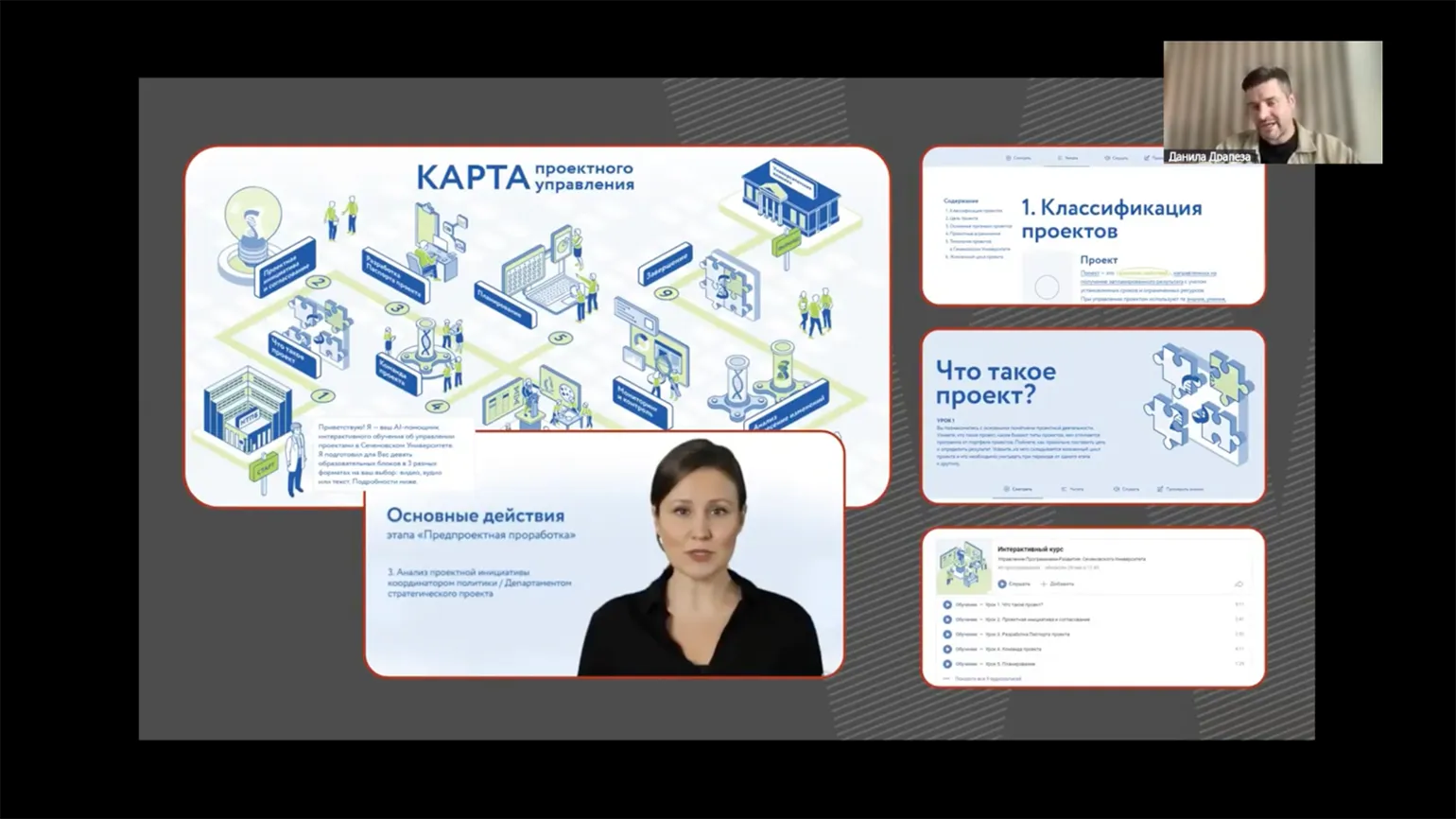
With the help of ChatGPT materials prepared by an expert were adapted for ease of access by all participants. Course visualization, designed in the university's corporate style and colors, was created using Midjourney. Additionally, all materials were supplemented with audio versions featuring a robot voiceover and a video featuring a virtual "talking head." This allows participants to choose their preferred learning format. The speaker noted that this approach has proven successful, with the course demonstrating high completion rates.
As part of a project for the Sequoia School, which specializes in business training for the tourism industry, WINbd is taking an innovative approach. The educational blog includes materials dedicated to the use of artificial intelligence in business. Danila Drapeza served as an expert on this topic, transcribing his lectures and compiling an extensive database of text materials. Additionally, the school's founder, Daria Loseva, was filmed, and a digital avatar was created based on her voice and appearance. This avatar was integrated with text lectures, resulting in realistic video lectures that mimic the experience of interacting with a live speaker. This approach not only makes learning more interactive but also significantly increases student engagement, which is especially important in today's educational environment.
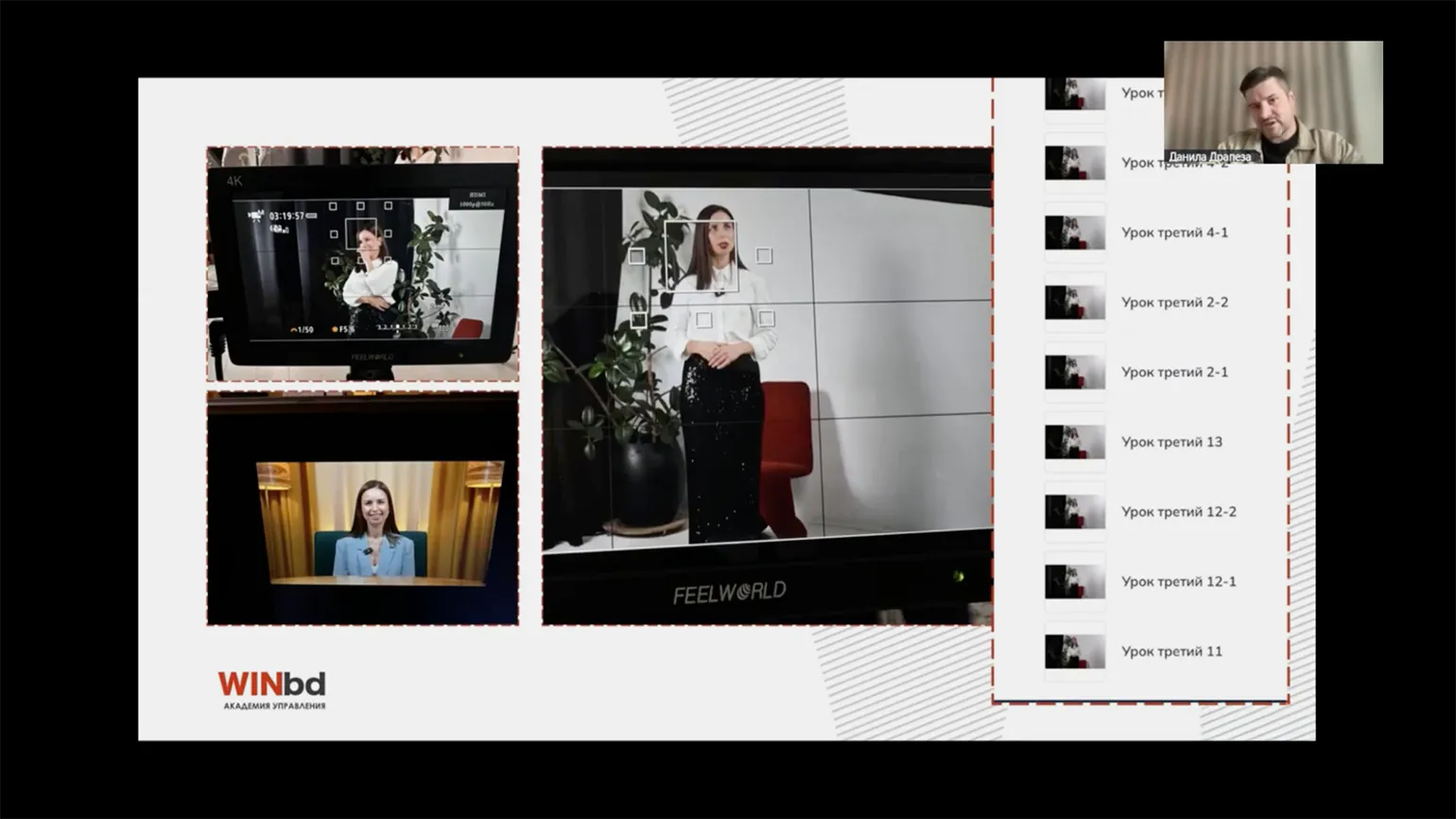

A more "cartoony" avatar of Daria was developed for Sequoia, which the school plans to use in short videos for social networks. This approach will attract audience attention and make content more engaging and memorable.
Danila also shared an interesting case study. A large company with tens of thousands of employees approached WINbd to create a digital avatar of its CEO. However, this avatar was not designed for recording video lectures, but rather so that the virtual director could personally greet each employee in a corporate messenger and inform them of significant company events and news. This approach not only strengthens corporate culture but also helps create a closer connection between management and staff.
Danila Drapeza discussed situations where digitizing a real person to create an avatar becomes impossible for various reasons. In such cases, fictional characters created entirely using virtual graphics come to the rescue. These generated avatars can be adapted for use in various digital environments, opening up new possibilities for creativity and interaction in the virtual space. Using virtual characters eliminates the limitations associated with realistic models and gives developers the freedom to create unique images. For the large company WINbd, portraits of fictitious people were created, along with several voice options—both male and female. Approved by top managers, the portraits and voices became characters that are actively used for recording internal video courses and voicing knowledge base materials. These technologies are also used for marketing purposes, allowing the company to improve customer interactions and increase the effectiveness of employee training.


Modern capabilities of artificial intelligence significantly simplify the work of specialists, allowing to save a company’s time and money. A virtual teacher is immune to illness and won't cancel filming, eliminating the need to rent a studio to record new video lectures. This is especially important when educational content needs to be updated regularly. Using AI helps avoid multiple takes and lengthy editing processes, ultimately increasing the efficiency of the educational process and the quality of services provided.
When WINbd began integrating artificial intelligence into its development processes, the company decided to end its collaboration with the design agency that was previously responsible for creating visual materials. Now, all visual content is developed in-house using neural networks, significantly speeding up the process and increasing efficiency. The integration of AI not only optimized the visual creation process but also allowed the company to reduce costs while maintaining high content quality.
Danila Drapeza notes that a neural network is a tool that expands human capabilities, like a digital shovel helping to deepen research. However, any content created using neural networks—whether text, images, audio, or video—requires careful review by a professional. This underscores the importance of human attention and expertise in the content creation and processing process to achieve high-quality results.
AI in the Full Cycle of Employee Training Development
The HYPER / DIR-2025 conference was held on June 25 and 26, focusing on artificial intelligence and its implementation in the educational process. At the event, Natalia Kubrak, business coach and methodologist at SOGAZ-Med JSC, shared her experience using AI technologies in creating online courses. She discussed how the use of artificial intelligence helps improve the quality of education and adapt courses to student needs. Integrating AI into educational programs opens new horizons, enabling the creation of personalized and effective learning materials. Natalia says the corporate training center employs six specialists. The company has 4,500 employees, for whom the center develops a variety of courses covering both technical and general skills, as well as occupational safety and talent development programs. Mandatory courses demonstrate high attendance rates, but employees often show low engagement in optional training and rarely initiate learning processes. The implementation of artificial intelligence tools has significantly increased interest in optional courses, contributing to an overall improvement in employee qualifications and the development of professional skills. Natalia Kubrak and her team use neural networks to solve a variety of problems related to course development. Neural networks help optimize the learning process, improve the adaptation of materials to student needs, and enhance the effectiveness of the educational process. The use of modern technologies in course development enables the creation of more interactive and personalized educational solutions, making learning more accessible and high-quality.
The neural network creates a detailed profile of the target audience for the teamwork course. It identifies the key skills and competencies necessary for successful completion of the program. The neural network also identifies common problems faced by companies and suggests solutions provided by the course. By analyzing similar courses and current trends in online learning, the system recommends optimal formats for presenting educational content to enhance its effectiveness. This makes learning more targeted and meaningful for participants.
Natalia developed a unique course on teamwork, inspired by an illustration of the ancient Greek gods. She decided to combine the images of Zeus, Athena, Ares, and other Olympians with Belbin's typology of team roles. ChatGPT helped her with this, generating a course scenario consisting of modules and lessons. It described the characters, offered case studies, and offered assignments for students, making the learning more engaging and effective. The course is aimed at developing teamwork skills and understanding the role of each team member, which is especially relevant in modern business.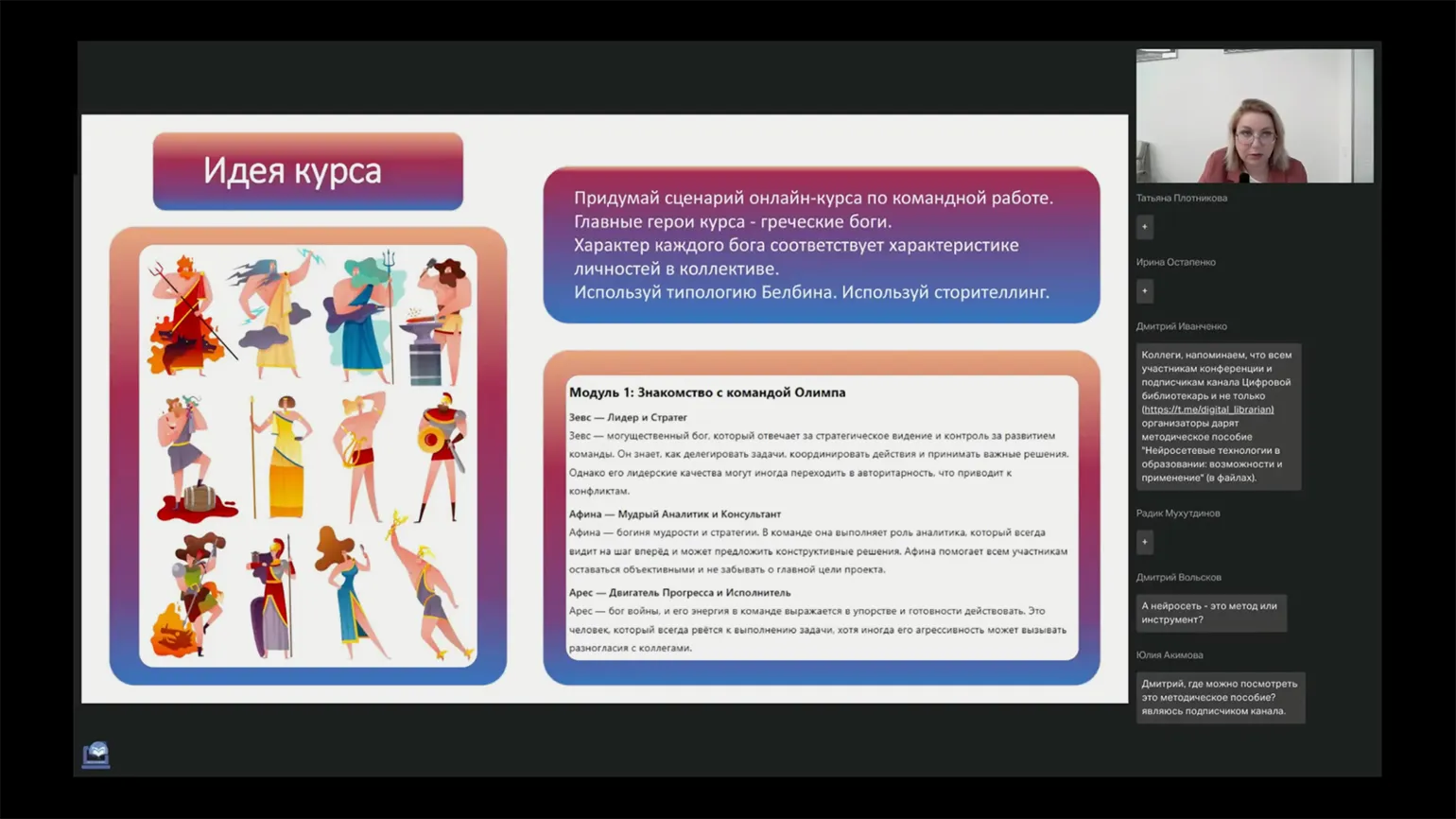
A neural network can significantly assist in refining ideas. Natalia suggested an effective method: to improve results, include a creative technique in the prompt that is appropriate for your task. For example, a prompt might sound like this: "I need help brainstorming the details of a course on the interaction of gods. What gamification elements, such as achievements or Easter eggs, can be used? What practical tasks will help adult participants develop teamwork skills? Help me refine the concept using the SCAMPER technique." Using such techniques allows you to structure your thoughts and generate more original ideas.
The speaker recommends using various creative techniques to achieve the desired results. Among them are the "Five Whys" method, "Six Thinking Hats," the focal object method, lateral thinking, and the Jobs to Be Done approach. Natalia Kubrak was particularly interested in the expert panel method, implemented using ChatGPT. This tool allows you to request the opinion of a bot, which will act as a marketer, methodologist, creative director, or subject matter expert, providing ideas and feedback from a relevant perspective. Using such methods allows you to expand your horizons of thought and find innovative solutions.

Read also:
Generating creative ideas for corporate training is an important task for improving the effectiveness of the educational process. Effective methods can not only improve the quality of training but also make it more engaging for employees. Let's look at five proven methods that will help you with this.
The first method is brainstorming. Organize meetings where the team can freely share their ideas and suggestions. Create an atmosphere conducive to creativity, where everyone feels comfortable expressing their thoughts.
The second method is using mind maps. This tool helps visualize ideas and the connections between them. Creating mind maps can help identify new directions and solutions that have not previously been considered.
The third method is conducting employee surveys. Collect the opinions and preferences of your colleagues regarding training topics and formats. This will not only help identify current needs but also increase employee engagement in the learning process.
The fourth method is observing successful practices in other companies. Study what approaches to corporate training are used by leading organizations in your industry. This can give you new ideas and inspiration for implementing your own programs.
The fifth method is creating an innovative environment. Encourage employees to experiment and implement new ideas in training. Create a platform where employees can share their developments and receive feedback. Using these methods will help you generate creative ideas for corporate training, which in turn will improve employee skills and the effectiveness of the entire organization. Once an idea is formed, the neural network supports the SOGAZ-Med methodological team at various stages of course development. This includes content analysis, creation of educational materials, and adaptation of teaching methods to improve information absorption. The neural network can also suggest innovative approaches to assessing learning outcomes, allowing the team to more precisely tailor the program to user needs. The use of modern technologies in teaching contributes to the creation of a high-quality educational product that meets current market demands.
- create a course syllabus in table form;
- create a slide presentation plan based on the course scenario;
- generate text for slides and ideas for illustrations;
- create case studies for students and test questions;
- develop visual materials;
- create a content development checklist to ensure nothing is forgotten or overlooked.
The speaker recommends providing neural networks with the most specific input data possible. This is especially important when using creative techniques. It is also important to specify the desired methodology for completing the task. For example, before requesting a module scenario from ChatGPT, it is useful to download an article on the Kolb cycle and specify in the request that the result should be based specifically on this model. This approach will help you obtain more accurate and relevant results that meet your requirements.
Natalia Kubrak emphasized that the neural network is good at generating multiple-choice test questions. However, practical assignments are still being developed by a methodologist. Artificial intelligence can suggest ideas for such tasks, but is not yet able to independently formulate them in such a way that they effectively help develop the necessary skills and meet the requirements of the courses, as well as the technical capabilities of the learning management system (LMS).

Learn more about our content.
Five skills of instructional designers that are being transformed by neural networks
Modern instructional designers are facing changes in their professional activities due to the introduction of neural network technologies. These changes concern both the methodology of developing educational programs and approaches to interacting with students. First of all, it is important to highlight the skills that are becoming especially relevant in the context of using neural networks.
The first skill is content adaptation. Instructional designers must be able to effectively integrate neural network tools to create an individualized learning experience that takes into account the needs and level of preparation of each student.
The second skill is data analysis. Using neural networks involves working with large volumes of information, and instructional designers need to be able to interpret data in order to improve learning processes and make informed decisions.
The third skill is creative thinking. Despite the automation of many processes, a creative approach remains indispensable. Instructional designers must generate new ideas and methods using the capabilities of neural networks to create interactive and engaging educational materials.
The fourth skill is collaboration. Neural networks often require an interdisciplinary approach, so the ability to work in a team with experts in technology, pedagogy, and design is becoming an important aspect of professional work.
The fifth skill is continuous learning. In a rapidly evolving world, instructional designers must be prepared to continually update their knowledge and skills to effectively utilize new tools and methodologies in their work.
As a result, the introduction of neural networks into the educational process is changing approaches to instructional design, and professionals in this field must adapt to new challenges and opportunities to remain competitive and provide high-quality learning.
The speaker emphasizes the importance of carefully evaluating content generated by neural networks. It is necessary to carefully sift through the information to select the most useful materials for a specific target audience and educational objectives. After this, it is necessary to combine the selected elements into a coherent whole. Creating a course in a course designer also requires manual work, which emphasizes the importance of a careful approach to content development.
Using a neural network, you can create a variety of effective course title options, slogans, and annotations for its successful promotion among employees. It is also possible to generate email texts for sending out training invitations. This will increase interest in the course and the number of participants.
The SOGAZ-Med Training Center noted the positive response of employees to the use of AI storytelling in course promotional materials. To create an announcement of the course on multitasking, Natalia developed an effective prompt that helped attract attention to the topic and increase interest in the training. AI storytelling made the information more engaging and accessible, which contributed to improved comprehension of the material and increased participant engagement. Experience using such innovative technologies in training confirms their relevance and effectiveness in modern educational practices.
Want to unravel the secrets of effective multitasking in the work of an insurance agent? We invite you to our unique course, which will help you master the key skills for successful work in the insurance industry. In our course, you will find three engaging modules: "Planning," where you will learn to prioritize and effectively manage your time; "Organizing the Media Space," in which we will discuss how to create a comfortable and productive work environment; and "Antistress", thanks to which you will be able to cope with stress and avoid burnout.
Each module includes practical tasks and games that will help you consolidate the acquired knowledge in practice. At the end of the course, you will have a final test that will allow you to evaluate your achievements. Join us and become a master of multitasking!
- What is this course;
- Who is the course for;
- How the course is structured;
- A parable story on the topic of multitasking;
- A quote from a great person on the topic of multitasking;
- A success story - motivator;
- How to study on the course;
- What will you learn on the course."
ChatGPT created a story about a glassblower who faces difficulties due to a large number of important orders. The main character achieves success when he stops panicking and begins to properly plan his time and resources. This story made a positive impression on employees, and the subsequent use of storytelling in announcements attracted more participants to optional courses. Effective use of storytelling has become an important tool for increasing interest in training and staff development. Natalia Kubrak emphasizes that all stories generated by neural networks share similar characteristics. They regularly repeat the same plot elements and phrases. Therefore, true creativity should not be expected from neural networks at this time. Neural networks are not yet capable of unique and diverse storytelling, which limits their use as a source of original content. ChatGPT effectively supports the SOGAZ-Meda training center in collecting feedback on the courses. Students complete questionnaires, and the most valuable part of these questionnaires consists of open-ended questions that provide useful insights. The neural network can generate questions that encourage reflection and genuine feedback from learners, which can improve the quality of educational programs and increase participant satisfaction.
If a course is attended by hundreds of people, their answers to open-ended questions can be uploaded to ChatGPT for analysis and general conclusions. However, Natalia noted that the neural network is not good at capturing the emotional component of reviews and tends to average out ratings. For example, among 500 positive and neutral reviews, one sharply negative one could point to significant issues in the course content, the learning process, or student support. The neural network may overlook such a review, evaluating it equally with the others. Therefore, for a high-quality analysis, it is necessary to consider not only the total number of reviews but also their emotional content.
Natalia Kubrak notes that the free version of ChatGPT offers extensive capabilities, and the results of using the neural network largely depend on the correctness of the request and the input information provided. It is especially important to consider information security aspects, especially in a corporate environment. However, designing a learning process aimed at achieving the stated goals remains a task requiring manual intervention from a methodologist.
The speaker noted that several unresolved issues remain regarding the authorship of generated content and intellectual property rights. There is also concern about how students and employees will perceive the courses if they learn that the material was created using a neural network. Natalia openly admitted that she would be uncomfortable taking a course developed entirely by artificial intelligence.
The speaker raises an important issue regarding trust in artificial intelligence analytics. According to Natalia Kubrak, neural networks can be useful for analyzing employee feedback, but the results must be independently verified. However, relying on AI analytics when making serious business decisions is not advisable. This approach will help avoid mistakes and improve the quality of decisions.

Read also:
- A Russian company has created digital avatars of teachers for employee training
- An experiment has shown which AI models can act as teachers
- 5 mistakes in implementation AI tools in employee training and development
- New AI agents can turn corporate online training into fiction