
Contents:

Learn: Profession Methodist from scratch to PRO
Learn moreAt the Global Design Thinking festival, organized by the Design Thinking Center, Anastasia Kuznetsova, head of the Preschool and Primary Education program at the Foxford online school, shared her experience using design thinking in developing educational courses. Although her presentation focused on products for children, design thinking methodology is also effectively used in creating educational programs for adults. In her comments for Skillbox Media, Anastasia spoke in detail about the key aspects of implementing design thinking in the educational process, emphasizing its flexibility and versatility.
- What is design thinking and why do those designing education need it?
- What stages does design thinking consist of and how to create a course using them?
- How to turn design thinking not only into a development tool, but also into course content.
What is design thinking?
Design thinking is a methodology and problem-solving process aimed at deeply understanding the needs of users, including users of educational products. The main goal of this approach is to identify the key problems and needs faced by the user. After that, innovative and effective solutions are created that help eliminate these problems. In the language of marketers and UX designers, this means "closing the user's pain." Design thinking contributes to the creation of higher-quality, user-centered products, making it an essential tool in the development of both educational and other types of solutions.
Design thinking is based on three key principles. These principles include understanding user needs, active team collaboration, and iterative testing of solutions. Understanding user needs allows for a deeper understanding of their problems and expectations, which leads to the creation of more effective and relevant solutions. Team collaboration allows for the integration of diverse perspectives and expertise, leading to more creative approaches. Iterative testing of solutions allows for the validation and refinement of ideas at each stage of development, ensuring they meet real user requirements. These principles form the basis for the successful application of design thinking in various fields, including business, education, and social projects.
- empathy, that is, the ability to sympathize with others and understand their feelings;
- the ability to look at a problem as a whole and in detail;
- willingness to try and make mistakes.
Design thinking is a methodology aimed at creating unique projects to effectively solve specific user problems. This approach not only helps find optimal solutions but also promotes the continuous improvement of products and services. In a dynamically changing world, the ability to adapt and improve is becoming especially relevant. Anastasia Kuznetsova emphasizes the importance of this methodology in modern conditions.

Why design thinking is needed in education
An expert highlights several key advantages of developing online courses using the design thinking methodology. First, this approach focuses on user needs, ensuring courses are created that best meet learners' expectations and interests. Second, design thinking fosters an innovative approach to learning, enabling the development of unique and engaging learning materials. Furthermore, this process incorporates active testing and iteration, helping to adapt the course based on feedback and improve its quality. Finally, using design thinking in online course development fosters deeper engagement with learners, as they become active co-authors of their learning. This makes courses more effective and efficient, which in turn increases user satisfaction.
- it helps developers to clearly understand the requirements and desires of the target audience and make decisions quickly;
- it contributes to the improvement and updating of products through prototyping;
- it allows you to constantly create and launch new courses, since the process of generating ideas for one product often leads to many good ideas for other products.
How to Develop a Course Based on Design Thinking
The design thinking process includes six key stages: empathy, focus, idea generation, prototyping, and testing. After completing the last stage, the process begins again, which emphasizes the cyclical and iterative nature of the methodology. This scheme is largely similar to other design models, such as SAM and ALD, which also emphasize a deep understanding of user needs and the continuous optimization of solutions. Design thinking provides an opportunity to create more effective and innovative products that meet the real needs of the audience.
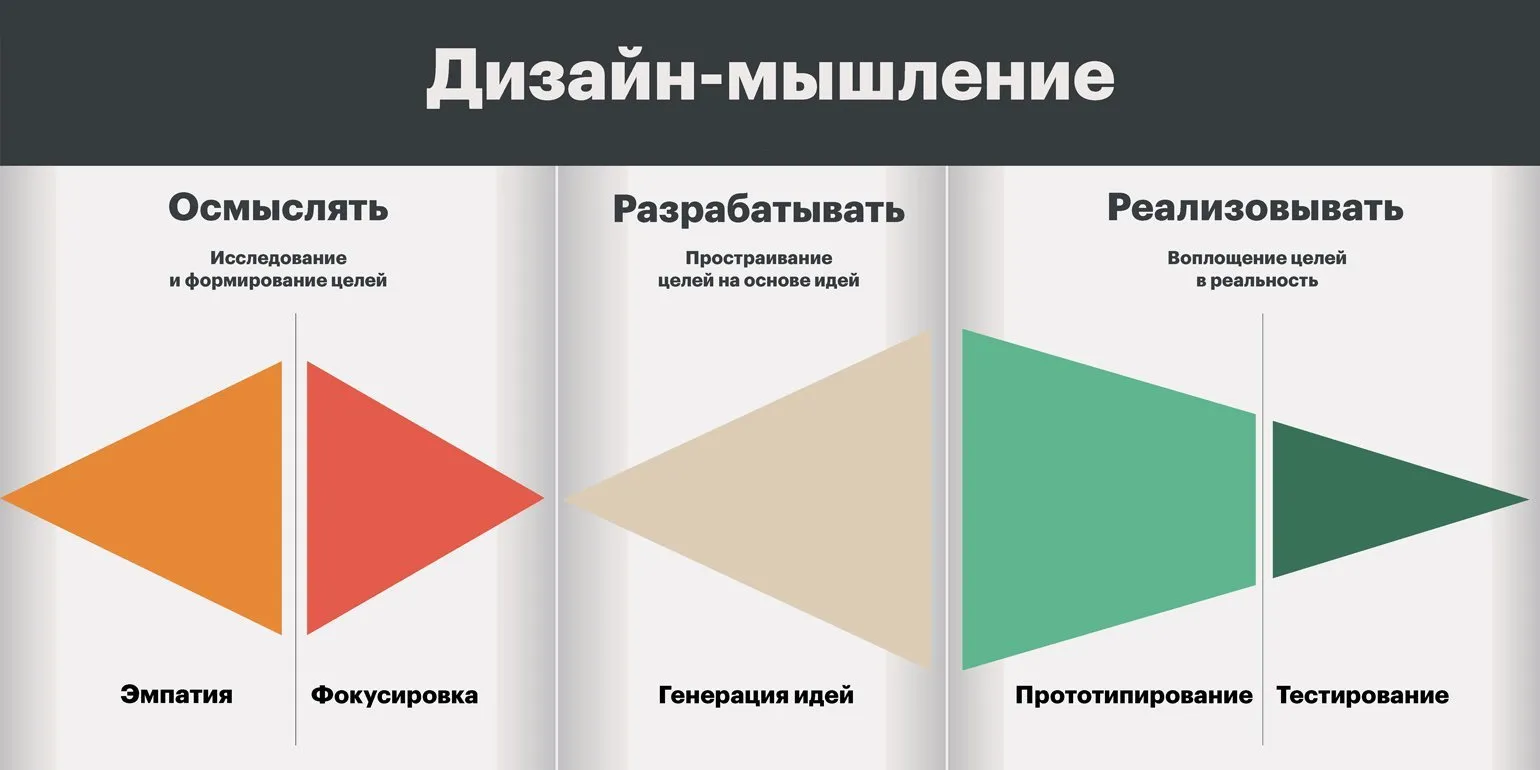
Let's look at each stage Design Thinking in more detail. This approach includes several key steps that help solve complex problems and create innovative solutions. The first stage involves Empathize, where we seek to understand the needs and desires of users. In the second stage, Define, we formulate clear problems to be solved. The third stage, Ideate, involves brainstorming and searching for creative solutions. The fourth stage, Prototype, involves creating prototypes that allow us to visualize ideas and test them in practice. Finally, in the final stage, Test, we collect user feedback and make any necessary adjustments. This cyclical process allows us to continuously improve the product and adapt to changing user needs. Design thinking is a powerful tool for creating effective and user-friendly solutions.
Empathy in design thinking is a key stage in which we study the needs and interests of users. This stage includes identifying educational gaps, which emphasizes the importance of understanding the audience. Anastasia explains that this can be compared to traditional research methods used by experienced methodologists, such as surveys, interviews, and focus groups. However, empathy in design thinking requires a more detailed and in-depth approach, allowing for the creation of courses that best meet user expectations and needs.
During content development, key attention is paid not only to the interests but also to the pain points of the target audience. The main goal is to create a product that effectively solves users' current problems. This approach allows for a deeper understanding of the needs of listeners and offers them valuable content that is relevant and in demand.
Creating a successful product requires a deep understanding of user needs, their limitations, and challenges. In particular, when developing children's courses, it is necessary to consider many factors, such as optimal learning time, parents' financial capabilities, and aspects that evoke an emotional response in children. By considering these elements, a more engaging and effective educational product can be created.
During the focus phase, developers carefully analyze the data collected in the first step to identify the key pain point the future course will address. It's important to identify one core problem rather than trying to address several aspects simultaneously. This will allow for the creation of a more targeted and effective educational product that will be truly useful to the target audience.
Dividing efforts can lead to a product that doesn't satisfy any of the target audiences. If we try to solve several problems at once, we risk creating a solution that won't be effective for any user group. The speaker emphasizes the importance of focusing on a specific task to ensure a product is truly relevant and useful. Understanding the needs of the target audience is key, allowing for a high-quality and targeted solution.
The core problem will likely be the most noticeable and stand out from the rest.
It's important to pay attention to detail, the expert notes, as needs can be varied and multifaceted.
Anastasia cites the example of a multiplication skills trainer, which is being developed by the Foxford team using the design thinking method. The main problem parents face is the desire for children to master skills independently without their help. However, there is also an underlying problem: many parents have difficulty getting their child to learn the multiplication tables. This detail may seem insignificant, but it highlights the importance of adding a motivational aspect to the learning process. Without engaging the child in independent learning, it will be difficult to achieve results. The trainer should not only develop skills but also spark interest in learning, which will make the process more effective and enjoyable for children.
Once the problem has been identified, the idea generation stage begins, which can be described as brainstorming. Anastasia describes the process as follows: "We assemble a team of methodologists for each subject, provide input, and the team begins to come up with options. All ideas are recorded, and then we can expand on them after the meeting, when each participant has the opportunity to consider the proposed ideas in more detail. At the end of the process, we hold a vote and select the two or three most promising ideas."
The development process involves not only methodologists but also producers, project managers, and other specialists. The final ideas are carefully checked against the stated goals to ensure they align with the original concept. They are also checked for alignment with other important factors, such as business goals, platform capabilities, and available resources.
During the prototyping stage, methodologists develop a small amount of content for the future course to demonstrate to potential users. Typically, elements that are likely to generate the greatest interest and response from the audience are selected. This "snippet" of the product is published and offered to users for free review, which initiates the testing phase. This can take the form of a mini-course or a simulator. Thus, a minimum viable product (MVP) is created, which allows us to assess the actual interest of the target audience and make the necessary adjustments to the further development of the course.
In the Foxford case study of the multiplication skills trainer, the initial testing revealed opportunities for course improvement. We collected feedback and discovered that users weren't simply solving problems and practicing skills. They wanted a more game-like and motivating course, with a captivating story and visuals, which would increase interest and engagement.
After testing, the team returns to the ideation process, taking user feedback into account. Based on the data obtained, the product is refined, improving its functionality and meeting the needs of the target audience. This approach to development contributes to the creation of a higher quality and more in-demand solution on the market.

Read also:
Online classes for children have their own unique features that teachers and methodologists need to take into account to achieve maximum effectiveness. Firstly, an important aspect is the adaptation of the content to the distance learning format. It is necessary to use interactive methods to keep children's attention and engage them in the process.
Secondly, technical aspects should be addressed. Teachers must ensure that all participants have access to the necessary devices and a stable internet connection. This will ensure smooth lessons and minimize technical glitches.
Thirdly, attention to the individual characteristics of children is key. Each child has unique needs and skill levels, so it's important to adapt methods to different groups of students.
Fourthly, the need to create a comfortable and safe environment in the online space is crucial. Teachers must provide psychological support and foster an atmosphere of trust so that children feel free and can actively participate in lessons.
Finally, the fifth aspect is constant feedback. Regular interaction with parents and children will help identify learning weaknesses and adjust approaches, significantly improving the quality of online lessons. Taking these features into account, teachers and methodologists will be able to significantly improve learning outcomes in a distance learning environment.
How else can design thinking be used in teaching?
At Foxford, design thinking is actively used not only in course development, but also in the teaching process, as Anastasia noted. This approach was tested on participants in the online course "Emotional Intelligence." In a sense, design thinking has become an alternative to project-based learning, allowing students to delve deeper into the material and develop critical thinking.
At the first stage, the teacher invited students to discuss the problems they face when planning their time. The discussion took place synchronously in a chat, where students shared their options and ideas, and the teacher voiced them. Through voting, the students identified the main problem, after which they jointly began to generate ideas for its solution.
During the webinar with children, organizing the process of idea generation proved to be quite difficult. So, we decided to make it a homework assignment. The children used a shared virtual board, where they pasted sticky notes with their own suggestions. We used a voting method to select ideas. This allowed the children to actively participate in the discussion and make collective decisions.
The children worked on creating their own small planners, presenting individual pages rather than bulky notebooks. They presented their work in the virtual space and received feedback from other group members. Afterwards, the planners were refined, and the children presented their improved versions again. This approach fosters creativity and collaboration skills, and also allows children to learn to accept constructive criticism and improve their ideas.
Challenging tasks suitable for adults can significantly develop design thinking skills. Experience shows that these skills are useful at any age and promote creativity, empathy, and constructive criticism. Mastering design thinking helps create innovative solutions and improve interaction with others, which is especially important in the modern world.
Read also:
- CRAFT/ED: What is this tool for educational designers?
- Designing learning from the results: 3 concepts you need to know.
- How to create an online course that is suitable for both beginners and experienced people.
- How to design high-quality learning with limited resources.
Profession Methodologist from scratch to PRO
You will improve your skills in developing curricula for online and offline courses. Master modern teaching practices, structure your experience, and become a more sought-after specialist.
Find out more