
Contents:

Course with employment: "The Methodologist Profession from Zero to PRO"
Learn MoreCircle of Practice
For designing practice, I recommend using Michael Allen's simple and effective model, known as CCAF. This acronym stands for Context, Challenge, Activity, and Feedback. Since the term "CCAF" can seem too complex in Russian, I prefer to call it a "circle of practice," as the model is presented in the form of a circle. In this text, I will cover in detail the key elements of this model and their importance for successful learning.

Michael Allen — Allen is the founder of Allen Interactions, a company that has specialized in developing high-quality corporate e-learning for over 30 years. Allen is an experienced instructional designer and has dedicated his entire career to this field. He is one of the first authors of books on modern learning methods, and his first book was published in 2001. I learned how to create learning systems and e-courses using his work. His books are distinguished by their practicality and content. Unfortunately, only one of his works was translated into Russian, and by that time it no longer reflected all modern trends. I recommend reading his book, Designing Successful e-Learning, which will be a useful resource for e-learning specialists.
The CCAF model first caught my attention at Allen's masterclass at a conference in the United States. After that, I took all of his courses and programs to gain a deeper understanding of how to properly design learning practices. Michael Allen also focuses on experiential learning, and based on his methodology, I developed the design framework I now offer. This approach enables the creation of effective learning programs focused on the real needs and objectives of learners. Allen believes that learning is only effective when information and skills have real meaning for the learner. Therefore, experiential tasks must be relevant, aligned with learning objectives, and support the learner's future actions. This approach ensures not only better assimilation of the material, but also motivation for learning, which ultimately leads to better results.
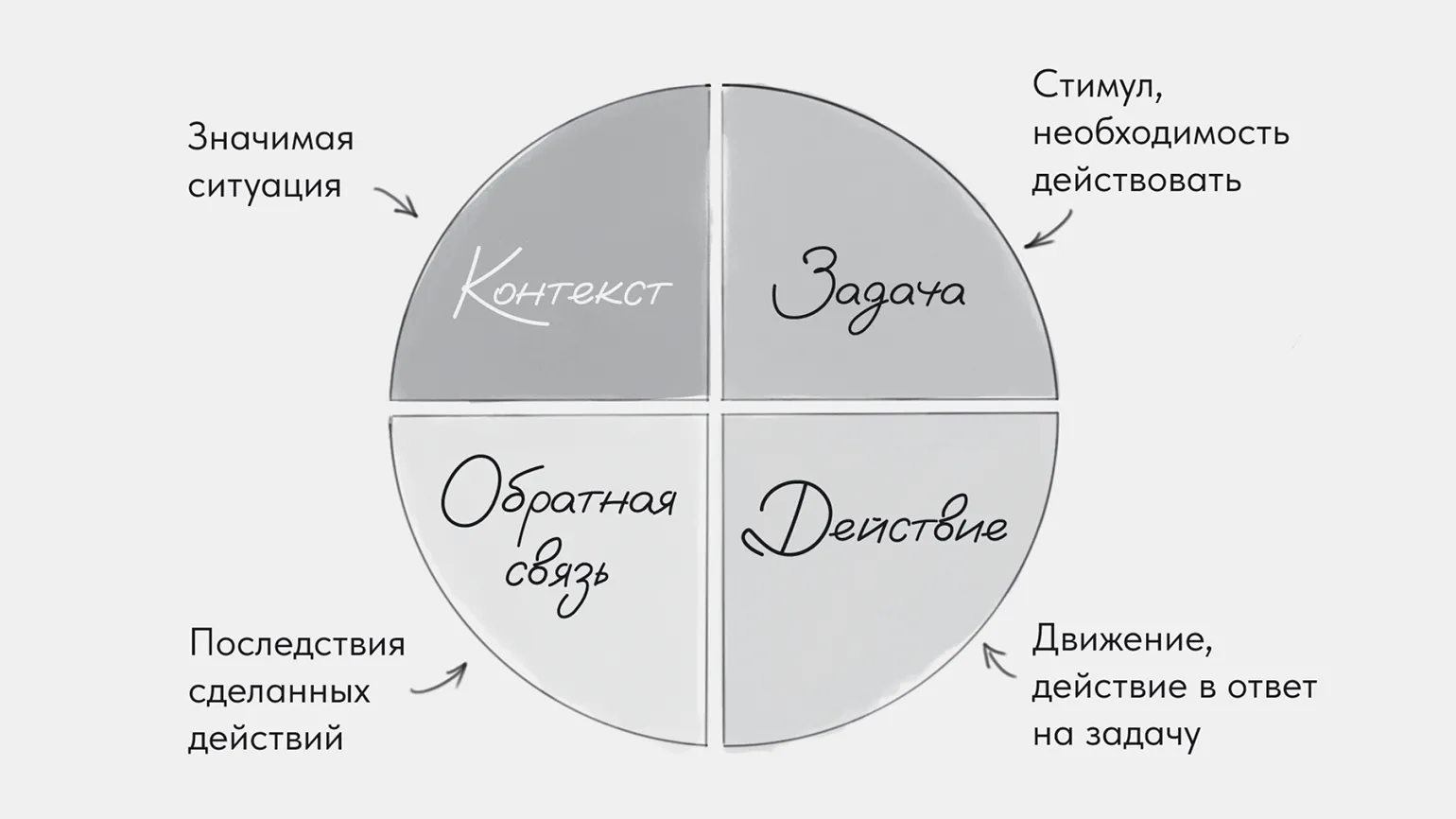
Each practical assignment includes four mandatory elements, and it is impossible to exclude even one of them.
Context is a description of the conditions in which the practical session will take place. It is important to create a situation that is familiar and meaningful to the participant, so that they can easily imagine themselves in this place. The context should be realistic and credible so that participants can better understand and prepare for the upcoming experience. This approach promotes a deeper perception of the material and improves the assimilation of practical skills.
A task is a specific action that must be performed in a given situation. It arises from the context and is closely related to it. It is important to note that the task should not be related to learning, so examples such as "choose from a list" are not suitable, as they do not reflect real life. For example, "solve a customer's problem" is a good example of a task. However, it is important that this task aligns with the tasks presented in the cascade developed in the previous step.
Action. In this section, we explain in detail what actions the learner should take. These could be tasks related to working on a computer, writing a text, or giving an oral presentation. It is important to clearly state what exactly is expected of the learner in the context of the assigned task to ensure understanding and readiness to complete the tasks. Detailed guidance will help avoid misunderstandings and improve the effectiveness of task completion.
Feedback is an important element of the learning and interaction process. In this part of the cycle, we inform the learner of the results of their actions, focusing on the consequences and developments. Instead of using simple assessments such as "true" or "false", we demonstrate cause-and-effect relationships, which allows for a better understanding of the context and significance of the steps taken. This promotes deeper understanding of the material and helps the student understand how their decisions affect future results.
When designing a practice, our goal is to create a realistic context for the student. We strive to pose a question about how to act in a specific situation, provide an opportunity to make a decision, and demonstrate the consequences of this choice. This approach promotes a deep understanding of the material and the development of critical thinking.
The main advantage of this model is its versatility: it functions effectively in various learning formats. This allows it to be used both online and in the traditional classroom, ensuring the flexibility and accessibility of the educational process.
The circle of practice implies that the participant continues to practice until they eliminate errors and master the correct actions. We do not remove the person from the context after their first mistake and do not evaluate their results. Instead, we analyze the situation, discuss what happened, and offer alternative approaches if the outcome is not positive. This method promotes a deep understanding and the formation of the skills necessary for successful task completion.
Context-based practice becomes a powerful learning tool. The context and the task not only deepen understanding of the material but also demonstrate its practical application. Participants gain a clear understanding of how to apply the knowledge they've learned in real-world situations. After such practice, they have no questions about how and where to apply their acquired skills. They are confident in the many scenarios in which they can apply their new knowledge, significantly increasing their confidence and readiness to take action.
Let's consider the example we discussed earlier. Let's say we're designing educational programs. Our goal is to break down the learning task into specific actions to create an effective learning process. This approach helps structure the material and make it more accessible. Cascading tasks helps identify key learning elements and optimize their implementation, which in turn improves the quality of the educational process.

I propose the first version of the practical assignment I mentioned earlier. In this version, we will build the structure in a circle.
Your colleague from the training department is engaged in design.
The head of the "Time Management for Executives" program conducted a thorough analysis of the tasks and target audience, and also examined all the conditions for implementing the training. Today, he has completed the cascading of the training task, but he still has doubts about the correctness of his actions. He asked for advice to make sure his decisions are correct.
Evaluate the cascading completed by your colleague and share your thoughts.
Check whether all elements are implemented correctly and whether the stated functional tasks are solved. Do you think the proposed cascade will contribute to the achievement of the learning objective?
In the presented cascade on the topic of time management, highlight the key aspects that will help you effectively organize your time and increase productivity. Focus on task planning methods, priorities, and strategies that help better allocate resources and minimize stress. Using time management techniques can significantly improve your ability to achieve goals and manage your daily responsibilities.
Please specify what you consider inappropriate or confirm that the waterfall meets the stated goal.
Feedback is an important aspect of interaction with customers and users. It allows you to obtain valuable feedback on products and services, as well as identify the strengths and weaknesses of your business. An effective feedback system helps improve service quality and increase customer satisfaction. It is important not only to collect feedback but also to respond promptly, demonstrating that customer opinions truly matter. Creating convenient feedback channels, such as website forms, surveys, and social media, promotes active user engagement. Optimizing the feedback process can significantly improve a company's reputation and increase its competitiveness in the marketplace.
A colleague made changes to the waterfall based on your comments.
The training was designed with the waterfall model in mind. It was successful and yielded positive results, provided the answers were correct.
A colleague left everything unchanged because you missed important details.
When launching the developed training, it turned out that the target audience received it negatively due to an excessive amount of theoretical material. If you had the opportunity to review the project, would you make any changes?
Feedback can take a variety of forms depending on the answer options and formats chosen. The main goal is to reflect on the end result and illustrate the sequence of events.
This task can be approached from a different angle. In the first option, we emphasize helping a colleague, focusing on information analysis. However, in the second option, we can offer direct implementation of the action.
Your new project is a training program for executives aimed at developing effective management skills. As part of this program, participants will master key methods and techniques that will help them become more successful leaders. The training will cover such important topics as strategic planning, team motivation, time management, and decision-making. The program is designed to address modern management challenges and is suitable for both experienced executives and those just beginning their career in this field. Participants will be able to apply the acquired knowledge in practice, which will significantly improve their professional competencies and team effectiveness.
After analyzing the task, target audience, and training conditions, it is necessary to cascade the training, which involves breaking the task down into individual actions. The target audience, having a high status, is extremely attentive to the learning process and is not willing to waste time on theory. In this context, I provide participants with the opportunity to review key information and guide their thoughts in the right direction for effective problem solving. This makes learning more focused and practice-oriented, which is especially important for a busy audience.
Create a cascade for a given program learning objective. This will structure the learning process, ensuring a logical sequence and interconnections between different levels of learning materials. Cascading will help students better absorb information, moving from simple concepts to more complex ones, which promotes a deeper understanding of the topic and effective learning.
Time management is an important task for achieving goals and increasing productivity. Effective time management not only improves the quality of task completion but also reduces stress. To successfully manage time, you need to set priorities, plan your actions, and stick to the established schedule. Using various tools, such as calendars and scheduling apps, can significantly simplify this process. Developing time management skills not only promotes personal effectiveness but also improves teamwork, which in turn affects overall success.
Cassack by listing your action options in a table. This will help structure the information and simplify the decision-making process. Cascading allows you to visualize and prioritize actions, which facilitates more effective project management. Use a table to organize options and assess their impact on the overall strategy.
Rework the text, maintaining the main topic and avoiding unnecessary details. Optimize it for SEO and add useful information where necessary. Eliminate emojis and unnecessary symbols. Avoid using bullet points or lists; simply present clean text.
Feedback is an important element of interaction between a company and its customers. It helps understand user needs and expectations, as well as identify potential shortcomings in products or services. Effective feedback contributes to improved service quality and increased customer satisfaction.
To obtain high-quality feedback, it's essential to use a variety of channels, such as surveys, website reviews, and social media. It's important not only to collect information but also to respond promptly, demonstrating to customers that their opinions matter. Analyzing feedback helps identify trends and preferences, which in turn helps fine-tune marketing strategies and optimize offers.
Therefore, feedback plays a key role in business development, helping build trust with customers and increase their loyalty. Regularly listening to user feedback helps create a competitive advantage and strengthens the company's reputation in the marketplace.
The training program was successful. Management noted the positive results and high level of participant engagement. Participants acquired new skills and knowledge, which contributed to improved work processes and increased overall team productivity. This approach to training demonstrates the importance of investing in employee development and professional growth. The program's success also highlights the need to continually update educational methods to achieve maximum results.
Training participants noted its practicality and shared information about which tools from the material they learned they began actively using.
After its launch, the program did not produce the expected results.
Many managers abandoned the training early due to excessive theoretical material. If you had the opportunity to redesign your training, what would you change?

If If we really had to teach curriculum design, we would use both types of tasks. This approach provides varied practice and allows for the development of knowledge retrieval skills in a variety of settings. We focus on developing not only the practical actions that the learner must master, but also an understanding of possible errors and their consequences. This promotes deeper assimilation of the material and the formation of the necessary competencies.
Errors must be designed in
Two main problems often arise in electronic forms of learning. The first is that learners do not have the opportunity to make a mistake, since they are not provided with options that could lead to an incorrect answer. As a result, the task ends with the system's standard response: "Wrong, try again." In such conditions, instead of full learning and understanding of the material, only a mechanical selection of options occurs. This negatively affects the assimilation of knowledge and reduces the effectiveness of the educational process. Effective e-learning courses should allow for mistakes, allowing learners to reflect on their answers and learn from their mistakes.
It's important to create conditions where learners will encounter mistakes. In some cases, a trick can be used to ensure that mistakes are inevitable the first time. This will not only enrich the learning process but also give learners the opportunity to reflect on their actions and learn from them. This approach promotes a deeper understanding of the material and the development of critical thinking.
To allow learners to make mistakes, it's necessary to provide a diverse set of tasks. If each action in the cascade is represented by only one task, then it will be completed correctly on the second or third attempt. Therefore, it's important to create a wide variety of tasks to ensure a deep understanding of the topic and the ability to apply it from different perspectives. This will help students better understand the material and develop the skills necessary to successfully complete tasks.
We do not evaluate
Assessments for adults can be dangerous, as they can reveal internal fears that can discourage the learning process. Evaluation itself is often associated with limitations rather than with the opportunity for development. Adults need to focus on their further growth and understanding the cause-and-effect relationships of their actions. This is especially important in learning, as awareness of the consequences of their decisions helps avoid mistakes and promotes a deeper understanding of the process. The development of skills and knowledge occurs through awareness of one's actions and their results, which is a key aspect of successful learning for adults.
Feedback in practical tasks should be internal. Internal feedback is an assessment based on a context that is close and understandable to students. It helps participants better understand their achievements and areas for improvement. Unlike internal feedback, external feedback is limited to simple assessments, such as "true" or "false," which does not always promote a deep understanding of the material. It is important to emphasize that it is the internal approach to feedback that promotes more effective learning and skill development.
Internal feedback demonstrates relationships in a specific context, as well as the development of events, their consequences, and possibilities. It is an important element of learning. Context teaches how to apply the acquired knowledge, and feedback helps realize that every action has real consequences, both positive and negative. Mistakes can lead to negative results, which emphasizes the importance of analyzing and comprehending the information received.
Feedback should reflect the realities of the surrounding world. In many situations, we realize that something went wrong not at the moment of the incident, but only after it has occurred. During the learning process, it is important to at least partially reproduce this time gap. In my examples, this gap is created by demonstrating the consequences that occurred after the course was completed. I don't limit myself to just pointing out errors, such as incorrect implementation of the cascade.

If the task includes several stages, it is more appropriate to provide feedback in At the end, to maintain the integrity of perception. In real life, we rarely receive comments on each individual action. This approach allows us to better understand the overall result and draw more substantiated conclusions.
Assignment Format
Currently, a significant portion of adult learning is carried out digitally. This is quite justified, since this target audience often does not have enough time for learning, and resources may be limited. Moreover, face-to-face learning is not always the best option, since this approach is not suitable for everyone. Digital learning methods allow for flexible planning of lessons and their adaptation to individual needs, which makes the process more effective and accessible.
In digital learning, there is a significant temptation to automate all tasks and check them without human intervention. This does reduce training costs, but automation often comes at the expense of quality. Automated systems may not take into account individual student characteristics and are not always able to provide adequate feedback, which can negatively impact learning. Therefore, it is important to find a balance between automation and a high-quality, personalized approach to the educational process.
Automated tasks often involve choosing from several predetermined options. Currently, tools for checking text input exist, but their number is still limited. Suggested options narrow the user's range of thought, which changes the nature of their interaction. Instead of completely independently analyzing the situation, they simply select the most appropriate option from the proposed ones. This is fundamentally different from a traditional approach to problem solving, which requires independently composing and recording answers. Thus, automation influences the thinking process, limiting creativity and independence of choice.
To achieve significant learning aimed at changing behavior, it is necessary to provide participants with completely independent tasks. These assignments should be reviewed by the course leader, which will provide high-quality feedback and help participants better absorb the material. This approach promotes deeper understanding and the application of new knowledge in practice.
The best learning context is one that the student creates themselves. This is a situation that has real-world significance for them, as mentioned at the beginning of the chapter. We then invite the student to work on this case, performing specific tasks and actions. Upon completion of the work, we provide feedback on the results. This approach makes the training as effective and relevant as possible for each participant.
During the training process, it can be effective to use a combination of different formats. For example, students can complete automated practical assignments throughout the course and then complete a large independent assignment at the end. This approach provides variety in training and allows for high-quality practice at the end.
When developing automated assignments, it is important to consider several key aspects. First, it is necessary to clearly define the goals and objectives to be achieved. This will allow you to create an effective and targeted automation process. Second, it is necessary to carefully select tools and technologies that meet the project requirements. This includes selecting software, hardware, and methodologies that will ensure maximum productivity. Data security and system reliability are also important to consider. Reliable automation requires regular monitoring and updates to meet changing conditions and requirements. Ultimately, successful task automation requires a comprehensive approach and careful planning. Answer options should not be obviously right or obviously wrong. They must be carefully considered so that the learner does not immediately see the single, obviously correct option or cannot easily eliminate all incorrect ones. It is best to create practical tasks consisting of several steps, that is, one task, but several actions must be performed. This provides greater immersion in the context. Feedback should be provided after the entire series of actions, since in real life we do not receive feedback for every step. Visualization of tasks is important, but not required. It is essential where we are practicing a physical action, for example, the process of repairing equipment. There, the student will subsequently navigate visually, so in the training we must show him everything as it will be in the workplace. But soft skills, communication, and much more can be described in text cases; sometimes this is even better, as there are no distractions.
Task Ideas
During one of the trainings, I was asked: "Can you provide templates for practice?" I replied that there are no templates, but your opportunities for practice are limitless.

Each training topic involves a variety of Practice methods that correspond to a specific goal. This diversity allows for effective consolidation of acquired knowledge. Trying to limit all of these methods to a single framework is inappropriate and can negatively impact the learning process.
We have many ideas for tasks that will help you get started effectively with design. These ideas can form the basis for your project and significantly simplify the development process.
- Find a mistake in what someone did. A good task for analysis and attentiveness.
- Find what went wrong. Similar to searching for an error, only here we study the course of events and look for the moment where the error was made. Then the listener should be asked to restore the correct process.
- Help a colleague. This is almost like searching for an error, but here the colleague may not have started acting yet; we need to tell him exactly what should be done and how. One option is to assign the listener some conditional role - make a newcomer a mentor, for example.
- Complete a task. Everything is clear here – do what we teach you.
- A view from the future. We tell the listener a story in the form of a case study. The company is currently in such-and-such a position, things are such-and-such, the difficulties are such-and-such. And then we ask them to understand what could have gone wrong for what we are seeing to happen. Alternatively, we can describe a positive development in a difficult situation and ask what decisions were made to make everything work out so wonderfully.
- What to do? These are simple tasks where we describe the situation and ask them to think about how to act in it. Despite their simplicity, such tasks teach different contexts for applying knowledge, which is very helpful later in correctly extracting what has been learned."