Contents:

Learn: The Profession of a Methodologist from Scratch to PRO
Find out more1. Overcoming the Passivity of Participants. Goals, Meanings, Rules of the Game
Those who intend to act and think independently need to ask their own questions. However, when a new group gathers for an interactive questioning session, it's common to notice that participants expect a traditional lesson or university workshop. They expect the instructor to share useful information, demonstrate materials, offer assignments to reinforce their knowledge, and assess their performance. It's important to change this perception and create an atmosphere in which participants can actively engage in the learning process, ask questions, and develop critical thinking. This will not only deepen their understanding of the topic but also make the learning more effective and engaging.
Participants' expectations often lack space for asking their own questions and discussing them with other participants. Being prepared to be "good students" to some extent protects the facilitator from open protests and disappointment. However, if by the end of the session it turns out the facilitator is unwilling to answer the questions posed, this can lead to disappointment and confusion. It's important for participants to recognize and appreciate the knowledge and experience they've gained, rather than focusing on their unmet expectations. Effective communication and openness on the part of the facilitator can significantly increase the value of the session for all participants.

First of all, it is necessary to promptly notify participants that the lesson is canceled. It's important not only to communicate this but also to explain the meaning of the process you've proposed, which includes asking and discussing questions. Start the session with this explanation and periodically return to discussing the achieved and expected results of the interaction to maintain clarity and understanding of what is happening. This will require technical preparation and a clear communication structure.
- state as simply as possible (in the participants' language) what results of the session you plan and will try to ensure for the participants;
- find out what expectations, desires, and goals the participants brought to the session.
You can choose which task to start the session with. The first task is familiar: it serves as a starting point for most trainings ("Today you will learn how to evaluate employee performance without negative consequences"), similar to lessons in school ("Today you will learn about Newton's first law"). However, unlike a standard lesson or training, in interactive question and answer sessions we do not impart new knowledge to participants or form new skills. The focus is on discussion and analysis, which deepens understanding of the topic and develops critical thinking in participants.
Participants in interactive questioning sessions achieve meaningful results, which can be assessed through the personal experience of asking questions acquired in the first part of the training. Expected results can be formulated using the verbs "figure out," "think about," and "understand better." For example, the "Mine or Not Mine" program, developed by students of the Moscow State Pedagogical Univ.'s Master's Degree Tutoring Program, helps potential applicants understand their expectations of a Master's degree and determine whether tutoring is right for them. As in training sessions, interactive questioning sessions provide both specific and non-specific results, promoting a deeper understanding of the topic and personal growth in participants.
The session's results should be relevant to its topic and take into account the participants' current circumstances. Potential applicants are offered a "Mine or Not Mine" session, which helps them identify their interests and inclinations. Second-year students in the MSPU Tutoring Master's program participate in a session before their state exams, aimed at systematizing their knowledge and identifying gaps that need to be addressed in the remaining time. Interactive questioning techniques allow for effective analysis of conflict situations, reflection on past events, a deeper understanding of complex texts, as well as the initiation of projects and the identification of difficulties that arise during work. These approaches enhance the quality of learning and ensure a deeper understanding of the material.
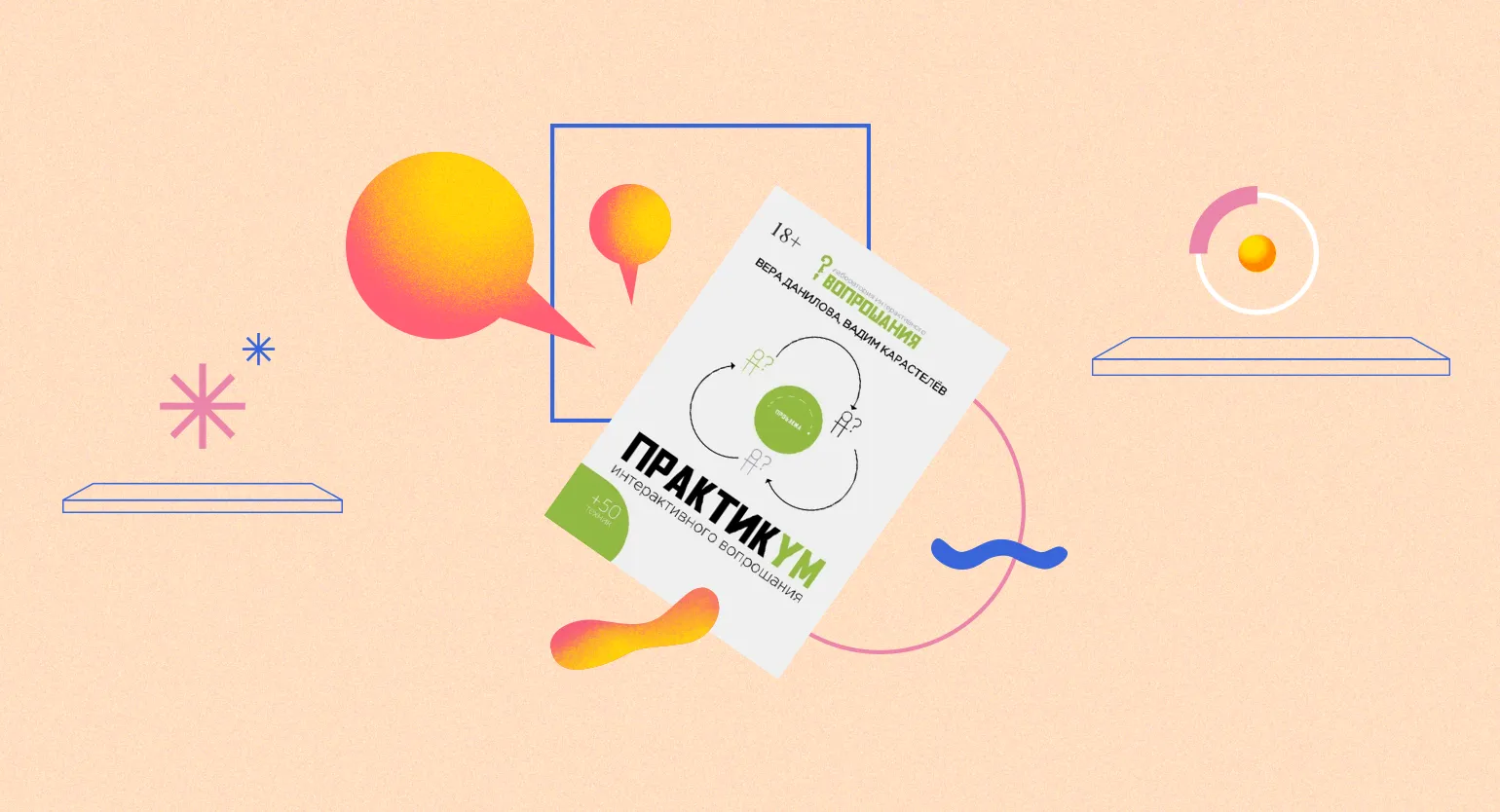
The first part of the book explores a variety of topics where the use of these techniques is appropriate and offers collections of techniques for each. However, these collections should be approached with caution, as they reflect our experience and personal style. You can use the suggested sets of techniques or create your own. It is important to understand the effect of each technique and to be alert to unexpected reactions from participants during sessions. This will allow you to adapt your approach and achieve the best results.

Non-specific session results are similar regardless of their topic. Participants gain experience formulating their own questions and discussing them with others. This allows them to more deeply analyze the topics or situations under consideration, considering various aspects and perspectives, and to identify the specifics of their approach. For example, first-year students in the "Captains" department at Southern Federal University, after applying the "Leaky Mirror" method to one of the most challenging courses of the semester (Economics), concluded that meaningful and important questions for them fell into two categories: questions related to successfully passing the exam and questions related to the application of the course material in real-world practice. As a result, two groups of students emerged, each focusing on its own priorities. During reflection at the end of the lesson, the students noted that understanding this distinction was one of the key results of their work. Non-specific results largely depend on the participants' comfort level in formulating their own questions and their approach to this process. When first introduced to interactive questioning techniques, the need to ask their own questions and discuss them with others often evokes strong emotional reactions, both positive and negative. This highlights the importance of creating a supportive environment that fosters openness and active engagement among participants in the discussion process.
Gaining experience with interactive questioning becomes a key outcome for participants. One participant remarked, "Wow! I've never asked so many questions in my life." However, this effect may not be repeated in subsequent meetings. Mastering the skill of formulating their own questions helps participants focus on more meaningful aspects of the practice. For example, you can offer to compare your questions with those of other participants, highlight individual characteristics, and analyze what they typically pay attention to and what remains unnoticed. This improves the quality of interaction and promotes a deeper understanding of the topics discussed.
Experienced participants often demonstrate a willingness to apply interactive questioning techniques in their professional work. Time for reflection can be allocated during the session to discuss the most appropriate places and ways to implement these methods. This will allow you to more deeply analyze the knowledge gained and improve its effectiveness in future applications.
When preparing for an interactive question-and-answer session, it's important to clearly define both the specific and non-specific outcomes you want to achieve. You should also choose an appropriate format for informing participants of your plans. This could be an announcement, posting information on a whiteboard, or beginning the presentation with this material. Using a whiteboard has its advantages, as it allows for a vote in which participants can express their preference for the outcome they are most interested in. This helps create a more inclusive atmosphere and ensures greater participation from all participants.
To better understand participants' needs and help them clarify their expectations, you can use a standard method in which participants write down their expectations for the session on a separate frame. This technique is often used in trainings and workshops. Instead of simply listing desires, we encourage participants to formulate their expectations as questions they would like answered. This approach not only promotes a clearer understanding of requests, but also helps participants focus on their goals and needs during the session.

It is recommended that participants create stickers with questions, placing one question on each sticker. These stickers can be placed in a pre-prepared location either online or offline. If you have time, encourage participants to review each other's questions and group them by moving stickers so that similar questions are close together. If time permits, you can organize two separate frames: one for questions and one for suggestions, although we usually limit ourselves to questions only. It is also recommended that participants sign stickers with their suggestions and questions, which can be a good start for a meaningful introduction.
During the session, it is important to keep in mind that participant requests may be clarified and changed. If the session lasts 2-3 hours, it is advisable to invite participants to return to previously formulated questions midway through the meeting. Participants can mark those questions that have already been answered and write down new ones that arise during the discussion. A similar task should be offered at the end of the session, which will be an effective way to summarize and allow participants to better understand the information received.
2. Overcoming Resistance to Asking Your Own Questions
The discussion of this topic was initiated by Marina Neganova, one of the first readers of this text. Formulating questions for discussion, which are then brought up for general discussion, often provokes resistance among participants. The degree of such resistance depends on several factors: whether people came to the session voluntarily or at the direction of management, their educational level and habits, and their desire to make changes in their activities. When preparing for an interactive question-and-answer session with teachers at the request of the administration, it is important to keep in mind that the number of dissatisfied and resistant participants can be quite high. This knowledge will help you better organize the discussion process and find an approach to participants to make the session more productive and constructive.
There are several objective reasons that explain this resistance. Firstly, from an early age, starting in school or even kindergarten, people are accustomed to the idea that successful students have the "right answers". This attitude continues into adulthood: experts in public speaking strive to demonstrate their knowledge by answering any questions. Teachers, in turn, believe that not knowing the answer to a student's question undermines their authority. In the public consciousness, the willingness to give answers becomes an indicator of intelligence and competence. In this environment, the need to ask a question to which the interlocutor does not know the answer is perceived as a sign of weakness. This creates a barrier to an open exchange of opinions and complicates the learning process, since many people are afraid to show their ignorance.
The popular opinion can be countered by the statements of outstanding figures, such as scientists and entrepreneurs, about the importance of questions. It's important to note that the culture of questioning began to develop over two and a half thousand years ago. Although it was never a mass phenomenon, intellectual leaders have always been adept at using this tool. More detailed information on this can be found in Vadim Karastelev's book, "The Navigator of Questioning."

The second reason, closely related to the first, is that the participants most likely had no experience in formulating questions. Although they may be willing to ask questions, they are concerned about formulating them correctly. There is a fear of asking a "stupid" question, perhaps because they have already encountered criticism of their questions in the past. This leads to frequent requests for criteria for good questions and methods for formulating them. Teachers with experience in problem-based learning are especially persistent in this regard. They understand that it is possible to create conditions in which students are more likely to ask the questions that interest the teacher. For our sessions, we can identify several criteria that will help formulate the right question. Although these criteria cannot always satisfy all requests for rules, they are still important. The right question should be clear, specific, and relevant. It should promote a deep understanding of the topic and stimulate reflection. It is also important to consider the context in which the question is asked to ensure it is relevant and facilitates productive dialogue.
- It is relevant to the topic (problem) being discussed,
- It does not have an indisputable answer known to the participants.
The right question plays a key role in understanding the topic and increasing the effectiveness of actions. An important approach is not only to answer the question, but also to explain the possible significance of this answer. This demonstrates respect and attention to each request. It is worth discussing with participants the importance of unexpected and original questions, as they contribute to scientific progress and open up new business horizons. We recommend reading Warren Berger's book "The Beautiful Question" and our publications for a deeper understanding of this topic.
One of the social norms that prevents participants from asking questions on the issue being discussed during a session is the traditional perception of questions in the context of hierarchy - the relationship between management and subordination. These restrictions on socially acceptable questions are often perceived intuitively, even if participants have not studied communication norms. For example, sometimes a refusal to ask questions is expressed as the phrase, "We have plenty of questions, but there's no one to answer them," implying a lack of leadership capable of resolving the identified problems. In such relationships, a question can be perceived as a request from a subordinate to a superior or as a tool of control by superiors. By contrasting this approach with the value of collective thinking, we strive for a joint analysis of the situation and mutual support in self-determination. It is important for the facilitator to create an atmosphere for open reflection and a friendly exchange of questions, which facilitates more effective interaction and problem-solving. Teachers' fear of asking the "wrong" questions often arises from their professional skills in formulating test questions. They are accustomed to asking precise questions based on known correct answers. However, asking questions about the unknown contradicts this habit. To overcome this barrier, simple game-based tasks that require active participation in questioning can be used. Games such as "danetki" or guessing the intended subject help develop question-formulating skills and promote a deeper understanding of the educational material.
The Methodologist Profession from Scratch to PRO
You will improve your skills in developing curricula for online and offline courses. Master modern teaching practices, structure your experience, and become a more sought-after specialist.
Find out more