Contents:
Learn: Educational Methodist
Learn moreWho is Richard Mayer, the author of the theory of multimedia learning?
Richard Mayer is an iconic figure in the field of psychology, a professor at California State University. For many years, he has been researching the perception of verbal and visual information. His work focuses on how people process information presented in words and images. This research has important implications for educational technology and the development of effective teaching methods.
Richard Mayer and his team argue that effective educational content is formed through the integration of visual and verbal elements. A key aspect is adherence to the principles of cognitive load theory, which implies the need to avoid overloading the learner's working memory. This allows for optimal acquisition of new knowledge. Based on the cognitive theory of multimedia learning, it is important to create materials that promote better understanding and retention of information.
Mayer's theory is the culmination of his extensive research and in-depth analysis. It draws not only on his own discoveries but also on the work of other psychologists and physiologists. In particular, Mayer drew on fundamental ideas such as the concept of sensory systems developed by Academician Ivan Pavlov, as well as more modern theories such as Allan Paivio's dual coding theory. These connections highlight the importance of an interdisciplinary approach in psychology and cognitive science.

John Mayer Mayer presented his theory of multimedia learning in the book "Multimedia Learning," first published in 2001 in Cambridge. The second edition was published in 2012, and the third in 2020. The book is currently not translated into Russian. Mayer is also the author of the "Handbook of Multimedia Learning," which has been reprinted twice. In collaboration with other experts, he wrote "E-Learning and the Science of Instruction: Proven Guidelines for Consumers and Designers of Multimedia Learning." These studies highlight the importance of effective approaches to learning using multimedia technologies and provide useful guidance for both learners and instructional designers.
What is Multimedia and How is it Related to Multimodality?
Multimedia learning is often associated with multimodal learning, which can be considered its synonym. In 2023, the Institute of Educational Technology at the Open University in the UK identified multimodal pedagogy as one of the most promising innovations in education. This confirms the growing interest in the integration of different forms of media and teaching methods to improve educational outcomes and student engagement. Multimodal learning enables the use of text, sound, images, and video, which promotes deeper understanding of the material and caters to different learning styles.
How are the concepts of media and modality related? To understand this connection, it is important to consider the definitions of these words. "Media" refers to any means of communication used to convey information. The English word "media" comes from the Latin "medium," which translates as "intermediary." Multimedia, in turn, implies the integration of various information delivery formats into a unified whole. This can include text, images, sound, and video, allowing for the creation of richer and more diverse content. Thus, media and modality are interrelated, as different modalities enhance the effect of information transmission through media.
Multimedia originally emerged in the context of mass media, and its essence can best be understood through these media. In the past, there was a clear division: print media provided information in written form and through images, while radio broadcast information only orally. With the advent of television, viewers were able to perceive information simultaneously through video, audio, and text scrolling. Thus, the television format combined visual and verbal means, significantly expanding the possibilities for information transmission. Multimedia has thus become an important element of modern content, allowing for the creation of richer and more interactive stories.
With the advent of the internet, traditional media began to migrate to an electronic format, which led to a significant blending of various media. On newspaper websites, users can not only read articles but also watch video reports, listen to podcasts, and view photo galleries. Interaction with interactive elements makes the content more attractive and engaging. Multimedia materials are becoming an important part of the information space, providing users with a variety of ways to perceive information.
Multimedia has rapidly entered all areas of information transfer, including education. An online course in which a student listens to a lecture while simultaneously viewing a presentation with text summaries, static and animated images is a prime example of a multimedia approach to education. The use of multimedia elements makes learning more effective and engaging, allowing you to better perceive and remember the material.

Modality (from the Latin modus - Modality (modality, or modality) and multimodality are complex concepts that are particularly relevant in the context of information transmission and perception. These terms are used in various fields, such as physiology, psychology, linguistics, semiotics, and communication theory, each of which imparts their own unique characteristics. In particular, multimedia learning theory draws on the concept of modality from physiology, which emphasizes the importance of understanding different ways of transmitting information to optimize the educational process. Multimodality implies the use of multiple channels of perception, which can significantly improve the effectiveness of learning and communication.
The concept of modality is associated with the first human signaling system, and to understand it, it is important to recall the basics of biology. A person receives information about the surrounding world through various sensory systems, each of which functions with the help of specific senses. Signals that are processed by a specific sensory system and transformed into sensations are called modalities. These include vision, hearing, taste, smell, and touch. Modality can be characterized as a physical way of perceiving information, carried out through specific senses. Understanding modalities fosters a deeper understanding of how we perceive the world.
Multimodality is the process by which a person simultaneously processes information from multiple sources and modalities. This involves perceiving and interpreting external signals using multiple sensory channels. This approach allows for a more complete and effective perception of the surrounding world, integrating visual, auditory, and tactile cues to form a holistic understanding of the situation. Multimodality plays a key role in learning and communication, improving analytical and decision-making abilities.
It is important to note that, unlike animals, humans have a second signaling system in addition to the first. This second signaling system, which represents conditioned reflex connections in the brain, is responsible for our thinking. In this system, signals are words, symbols, and images. Thanks to this system, we perceive information coming through vision and hearing in a unique way. First, we sort of "decode" it, which complicates understanding the different modalities.
We've covered the complex aspects to understand that media serves as a means of transmitting information, and modality determines how a person perceives this information. The designer of educational materials must correctly match different means of transmitting information with the corresponding modes of perception. Thus, multimedia and multimodality represent two interrelated sides of the same process, which is essential for effective learning and perception of materials.
What is Multimedia Learning Theory Based On?
Multimedia learning theory is based on cognitive load, in particular, on its concept of working memory. Importantly, scientific research on the functioning of human working memory is constantly evolving, leading to new discoveries and deepening our understanding. This research helps to determine what promotes the effective use of memory and what, conversely, causes its overload. In this regard, the theory of multimedia learning is also evolving and can be supplemented with new approaches and practical recommendations. It is possible that some of its principles will be revised in light of new data.
Multimedia learning theory is based on the concept of dual coding proposed by Allan Paivio. Simply put, it posits that for better comprehension and retention, verbal information presented in words can be supplemented with visual images. Paivio explains that the cognitive process involves two distinct subsystems: the verbal system, which processes words, and the nonverbal system, which processes nonlinguistic objects, including images. This emphasizes the importance of the second cue system in learning, where the combination of words and visual elements facilitates deeper assimilation of information.
When a person perceives words through hearing or seeing, they form an internal representation. This representation can manifest itself as inner speech, as when a person reads silently, or as images. The process of representing words involves the use of various modalities, such as visual, auditory, and even kinesthetic, which encompasses tactile, gustatory, and other sensations. This multifaceted perception plays a key role in understanding and interpreting information, allowing people not only to make sense of the text but also to connect it with personal feelings and experiences.

When reading a word, we can not only pronounce it silently but also visualize the associated image. These phenomena reflect the characteristics of language and the mechanisms of human thought. The ability to associate words with images plays a vital role in our perception of information and understanding of language. This interaction between words and images promotes deeper comprehension and memorization of material, which is especially important in learning and communication.
Allan Paivio emphasized that human cognition occurs through the integration of verbal and nonverbal systems. He believed that to improve the effectiveness of information acquisition, new information should be presented simultaneously in words and visual images, using both "codes" simultaneously. This is especially important, as visual images are easier to remember than textual data. The use of such teaching methods can significantly improve the process of perception and assimilation of information, which makes it relevant in educational contexts.
Three Main Postulates of Multimedia Learning
According to numerous studies by Richard Mayer and his colleagues, the theory of multimodal learning is based on three key assumptions. These assumptions emphasize the importance of using different modalities in the educational process to improve the effectiveness of learning. Multimodal learning includes a combination of text, visual and auditory information, which promotes better assimilation of the material and improves memorization. Understanding these principles allows us to develop more effective curricula and methods that meet the modern requirements of the educational environment.
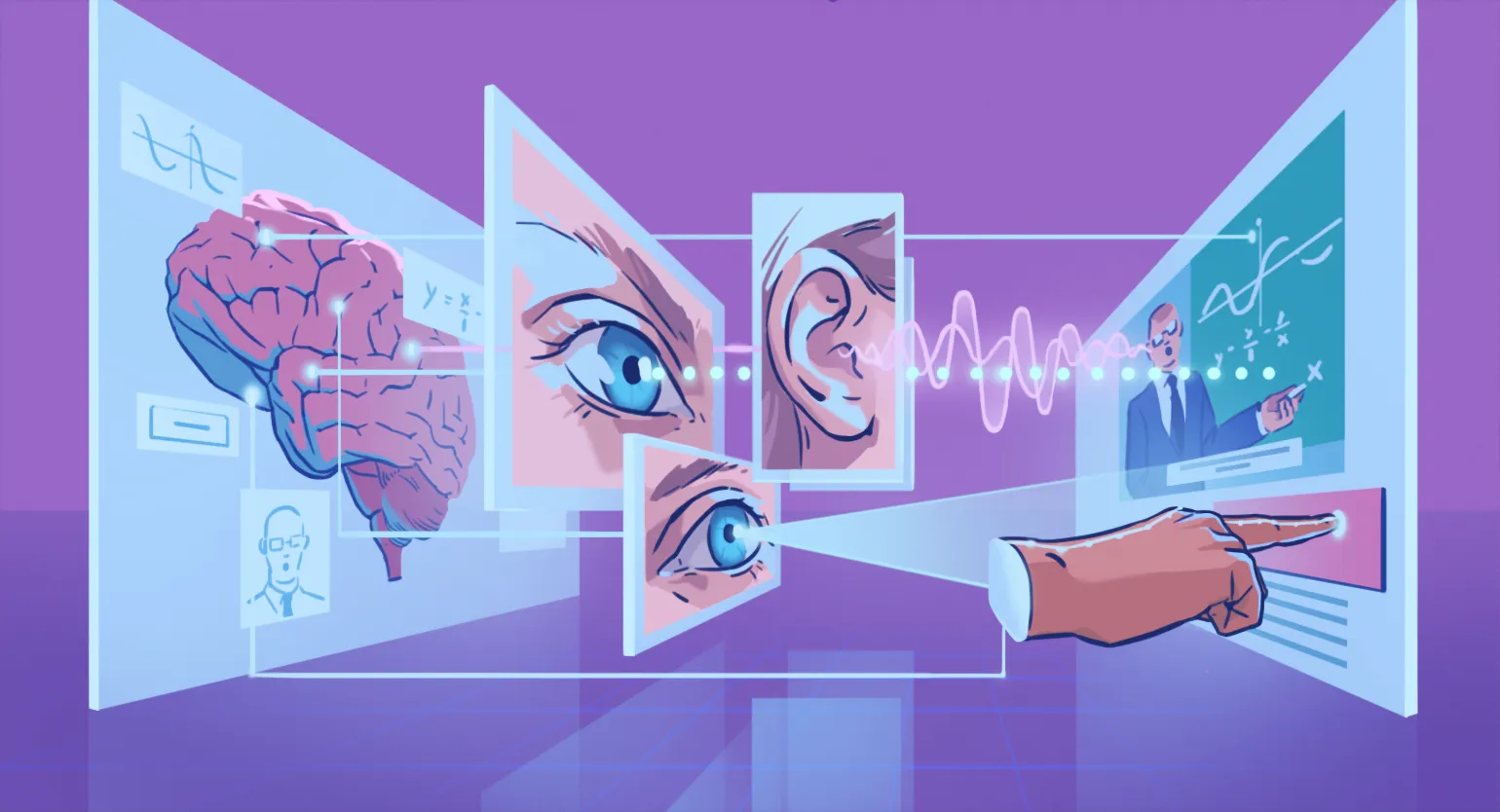
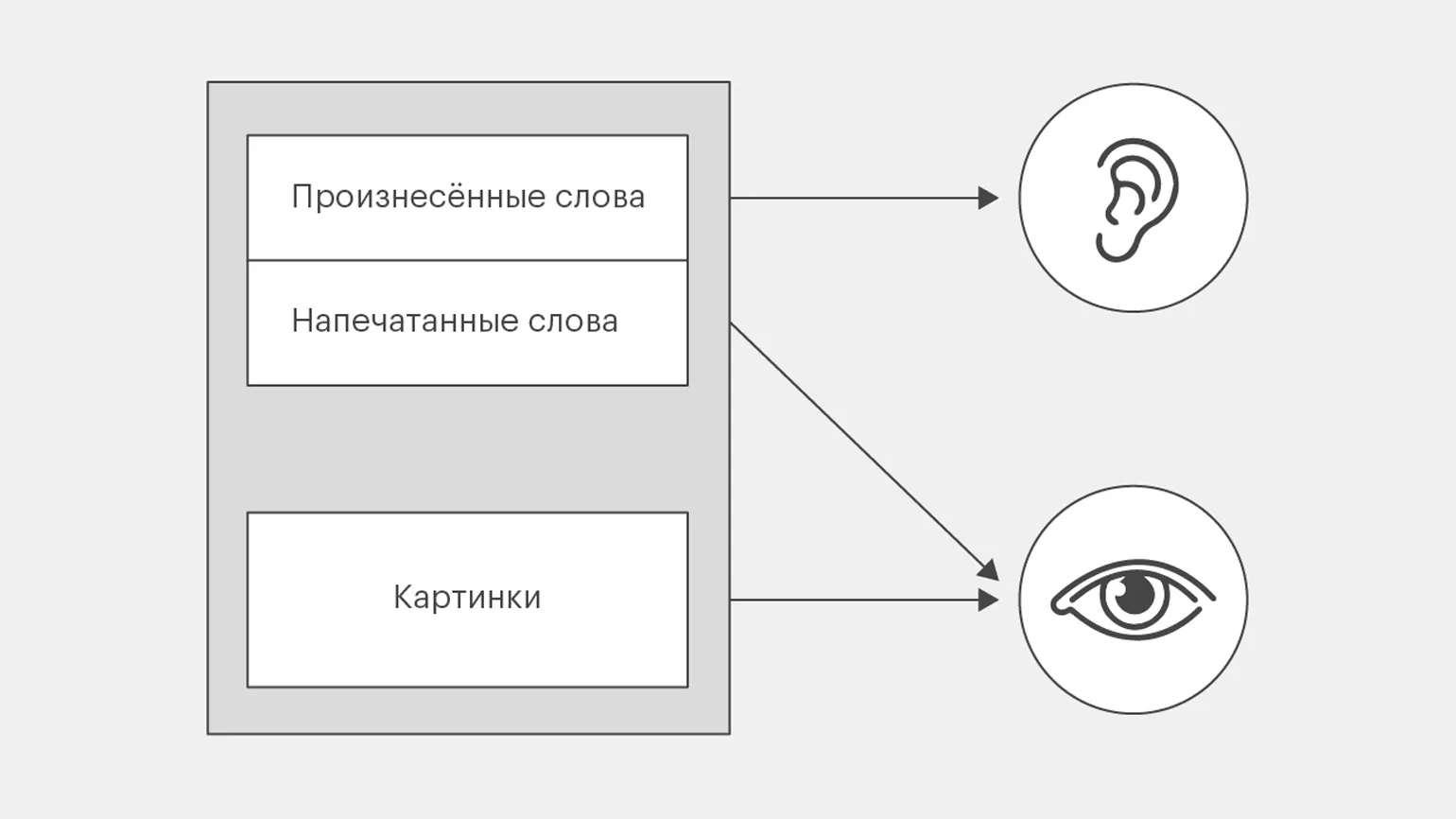
By channels we mean the modalities mentioned earlier. Mayer, like the author of the dual coding theory Paivio, argues that the simultaneous use of visual and auditory channels does not lead to an overload of short-term memory. On the contrary, it contributes to better memorization of information. When information is presented visually with a sequential verbal explanation, it is more easily perceived, and the brain more effectively transfers it to long-term memory. This approach to learning and presenting information can significantly improve comprehension and retention. Mayer emphasizes that the perception of verbal information presented in text occurs not only visually but also auditorily. When you read this article, you see the text, but you can also hear it if you are accustomed to silently speaking what you read. In this case, your auditory canal is actively engaged alongside your visual one. Therefore, it is important to avoid additional auditory strain. Therefore, listening to a verbal explanation is effectively combined with viewing visual materials, such as images or animations, but not with reading text. This allows you to optimize the process of perception of information and improve the assimilation of the material.
The brain and working memory can process a limited number of cognitive units, or new information, at a time. For example, try to accurately recall this short paragraph in a few minutes. This is a task that requires significant brain effort.
When a person perceives new educational information, it enters short-term working memory. At this point, the brain actively processes the data: it filters relevant information, organizes it into visual and verbal mental models, and then integrates it with existing knowledge in long-term memory. This process allows for the creation of connections between new and existing information, which facilitates more effective information acquisition.
When a person listens to or watches an explanation of a new topic, their brain actively and complexly processes information. Multimedia learning materials should support this process, not distract from it. High-quality learning resources, such as video tutorials and interactive presentations, can significantly improve learning by providing visual and audiovisual stimuli that promote understanding. It is important that multimedia elements are integrated logically and effectively, enhancing the perception and retention of information.
Excessive information in educational content can negatively impact learning. For example, if a presentation contains many brightly colored illustrations that are irrelevant to the topic, this distracts attention. In this case, the brain is forced to expend more resources filtering relevant information from irrelevant information. This can lead to short-term memory overload, which means important information is less easily retained and is not integrated into long-term memory. For effective learning, it is important to minimize distractions and focus on the key aspects of the material.
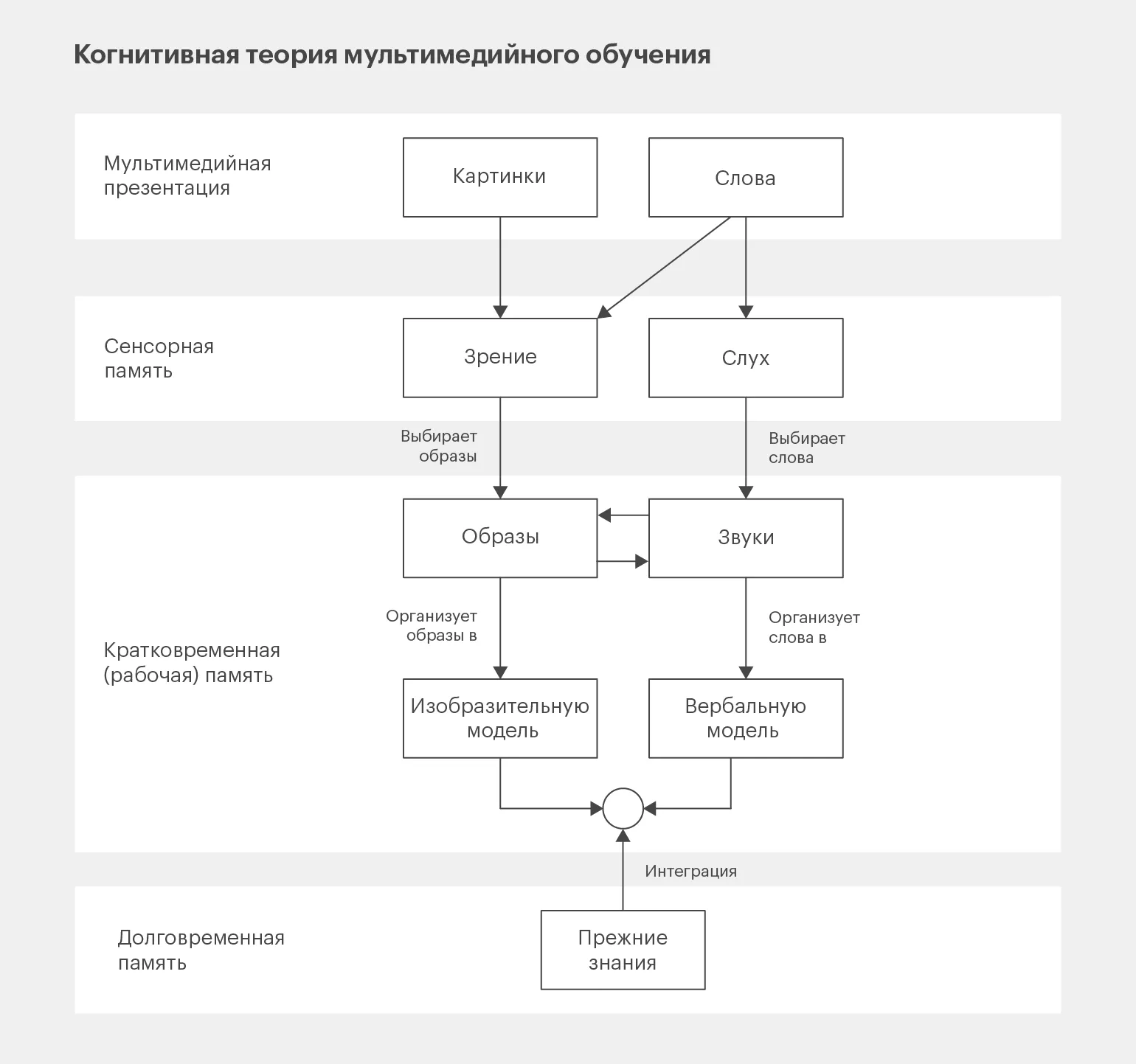
Richard Mayer's cognitive theory of multimedia learning is based on three key assumptions. These assumptions serve as the foundation for creating applied principles that will help in the design of effective educational content. In a separate article, we will examine these principles in detail so that you can improve your educational materials and increase their effectiveness.
Why Mayer's Theory Is Not Well Known in Russia
Russian scientific publications actively consider the theory of multimedia learning, as well as its application in various educational contexts. For example, at Tver State University, the principles of multimedia learning developed by Richard Mayer were used to select educational video materials for teaching foreign languages. At the St. Petersburg State University of Architecture and Civil Engineering, these same principles were applied in the development of presentation lessons in foreign languages. Such examples demonstrate the growing interest in multimedia learning and its effectiveness in educational practice. In the field of informal online education (EdTech) and corporate training, Mayer's theory of multimedia learning is more actively applied than in traditional educational content for schools, colleges, and universities. For example, Alina Sandarova, Head of Educational Content at the Skillbox platform, noted that the principles of this theory formed the basis for the development of content for versions 2.0 and 3.0 of the programs. This applies to various formats, including longreads and video lessons. The application of Mayer's principles is also supported by E-learning Center, a corporate training provider, as noted by Elena Tikhomirova, CEO of the company and author of the blog "Live Learning." The implementation of Mayer's theory facilitates the creation of more effective and engaging learning content, a key aspect of successful learning in today's environment. Multimedia learning theory has not yet been widely adopted in Russia, one of the reasons being the lack of Russian translations of Richard Mayer's works. Without accessible materials, Russian specialists face difficulties mastering the concepts presented in his research. Multimedia learning theory is typically learned by those delving into instructional design, for example, through courses for online learning methodologists and professional methodological communities. Increasing the availability of information on multimedia learning can contribute to its more active implementation in the educational process in Russia.
Educational Programs Methodologist
You will go through the full cycle of creating an educational product from scratch. Learn to design curricula for online and offline courses. Become a versatile specialist – you can launch your own project or get a job as a methodologist at a large company.
Find out more