Contents:

Course with Employment: "The Profession of Methodologist from Beginner to Advanced"
Learn moreWhat are the principles of multimedia learning based on?
Multimedia learning theory builds on a number of other theories that deepen our understanding of the process of perceiving and assimilating information. This theory emphasizes the importance of combining different formats of data presentation, such as text, images, and audio, to enhance learning. The interaction of these elements contributes to better memorization and understanding of the material. Expanding the context of multimedia learning through the integration of cognitive and constructivist approaches allows us to create a deeper and more multifaceted educational environment in which students can develop critical thinking and analytical skills.
- cognitive load (the essence of which is that it is important not to overload the student's working memory, that is, the operative memory, with an excess of information, otherwise the person will remember little of the new information);
- dual coding (the essence of which is that for better understanding and memorization, verbal information should also be visualized, that is, using two "codes" at once to convey it to students - words and visual images).
Initially, the theory of multimedia learning had 12 principles. However, after the publication of the first edition of the book "Multimedia Learning", work on this theory did not stop. In subsequent editions, Richard Meier and his team added three new principles, bringing the total number of principles to 15.
Mikhail Osipov explains that the principles can be divided into two categories: principles of content organization and principles of knowledge transfer. In this article, we will examine each category in detail. Some of the principles will be illustrated with examples created by Mikhail Osipov and the team at Elena Tikhomirova's eLearning Center, which will provide a better understanding of their application in practice.
Principles of Content Organization
This block includes nine principles describing how to effectively combine various content formats and ensure proper design. Although these principles are widely used today, it is worth noting that Richard Meier originally developed them for the design of multimedia slides in asynchronous online courses that are viewed as recordings. These principles help create more effective and understandable learning materials that promote better comprehension.
Examples of the principles are most effectively demonstrated on educational presentation slides. When using these principles in other multimedia learning materials, it is necessary to critically evaluate how each specific principle aligns with your educational objectives. This approach will help optimize the learning process and make it more effective.
People learn information more effectively when learning materials are focused solely on the topic. Removing unnecessary text that is not relevant to the learning, as well as unnecessary images and sounds, promotes better understanding and retention of the material. Clarity and simplicity in the presentation of information play a key role in the learning process, allowing students to focus on the main point and avoid distractions. Optimizing learning materials with these principles in mind can significantly improve their effectiveness and comprehension.
According to the principle of coherence, learning materials should include only those elements that contribute to the achievement of educational objectives. Excessive details and distractions should be eliminated, as they can create unnecessary cognitive load and divert students' attention from the learning task. This is essential for enhancing learning effectiveness and improving information retention. Proper content organization allows students to focus on key aspects and promotes a deeper understanding of the material.
When adding images to a presentation, it is important to consider their usefulness for comprehension. Ask yourself: "Do they contribute to a better understanding of the topic? Are they functional or merely decorative?" If you are unsure of their necessity or you realize that an image does not add educational value, it is best to avoid using it. An effective presentation focuses on the content, and each illustration should be justified and useful.
A similar approach should be taken with graphics, complex aesthetic elements, and unnecessary sound effects. This also applies to text - analyze it for redundant details that do not affect understanding of the main meaning, or interesting but useless elements. It is better to remove everything that is distracting and does not serve the purpose.
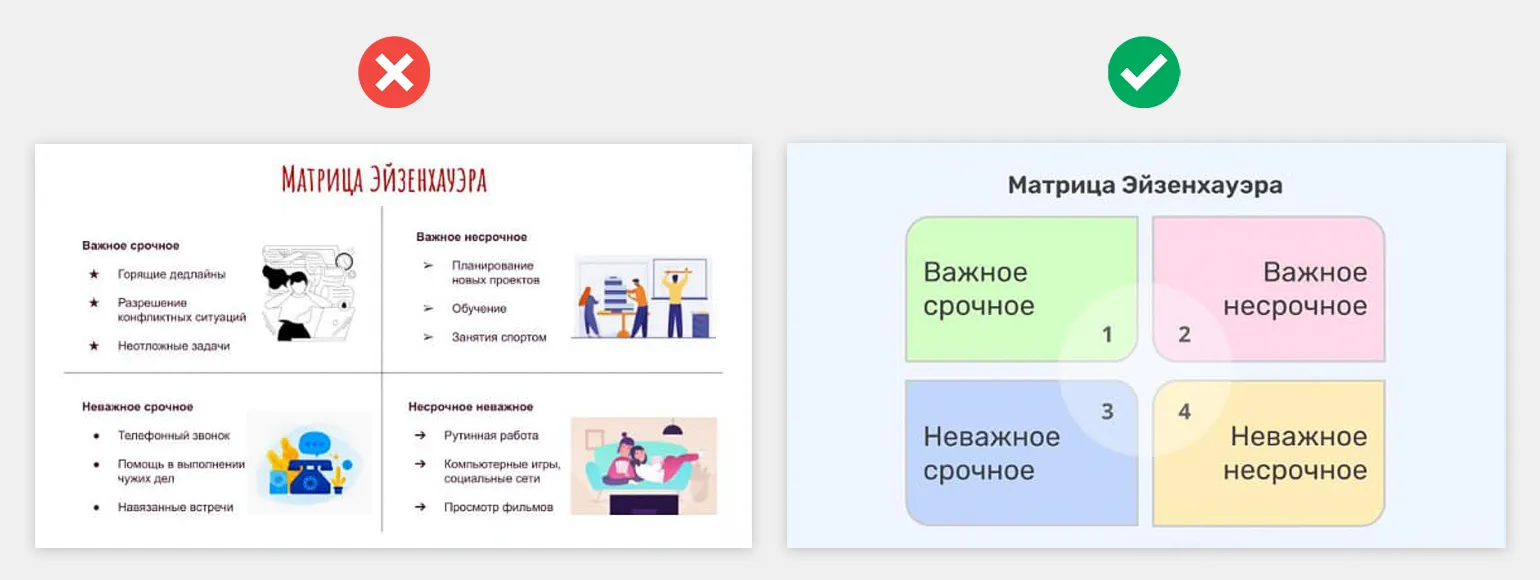
Research shows that people absorb information faster and more effectively when the material is organized and key points are highlighted. Simplifying the text structure and using visual cues, such as headings and highlights, promotes better comprehension and memorization. Clear organization and an emphasis on main ideas help the reader navigate the content and extract important information more easily. Thus, well-structured material not only facilitates the learning process but also significantly increases its effectiveness.
The screen or slide should clearly indicate to students what should be paid primary attention to. This can be done by using arrows pointing to key points, as well as by highlighting the main idea with a different font or color. In oral explanations, emphasis can be placed through pauses, intonation, or word emphasis, such as with the phrase, "Remember this fact; we'll come back to it!" This approach promotes better assimilation of the material and helps students focus on important information.
Research shows that people retain information better when it impacts two modalities – visual and auditory. Verbal information is remembered more effectively if accompanied by visual images, such as pictures or animations. This confirms the importance of using multimedia materials in training and presentations, as the combination of text and images helps improve comprehension and retention of information. Using such approaches in educational and advertising purposes can significantly improve the effectiveness of knowledge transfer and attract the audience's attention.
Dual coding theory states that information presented simultaneously in visual and auditory formats promotes better memorization and does not overload working memory. This approach works most effectively with images, as visual information is absorbed more easily than text. For optimal assimilation of educational material, it is recommended to combine verbal explanations with visual elements, such as illustrations, infographics, photographs, and animations. This allows for a more complete perception of information and improves the learning process.
It is important to remember that illustrations do not simply refer to any images, but rather those that have educational value and facilitate the assimilation of the material. The use of such illustrations will help create a consistent perception of information and improve the educational process. Ineffective images without educational value can only distract and confuse, so they should be avoided.
Research shows that users who took e-learning courses with animation and consistent oral explanation successfully assimilate the material better than those who studied with animation without oral accompaniment and textual reading materials. This emphasizes the importance of integrating audiovisual content into educational platforms to enhance learning.
Research shows that people perceive information more effectively when it is presented in a format that combines visual elements and oral explanation. This approach significantly improves the assimilation of the material compared to traditional methods that use visuals, oral explanations, and text. An optimal combination of visual and verbal formats promotes better understanding and retention of information, making it an effective tool in educational and professional processes.
A presentation should avoid repeating the same information in text, graphics, and audio formats simultaneously. This leads to redundancy, especially in the case of text. According to the principle of modality, the most effective way to convey information is a combination of verbal explanation and visual elements. This approach allows for better assimilation and retention of material, as it activates different sensory channels.
Reading text and listening to audio do not always combine well, as many people silently repeat the text when reading. This leads to the activation of both visual and auditory perception channels. An oral explanation provided off-screen places additional strain on the auditory canal, which can hinder the process of information comprehension. While reading, a person may move faster than the off-screen speaker speaks, resulting in a conflict between the internal voice and the speaker's voice. This can reduce the effectiveness of learning and information comprehension.
While on-screen text shouldn't be completely eliminated, its volume should be minimized, especially when key information is presented in audio format. A concise summary of key points and a list of sources is optimal. This will help focus viewers' attention on the audio message while maintaining accessibility to important information.
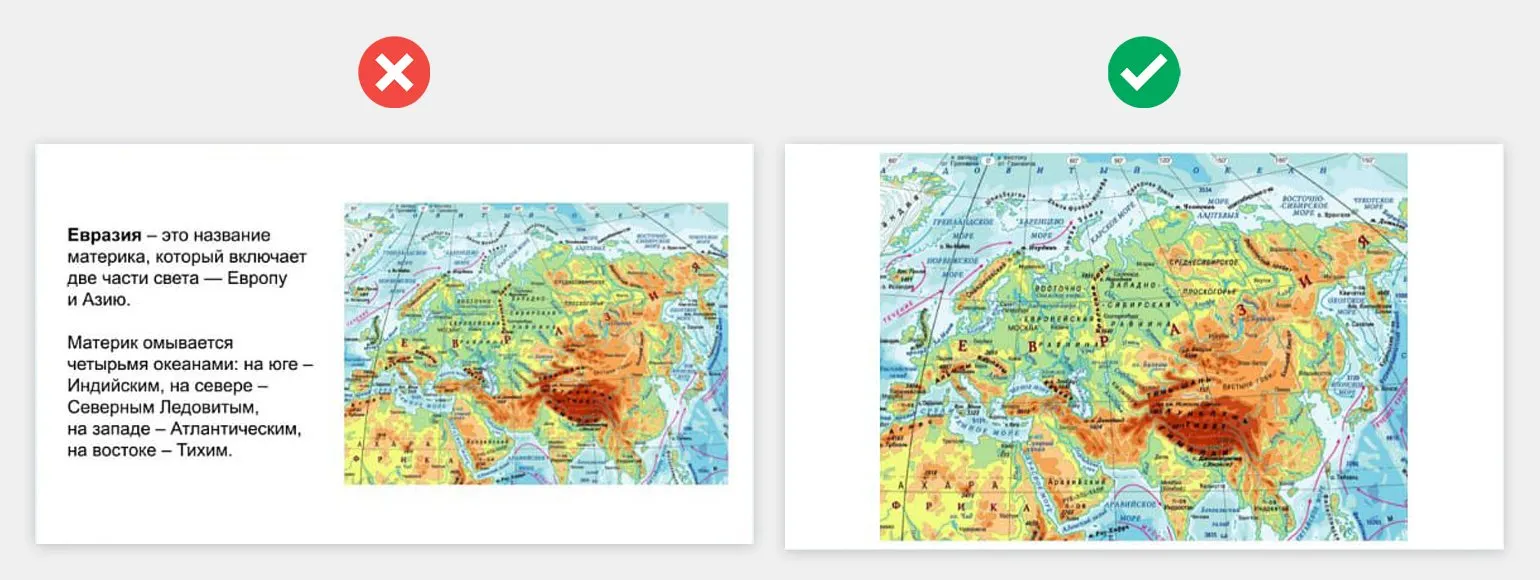
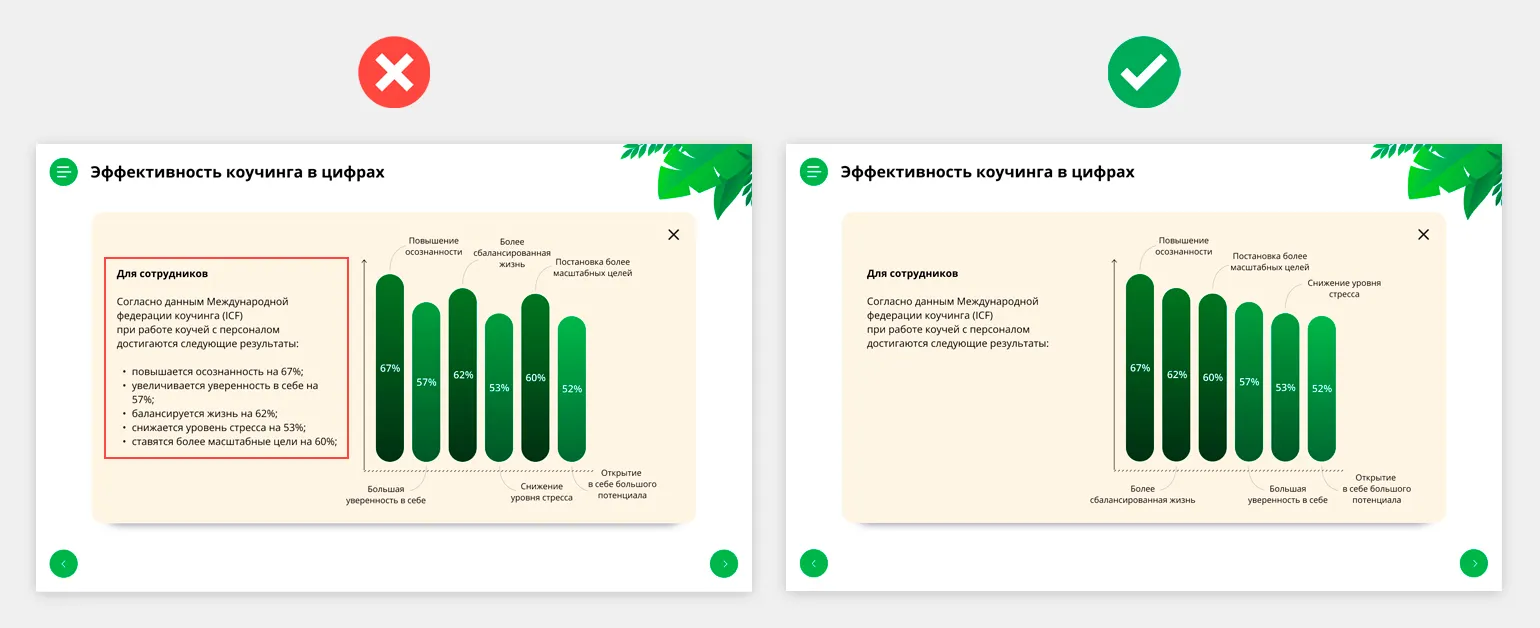
Research shows that people perceive information more effectively when it is presented using both words and images. This approach promotes better comprehension and memorization of the material. Combining text and visual content activates different areas of the brain, which helps to assimilate information faster and more deeply. Visual elements such as graphs, charts, and images emphasize key points and make learning more interactive. Thus, the use of words and images in the educational process significantly increases its effectiveness.
Research shows that effective assimilation of educational information is achieved with a combination of verbal explanation and visual accompaniment. When a text explanation is used, it should be supplemented with illustrations. This is related to dual coding theory, which states that information is better perceived when presented in multiple formats. Therefore, the use of graphic elements and images helps improve comprehension and retention of material, making learning more productive. It's important that images in content serve not only an aesthetic purpose but also effectively convey meaning, complementing textual information. Visual elements help students better perceive and retain new material by creating mental models that facilitate retention. Correctly selected images contribute to a deeper understanding of the topic and make learning more effective.
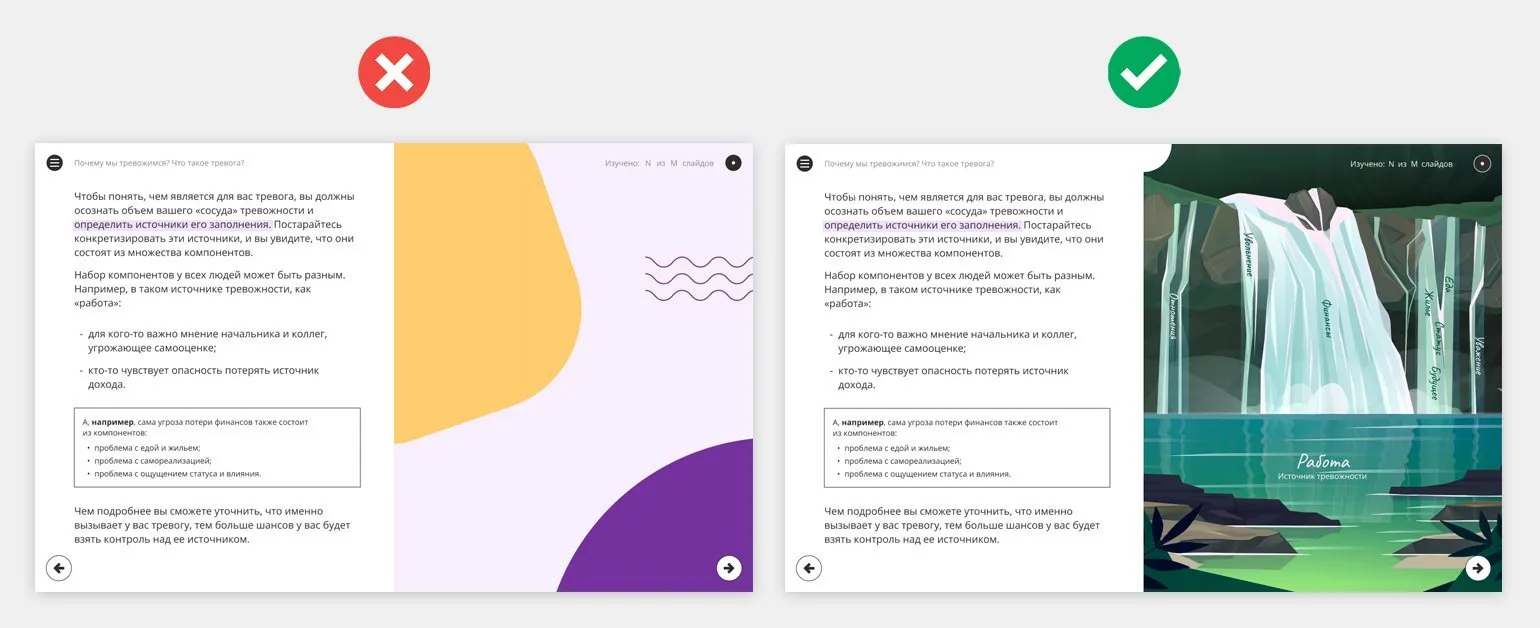
Research shows that students retain information more effectively when illustrations and corresponding captions are placed next to each other. This juxtaposition of visual elements and textual content helps improve comprehension and retention of the material. Proper placement of images and captions helps create connections between them, which, in turn, strengthens the educational process. Therefore, to improve the quality of learning, it is important to consider the placement of illustrations and their descriptions in educational materials.
Concentrating an illustration and caption on one slide simplifies information perception. When an image and its description are close together, viewers do not need to make additional efforts to connect them. This predictable placement helps reduce cognitive load, making the information more accessible and understandable. Proper placement of elements on a slide improves comprehension and helps better absorb the material presented.
The principle of placing related elements close together applies not only to images and their captions, but also to other related components. For example, tasks and instructions for completing them, as well as questions and answers, should be placed in close proximity to one another. This improves information comprehension and promotes more effective user interaction with the content. Correct placement of elements helps create a logical structure and makes it easier to find the necessary information.
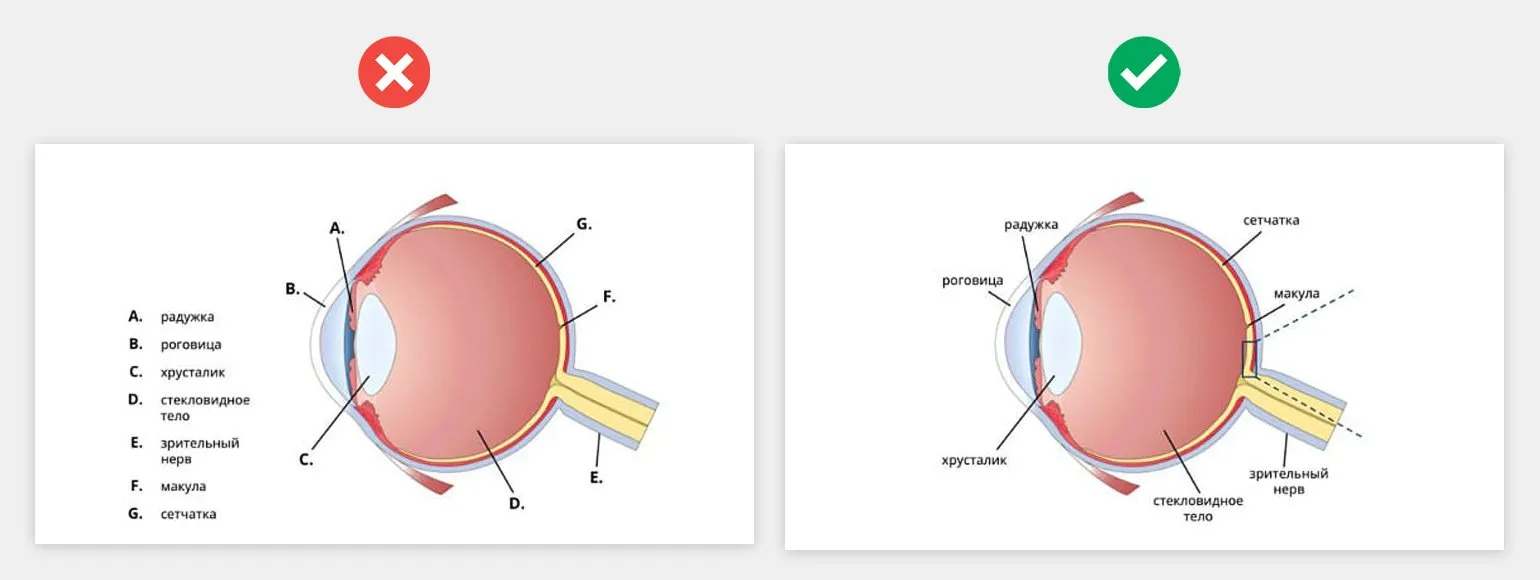
Students learn more effectively when illustrations and oral explanations are presented simultaneously, rather than alternately. Synchronous presentation of information promotes deeper understanding and retention, as visual and audiovisual elements interact, enhancing perception. This approach is especially important in the educational process, where the combination of different teaching methods helps create a more dynamic and productive atmosphere for students. The use of synchronous illustrations and explanations can significantly improve the quality of learning and improve learning outcomes.
During a physics lesson, the teacher often comments on what is happening in real time while demonstrating an experiment. This principle is also relevant for online courses. The simultaneous use of visual and auditory perceptions promotes better assimilation of material, as information is presented verbally and figuratively. If information is first presented and then shown (or vice versa), this can negatively impact the quality of students' mental processing of new information. Therefore, the integration of commentary and demonstration is a key aspect of effective learning both in the classroom and online.
Research shows that people absorb information more effectively when multimedia messages are divided into small segments or blocks. Each block should be adapted to the optimal pace of perception, which improves comprehension and retention of the material. Instead of absorbing a large amount of information in one continuous stream, breaking it down into sections promotes deeper analysis and assimilation of the data. This approach to presenting information makes it more accessible and easier to perceive, which is especially important in the context of today's information society.
Dividing educational content into short, clear blocks is an important strategy. This helps reduce the cognitive load on listeners and significantly facilitates the process of memorization. This approach promotes better knowledge retention because students can focus on each element without overloading their minds. Effective structuring of the material promotes increased activity and engagement, which in turn leads to a deeper understanding of the subject. It's important to allow students to control the pace of their learning, especially in an asynchronous format. This can be accomplished with a speed slider and a "next" button to move to the next slide or section. Research by Richard Meier has shown that students who have the opportunity to control their own learning pace perform better on recall tests. This approach promotes more effective assimilation of the material and increases the level of student engagement.
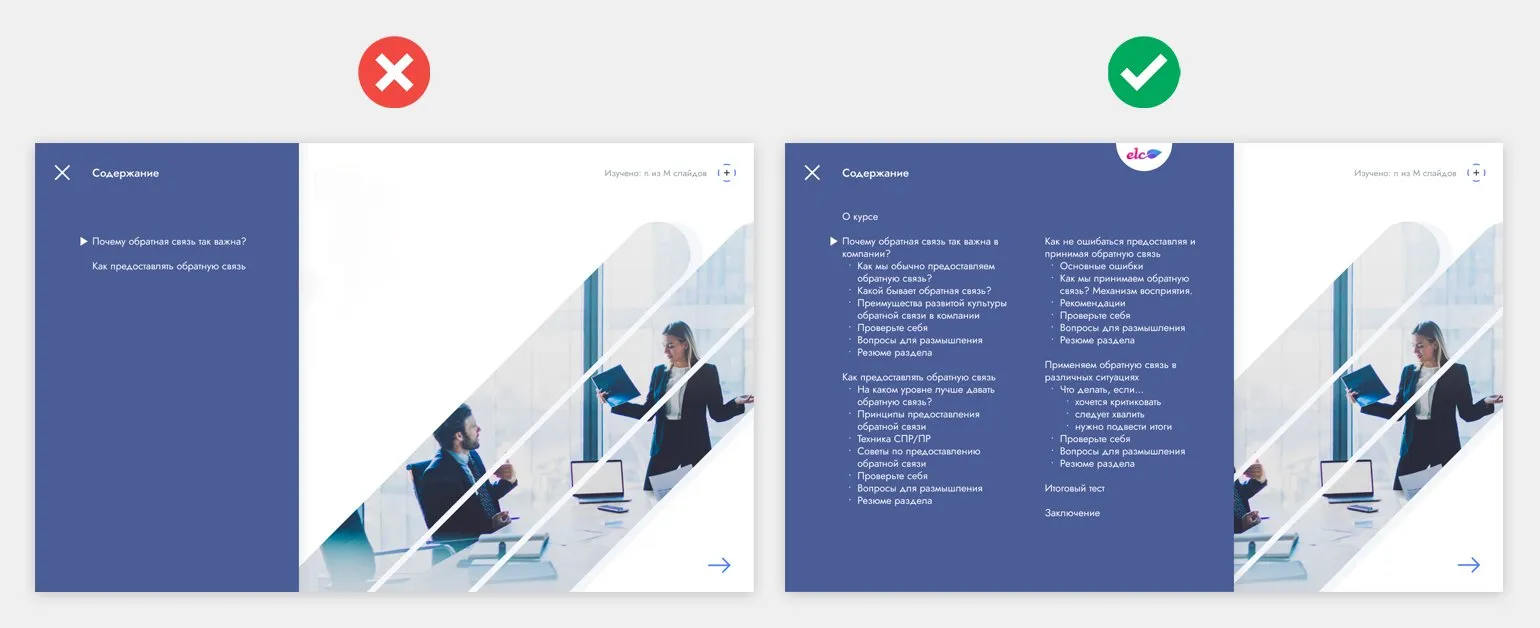
Research shows that retention of information from multimedia messages is significantly improved when audiences are familiar with the terms and concepts mentioned in the content. This is because prior knowledge creates a foundation for better understanding and interpretation of the presented data. When people have the necessary terminology, they perceive and analyze information more easily, which contributes to a deeper understanding of the topic. Therefore, to increase the effectiveness of multimedia materials, it is important to familiarize viewers with key concepts and terminology beforehand.
The principle of pre-training is that learners should have background knowledge and a glossary before delving into a topic, especially if they are new to the topic and it has a lot of specific terminology. This will help build a solid foundation for further study. To effectively prepare students, it is recommended to provide them with clear instructions and materials that will help them understand key concepts. This will help them better understand the topic and learn the material faster.
- Create an introductory guide or conduct an introductory lesson on the basic concepts of the course topic;
- Provide definitions of terms (glossary) at the beginning.

What all the principles of content organization boil down to
Elena Tikhomirova emphasizes the importance of the correct combination of various media elements in designing according to Mayer. The main idea is the harmonious interaction of sound and text, images and text, as well as the combination of all three components: picture, text and sound. This combination promotes more effective perception of information and improves the learning process. The correct use of media allows you to create richer and more memorable educational materials.
It is important to note that the key aspect is not the number of illustrations, audio explanations and text in the course, but their synchronous combination. Effective learning is achieved when text and images are displayed simultaneously, audio explanations accompany visual content, or all elements interact with each other. This approach promotes better retention and increases student engagement. The synergy of these components creates deeper understanding and makes the learning process more engaging and productive.
There are three main methods of delivering information in an online course. The first is video content, which allows learners to perceive the material visually and also provides the opportunity to demonstrate complex topics. The second method is text content, which includes articles, course materials, and assignments that promote a deep understanding of the course material. The third common means is interactive content, such as tests and quizzes, which help consolidate knowledge and increase student engagement. These three methods effectively complement each other, creating a complete and engaging learning environment in online courses.
- visual images (illustrations, graphs, animation);
- audio recording with an oral explanation of the topic;
- textual explanation.
According to Mayer's theory, for the effective delivery of new information, it is optimal to use a combination of these two formats, rather than limiting yourself to one or all three simultaneously. The synchronous combination of verbal and visual presentation of information significantly facilitates its perception and promotes better memorization. This allows for a more complete and structured understanding of the material, which is especially important in educational and training contexts. The correct combination of formats helps activate different channels of perception, which, in turn, improves understanding and assimilation of information.
- The ideal option is to combine visual presentation with audio (that is, images with synchronous oral explanation).
- Combining text explanations with images is also acceptable, but this option is less effective.
- However, synchronously combining text explanations with audio (oral explanation) is not recommended; this option is the least effective. Simply put, there is no need to repeat what is already written in the presentation.
The second key idea of the principles of multimedia learning is that all elements should be organized in such a way as to minimize the cognitive load on the learner. This means that information should be presented logically, interconnectedly, and concisely, without unnecessary details, to ensure comfortable perception. Richard Meyer explains in detail what is meant by the terms "logical" and "convenient", emphasizing the importance of proper structure and presentation of training material for its effectiveness.
Principles of Knowledge Transfer
This block includes six basic principles that should be considered when developing materials in both synchronous and asynchronous formats. These principles apply not only to presentation slides but also to more modern technologies. It is important to note that the pace of technological innovation significantly outpaces the accumulation of an experimental base on them.
People absorb information more effectively when it is presented in a conversational style. This approach makes the material more accessible and understandable, which contributes to better understanding and memorization. Using a lively and natural language helps establish a connection with the audience, which in turn increases interest in the topic. A conversational style avoids complex terms and formalities, which makes the information more attractive and easier to perceive. As a result, readers or listeners can more quickly grasp the essence of the material and apply the acquired knowledge in practice.
Official jargon and professional terminology hinder the perception of information, increasing the cognitive load. A person must "translate" complex formulations into more understandable language. Therefore, the topic should be explained in a simple and accessible style. Using clear and conversational language promotes better understanding and assimilation of information, making it more accessible to a wider audience.
The teacher's relaxed tone of communication creates a sense of individual attention in each student. This contributes to increased motivation and attention to the material, as students feel that the information is addressed specifically to them. Thus, creating a comfortable atmosphere during the learning process positively influences the perception and assimilation of knowledge.
Mikhail Osipov, in his commentary for Skillbox Media, explains that this principle applies to all forms of communication with students. This applies not only to teachers, but also to mentors, curators, and everyone who interacts with students. This approach ensures more effective and productive communication, promoting better understanding and retention of the material.
Research shows that people perceive information better when it is presented in a human voice rather than a synthesized one. A human voice evokes greater trust and emotional connection, which contributes to better retention and comprehension of the material. Using natural sound in audio content can significantly improve its effectiveness. This opens up new opportunities for learning and communication, as users become more engaged and interested. It is important to consider this aspect when creating audio materials and choosing appropriate technologies for their voiceover.
A live human voice can more accurately convey emotion and the meaning of information compared to a computer simulation. The first thing that comes to mind is the artificial voice often used by bloggers on TikTok. Mikhail Osipov, commenting on this aspect for Skillbox Media, cites research by Richard Meier, according to which even a voice created by artificial intelligence and as close as possible to a human voice is perceived as worse than a real human voice. This emphasizes the importance of live communication in the context of conveying information and interacting with the audience.
Research shows that effective information absorption does not require the presence of a teacher on the screen. It is important that the educational content is structured and presented in an understandable form. Audiovisual elements such as graphs, diagrams, and text explanations can significantly improve the level of comprehension of the material. Using a variety of teaching methods, including text descriptions and visual cues, allows you to focus on the content, rather than the appearance of the teacher. This approach promotes deeper understanding and memorization of information. Thus, effective learning is possible without the visual presence of a teacher, which opens up new opportunities for distance education and self-study.
Richard Mayer advises avoiding the use of "talking heads" in asynchronous courses. Instead, he recommends using presentations containing illustrations and text. This approach helps better retain learners' attention and promotes more effective perception of information. Visual elements that support the text help create a more interactive and memorable learning experience, which can ultimately lead to better student outcomes. A speaker's image is essential for building trust and credibility with the audience. It allows for an emotional connection with listeners, which facilitates better information comprehension. The right image helps emphasize professionalism and competence, and draws attention to the ideas and materials being presented. Developing a speaker's image includes not only appearance but also communication style, level of preparation, and the ability to adapt to the audience's interests. An effective speaker image can significantly improve the quality of the presentation and its perception.
- demonstrate the teacher's involvement in the creation of the course;
- convey the teacher's personal position on the lesson topic;
- retell the material in the teacher's own words;
- make an emotional emphasis.
Read also:
There are several opinions on whether a teacher should appear on camera during a video lecture. Some believe that the teacher's visual presence promotes better comprehension of the material and creates a more personal interaction with the audience. Others argue that the main focus should be on the content of the lecture, not the lecturer's personality. It is important to keep in mind that the choice depends on the topic of the lesson, the target audience, and the format of information delivery. Teachers can experiment with different approaches to determine what works best for their particular case.
People absorb information more effectively when on-screen characters use human-like gestures, movements, and facial expressions, and also establish eye contact. These elements of interaction create a more natural environment for perception and increase audience engagement. Empathy and connection with the characters contribute to a better understanding of the material being presented. Using such techniques in educational and entertainment videos can significantly improve learning outcomes and information comprehension.
Currently, animated and drawn characters are becoming increasingly popular in educational courses. Research shows that imbuing characters with human traits, such as facial expressions and emotional expressions, significantly increases student engagement and retention. Using such characters not only makes learning more engaging but also promotes better retention of the material.
For online teachers, facial expressions and nonverbal cues play a key role in communication with students. These elements help create more effective interactions and establish trusting relationships. Teachers who are proficient in using nonverbal communication can better convey their thoughts and ideas, as well as maintain the interest and attention of their students. In an online learning environment, it is important to consider how visual aspects of communication can influence the perception of information and the overall atmosphere of the lesson.

Read also:
Adding interactivity to a course using characters is an effective way to increase student engagement and improve the learning process. Characters can serve as guides through the material, helping to create an emotional connection and make learning more engaging.
To successfully integrate characters into a course, it's important to consider their characteristics and roles. They can be mentors who guide students, or competitors who create elements of competition. This approach not only makes lessons more engaging but also promotes better retention of information.
Use dialogue and scenarios to have characters interact with students, asking questions or proposing tasks. This allows students to not only absorb information but also actively participate in the process, significantly increasing the effectiveness of learning.
Also, consider visual and audiovisual elements. Animation, graphics, and character voiceovers can make lessons more dynamic and engaging. Online learning platforms often offer tools for creating such elements, making them easy to integrate into the learning process.
Therefore, using characters to add interactivity to a course not only improves comprehension of the material but also makes learning more engaging and effective.
3D immersive virtual reality does not always provide better learning outcomes than 2D computer presentations. Research shows that while 3D visualizations can create a more immersive experience, this does not always lead to more effective information retention. Traditional 2D methods can sometimes be more understandable and accessible. It is important to consider that learning effectiveness depends not only on the format but also on individual learners' preferences and learning styles. Therefore, to achieve the best educational outcomes, it is worth considering a variety of approaches, including both 2D and 3D formats.
Before developing VR training, it is important to determine whether the additional sensory load actually improves learning outcomes. In practice, this is not always the case. Moreover, complex technical solutions do not always guarantee greater effectiveness than simpler methods. Therefore, it is important to carefully analyze learning needs and goals to select the optimal approach that will be truly effective.
Research confirms that learning is more effective when students receive guidance and support while completing generative learning tasks. Approaches based on mentoring and support help students develop deeper understanding of the material, critical thinking, and creativity. Guidance during the learning process promotes a deeper understanding of the subject matter, which is especially important when solving complex problems. Therefore, integrating support into the learning process can significantly improve learning outcomes and prepare students for real-world challenges.
Gererative learning tasks encourage students to connect new information with their existing knowledge. Such tasks include reflection, mind mapping, and pair work. These tasks require active student participation in the learning process. Success in completing such tasks is easier if clear instructions and teacher support are provided.
Can you trust Richard Meyer's principles?
The principles proposed by the researcher may seem simple and obvious. Italian experts, studying the role of illustrations in learning, conducted a series of experiments and found that even those unfamiliar with Meyer's theory intuitively came to similar conclusions. This confirms the undeniable value of his work: the principles are based on scientific data and evidence, which is what makes them so popular and effective in educational practice.
Multimedia learning theory, unlike many popular but ineffective educational approaches, is based on reliable scientific research and justification. Richard Meyer and his team conducted over 200 experiments to test each of the principles, repeating them multiple times to increase the reliability of the results. These studies confirm that multimedia elements such as text, images, and audio can significantly enhance the learning process, promoting better information absorption. Developing effective educational programs that utilize multimedia learning principles can lead to improved learning outcomes and comprehension.
For decades, Mayer's theory has been studied not only by his followers but also by many other scholars, including Russian researchers. A striking example is a recent meta-meta-analysis conducted by Australian researchers. This study analyzed 29 systematic reviews that summarized the results of numerous scientific studies. Ultimately, the articles included data from 1,189 experiments involving more than 79,000 participants. This large-scale analysis confirms the significance and relevance of the theory, opening new horizons for further research.
Most design principles based on multimedia learning theory are robustly supported in systematic reviews and meta-analyses. Moreover, we found confirmation of the core premises of the cognitive theory of multimedia learning: learners integrate information more effectively when it is presented both visually and auditorily. This is possible provided that measures are taken to reduce the risk of cognitive overload.
Multimedia learning theory, based on a thorough collection of evidence, occupies an important place in modern instructional design. The principles proposed by Richard Mayer are applied not only to the development of slide courses and teaching materials, but also in a broader context. They serve as the basis for the creation of tools for assessing the quality of visual materials in textbooks and the development of digital library resources, which makes learning more effective and accessible. The implementation of these principles helps improve the perception of information and increase the level of knowledge acquisition by students.
Why Mayer's principles are criticized
Despite the extensive evidence base, researchers note a number of shortcomings in existing theories. One of the critics was Australian educational psychologist John Sweller, the author of the cognitive load theory. He questioned Richard Mayer's basic assumption that the simultaneous use of visual and auditory channels of information perception contributes to the effectiveness of learning. Sweller and his colleagues argue that this practice can reduce a person's cognitive resources, which is important to take into account when developing educational methods.
The researchers cite the theory's shortcomings as ignoring student motivation and their individual information processing abilities. A lack of motivation or stress can significantly reduce working memory resources. At the same time, course elements that seem redundant from the point of view of the principle of coherence actually contribute to student engagement and retention of their attention. Individual characteristics also play an important role: some students are able to focus on a long lecture by a teacher, while others lose their focus after just a few minutes. This emphasizes the need to consider student diversity for more effective learning.
When using multimedia learning principles, it is important to consider additional aspects. Learning effectiveness can be significantly improved by using a variety of methods and approaches. It is important to integrate text, images, audio, and video to ensure a multifaceted perception of information. Individual learners' characteristics should also be taken into account in order to tailor materials to their needs. Practical application of theoretical knowledge, as well as the creation of interactive elements that promote active engagement, play a key role in successful multimedia learning.
- The more experience and knowledge the learners have, the less effective these principles are.
Mayer's principles are designed for students with limited educational experience. Mikhail Osipov emphasizes that applying these principles to teaching people with more experience will lead to lesser effectiveness. This is important to consider when developing educational programs in order to adapt approaches to different levels of student preparation and improve learning effectiveness.
People with extensive learning experience have the skills to effectively retrieve the necessary information, including working with long and complex texts, as well as studying materials presented in an inconvenient format. Reducing cognitive load is unlikely to significantly improve their learning effectiveness, especially when the load level is already high. These skills enable them to adapt to new knowledge more quickly and successfully apply it in practice.
- Mayer's principles are not suitable for everyone.
Elena Tikhomirova emphasizes that although many of the principles of multimedia learning have an empirical basis, their application should be determined by the educational context. For example, the principle of segmentation, which involves dividing the material into smaller parts, will not have a significant effect if the material itself is simple and presented at a slow pace. Similarly, the principle of redundancy may be ineffective for visually impaired students. This suggests that the application of multimedia learning principles requires consideration of both the individual characteristics of students and the nature of the educational content itself. Correct adaptation of these principles contributes to a more effective learning process and improves its quality.
- Mayer's principles alone are not enough for high-quality design.
The principles described are clear enough, but do not cover all aspects of the importance of visual design. For example, Richard Meier doesn't emphasize the importance of color enough, which is critical for the design of e-learning materials. Inappropriate color choices, such as using lime-green text on a bright yellow background, make the material difficult to read. This also applies to low-quality images and videos. Therefore, it's important to pay attention to visual clarity and clean design to ensure a comfortable user experience, which in turn positively impacts learning effectiveness. Experts emphasize that Richard Meier's principles are guidelines, not rigid rules. While they can serve as valuable guidance, the target audience, expected learning outcomes, and available technical resources should remain the primary factors when developing any course or educational material. Taking these aspects into account will allow us to create more effective and tailored educational solutions that meet the needs of learners.
Study additional materials:
- 10 design mistakes that will ruin an online course
- Why is it difficult for students to study online and how to make this process easier
- Cognitive learning: what is this approach and why is it important
- What influences attitudes towards the digital educational environment?