
Contents:

Head of Educational Experience at Business Tools and a methodologist for microlearning educational content on the SwipeLMS platform. Over ten years of professional experience in adult learning, including roles as a teacher, trainer, online course developer, and methodologist. Specializes in creating effective training programs and materials that promote skill development and professional development.
This article is based on the webinar "Microlearning: A New Format of Effective Corporate Training," conducted by Skypro. The webinar focused on the concept of microlearning, which is an innovative approach to employee training. This training format involves the use of short, concentrated training modules, which allows employees to absorb information faster and more effectively. Microlearning is ideal for corporate environments because it provides flexibility and allows for the integration of training into daily activities. Webinar participants discussed the key benefits of microlearning, such as increased employee engagement, improved information retention, and the ability to tailor the learning process to individual needs. With microlearning, companies can optimize their training programs and improve overall team productivity. Microlearning, or microlearning, is a modern approach to learning that delivers educational content in compact and accessible formats. The basic idea is that information is delivered in small chunks on a regular basis, which promotes better absorption and retention of the material. Microlearning formats include short articles, checklists, short exercises, and video tutorials lasting as little as ten minutes. This method is ideal for today's environment, where people often lack time for lengthy training, and allows for the effective acquisition of new skills and knowledge at a comfortable pace.
When it becomes necessary to teach employees a new skill, for example, handling objections, managers often perceive the process as linear. Employees initially lack the necessary knowledge, and then, after completing training, they move on to practice, where they apply the acquired skills. However, this process involves many stages, such as assessing their current level of competence, adapting training to the team's needs, and subsequently monitoring progress. Effective training requires a comprehensive approach that takes into account the individual characteristics of employees and creates the conditions for their further development.
From the learner's perspective, the process of mastering new skills and knowledge appears completely different. In their book "Innovative Productivity Support," methodologists and experts Konrad Gottfredson and Bob Mosher presented a visualization of the competency acquisition path in the form of curved lines. This framework emphasizes the cyclical and iterative nature of learning, rather than the linear one, which involves constant repetition, practice, and adaptation to new conditions. This approach allows for a better understanding that the learning process requires time and effort and can also include mistakes and failures, which are an essential part of successful skill acquisition.
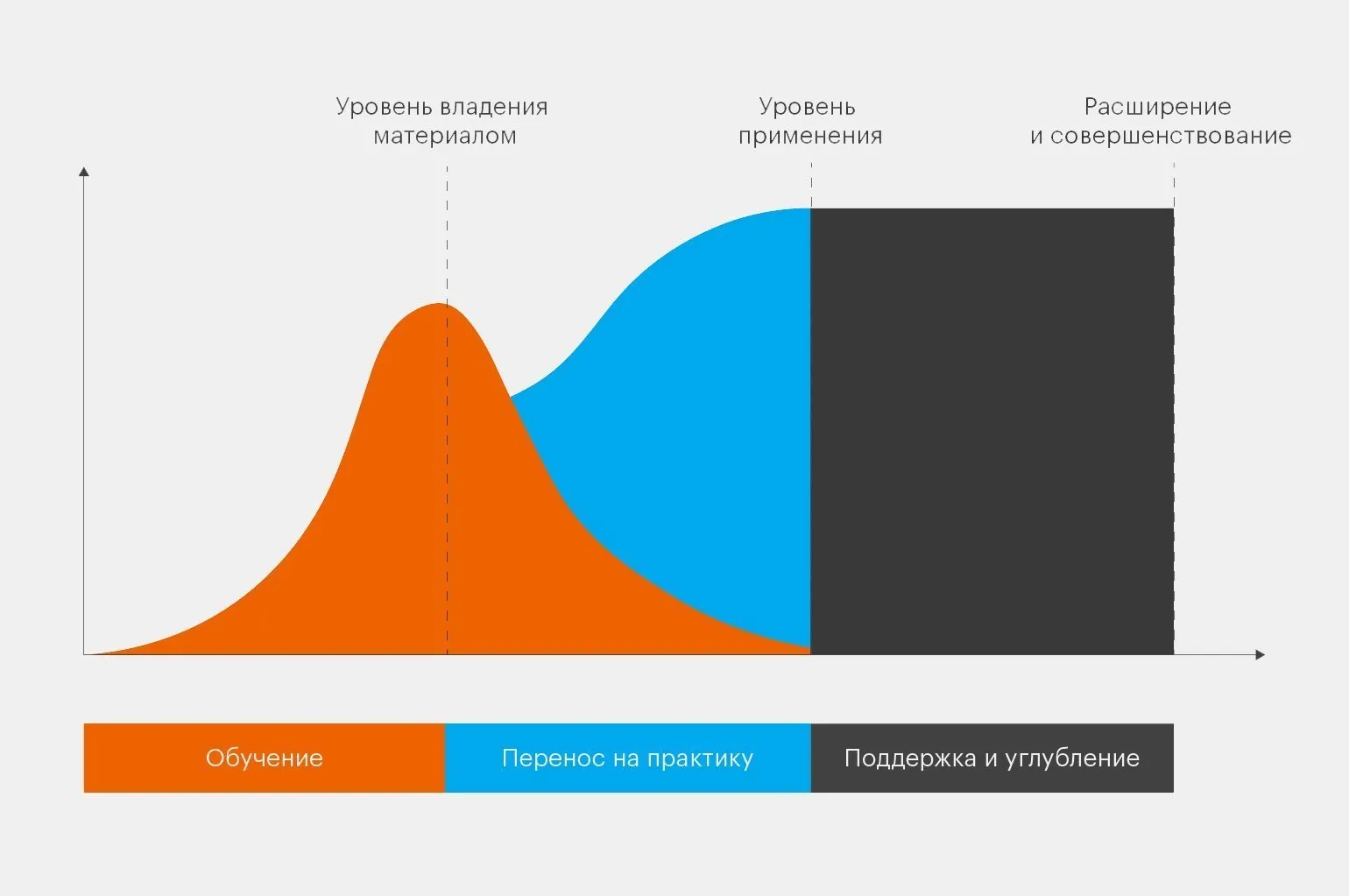
Learning, shown in orange on the diagram, plays a key role in the process of assimilation of material. With proper organization, which includes a competent structure and practical work, a student is able to move from a basic level to a high level of knowledge. However, according to the well-known forgetting curve, the level of material assimilation declines over time. In the late 19th century, the German scientist Hermann Ebbinghaus found that a person forgets more than 60% of information within a day of studying it. After a month, less than 20% of the studied material remains in the memory. This theory has been confirmed by numerous studies by modern scientists, which emphasizes the importance of effective study methods and regular practice for knowledge consolidation.
To effectively combat forgetting, it is important to provide opportunities to apply new skills and review what has been learned immediately after learning. This stage, shown in blue on the diagram, is key to material assimilation. In this context, microformats such as practical exercises, reminders, and checklists become indispensable tools. They help overcome the "know-but-don't-do" effect and foster the formation of new habits and work methods. Using these resources not only strengthens knowledge but also promotes its active application in practice.
Once knowledge has been transferred to practice, the third stage begins—skill maintenance and deepening. At this stage, a person achieves mastery, freely and creatively applies acquired abilities, and continues their development. It is important not only to consolidate skills but also to actively seek new ways to apply them, which contributes to the further improvement and deepening of professional competencies.
At this stage, microlearning will become a useful tool for deepening and expanding professional skills. For example, if an employee has mastered handling customer objections, they can move on to learning conflict resolution and closing techniques. Regularly introducing new material in small increments will allow it to be effectively integrated into daily activities. This approach not only promotes the development of key competencies but also improves overall work efficiency. Organizing the educational process is an important and complex task. There is a common misconception that if an employee is motivated to develop and understands the value of learning, they will easily complete the course and move on to practical application of their knowledge. However, in practice, this is not always the case. Motivation can quickly fade when faced with routine or distractions. Relying solely on an employee's willpower and self-management skills in such situations is ineffective. To ensure successful learning, it is important to create a supportive environment and implement a systematic approach to the educational process that takes into account the individual needs and circumstances of each employee.
A properly organized learning process ensures comfortable perception of information, reduces cognitive load, and helps students avoid the dilemma between studying and entertainment, such as watching TV series. An effective learning structure promotes better assimilation of the material and increases motivation.
Of course, I am ready to help with text editing. Please provide the source text you wish to revise.
In order for students to successfully achieve their goals, learning must be based on a number of key principles. These principles ensure effective assimilation of the material and contribute to the development of the necessary skills. It is important that the educational process is structured and goal-oriented, which helps students better navigate the curriculum and motivates them to achieve results. Effective learning should also take into account the individual needs and interests of students, offering a variety of methods and approaches for knowledge acquisition. Thus, adherence to these principles will create optimal conditions for successful learning and the achievement of goals.
- A clear structure. The material being studied is divided into topics, modules, sections, and so on—for easier and more consistent assimilation.
- Clear Task. The learning objective is formulated as specifically as possible. It is also crucial for adult learners to understand the value of the task ("what it's for") and divide it into subtasks.
- Single Point of Material Assembly. If learning requires clicking a link on one platform, watching a video on another, and downloading an assignment from a folder uploaded somewhere else, this complicates the process and prevents focus on the goal. Therefore, it is better to keep all training content in one place—for example, on an LMS platform.
- Progress Tracking. Regularity of classes is very important, but it can be difficult to keep track of it on your own. Therefore, it is worth offering the student a visual schedule of the entire course, from start to finish: "Today you need to do this, and tomorrow - that." This will help the person always stay on track with their learning and notice their progress.
- Reminders. It's great when learners don't have to think, "I still need to read a few articles and watch a couple of videos." If you can move your LMS to a mobile platform, it's helpful to add reminders. However, it's important to ensure they aren't intrusive, otherwise, instead of encouraging learning, you'll create irritation.
Experts in instructional design and technology, Karl Kapp and Robin DeFelice, in their book "Microlearning: Brief and Clear," propose classifying the tasks solved with microlearning into two main groups. This division allows for more effective use of microlearning to achieve educational goals and optimize the learning process. Understanding these groups of tasks will help program developers and learners better navigate microlearning methods and their application in various contexts.
In the first case, microlearning acts as an important component of a comprehensive educational process. It is integrated into an educational program that includes, for example, synchronous classes with a trainer. In this context, microlearning effectively solves two main problems:
First, it allows learners to master the material in a convenient and compact format, which facilitates better information absorption. Second, microlearning provides a flexible approach to learning, allowing the process to be adapted to the individual needs and schedule of students. Thus, microlearning is becoming an integral part of modern education, ensuring more effective and adaptive learning.
- Preparing the group for training. This is especially important if the group includes employees with varying experience levels. In such a situation, it is useful to prepare a short theoretical course to introduce the topic to those who are new to it and refresh the knowledge of those who have forgotten much. This will help synchronize the students' levels, and the training session will provide more time for practice. An introductory mini-course also plays an engaging role – it can interest employees in the training topic even before the main program begins.
- Post-training support. Questions, short case studies, notes, checklists, and cards will help employees who have completed the training independently monitor their knowledge, review, and practice what they have learned.
In the second group of tasks, microlearning is used as an independent method. The micro-course itself is aimed at achieving a specific educational goal. In the context of corporate training, these goals may include: upskilling employees, developing specific skills, improving productivity, and acclimating new employees to work processes. Microlearning allows for the effective transfer of knowledge and skills, providing access to information at a convenient time and in a concise format. This promotes rapid assimilation of the material and its practical application in the work environment.
- Onboarding. In companies with high employee turnover (for example, in retail), a comprehensive onboarding course is often impractical, as employees in the same position change rapidly. In such a situation, microlearning is indispensable. Newcomers can be given clear and understandable step-by-step instructions, action templates, and standards necessary for the job.
- Performance Maintenance. This refers to a situation where an employee occasionally has to perform certain tasks that require specific knowledge. However, devoting time to lengthy training for this is impractical. For example, a specialist is promoted to a line manager. Previously, he had not encountered HR tasks, but now he must hire and fire employees from time to time. Specially compiled reference books and guides can help here, which can be referred to as needed.
Incorrect use of microformats can lead to a lack of the expected effect. The following mistakes are often encountered in corporate microlearning: insufficiently adapting content to the target audience, ignoring the principles of easy-to-understand information, and lacking a clear structure and logic in the presentation of the material. These mistakes can reduce the effectiveness of training and hinder employee absorption of information. To achieve maximum results, it is important to organize microlearning correctly, taking into account the needs of users and the specifics of the information presentation formats.
- Simply cutting a large course into microlessons. It is important to remember that dividing a complete two-hour video lesson into ten-minute fragments will not result in a microformat course. Each portion of content should cover its own topic and solve an educational problem. That is, the course must be designed from the outset in a microlearning format.
- Setting unrealistic course goals. Microformats have inherent limitations. Microlearning alone won't be able to master complex competencies and convey a large volume of material to students.
- Adding "everything and more" to a microlearning course also contradicts the purpose and value of microformats. They should contain only what is truly necessary, without fluff or information on unrelated topics.