Contents:

Learn: Profession Methodist from scratch to PRO
Learn MoreHow the BOPPPS Model Came About
By the 1960s, British Columbia, Canada, was experiencing a significant increase in demand for vocational education. This phenomenon was driven by several factors, including the effects of the post-war baby boom, when children born during this period began to graduate from school. Increased employer demands for worker skills and the spread of the concept of lifelong learning also contributed to this demand. In response to these changes, between 1965 and 1975, the province created a system of community colleges and doubled the number of university places, providing access to quality education and preparing specialists to meet the needs of the labor market.
A significant problem arose - who would teach the students? Teacher training universities were unable to quickly prepare the required number of qualified teachers. Former school teachers or specialists from the real sector with no teaching experience were coming to colleges, which negatively impacted the quality of education. To address this problem, the British Columbia Ministry of Education commissioned Douglas Kerr of Vancouver Community College to conduct a study of teacher training and develop an effective project to improve the situation.
In 1979, the Instructional Skills Workshop (ISW) program was developed, an intensive workshop aimed at developing teaching skills. ISW is based on a constructivist approach and Robert Gagné's theory of learning conditions. The program emphasizes structuring the learning process, active student engagement, independent learning, transfer of knowledge to practical application, and receiving feedback. Douglas Kerr's main goal was to prepare experienced teachers who could later become trainers for their colleagues, contributing to the improvement of the quality of education.

The ISW program introduced the model BOPPPS lesson design. Instructors learn this methodology through training, where they design lessons using this model, deliver lessons, and receive constructive feedback from the trainer and other participants. This process allows instructors to effectively integrate BOPPPS into their courses, improving the quality of learning and student engagement.
What does the BOPPPS model include?
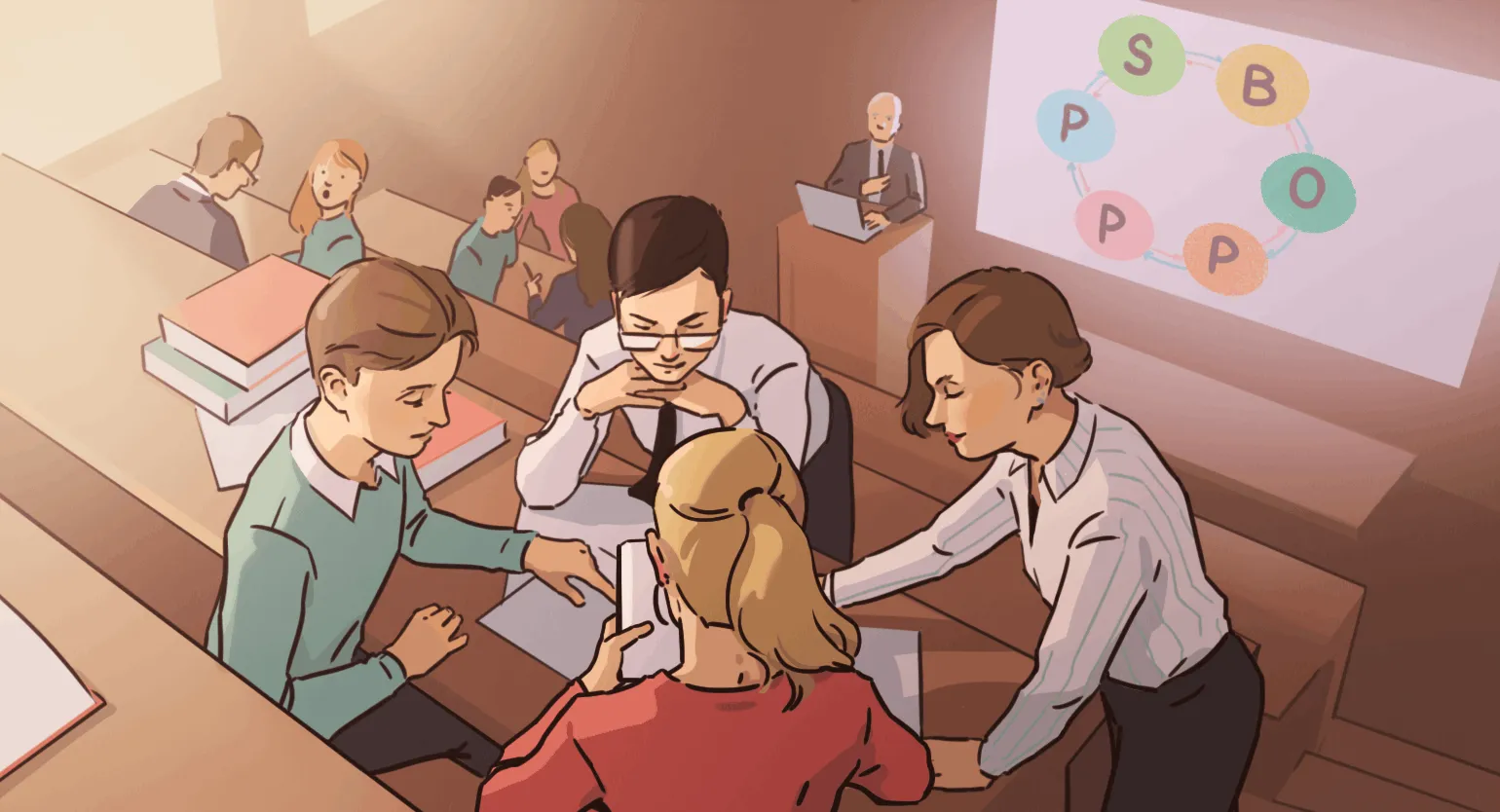
According to the BOPPPS model, an effective lesson includes six key components. Each of these elements plays a significant role in the organization and delivery of the learning process, ensuring maximum student engagement and optimal learning. The BOPPPS model helps instructors structure lessons, improving the quality of learning and promoting the development of critical thinking in students. Each component of the model contributes to the creation of an active learning environment, which in turn increases student motivation and their interest in the topic. Using this model in educational practice can significantly improve learning outcomes.
At the beginning of a lesson, it is important to attract students' attention to the topic and engage them in the learning process. This component can be used both before and during the lesson. Oksana Zhirosh, an expert in humanities and social sciences at Innopolis University and a certified ISW trainer, suggests several effective methods. One is to create a slide or handout with the title of the lesson topic. Additionally, the teacher can ask students a question, such as, "What do you want to know about this topic?" This approach encourages active student engagement. Students can also rate their mood on a scale of 1 to 10, which is especially useful if the lesson takes place early in the morning or late in the evening, when students may be less attentive. These methods help create a favorable learning atmosphere and increase student engagement.
Today we will look at growing radishes. Growing radishes is a fun activity that even novice gardeners can master. Radishes are fast-growing plants that can be harvested within a few weeks of sowing. To successfully grow radishes, it's important to select a suitable location with good sunlight and fertile soil. The optimal temperature for radish growth is between 10 and 18 degrees Celsius.
Radishes can be sown in both spring and fall. When sowing, plant the seeds 1-2 cm deep, leaving 3-5 cm between them. Caring for radishes includes regular watering, especially in dry weather, and weeding. It's important to monitor the condition of the plants to prevent the spread of pests and diseases.
Harve radishes when the roots reach the desired size to prevent them from becoming bitter. Growing radishes is not only enjoyable but also allows you to harvest fresh vegetables straight from the garden.
The second step in a BOPPPS lesson is to clearly communicate to students the accomplishments they will achieve by the end of the lesson or part of it. It is important to outline the expected learning outcomes and explain how students will demonstrate the knowledge and skills they have acquired. This will help students understand their goals and actively engage in the learning process.
When formulating learning outcomes, it is important to ensure they are specific, achievable, and measurable. Raina Friendly of California State University, San Jose, advises clearly defining the knowledge and skills students will acquire and what they will be able to do based on the information they have acquired. Bloom's Taxonomy, which associates each cognitive skill level with specific actions, is helpful in this process. This allows you to create clear and structured learning goals that promote effective learning and assessment.
Let's discuss radish varieties that are suitable for your region. We'll determine which ones are best adapted to your climate and soil conditions. Within 10-15 minutes, I'll ask you to name at least two varieties you could try growing.
This stage of the lesson helps determine students' knowledge of the topic, their level of engagement, and the homogeneity of their prior knowledge within the group. Short quizzes, oral, or online surveys are often used for preliminary assessment. Based on the results, the teacher can adapt the lesson content to make it more effective and relevant to the needs of the students. This helps optimize the educational process and improve the quality of material acquisition.
What varieties of radishes are there? How to choose the right ones for your region? What factors influence the successful cultivation of radishes?
The English term literally means "with participation," emphasizing active participation. At this stage, the teacher or trainer actively uses teaching methods and techniques that meet the goals and expected results. Effective implementation of such methods helps increase participant engagement and improve the quality of material acquisition.
According to the constructivist approach, teachers are encouraged to choose methods that encourage students to engage in active participation. This may include pair and small group work, such as discussions, experiments, problem-solving, case studies, and role-playing. It is also important to integrate methods typically considered passive, such as lectures or textbook readings, with an emphasis on reflective questions and class discussions. This approach promotes deeper understanding of the material and develops critical thinking in students.
The instructor discusses different radish varieties, focusing on their characteristics and suitability for growing in specific climates. They explain the factors that influence variety selection, such as temperature, humidity, and soil composition. The instructor may then introduce additional radish varieties and ask students to analyze their characteristics to determine whether they meet the necessary criteria for successful growth in a given region.
At this stage, it is necessary to evaluate the effectiveness of the learning and determine whether the stated objectives have been achieved. It is important to keep in mind that assessment methods should be directly related to the expected learning outcomes. For example, a multiple-choice test is suitable for testing theoretical knowledge, but a practical assignment would be required to assess students' practical skills. This approach will allow for a more accurate assessment of students' learning and preparation.
Each student must independently identify at least two radish varieties suitable for growing in their region. After completing the assignment, students submit their work to the teacher, who checks and evaluates their answers and explains any errors.
At the end of the lesson, it is important for students to discuss what they have learned. The teacher should prepare a brief summary of the material covered to summarize and emphasize key points. It is also advisable to highlight connections to future topics, creating a bridge to the next lesson. Students can also summarize themselves: after a group discussion, leaders can share their conclusions on what they have learned. This approach promotes knowledge consolidation and improves learning.
An additional important function of summarizing is that students restructure the material covered and recognize which aspects remained unnoticed and which connections were not grasped. This creates an opportunity for students to ask the instructor clarifying questions, which helps them fill in any gaps in their knowledge. This process not only deepens their understanding of the topic but also promotes more effective learning.
We discussed the different varieties of radishes, listed ten popular types, and determined that three of them are ideal for growing in your region based on climate conditions and ripening times.
How to Plan a Lesson Using the BOPPPS Model
The BOPPPS model provides flexibility and adaptability in lesson planning, allowing you to effectively structure lessons of varying lengths. Each component of the model can be customized based on educational goals, audience characteristics, and other factors. Typically, active learning is allocated about 50% of the lesson time, while the other components each take up 10%. It is important to note that the pre-assessment stage of student knowledge can be conducted outside of the main lesson time, for example, using online quizzes or checking homework. This allows teachers to better understand the level of students' preparation and adapt the lesson content to their needs.

Oksana Zhirosh noted that within the framework of one lesson organized according to the BOPPPS model, it is possible Integrate multiple cycles. This begins with an introduction and concludes with a summary. This approach is especially effective when students need to cover several interrelated topics or master a specific set of skills. The BOPPPS model helps structure the learning process, ensuring a deep understanding of the material and active student engagement.
A lesson can be organized according to the following scheme: BO (PPPS) (PPPS) (PPPS) S or B (OPPPS) (OPPPS) (OPPPS) S. In this structure, several cycles are implemented within a single topic, each of which begins with a pre-assessment or goal setting, which in this context is intermediate for a certain part of the lesson. For example, after studying radish varieties, you can move on to the process of growing them within the same lesson. This approach allows for a deeper understanding of the material and connects theoretical knowledge with practical skills.
The BOPPPS sequence describes the structure of components that follow one another during the lesson. However, when planning a lesson or training session, the sequence of working with these components may differ. As Oksana Zhirosh notes, it is important for a teacher to consistently answer four key questions when developing a lesson: what goals are set, how will interaction with students be organized, what teaching methods and tools will be used, and how will the results be assessed. This will help create an effective and focused learning process.
- What am I teaching, what is the topic of the lesson?
- How will I know that students have learned what was planned?
- How will I lead students to the result?
- Why will students want to learn this?
Oksana Zhirosh emphasizes the importance of the second question: "How will I know that students have learned the planned material?" The answer to this question includes the stages of formulating the expected result and the final assessment. At the beginning of the lesson, the teacher informs students what they should focus on and what tasks they will complete at the end, which allows for a clear definition of the assessment criteria. This approach promotes more effective learning and allows both students and instructors to better understand their progress.
When planning a lesson, it's important to identify the necessary learning materials and resources. Additionally, clearly allocate time for each stage of the lesson to ensure its effective delivery. This will help create a structured approach to learning and improve retention.
The official ISW Participant Guide provides a sample 50-minute lesson on neurophysiology. This lesson plan is designed to provide an in-depth introduction to the fundamentals of neurophysiology and incorporates a variety of teaching methods to encourage active participant engagement. The lesson aims to develop an understanding of key neurophysiological concepts and their application to practical activities.
Learning Outcomes: Students will clearly identify the differences between neurons and glial cells, as well as identify the major types and functions of glial cells. Additionally, students will be able to describe in detail the structure, function, and significance of the blood-brain barrier in the nervous system. Understanding these aspects is key to the study of neurobiology and the role of cellular components in maintaining the health of the nervous system.
The instructor performs a number of important activities aimed at student learning and development. First and foremost, they develop curricula and programs taking into account current requirements and standards. The teacher organizes the educational process, conducts lectures and seminars, ensuring the accessibility of information and the active involvement of students.
An important aspect of the teacher's work is assessing student performance. They conduct tests, exams, and provide feedback, which allows students to understand their strengths and weaknesses. The teacher also creates a comfortable learning atmosphere, maintains interest in the subject, and promotes the development of critical thinking.
In addition, the teacher actively uses modern technologies and teaching methods, which helps make the process more interactive and effective. They constantly improve their skills by participating in seminars and conferences, which allows them to stay abreast of the latest trends in education.
Thus, the teacher's actions include not only the transfer of knowledge but also the development of the skills necessary for the successful professional activity of students.
- 2 minutes. Explain the purpose of the lesson.
- 5 minutes. Review the structure of a neuron from the previous lecture.
- 1 minute. Distribute printed materials.
- 2 minutes. Explain why it is important to know about the different types of brain cells and the blood-brain barrier.
- 15 minutes. Explain the differences between neurons and glial cells, using the diagrams on the screen and in the handouts.
- 15 minutes. Facilitate a discussion about the roles of different types of glial cells in the nervous system.
- 5 minutes. Explain the blood-brain barrier, its structure, and functions, using the diagram on the screen.
- 5 minutes. Use the Think-Pair-Share method to review what has been covered. Assign homework.
Students actively participate in the learning process by completing a variety of tasks and projects. They research new topics, discuss material in seminars and lectures, and work in groups to share knowledge and experiences. Participation in practical classes allows students to apply theoretical knowledge in practice, which contributes to a deeper understanding of the subject.
Furthermore, students can participate in research, competitions, and conferences, which helps develop their professional skills and strengthen their resumes. It is also important that students actively use online resources for self-education, which broadens their horizons and allows them to stay up-to-date with the latest trends in their field.
Thus, students' activities are aimed at deepening their knowledge, developing skills, and forming the competencies necessary for a successful career.
- Discuss the differences between neurons and glial cells.
- Explore diagrams with types of glial cells.
- Discuss the roles of different types of glial cells in the nervous system.
- Using a diagram, describe the structure and functions of the blood-brain barrier.
What are the advantages of the BOPPPS model?
BOPPPS differs from traditional lesson planning methods and provides many benefits for both students and teachers. This model allows you to structure the learning process more effectively, improving comprehension and student engagement. Teachers can more easily organize their time and resources, and students get the opportunity to master the course material more deeply and actively participate in learning. Using BOPPPS helps create a more interactive and productive learning environment.

Research conducted in China shows that for students, the learning process becomes more meaningful, and immersion in the learning material is deeper thanks to the features of the BOPPPS model. This teaching method promotes active student engagement, improves information absorption, and develops critical thinking. Using BOPPPS allows for a structured and interactive learning process, which leads to higher motivation and better learning outcomes.
- Active engagement. Students don't simply absorb new information—they interact with the material, reflecting on it, completing practical assignments, discussing with classmates, and seeking solutions to problems. Thanks to this, they become fully involved in the learning process, constructing their own knowledge. Importantly, this helps students develop self-regulated learning skills—that is, the ability to set educational goals for themselves, plan steps to achieve them, and evaluate the results.
- Clear learning objective. Knowing the goal, students understand what exactly is important to focus on during a particular lesson. Thanks to this, they can distribute their efforts and attention more effectively, which contributes to better memorization of the material.
- Learning in a context familiar to students. During the introduction, the teacher places the topic of the lesson in the student's world—linking it to a typical problem, showing how it is reflected in reality, and explaining its importance and relevance. This makes it easier for students to personally determine the value of learning and find learning motivation.
- Space for reflection. The pre-assessment and debriefing stages also contribute to conscious learning. During the pre-assessment, the student can assess their mastery of the lesson topic and recall relevant information—this will become the basis for mastering new material. The debriefing stage is a good opportunity to reflect on acquired knowledge and skills and integrate new experiences into existing ones.
The BOPPPS model is an effective tool for teachers and trainers, providing flexibility in adapting to various topics and learning contexts while maintaining a clear structure. Focusing on the learning objective allows for careful selection and organization of all lesson elements, which contributes to the achievement of the set objectives. At the same time, the model helps eliminate unnecessary information and emphasizes key aspects of the learning process.

Also study:
Unusual Practice: The Impact of Gratitude to Teachers on the Learning Process
Showing gratitude to teachers can significantly impact the learning process and the overall atmosphere in the educational environment. Research shows that expressing gratitude helps create a more positive classroom environment, which, in turn, increases student motivation and engagement in learning. Gratitude improves interactions between teachers and students, which can lead to more effective learning and better academic results. Thus, a simple "thank you" can have a powerful impact on attitudes towards learning and the quality of education in general.
When Applying the BOPPPS Model Can Be Difficulty
According to Oksana Zhirosh, participants in ISW training on the application of the BOPPPS model often need to put significant effort into developing two interrelated components: the educational goal and the post-assessment. This task is especially relevant for experienced teachers who strive for high-quality teaching and effective assessment of results. A well-formulated educational goal allows for a clear definition of the direction of learning, while post-assessment helps evaluate achieved results and identify areas for improvement.
One of the reasons for the difficulties that arise may be the desire of teachers to convey to students all the material they have studied for 15 years in 90 minutes. This leads to a lack of time for the final assessment of knowledge. Moreover, limiting oneself to a narrow framework of educational outcomes causes dissatisfaction. As Howard Gardner noted, "the greatest enemy of understanding is trying to cover everything."
According to observations, many teachers tend to formulate educational outcomes from their point of view, rather than from the students' perspective. Often, the outcomes sound like: "Tell this," "Explain this." However, the BOPPPS model suggests that educational outcomes should be formulated precisely from the students' point of view. They should be as specific and measurable as possible. For example, instead of general statements, it's worth using: "List this from memory," "Recount this in your own words," "Solve a problem using Newton's second law," "Compare two problem-solving methods and choose the most appropriate one for a specific problem, justifying your choice." This approach promotes a deeper understanding of the material and improves the quality of the educational process.
Formulating educational outcomes for a lesson can be difficult. However, when they are defined from the students' perspective, it becomes easier for the instructor to plan the lesson. This allows for the elimination of irrelevant material, the development of a learning sequence, and ways to motivate students to study the topic. Properly formulated objectives help not only in organizing the process but also in increasing student engagement. This approach promotes more effective knowledge acquisition and improves the educational process as a whole.
Inexperienced instructors in ISW training often face difficulties associated with estimating the time required for lesson preparation. This leads to the perception that planning using the BOPPPS model is too time-consuming. As Oksana Zhirosh notes, beginning teachers often make the mistake of believing that a ten-minute lesson can be prepared in just ten minutes, or even without any preparation. However, in practice, developing such a lesson can take from one to three hours, which is an unpleasant discovery for many. Correctly estimating lesson preparation time is a key aspect of effective teaching and helps avoid stress and misunderstandings in the educational process.
The teacher's level of expertise in the subject they teach also plays a significant role in the learning process. If the teacher lacks knowledge on the topic, they must study the material in parallel with lesson planning. This, of course, requires a significant investment of time, which can negatively impact the quality of instruction. High-quality preparation and a deep understanding of the subject contribute to more effective student learning and improved academic performance.
A study conducted by the Innopolis Institute demonstrated the benefits of using the BOPPPS model in the educational process. Experienced teachers note that the use of this model allows for significantly faster lesson preparation compared to traditional methods. Using BOPPPS not only helps optimize the time spent on developing educational materials, but also improves the quality of lessons, which contributes to more effective student learning.

In teaching social sciences and creative In disciplines, as well as in the development of soft skills, the emphasis may shift from the specific and predictable outcomes embedded in the BOPPPS model to student reflection. In this context, educators should consider the CARD model developed by David Tickner, one of the founders of ISW. The model includes four key components that promote deeper understanding and reflection on the learning process, which in turn leads to improved critical thinking and creativity skills in students. Effective application of this model can significantly improve the quality of learning and student engagement in the process.
- Context - the teacher introduces the topic of the lesson, raises a problem, provides introductory information, explains how the lesson will proceed and what is expected of the students at the end.
- Activity - what exactly the students do in the lesson. This could be, for example, a group discussion or writing an essay.
- Reflexion - this component reflects the process of reflection itself. It is usually formulated as a list of open questions for reflection and/or discussion.
- Documentation - what students will take away from the lesson. For example, notes with insights gained during discussions with classmates.
The Methodologist Profession from Scratch to PRO
You will improve your skills in developing curricula for online and offline courses. Master modern teaching practices, structure your experience, and become a more sought-after specialist.
Find out more