
Contents:

Learn: The Methodologist Profession from Scratch to PRO
Find out moreFirst: What Trends Are Defining the Future of the Labor Market
Experts from the World Economic Forum (WEF) conducted a survey among employers, which compiled a list of key economic, political, and technological global trends. Representatives of various companies assessed how these trends could affect their business by 2030. The survey allowed us to identify potential changes in the business environment and the adaptation of companies to new conditions.
In current economic trends, the key aspects are the rising cost of living, noted by 50% of respondents, and a slowdown in economic growth, recorded by 42% of participants. In addition, 47% of company representatives indicated the impact of measures to reduce carbon emissions on their activities. Changes in the economic environment require businesses to adapt to new conditions and find effective solutions to maintain competitiveness. Employers expect geopolitical tensions and conflicts to have a significant impact on their operations, as stated by 34% of respondents. Furthermore, 23% of respondents noted that restrictions on trade and investment between countries will also have a significant impact on business. Expectations for the current trend vary by industry. In the automotive and aerospace industries, 46% of respondents expect restrictions to disrupt supply chains. In the mining and quarrying sector, this figure is even higher – 55%. At the same time, restrictions on trade and investment have virtually no impact on education: only 14% of respondents consider them a significant trend. Assessing demographic trends is becoming increasingly diverse. The current analysis revealed opposing trends: on the one hand, there is an aging population and a decline in the number of workers, which was noted by 40% of respondents. On the other hand, 24% of survey participants noted an expansion of the working-age population. These conflicting data highlight the complexity of the demographic situation and the need for further study of these phenomena to develop effective labor market strategies.

Employers around the world are voting for opposing demographic trends. While developed countries are experiencing population decline, the situation is different in a number of countries in the Global South. According to a World Bank forecast, cited by experts from the World Economic Forum (WEF), 1.2 billion young people will enter the labor market in developing countries over the next ten years, while only about 420 million jobs will be created. This significant disparity between the number of young people and available jobs underscores the need to address employment issues and create new jobs in these regions.
Reading is an important component of personal and professional growth. It helps expand your horizons, improves critical thinking skills, and helps you absorb new information. It is important to choose quality sources that will help you develop. In today's world, a wide variety of materials are available, including books, articles, and blogs on various topics. Don't forget the importance of regular reading to maintain mental activity. Invest time in reading, and you'll notice positive changes in your thinking and perception of the world around you.
McKinsey analysts studied the impact of the demographic crisis on education globally. According to their findings, population decline in some regions will lead to significant changes in educational systems. The decline in school enrollment is expected to impact funding for educational institutions, potentially leading to school closures and teacher reductions. Furthermore, this will create new challenges for providing quality education, as the remaining students will require a personalized approach and new teaching methods. Importantly, these changes may necessitate revising educational programs and adapting to new demographic realities. McKinsey emphasizes that successful adaptation to demographic change will require a comprehensive approach from governments and educational institutions.
According to employers, technological trends will be the main factor influencing the labor market. Among these, expanding access to digital technologies stands out in particular. According to the survey, 60% of respondents believe digitalization will significantly change their business by 2030. This trend highlights the importance of companies adapting to new technologies to improve competitiveness and efficiency.
A comparison with a similar previous survey shows that all trends received fewer votes in 2023. For example, expanding access to digital technologies was considered an influential trend by only 86% of respondents. Over the past two years, companies across various industries have felt the impact of numerous trends, making it difficult to identify the most significant developments for the future of work. In today's world, too many factors matter, and each of them can have a significant impact on the development of the professional sphere.
How will artificial intelligence change people's work?
The new report asked survey participants in detail about influential technology trends.
Artificial intelligence ranks high in business expectations, with 86% of respondents confident that its development and implementation will significantly impact their companies. In certain industries, this percentage is significantly higher: in the financial sector, it reaches 97%, in electronics manufacturing - 95%, and in education - 91%. These data highlight the importance of AI in transforming various business models and processes, making it a key factor for sustainable growth and competitiveness in the market.
According to surveys, the technological trend associated with robotics and automation received support from only 58% of respondents. Third place goes to innovations in energy generation, storage, and distribution, cited by 41% of survey respondents. These findings highlight current priorities and interests in technology and point to the growing importance of sustainable and efficient energy solutions in today's world.
According to survey respondents and experts from the World Economic Forum, the impact of artificial intelligence on jobs will manifest itself in several key ways. Half of employers indicated they plan to adapt their business models to accommodate AI developments. Two-thirds of respondents indicated their intention to hire employees with AI skills. At the same time, 40% of employers expect process automation to lead to workforce reductions.
The report's authors cite research confirming that artificial intelligence can enhance the competencies of specialists in various industries. Accountants and teaching assistants are expected to be able to solve complex expert problems more effectively with AI. Doctors and engineers working in rapidly evolving fields will be able to use AI to obtain relevant information and the latest data in their professional field. Thus, integrating AI into work processes can significantly improve the productivity and quality of specialists' work.
The World Economic Forum (WEF) emphasizes that the use of artificial intelligence (AI) tools as aids is only a potential opportunity. Realizing this opportunity depends on a sound approach to technology policy. Otherwise, there is a risk that humanity will face the opposite trend—the replacement of human labor by automated systems. It's important to consider that the balance between AI adoption and job security requires careful analysis and a thoughtful approach.
Respondents predict that by 2030, the number of tasks performed solely by humans will decrease significantly. This means an increase in the volume of work that requires technology, hardware, or software, as well as tasks that will be performed by machines without human intervention. In this regard, people will need to adapt and master new skills to effectively use modern technologies and software.
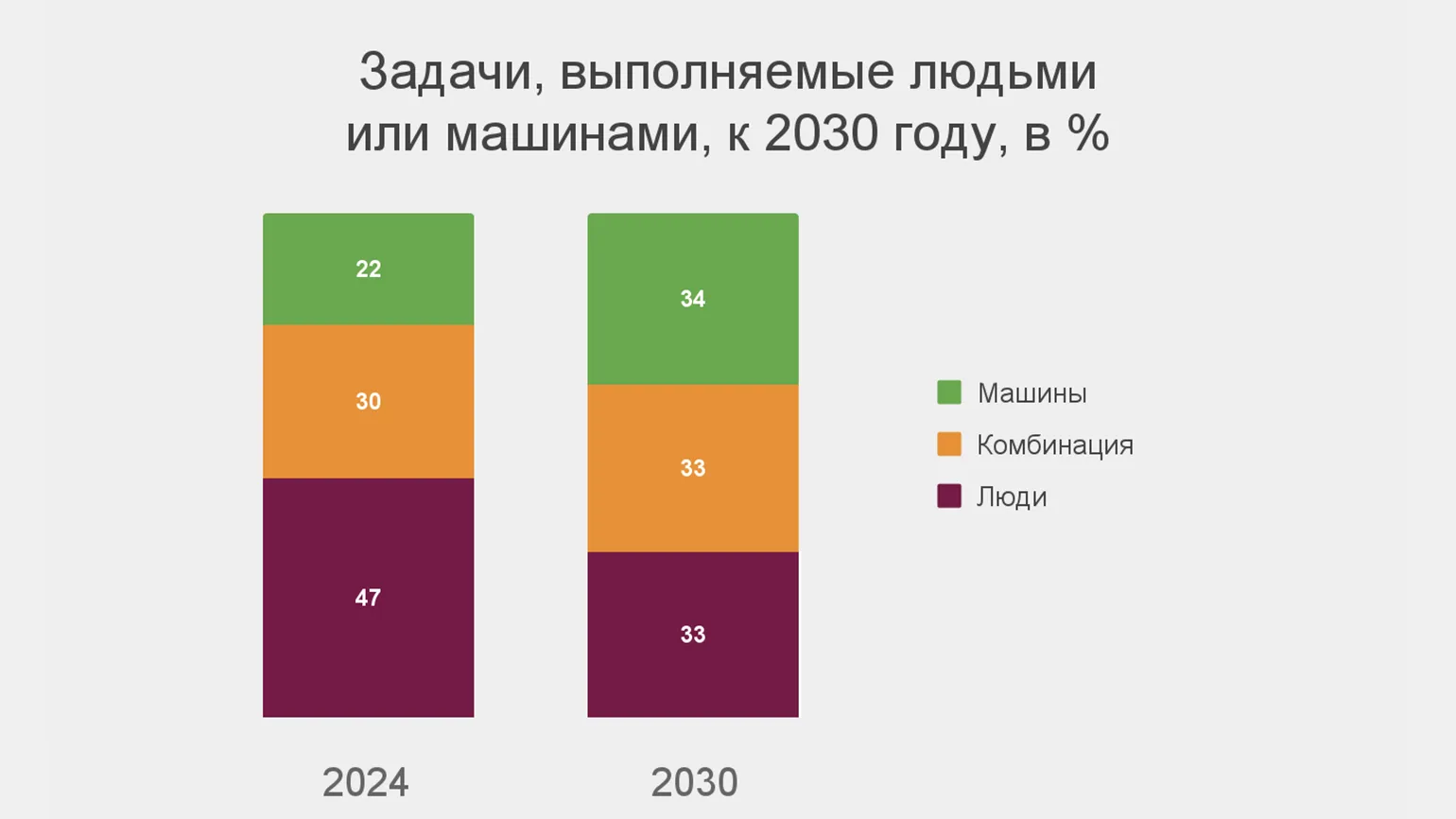
According to employer surveys, nearly half of work tasks (47%) currently require exclusively human labor. Of these, 22% are performed by machines, and 30% are a combination of humans and technology. Forecasts for 2030 suggest these three categories will become virtually equal. The share of tasks performed exclusively by humans is expected to decrease by almost 15%, and in education, this figure will decrease by 18%. At the same time, the share of fully automated tasks will increase significantly, highlighting the importance of worker adaptation to new working conditions and the need for upskilling.
A 2023 World Economic Forum report identified artificial intelligence as a key technology that more than 75% of surveyed companies plan to implement by 2027 for data analytics and content generation. However, that report did not consider AI as one of the major technological trends capable of changing the labor market as a whole. The mention of AI as a potential influence in the new report is likely due to the rapid development of generative neural networks in recent years. It is necessary to take into account that at this stage the assessment of the impact of AI may be exaggerated, and, perhaps, it will not lead to significant changes in people's working activities.

Reading is an important aspect of our lives, which Enriches knowledge and develops thinking. Books, articles, and other sources of information offer unique perspectives and ideas. Regular reading helps improve vocabulary, enhance literacy, and develop critical thinking. It is important to choose a variety of genres and topics to broaden your horizons and deepen your understanding of the world. Don't forget the importance of discussing what you read, as exchanging opinions with other readers can open up new perspectives and ideas. Reading not only entertains but also shapes our personalities, making us more informed and aware.
The skills crisis may turn out to be a myth, like the Great Manure Crisis of 1894. Despite widespread fears that a shortage of skilled workers threatens economic development, it is worth considering whether these fears are exaggerated. History has seen examples where predictions of resource shortages have not come true. Perhaps current changes in the labor market and technology are creating new opportunities for learning and adaptation, allowing us to overcome temporary difficulties. It is important to remember that economic and social systems have the capacity for self-regulation and renewal. Instead of fearing a skills crisis, we should focus on developing educational programs and upskilling specialists, which can lead to sustainable growth and innovation across various industries.
What Exactly Might Happen to Jobs
Employers have carefully assessed each of the current trends in terms of their impact on the creation and reduction of jobs in organizations. After analyzing all the data, analysts concluded that global changes in the labor market will affect 22% of current vacancies. About 170 million new jobs are expected to be created, which is 14% of the total number of existing positions, while 92 million jobs will be cut, which is 8%. Thus, the overall effect of these changes is predicted to be positive: employment will increase by 7%, which is equivalent to 78 million new positions.
Two years ago, the Eastern Economic Forum (EEF) predicted a decline in employment. However, in the current forecast, respondents' opinions have changed. Considering the opinions of both those who believe that current trends will lead to the creation of new jobs and those who expect layoffs, it can be argued that most trends ultimately contribute to the creation of new vacancies. The only factors that cause unambiguously negative expectations among employers remain slowing economic growth and the introduction of robotics. The most controversial trend is artificial intelligence (AI), which is simultaneously seen as a threat to jobs and a tool for their creation. Overall, forecasts suggest that AI could create approximately 1.8 million new jobs.
Which workers will be needed and who will be laid off
Survey participants selected from an extensive list of professional roles those that they believed would be important for their organizations in the next five years. They assessed which professions they expected to be stable, growing, or declining. Based on these estimates and International Labour Organization data on the global occupational distribution, the World Economic Forum (WEF) analyzed which occupations will grow and which will stagnate until 2030. These estimates help understand labor market trends and prepare for changes in the professional environment. Employers expect significant growth in so-called "green economy" occupations. This category includes engineers working in renewable energy, environmental protection, and specialists in electric and autonomous vehicles. According to the World Economic Forum, demand for these occupations remained stable even during the pandemic, when many sectors of the labor market were experiencing difficulties. However, these are not mass-market occupations. The OECD report on emerging education trends also highlights the growing interest in the "green economy," but it is worth noting that over the past ten years, the share of specialists in this field in total employment in the US and Europe has increased by only 2%. This highlights the need for further development and implementation of educational programs that will help prepare qualified personnel for a sustainable future.
Among the professional roles that are increasingly in demand, digital security specialists stand out. This segment continues to grow, despite its relative narrowness. Forecasts indicate that the greatest growth in demand is expected among big data specialists, fintech engineers, and machine learning engineers, where growth will exceed 80%. Over 40% growth is also predicted for data warehouse specialists, UI and UX designers, IoT experts, and data analysts and data scientists. Education is also seeing increased demand for artificial intelligence and machine learning specialists, as well as digital transformation experts in education. This growing demand in these areas underscores the importance of training qualified personnel who can adapt to rapidly changing market demands.

Read also:
Generative artificial intelligence (AI) will have a significant impact on IT staff skills and training, according to a McKinsey analysis. The implementation of generative AI in development and project management processes requires specialists to acquire new knowledge and skills. The primary focus will be on adapting to changes in technologies and work methodologies.
With generative AI, IT staff will be able to automate routine tasks, freeing up time for more creative work and strategic planning. This will necessitate the development of skills related to data analysis, machine learning, and AI-based project management. Training will become more focused on the practical application of technologies, which will improve the effectiveness of specialists.
Furthermore, it is important to note that generative AI will change the approach to teamwork. Specialists will need to develop collaboration and communication skills to effectively use new tools and technologies. Training in the ethics and safety of AI use will also become an integral part of IT personnel training.
Thus, the impact of generative AI on the skills and training of IT specialists will be multifaceted, requiring them to constantly update their knowledge and be prepared for changes in the professional environment.
It should be noted that the professions under discussion are niche. The popularization of these specialties could lead to a situation similar to that observed in China. There, universities annually graduate more specialists in artificial intelligence than the labor market can absorb. As a result, graduates face difficulties finding jobs in their specialty, despite the active development of this sector. This emphasizes the importance of a balanced approach to training specialists that takes into account the real needs of the market.
In absolute terms, the greatest increase in the number of jobs is expected in manual labor and at the "last mile" stage. It is predicted that 35 million new jobs will be created in agriculture, and the need for workers in the food industry, construction, and sales will also grow. A particularly significant increase, over 40% in percentage terms, is expected for delivery drivers. It's important to note that the widespread adoption of driverless cars isn't expected until 2030, which would create additional jobs in this field. The growing demand for social professions is also worth noting. In countries with aging populations, the need for nurses, caregivers, and social workers will increase, while in regions with high birth rates, the need for teachers and educators will grow. The forecast for professions with declining demand remains valid. The number of jobs for cashiers and ticket takers is expected to decline by almost 14 million. A decline in demand for secretaries is also observed. In percentage terms, the largest decline in demand is expected for postal workers, bank tellers, and data entry operators. These changes are driven by process automation and technological advances, leading to a decline in job openings in these fields.
A World Economic Forum report identified, for the first time, roles involving non-routine intellectual work, such as graphic designers and legal secretaries, among the occupations with the greatest decline in demand. This highlights the impact of generative artificial intelligence on employer demands and changes in the labor market. With the rise of automation and the adoption of AI, skills previously considered resilient are now under threat. Employers are increasingly seeking solutions that can complete tasks faster and more efficiently, leading to a decline in demand for traditional roles. It is important to adapt to these changes and review skills to remain competitive in the changing labor market.

Read also:
Online courses for older people are a promising direction. With increasing life expectancy and interest in self-development among older adults, this segment of the educational market is becoming increasingly relevant. Many older adults seek to master new technologies, develop hobbies, or improve their skills. Online learning offers convenience and accessibility, allowing them to study in a comfortable environment. It is important to consider that courses should be adapted to the needs of this audience, including a simple interface and accessible materials. Developing online courses aimed at older adults can become not only a successful business but also a significant contribution to their personal development and socialization.
Which skills will be most in demand?
Survey participants were also asked to predict which skills will be in demand among employees at their companies in the next five years and how demand for them will change: increase, decrease, or remain the same. Based on the responses received, the World Economic Forum compiled a ranking of skills that, according to employers, will be in increasing demand. The top spots in this ranking were:
- of course, AI and big data (87% expect demand to grow);
- computer networks and cybersecurity (70%);
- technological literacy (68%).
The list of in-demand skills whose importance will increase includes various soft competencies, such as creative thinking, resilience, flexibility, curiosity and a desire to learn, as well as leadership and social influence. Although there is nothing new in this list, these skills are becoming increasingly relevant in the current labor market.
Analytical and systems thinking are skills that remain important in any environment. Although you shouldn't expect them to grow immediately, they remain fundamental for success in various fields. Developing these competencies helps you effectively analyze information, identify patterns, and make informed decisions. In a rapidly changing world, their role is becoming especially crucial, as it allows them to adapt to new challenges and find optimal solutions.
Important skills that ranked among the top in-demand include talent management, training and mentoring, and employee motivation. These skills are becoming increasingly relevant due to various demographic trends. Some countries are seeing a growing need for teachers who can teach new generations, while others need to make the most of the existing workforce, including the ability to transition employees to new roles.
The list of skills that, according to the majority of respondents, will lose their relevance included the following.
- abilities related to the use of human senses (13%);
- reliability and attention to detail (named by 12% of respondents);
- reading, writing and arithmetic (in this survey, they were named both among those in demand and among those losing importance, but the second opinion was 4% more popular);
- dexterity, precision and endurance in manual labor (employers who believe that the demand for these skills is falling turned out to be 24% more than those who consider them in demand).
Experts from the World Economic Forum emphasize the ambiguity of conclusions about the demand for professions. There are specialized areas where skills that are losing relevance on a mass scale turn out to be extremely necessary. For example, installing solar panels and servicing complex machine tools require engineers not only to have a deep understanding of technology but also to perform tasks with high precision. Technological advances continue to increase the demand for such specialists, highlighting the importance of their skills in the modern world.
How employers plan to retrain employees
According to employers, 39% of the skills their employees possess today will change by 2030. These skills will lose their relevance and will be replaced by new, more modern ones. This underscores the importance of constantly updating knowledge and skills for a successful career in the future. To remain competitive, workers need to develop adaptability and a willingness to learn new skills.
The share appears significant, but previous reports had more optimistic forecasts: 44% in 2023 and 57% in 2020. World Economic Forum experts attribute the changes to the fact that by 2024, when the survey was conducted, the number of employees who had undergone retraining in companies had increased significantly, reaching 50% of the surveyed executives, compared to 41% in the 2023 report. This indicates a growing focus on skills development and employee adaptation to labor market requirements.

Reworked text:
Also study:
Five skills of instructional designers that are being transformed by neural networks
With the development of technology, neural networks are becoming an important tool in the field of instructional design. They are changing approaches to learning, requiring instructional designers to adapt and update their skills. Important aspects that are undergoing changes are:
1. Data analysis. Instructional designers must be able to work with large volumes of data generated by neural networks. The ability to interpret this data allows for the creation of more effective educational programs.
2. Personalization of learning. Neural networks are capable of adapting educational content to the individual needs of students. Instructional designers must be able to integrate these technologies to create personalized learning paths.
3. Interactivity and engagement. The use of neural networks allows for the creation of more interactive and engaging learning materials. Instructional designers must develop skills in creating content that promotes active student engagement.
4. Critical thinking. With the increasing use of artificial intelligence, it becomes necessary to critically evaluate its results. Instructional designers must develop the ability to analyze and adjust educational solutions based on insights from neural networks.
5. Technological Literacy. Understanding the fundamentals of neural networks and other technologies is becoming essential for instructional designers. This will allow them to effectively use new tools and remain competitive in a rapidly changing educational environment.
Thus, neural networks are having a significant impact on the profession of instructional designer, changing the skills necessary for successful work in this field.
Employers rated the need for employee retraining by 2030 as critical. Given the rapid development of technology and changes in the labor market, companies recognize the need to constantly update the knowledge and skills of their employees. This is due to the fact that new technologies require adaptation and mastery, and also because competition in the labor market is intensifying. Employers understand that investing in staff training and development not only increases productivity but also contributes to the retention of talented specialists. Retraining is becoming an important tool for ensuring competitiveness and achieving strategic business goals in a dynamically changing economic environment.
- 59% of employees will require training;
- 29% will learn and continue working in their current positions;
- 19% will change roles within the organization;
- 11% of employees will not be able to be retrained by employers.
Considering the importance of developing professional skills, employers identified three key policy measures that can improve the workforce situation. These measures are aimed at improving employee qualifications, adapting educational programs to labor market requirements, and creating incentives for investment in personnel training. The application of these approaches will not only help to narrow the gap between supply and demand in the labor market, but also to improve the overall competitiveness of the economy.
- funding retraining programs (55%);
- providing such programs (52%);
- improving the education system (47%).
According to the survey, 85% of respondents intend to engage in employee retraining. Half of them believe that this will help to effectively redistribute personnel within the company, which will allow the use of internal resources to fill open vacancies. This approach is especially in demand among employers in countries with an increasing number of older workers.
According to research, 70% of companies expect the need to hire employees with new skills. However, the likelihood of successfully attracting external specialists remains low: only 29% of respondents are confident that the situation with the availability of talent in the labor market will improve by 2030, while in 2023, 39% of respondents expressed such optimism. At the same time, 43% of survey participants noted that when hiring, they would still pay attention to whether an applicant has a university degree, but relevant work experience was mentioned twice as often. These trends remain stable compared to the results of a similar survey conducted two years ago.
The Profession of Methodologist from Scratch to PRO
You will improve your skills in developing curricula for online and offline courses. Master modern teaching practices, structure your experience, and become a more sought-after specialist.
Find out more