
Contents:
What is a qualification pit and who dug it
A qualification pit is The price we pay for progress. This problem has become more apparent during the pandemic, but its preconditions began to emerge much earlier. The need to adapt to new conditions and changes in the labor market requires specialists to constantly improve their skills and master new competencies. It is important to recognize that ignoring this issue can lead to a lack of necessary skills and, consequently, to a decrease in the competitiveness of workers.
The BCG report on the state of the global labor market highlights the key challenges of 2020: increased digitalization, rapid automation of processes, and the need to transition to remote work. These factors have significantly changed the landscape of labor relations, requiring employees and employers to adapt to new conditions. In the context of global change, it is important to consider the impact of technology on employment and the need to develop digital skills for career success.
Amid today's challenges, it has become clear that the current labor market's personnel issues stem not only from a shortage of specialists in new digital fields but also from a significant skills gap.
The essence of this phenomenon is that even with a sufficient number of workers, there is a shortage of the necessary skills and knowledge to successfully complete tasks. As a result, highly qualified specialists remain unclaimed and are forced to accept positions that do not match their professional qualifications. This creates an imbalance in the labor market, where the needs of employers do not match the competencies of job seekers.
This problem will become increasingly apparent, as the pandemic, according to BCG experts, has become a catalyst for long-term structural changes. These changes continue to have a significant impact on various areas of life and business.
- More than 1.5 billion jobs worldwide will be affected by structural changes in the next decade.
- 12% of jobs may disappear due to automation by 2030.
- 30% of job functions will require employees to have completely new skills that are still unknown in the labor market today.
- More than 10% of workers worldwide will switch to permanent remote work, and among office workers, this figure is up to 30%.
Three shovels digging a skills hole
The COVID-19 pandemic has exacerbated existing problems that were relevant even before it began, according to BCG experts. This underscores the importance of analyzing and addressing the social and economic challenges that have become more apparent during the crisis.
Long before this, every third worker in the countries of the Organization for Economic Cooperation and Development was working outside their field of study. In Russia, according to VTsIOM, in 2019, 47% of workers performed duties inconsistent with their education. The reasons for this phenomenon are much deeper than just the sudden transition to remote work. This indicates systemic problems in the labor market, such as a mismatch between educational programs and employer requirements, as well as the insufficient adaptation of graduates to real-world working conditions.
In 2019, a joint study by BCG and WorldSkills Russia found that the skills gap is widening under the influence of three main trends: technological, socioeconomic, and cultural. These trends generally have positive potential, but society is lagging behind in adapting to them. This lag creates difficulties in training and qualifying personnel, which in turn can negatively impact economic development and social stability. English: Measures are needed to ensure the timely adaptation of educational and professional standards to modern requirements.
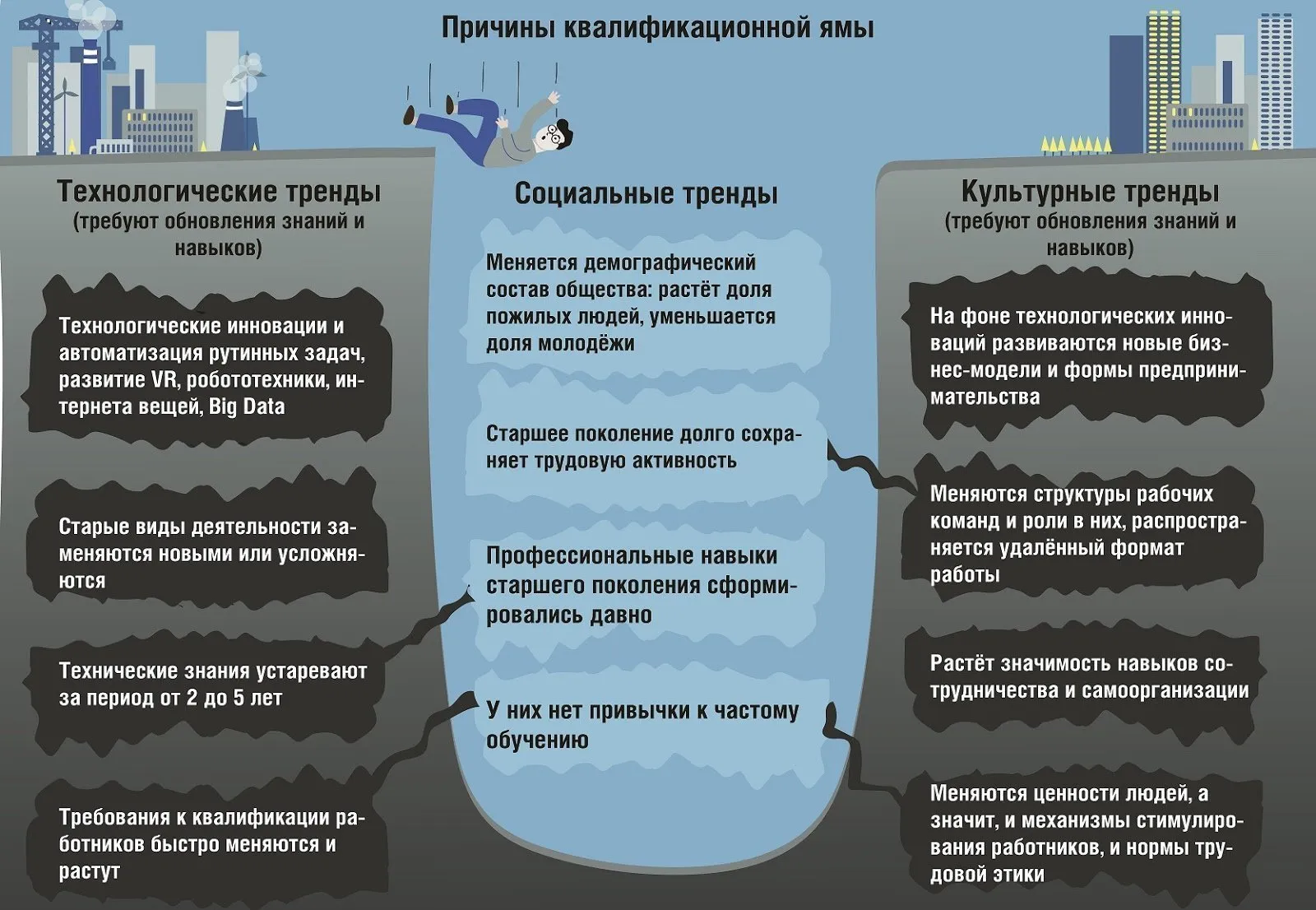
The labor market is experiencing an excess of workers with outdated skills. The education system and human capital development programs are failing to keep pace with changing market needs and are failing to provide the necessary updating of knowledge and skills. This creates a shortage of qualified specialists who meet modern requirements.
Developing relevant skills in the modern world is a complex task. One of the main reasons is that traditional training methods were developed in an era when people mastered one profession for life. Although technology and the requirements for specialists constantly changed throughout the 20th century, the pace of these changes was significantly slower than today. Previously, it was sufficient to undergo refresher training once every ten years. In the current reality, with the labor market and technology evolving rapidly, it is necessary to constantly update your knowledge and skills to remain competitive.
In today's world, professionals in any field face the need for retraining much more frequently. As BCG and WorldSkills Russia research indicated in 2019, education systems are failing to adapt to rapid changes in the labor market. This leads to rising costs of training, the process takes increasingly longer, and the skills acquired by graduates become obsolete even by the time they receive their diploma. Therefore, it is important to focus on continuous learning and development to remain competitive in a rapidly changing world.
How Deep Are We Already in the Hole?
Comparing the situation in labor markets around the world is possible using the FSA (Future Skills Architect) tool developed by BCG. This tool includes a rating of 75 countries, which is based on 59 parameters regarding the state of their labor markets. Using the FSA allows for a deeper understanding of the differences and trends in the development of skills necessary for a successful career in the future.
Russia ranks 52nd globally, between Mexico and Greece. According to BCG, our country's key indicators before the pandemic were as follows:
- 45% of workers (almost 33 million people) are underskilled or overskilled for their jobs;
- labor productivity (how much gross domestic product one worker produces) is $56,000.
The Netherlands, the United States, and Switzerland lead the global labor productivity rankings. In these countries, the level of underskilled workers is 37.7% in the Netherlands, 33.5% in the United States, and 36% in Switzerland. Despite this, labor productivity in these countries significantly exceeds that of other countries, reaching $100,000 in the Netherlands, $120,000 in the United States, and $106,000 in Switzerland per employee.
Russia's indicators for social parameters are significantly lower than the average values of the BRICS countries, which include Brazil, India, China, and South Africa. This is particularly true for social mobility, population movement between regions, and the formation of a human-centered environment. Improving these aspects can contribute to a more harmonious development of society and an overall increase in the standard of living in the country.
Russia demonstrates comparatively high rates of employee engagement in retraining, with approximately 15% of employees taking online courses before the pandemic. Also worth noting is the level of inclusiveness of the work environment, where women occupy equal positions with men. This creates favorable conditions for professional development and diversity in the workforce.
There are different opinions on this issue. According to research by sociologist Natalia Tikhonova of the Higher School of Economics, the skills gap in Russia may be much deeper than previously thought. This underscores the need for further analysis and discussion of this issue. Statistics show that more than half of employees have an education that is inappropriate for their professional activities. This underscores the importance of not only skills but also the relevance of educational background to labor market requirements. Education plays a key role in a career, and a mismatch can impact productivity and job satisfaction. Employers should consider this factor when recruiting, and job seekers should strive to improve their knowledge and skills to align with professional requirements. Natalia Tikhonova argues that one of the main reasons for the gap between education and the labor market is the imbalance in these areas. University graduates face difficulties finding jobs in their fields and are often forced to take positions for which their qualifications are superfluous. This creates problems for both young professionals and employers, who are unable to find qualified personnel for the necessary vacancies.
Despite the need for high qualifications in a number of professions, such as teachers, doctors, and engineers, they often remain low-paid. This leads to these positions being filled by underqualified specialists. The situation requires a review of approaches to job evaluation and the implementation of a more equitable compensation system to attract and retain true professionals in these important fields.
The Dangers of the Skills Gap
Unemployment poses a serious threat to the country as a whole, affecting more than just those who lose their jobs. The problem of skills mismatch with the workplace is often overlooked, but it is significant in scale. According to BCG estimates, in 2020, more than 1.3 billion people worldwide found themselves in the so-called skills gap. This phenomenon underscores the importance of adapting educational programs and training to the demands of the modern labor market.
According to BCG experts, in 2018, the global economy suffered losses of approximately $8 trillion due to the skills gap. This amount reflects the lost gross domestic product that was not created and realized due to low labor productivity. In 2018, productivity losses amounted to 6%, and BCG forecasts that this figure could rise to 11% by 2025 under a worst-case scenario.
The damage caused by the skills gap is examined in detail in a BCG and WorldSkills report. This damage arises from a shortage of qualified specialists in the labor market, leading to decreased productivity and business efficiency. A lack of necessary skills among workers also hinders the adoption of new technologies and innovations, which, in turn, impacts companies' competitiveness. Research shows that upskilling and training employees can significantly reduce this damage, contributing to economic growth and improving the quality of services.
- If a worker is underskilled, the losses are reduced productivity, lost income, or the cost of retraining employees.
- If a skilled worker is demoted and engaged in low-skilled work, the losses are the cost of their training, which turns out to be unnecessary for the market, and the gradual loss of skills.
According to a brief report by BCG researchers, secondary effects of skills mismatch have been identified. It has been found that countries with a high percentage of workers whose knowledge and skills do not match the requirements of their positions have low rates of innovation. These countries also face difficulties in achieving the UN Sustainable Development Goals. This highlights the importance of developing relevant skills to improve economic performance and implement global initiatives.
HR Business Partner Profession
You will learn all the nuances of HR BP work and learn how to solve business problems with the help of personnel. You will be able to plan the work of the HR department for the year ahead and present this plan to management.
Find out more