Contents:
A profession that underpins the modern entertainment and high-tech industries.
When people think of 3D modeling, they immediately think of computer games or film effects. But in reality, this skill is useful in many other fields today. Here are just a few industries that require specialists skilled in working with 3D graphics:
- Advertising.Almost all advertising, including video and printed banners, is 70-80% the result of the work of 3D graphics specialists.
- Television.Even small regional channels hire 3D graphics artists to create screensavers, virtual studios, and work on advertising and TV programs.
- Development of modern games. Closely related to 3D. First of all, this applies to large AAA projects with full-fledged virtual worlds.
- Metaverses. These are virtual worlds where you can communicate, hold business meetings, play games, and even organize concerts. So far, the projects are more entertaining, but the idea is actively developing.
- Film production. It's hard to find a film made in the last couple of decades that doesn't have 3D graphics. In some modern films, like Avatar, Ready Player One, and Aquaman, everything is drawn — from the characters to the buildings, trees, and even the sky. 3D graphics are present in 80-90% of the frames.
- Printing. A 3D generalist can create beautiful illustrations for magazines, booklets, books, and brochures. This could be a visualization of nature, interiors, or products.
- Online commerce, marketing. 3D generalists are often involved in packaging design, creating product mockups that are then used in advertising and on the displays of online stores and marketplaces.
- Manufacturing. Engineers with specialized engineering education work at large enterprises and in design bureaus. But today, the market is full of small manufacturing companies that create souvenirs, home decor, and custom advertising signs. All of this is created using computer numerical control (CNC) equipment, such as milling machines and 3D printers. Therefore, they often need specialists who can quickly create 3D models based on sketches or descriptions.
- Construction, real estate. Architects design buildings. But to create renders and visualizations of a building for advertising brochures, you don't need an engineering education - 3D modeling skills will be enough.

Learn how to create realistic textures in Substance Painter and retouch images in Photoshop in the course 3D Artist
Learn moreWhat does a 3D generalist do?
A 3D generalist is a three-dimensional graphics artist, also known as a 3D artist. Digital graphics has advanced to the point that 3D modeling is now divided into several specializations.
There are animators who animate characters or art scenes. There are modelers who create a layout or wireframe for a 3D model. There are lighting specialists who set up virtual light sources, and texture specialists who color characters or the environment. There are environment specialists who paint backgrounds and fill the surrounding world with buildings and plants, and there are special effects or VFX specialists who add wind, lightning flashes, and adjust sunset lighting to games or films.
However, not all studios can afford to employ an army of designers and artists, although in-depth knowledge of individual disciplines isn't always necessary. Most often, companies look for a generalist—a specialist who can single-handedly and within a limited timeframe complete a simple turnkey project. For example, create a concept for a game character or a render of a building project for a presentation.

A 3D generalist is an artist who has mastered the creation of 3D graphics in a comprehensive manner. Literally translated, this is a generalist who can replace several people. There are enthusiasts who have thoroughly studied 3D graphics from all sides, as well as the related tools. They can single-handedly produce a full-length animated film or develop turnkey graphics for a game, including game characters, mobs, and environments. But they don't necessarily need to know everything.
Generalists are divided into separate areas, and it is enough to master a certain set of tools to fully solve a specific problem. For example:
- Character Artist (3D Character Artist)creates a character. For example, a hero or an animal, a prototype of transport with textures, lighting and rigging (animation of movements, facial expressions) for a game or film.
- Environment Artistdevelops the concept of the environment. Assembles an entire world for a game, film, or cartoon from ready-made objects, adds natural phenomena (rain, wind, clouds), applies sky textures, and adjusts the lighting.
- A concept artist (3D Concept Artist) creates a prototype at the idea selection stage. The specialist is not required to provide extreme detail. The main thing is to work quickly. For example, in a few hours it is necessary to transfer a character sketch from paper to a 3D model or create several architectural options for a designed building.
Generalists also differ in the field in which they work and the tools they use. These may include interior design specialists, architects, 3D artists for video advertising and music videos, print advertising, and industrial designers who design various devices, household appliances, and automotive concepts. Each industry uses a specific set of tools and a pipeline—a step-by-step work plan from idea to result. But technically, retraining from one field to another is not difficult. The same tools are used for different tasks, and the work techniques are largely similar or even completely repeated.
List of tasks and pipelines in game development, television, film production, and advertising:
- creating a model;
- UV mapping, texturing;
- creating a “skeleton” of an object for animation (ed.: rigging);
- Setting up animation of objects and scenes;
- Working with the environment;
- Adding special effects (VFX);
- Setting up light;
- composing, rendering, post-production.
In other areas, the pipeline will be a little shorter. For example, architectural renders don't require special effects, and often animation either. In production, the environment is also eliminated, and sometimes textures are not needed either.
What skills does a 3D generalist need to develop and what tools are useful for the job?
A useful skill for a 3D generalist is the ability to draw by hand, which will help to express thoughts more clearly and implement ideas. It will make the work easier if you use a graphics tablet. But you can do without this skill. Many 3D generalists work in tandem with a designer and simply transfer "paper" sketches to a digital model.
The main work takes place in a single 3D editor. Usually, one of the universal and powerful applications is used, which is suitable for different specializations:
- Blender.A universal and free editor that allows you to do almost everything in the film industry, game development, advertising, printing, manufacturing, and architecture. You can model using polygons and sculpting, create effects, animation, apply and edit textures.
- 3DS Max. Another combine that is used almost everywhere. Allows you to customize the interface depending on the area of use.
- Maya. An editor with advanced tools for texturing, animation, working with particles, VFX. Can do almost everything, but is tailored for film production, advertising, and game development.
- Cinema 4D.The editor was developed by Maxon for the film industry as a competitor to Maya. However, thanks to its advanced capabilities for working with particles and special effects, good performance, and user-friendly interface, it is actively used in game development. It is suitable for advertising and renderings for printing.
- AutoCAD and its competitor SolidWorks.The applications were initially developed for industrial design. Although the tools are tailored for engineers and the development of parts, various devices, and modeling for 3D printing, they are also used in other industries.

Sometimes the capabilities of one of the universal editors are not enough. In some cases, implementing an idea, for example, adjusting textures and special effects, is much more convenient and faster in a specialized application. Therefore, in addition to one of the basic editors for a particular area, it is useful to study more advanced tools.
- Game Development. In addition, you need to know one of the 3D editors with advanced capabilities for adjusting special effects, sculpting (modeling), and animating models. For example, Unity, LightWave 3D, ZBrush, Houdini, Sculptris, Mudbox. Applications for texturing - Adobe Substance 3D Painter, 3D Coat, Mari. 3D designers based on game engines - Unity Editor, Unreal Engine.
- Television, advertising, film production. We also study a 3D editor with advanced animation, sculpting, and special effects features, texturing applications, and post-production software. For example, After Effect, Fusion, or Nuke.
- Architecture, interior design. Many architects and designers use 3Ds Max, Sketchup, ArchiCAD, Rhinoceros 3D, and Lumion from Act-3D.
- Printing, marketing Blender, Zbrush, Maya, SketchUp, and 2D graphics applications such as Photoshop, Gimp, Illustrator, and CorelDraw are used here.
- Manufacturing, industrial design. It is more convenient to use applications for designing prototypes in industry. For example, AutoCAD, Fusion 360, SolidWorks, Autodesk Alias, Inventor, and Rhinoceros 3D.
A generalist doesn't need to learn dozens of different applications. Usually, 2-3 tools are enough, but it's important to know their capabilities and strengths well. For example, Cinema 4D and Maya can handle character and object modeling, texturing, animation, and VFX. In television and film production, knowledge of post-production software, such as Fusion or After Effect, is also required. In game development, a 3D game world editor like Unity Editor is useful. It is useful to know Houdiny, ZBrush or Mari, but specifically for a generalist they are not essential and are not needed as often as for 3D animation and VFX artists.
If we talk about the main techniques and features of 3D development, then among the main hard skills of a 3D generalist we can note:
- Modeling.Working with polygonal models, sculpting skills.
- Mapping, texturing. Textures are raster two-dimensional images that imitate different materials - fabric, wood, leather, stone. A generalist needs to be able to edit, create new textures, and apply them to a 3D object.
- Rigging.Creating a "skeleton" of living creatures and objects that are planned to be animated in order to subsequently control their movements or facial expressions.
- Animation of characters and scenes.
- Ability to use assets - ready-made objects or entire sets. These can be models of buildings, plants, characters, templates with animation, effects.
- Working with lighting and virtual cameras.
- VFX. Using this program, the generalist works with particles (dust, rain, snow) and other phenomena (explosions, lightning and magical effects).
- ComposingCombining several objects in one scene. For example, superimposing special effects developed in a separate object, adding the environment.
- Rendering, visualization. Creating a frame or image based on a 3D project.
A generalist spends most of their work on a computer and often works on a project alone. Therefore, being sociable is not necessary. But you need to learn to understand the client or producer at a glance, and be able to correctly understand the task, even when the technical specifications contain a minimum of information.
Among the main soft skills that a 3D generalist needs to develop, we can also note:
- perseverance and attentiveness — sometimes you have to work for hours on drawing small details;
- ability to quickly switch between tasks;
- ability to plan time and bring work to completion;
- Personal organization and ability to prioritize;
- Proactivity - desire to develop and master new tools and technologies.
How much do 3D generalists earn
Jobs for 3D graphics specialists can be found even in small towns. The demand for such specialists is steadily growing. And what's important is that remote employment is common in this field, and you can find work for a foreign company.
Another advantage of the profession is flexibility. Specialists who can deliver turnkey projects are in demand by large studios and small companies alike. The career path for such a specialist is traditional for the IT sector: intern > junior > middle > senior. Eventually, one can advance to project manager or art director. You can work in a marketing agency, an interior design studio, an architectural bureau, on television, at a company engaged in 3D printing, in the film and gaming industries.
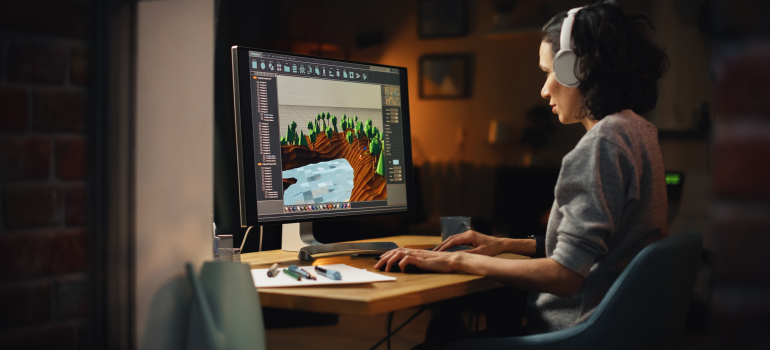
Freelancing is also developing in this profession. At the same time, you can earn at the level of a 3D artist employed in a large production company. Experts with experience in implementing large-scale projects receive several times more.
It's difficult to compile objective statistics on 3D generalist salaries in Belarus. Most production companies and studios working in the creative field prefer to negotiate salaries based on interviews and don't publish specific offers. Small furniture factories and apartment renovation companies, according to belmeta.com, are ready to pay 3D furniture and interior designers from 1,200 to 4,800 Belarusian rubles per month. According to belmeta.com, small furniture factories and apartment renovation companies are ready to pay 3D furniture and interior designers from 1,200 to 4,800 Belarusian rubles per month. According to belmeta.com, small furniture factories and apartment renovation companies are ready to pay 3D furniture and interior designers from 1,200 to 4,800 Belarusian rubles per month. 400;">glassdoor.comIn the US, the average salary for such a specialist is $93,000 per year. Generalists earn more than highly specialized 3D artists, and a mid-level generalist with three years of experience can earn as much as a senior 3D artist.
The bonus of mastering the full stack of 3D development technologies is many employment opportunities. Abroad, such a specialist is in demand in small companies, interior design studios, advertising agencies, jewelry workshops and large corporations such as Caterpillar or Microsoft. It is quite possible to get a job in a foreign company remotely with an intermediate level of English.
How to master the profession of 3D generalist. Useful resources from the editors of Skillbox.by
You can master 3D modeling at a university. For example, at technical universities of Belarus such as BNTU. There they study such tools as AutoCAD, Kompass 3D and 3Ds Max. There are also specialized specializations where you can study 3D technologies in more depth. The Belarusian State Academy of Architecture trains specialists in the fields of Consumer Goods Design, Graphic Design, Virtual Environment Design, and Furniture Design.
However, higher education is not required. Employers usually look at a portfolio of completed projects, as well as proficiency in 3D development technologies and tools. The latter criterion is the least important. It's not a big deal if you're a seasoned 3D generalist but have only mastered Blender, while the studio uses Cinema 4D. The principles of working in different applications are similar, and you can master a new tool in a couple of months.
As an alternative to higher education, you can consider distance learning courses—in this case, you can master the profession in 8-12 months. When choosing training, the editors of Skillbox.by recommend paying attention to the relevance of the training programs and the opportunity to work on real cases.
In order for you to get to know the profession of a 3D generalist better, the editors of Skillbox.by have collected useful online resources for you:
- Blog | CG Spectrum — a collection of useful articles and tutorials on modeling, animation, and VFX.
- Blog | ActionVFX — a blog for an asset sales portal. It has a lot of materials on animation and visual effects.
- Blender Guru — YouTube channel where you can find tutorials on Blender for beginners.
- SKStudio — YouTube channel on 3D modeling.
- Pix Cores — Art, 3D, and AI — A blog where you can find articles on graphic design, including 3D.
- VideoSmile — YouTube channel on 3D graphics, special effects and animation.
- Behance — community of designers and photographers. Here, authors post their work and portfolios.
The Skillbox.by editorial team also recommends reading:
- Expert analysis of the labor market. What professions will be in demand in 2024?
- How to take the first step into a new profession. Free checklists from Skillbox
- 3D artist. A profession that is essential for game design, advertising, and film production.
- How to improve your skills in areas that are in demand on the market. We have collected 50+ courses on one platform for 64.90 BYN.
Master the profession of "3D generalist" with Skillbox.
You will learn how to create 3D characters and environment objects. Select references for creating 3D models. Learn how to convert 3D models to 2D (UV Mapping). Master popular tools, including Houdini, Autodesk Maya, Blender, Photoshop, and ZBrush. Work on real-world cases and add these projects to your portfolio.
Take access