
Try 4 top design professions. Free ➞ In 5 days, you will get acquainted with illustration, UX/UI, web, and graphic design. Add 4 cool case studies to your portfolio and decide which direction to take next.
Learn moreThe world around us is a limitless source of inspiration for creativity. A vibrant grandmother sitting on a bus can become the basis for a unique character, and a picturesque cityscape makes the perfect composition for an advertising poster. Paying close attention to the beauty and details around us fosters creativity and simplifies the process of finding concepts for projects. To capture the most interesting moments, it's useful to sketch—all you need is a pencil and a piece of paper. This way, you can save ideas and images that will inspire you in the future.
Want to master hand sketching skills? Join our hand sketching course. Learn from the professionals and develop your creative abilities. Sign up now and dive into the world of drawing!
Even with the ability to generate ideas without a pencil, capturing all the details of an image can be difficult. This can lead to spending a lot of time creating a result you're not satisfied with. Sketches are a great solution to this problem. In just 10-15 minutes, you can quickly create several sketches, which will help you determine the optimal placement of objects, size relationships, and lighting. After that, you can confidently move on to the main work. Using sketches not only saves time but also improves the quality of the final product.
Clients often request preliminary sketches to ensure their expectations match your plans. Design, illustrations, and advertising graphics are usually created by a team of specialists, and explaining your ideas verbally can be ineffective. A conceptual diagram helps clearly convey ideas and facilitates communication within the team. This helps avoid misunderstandings and speeds up the development process.
How to Sketch
A variety of materials are suitable for sketching, including graphics tablets and traditional sheets of paper with a pencil or marker. Graphics tablets have the advantage of allowing you to easily make changes to your drawing. If you are not satisfied with the placement or size of objects, you can quickly edit them in Photoshop or another graphics editor. When drawing by hand, tracing paper is useful, as it allows you to repeatedly overlay it on the drawing, refining details and preserving all previous versions. This makes the process more flexible and simplifies working on artistic projects.
The first step involves creating black-and-white sketches, which helps better understand the tonal relationships between objects without being distracted by color. One of the most effective sketching techniques is spot painting, using a solid black or subtle shades of gray. This approach allows you to form silhouettes of objects and is an excellent way to plan simple compositions. Spots allow you to focus on the form and arrangement of elements, which contributes to a clearer perception of the overall structure of the work.
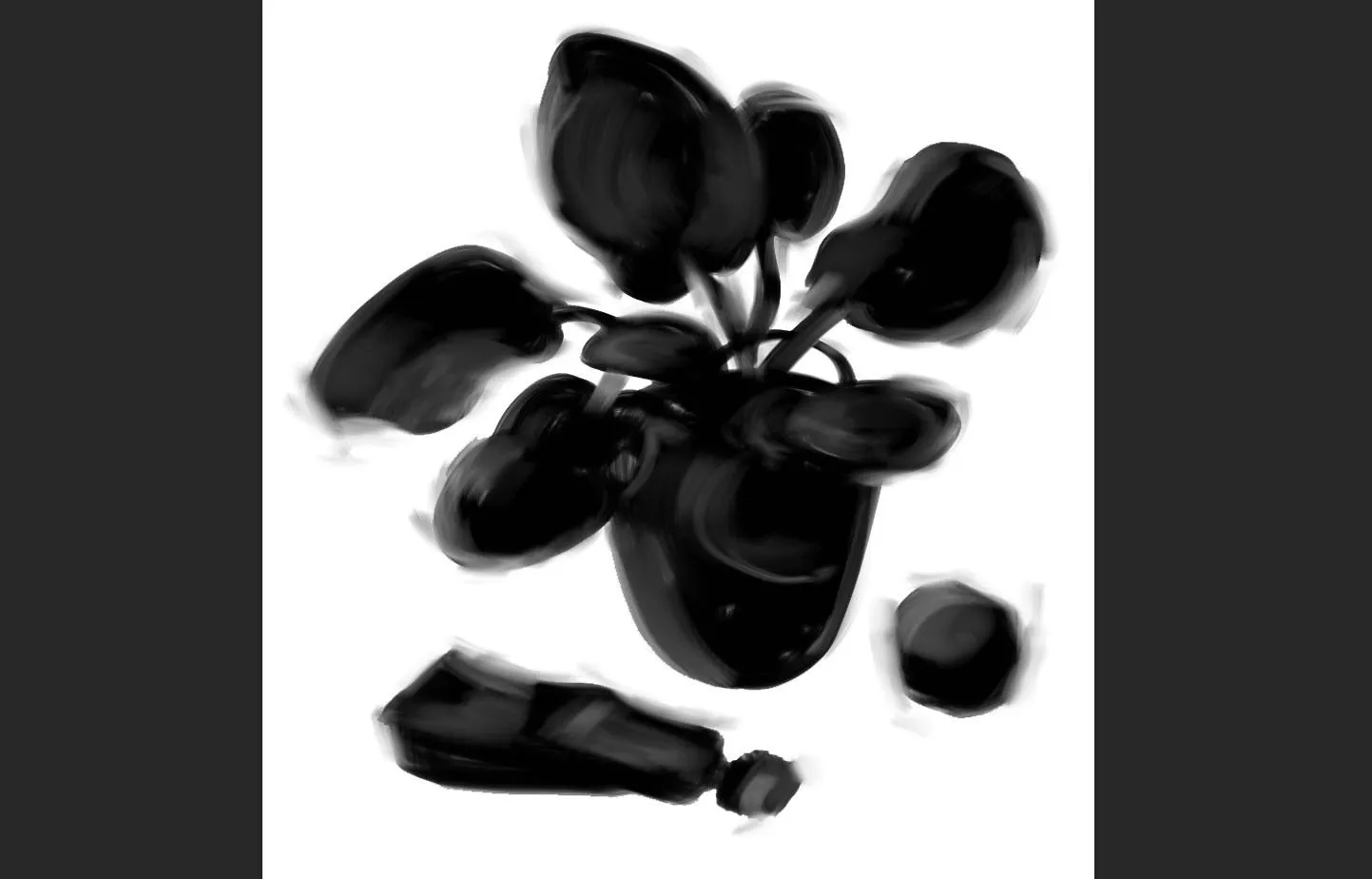
Creating sketches using single-color spots is ideal for developing logos, advertising creatives, and simple illustrations. It's important to focus on the larger forms and overall relationships of elements rather than on detailed elaboration. The basic proportions should be established during the sketching stage, while the details are worked out in the final stages. This approach allows for effective visualization of ideas and the creation of a harmonious composition.
For greater detail, you can use line. This method allows you to more accurately capture the shape of an object and the angle from which we view it. Unlike using spots, lines provide clarity and precision, which is especially important when creating precise images.
The main goal of line sketches is to depict the boundaries of large forms without delving into details, such as veins on leaves or lettering on tubes. It's important to focus on the structure of complex objects. For example, you can emphasize the main directions of a flower's branches, highlight the narrow bottom and wide top of a pot, and outline the side edge of a tube. Line sketches also allow you to demonstrate perspective reductions, which can be achieved using a schematic representation of construction lines. This approach helps create a clear and understandable idea of the form and structure of objects.
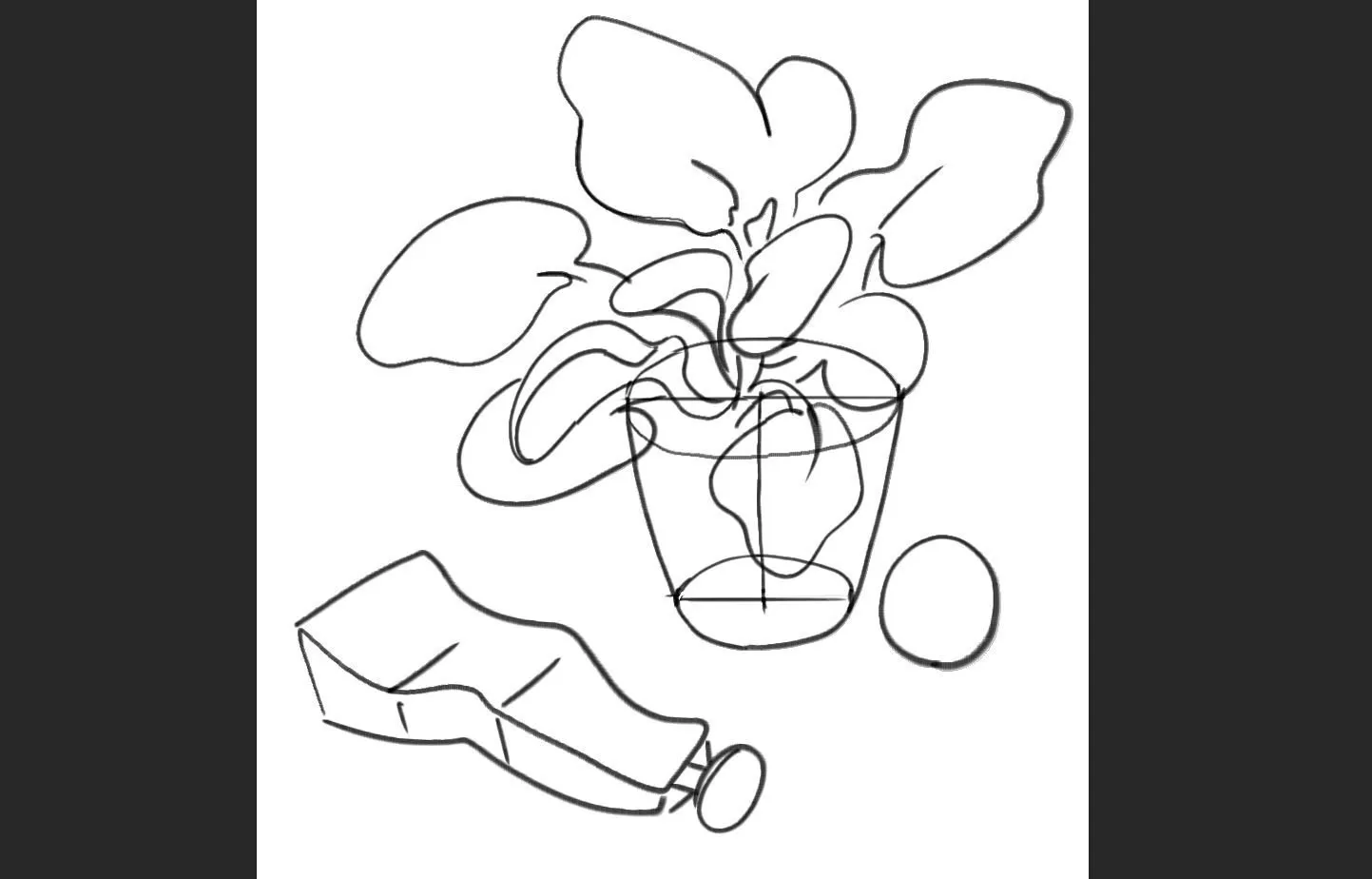
Creating many different sketches on the same topic is a useful practice. By slightly altering the composition, you can achieve new and interesting solutions. In the first sketch, the tube and apple are of similar mass and are positioned at an equal distance from the flower. In the second version, I enlarged the tube and slightly shifted the flower pot, which made the composition more dynamic thanks to the contrast in the sizes of the objects and the varying distances between them. Such experiments help develop artistic perception and find unique solutions in visual art.
Combining line and spot drawing allows for expressive compositions. Simple objects or background elements can be represented as silhouettes, while complex shapes requiring emphasis should be drawn with lines. If a sketch contains multiple objects and planes—near, midrange, and distant—it's recommended to use not only black and white but also various shades of gray, from dark to light. This will help distinguish overlapping objects and effectively convey spatial depth. This approach will improve the perception of the composition and add visual dynamics to it.
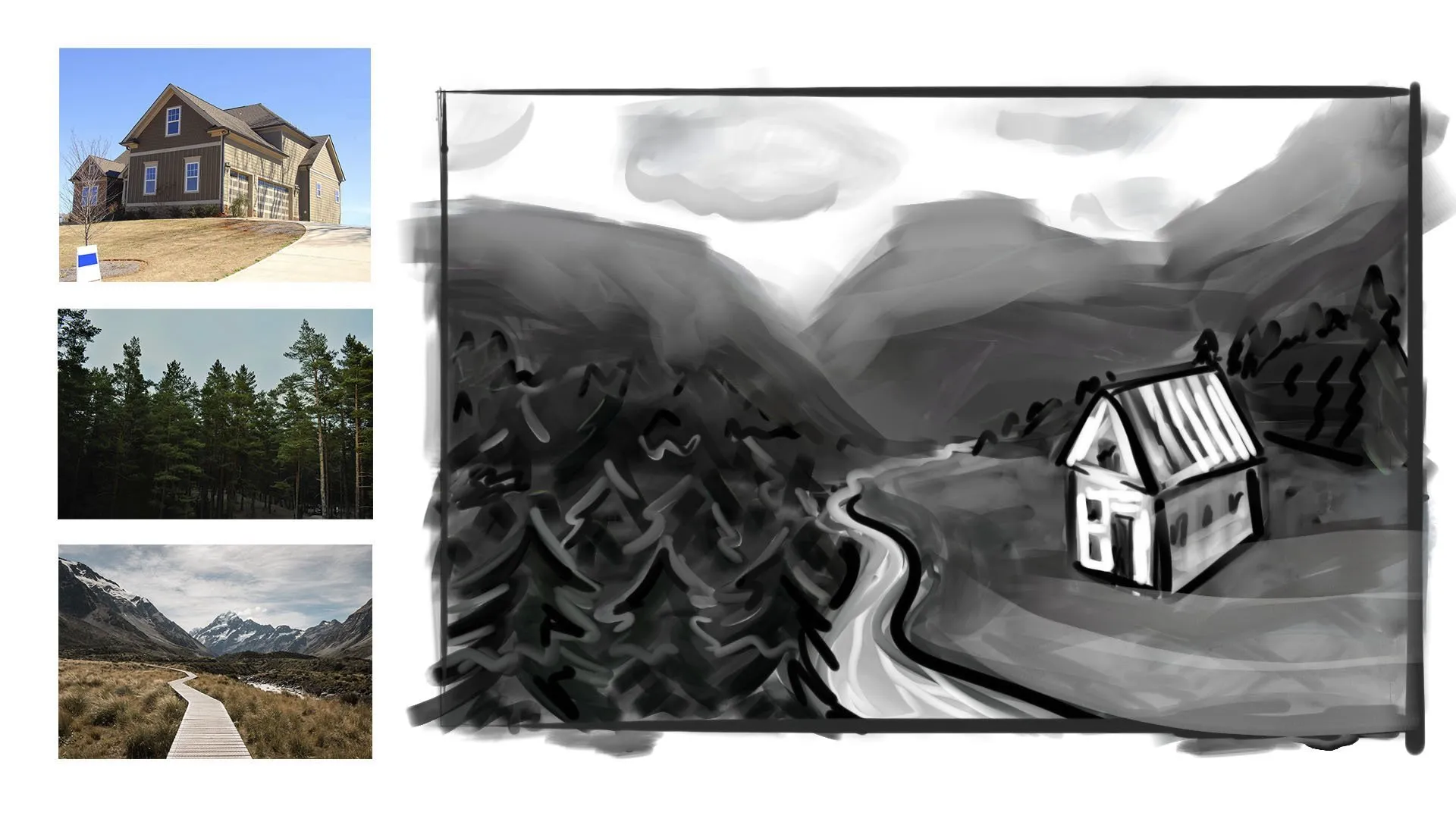
When creating sketches, it is important to use references. Selecting suitable images allows you to better understand how to schematically depict an object and serves as a source of inspiration. It is recommended to collect several references and combine their elements into a single composition to achieve a more expressive result.
The Main Rules of Sketching
In working sketches, beauty and small details fade into the background, while attention to large forms and relationships between objects becomes key. It is important to focus on the main aspects that determine the overall composition and structure. Let's consider the main points to pay attention to when creating working sketches.
According to the laws of optics, objects decrease in size as the distance to them increases. This means that near edges of objects appear larger, while distant edges appear smaller. Parallel lines receding into space do not maintain parallelism and eventually converge at one point on the horizon line. This perceptual effect is an important aspect in the study of perspective and visual art.
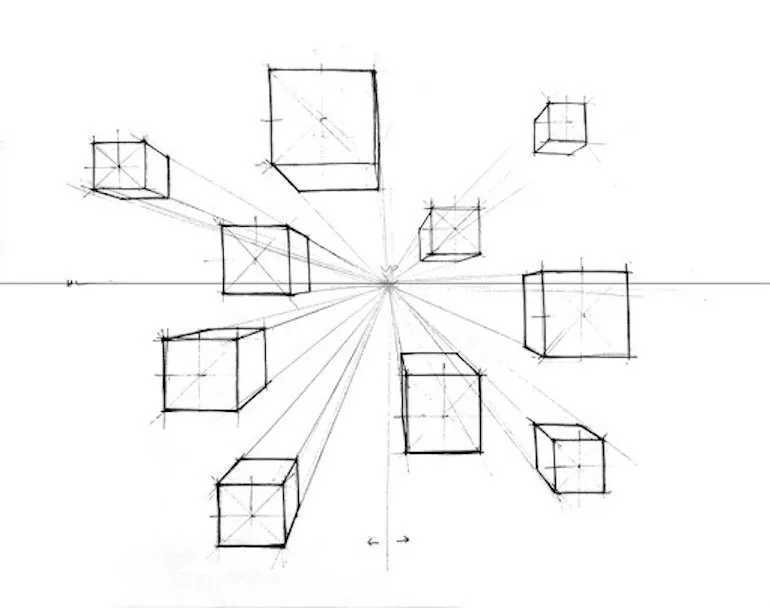
Changing perspective is a popular technique in advertising graphics. This method allows you to present a city from various perspectives, such as a bird's eye view, from the window of a five-story building, or from a child's height. Each of these images will be unique and convey different emotions and sensations. To achieve persuasiveness and expressiveness, it's important to correctly convey perspective reductions. This creates a sense of depth and helps the viewer better perceive the image, making it more appealing and memorable. Using different perspectives in visual content helps highlight the features of objects and convey atmosphere, which is especially important in advertising.
The feeling of nearness or distance of objects is formed not only by geometric factors. According to the rule of aerial perspective, objects closer to the observer appear sharper and have more contrast, while objects in the distance become blurrier, with less contrast and less defined lines. This rule plays an important role in the perception of space and depth in painting and photography, allowing for the creation of realistic images and the conveyance of atmosphere.
Composition is a key element that gives a painting appeal and expressiveness. Instead of randomly placing objects, an artist or designer organizes them into a harmonious structure, creating a visual narrative. Proper composition helps direct the viewer's eye, focusing attention on the main elements and conveying the intended idea. It is important to consider principles of composition such as balance, contrast, and rhythm to create an effective and memorable piece.
Good compositions often rely on the contrast of various elements, such as size, color, and complexity. It's important to strive to create compositions from which details cannot be removed or added without compromising the overall perception. This creates harmony and balance, making the work more expressive and memorable.
A good sketch should be clear, at least to its author. When we depict an object as a circle, it could represent many things: a tennis ball, an apple, a ball of yarn, or a round candle. However, without detail, it's difficult to clearly determine what exactly we're depicting. In the case of a sketch, for example, an apple juice advertisement, a round object will most likely be perceived as an apple. This understanding should be obvious not only to the author but also to clients and colleagues. If the image contains several similarly shaped objects, it's important to develop a way to distinguish them in the sketch to avoid confusion. Correct use of shapes and details in a sketch contributes to a clearer perception of the idea and increases the effectiveness of visual communication.
Profession Graphic Designer PRO
You will learn how to create corporate identity elements and graphics for business. You will put together a portfolio that reflects your style and confirms your design skills. You can start a career in a studio or as a freelancer.
Find out more