Contents:
- Why should women and men do abdominal exercises?
- What muscles form the abdominal press?
- What are the upper and lower press?
- Why it is important to train your core muscles instead of doing abdominal exercises?
- 10 effective exercises to pump up your abs at home.
- Myths about the abdominal press.
- Conclusions.
Free test: which digital profession is right for you? Find out the answer in 15 minutes and try your hand at a new specialty.
Learn moreWhy should women and men do abs workouts?
Abs are a nice bonus for both men and women when they do abs workouts. People with toned abs not only create a beautiful figure but also maintain their health. A strong abdominal muscle serves as an elastic muscular corset: it supports the internal organs in the correct position, normalizes intra-abdominal pressure, prevents hernias and back pain.
Which muscles form the abdominal muscle
When we talk about the abdominal muscle, an image immediately comes to mind: a sculpted stomach with coveted cubes. But what is behind this image? Which muscles make the abdominal muscle beautiful?
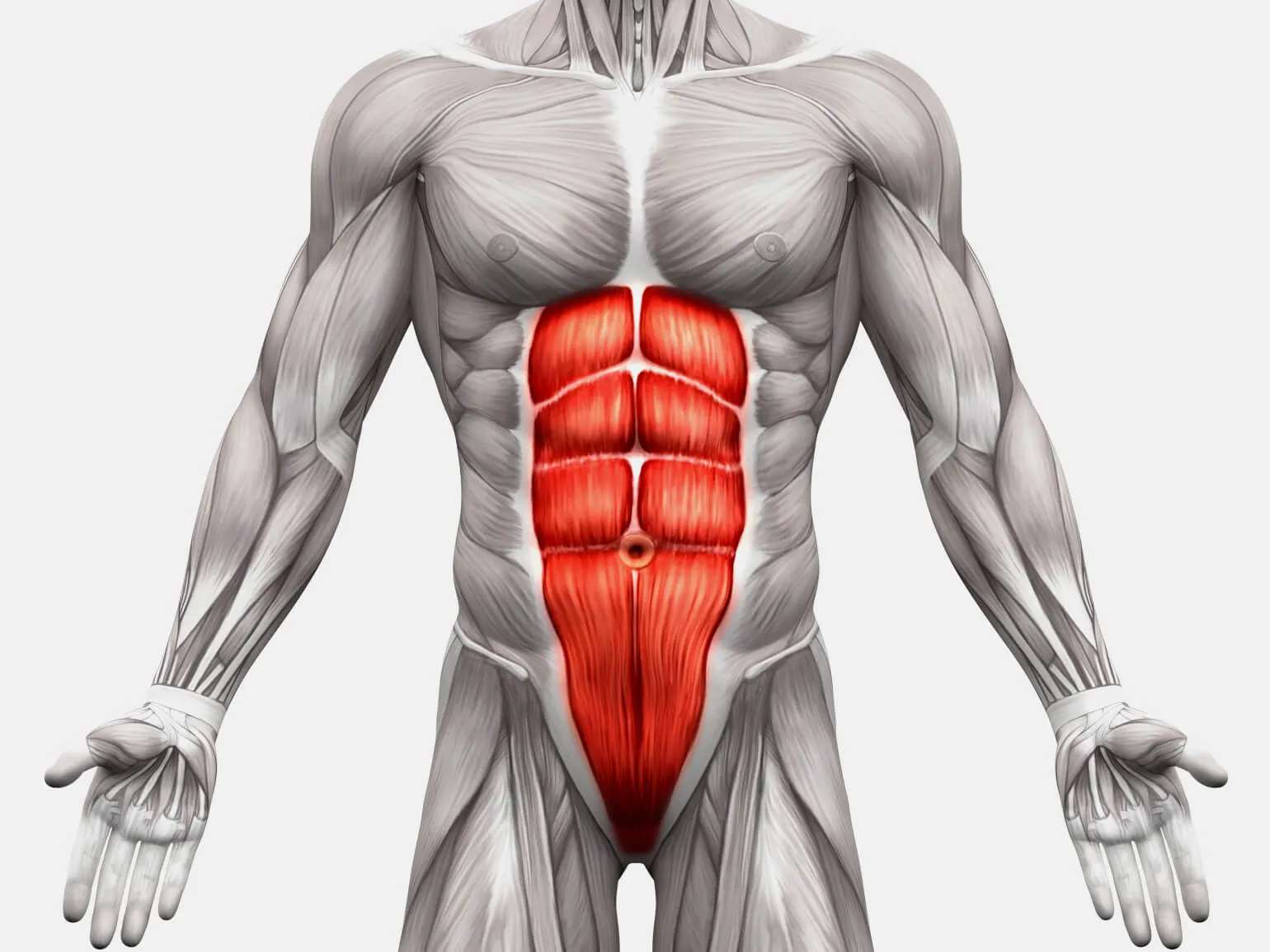
The main character is the rectus abdominis muscle, it is paired, located to the left and right of the navel. Each part runs from the pubic bone to the sternum and looks like a single powerful layer. It is the rectus abdominis muscles that allow you to pull your chest toward your pelvis (when lifting your torso) or your pelvis toward your chest (when lifting your legs).
The upper part of the rectus abdominis muscle is divided into sections, creating, depending on genetics, four, six, and sometimes eight cubes.
The lateral muscles are the second and third layers.
- The second are the oblique muscles. The outer ones emphasize the waist, and the inner ones are responsible for keeping the torso in a constant upright position.
- The third layer - the transverse abdominis - is the deepest lateral abdominal muscle, it is located under the internal oblique and is involved in straining.
Yes, the abdominal muscles also include the quadratus lumborum, which in shape resemble elongated quadrangles on either side of the lumbar vertebrae. When both muscles contract, the lumbar region is straightened. The quadratus abdominis is also involved in pelvic elevation and trunk flexion.
What are the Upper and Lower Abs?
Professor Len Kravitz, a certified strength and conditioning specialist (CSCS), explains that there is actually no such distinction as upper or lower abs. One muscle—the rectus abdominis—is responsible for "both abs." When we do regular crunches, that is, pulling our upper body toward our stomach, the upper part of the rectus abdominis is more heavily loaded. Leg raises train the lower part. And since the sensations when training the upper and lower abdominal muscles are different, trainers often talk about “upper” and “lower” abdominal muscles, simply because it is convenient, understandable, and visual.
Why is it important to train your core muscles instead of just doing abs?
Core muscles are the name given in English literature to the muscles of the torso that help us maintain body position. Core translates as “core” or “rod.”
The core muscle group includes:
- rectus abdominis;
- internal and external oblique muscles;
- transverse abdominis;
- lumbar muscles, including deep quadratus;
- The erector spinae muscle;
- The diaphragm;
- The pelvic floor muscles.
The core muscles are the center of your body, where many "chains" are "tied." When you engage one muscle, it transfers tension to others, and as a result, the entire complex is strengthened. Even if you're not yet setting yourself the global goal of pumping up your entire body, you should perform abdominal exercises in a way that also engages your back muscles. The abdominal and back muscles are a team. If one member is weak, the other is forced to take on more responsibility to "carry" everyone else. However, hypertonicity or weakness in one muscle can affect your posture, cause a protruding belly, and prevent you from achieving the desired six-pack look. Therefore, it is important to train all the muscles of the core together, then the six-pack will appear, the muscular corset will be strengthened, and the protruding belly will disappear.
10 effective exercises to pump up the abs at home
We use the abdominal muscles at home without even thinking about it. For example, when you pick something up from the floor, work in the garden, sweep or vacuum, climb the stairs. Unfortunately, the load on the muscles is small, so the six-pack does not appear. To pump up the abs, you need to do certain exercises.
1. This exercise strengthens the core muscles, including the rectus abdominis, transverse abdominis, shoulder girdle muscles, glutes, lower back, and quadriceps.
How to do the abdominal exercise:
- Sit on the floor, and then assume a push-up position on your elbows or palms.
- Keep your body in a straight line from head to toe.
- Tighten your abs and buttocks, avoiding sagging in the lower back.
How long to do it: Start with 20-30 seconds, increasing the time to 1-2 minutes as you progress. Perform 2-3 sets.
Jennifer Burke, a fitness trainer at The American Council on Exercise, explains: If you feel maximum tension not in your abdominal muscles, but in your buttocks, arm muscles, and lower back, then you are doing the plank incorrectly.
⚠️Precautions: Avoid the exercise if you have lower back pain.
2. The side plank works your obliques, transverse abdominis, shoulders, glutes, and legs.
How to do it:
- Lie on your side, propped up on your elbow.
- Lift your hips so your body forms a straight line.
- Keep your other hand on your hip or raise it up.
How long to do it: Hold the plank for 20-30 seconds on each side, gradually increasing the time to 1 minute.
You should feel tension throughout the right (or left) side of your abdomen, with the strongest tension felt a few inches to the right (or left) of your belly button.
⚠️Precautions:
- Don't drop your hips, tighten your abdominal muscles, then you will be able to lift them and hold a straight line.
- To prevent your shoulder from "sliding" forward, place your elbow directly underneath it.
- Do not perform side planks if your shoulder joint is unstable.
3. Regular crunches are considered a classic, but many people perform this abdominal exercise incorrectly, which is why they do not get results. If you do everything correctly, you will work the rectus abdominis, especially the upper part, getting closer to the "six-pack".
How to do it:
- Lie on your back with your knees bent.
- Lift your upper body, tensing your abs (smoothly, without jerking).
- Slowly lower yourself back down.
Perform the movement slowly, 15-20 reps in 2-3 sets. Keep your hands behind your head, but do not press down on it.
⚠️Precautions: Avoid upper body crunches if you have neck pain.
4. Reverse crunches are effective for the lower rectus abdominis.
How to perform:
- Lie on your back and raise your legs up, bending them at an angle of 90 degrees.
- Lift your pelvis up, contracting your abdominal muscles.
- Slowly lower your pelvis back down.
Do 12-15 repetitions in 2-3 sets. When doing the lower abdominal exercise, you should feel tension in the muscles below your belly button.
⚠️Precautions:
- Do not jerk your legs too hard, move slowly.
- Try not to strain your neck muscles.
- Do not perform the exercise if you have a herniated disc disk.
5. By performing this exercise, you can strengthen the rectus abdominis, transverse abdominis, hip muscles, and lower back.
How to perform:
- Sit down and lift your legs and upper body off the floor so that your body takes the shape of the letter V.
- Stretch your arms parallel to your legs or hold them behind your head.
- Hold the position for 10–20 seconds.
Gradually increase the duration of the exercise to hold the V-shaped position for one minute.
⚠️Precautions:
- Avoid sagging your back.
- Start with short intervals to avoid overexertion.
6. Improves coordination and core stability.
How to do it:
- Get on all fours.
- Extend your right arm forward and your left leg back.
- Return to the starting position and repeat on the other side.
Do 10-12 reps on each side, 2-3 sets.
⚠️Precautions: Move slowly to maintain balance.
7. Works both the rectus abdominis and oblique abdominal muscles.
How to do it:
- Lie on your back with your knees bent.
- Raise your shoulders off the floor and alternately pull your elbow toward the opposite knee, simulating riding a bicycle.
Do 15-20 reps in 2-3 sets.
⚠️Precautions: Avoid sudden movements, do everything slowly and smoothly, do not strain your neck - look up, not at your feet.
8. This abdominal exercise got its name from the position it takes: it's very reminiscent of Superman flying.
The Superman primarily works the lower back and buttocks.
How to do it:
- Lie on your stomach with your arms extended in front of you.
- Simultaneously lift your arms, chest, and legs off the floor, keeping your lower back engaged.
- Hold the position for 1-2 seconds and lower yourself down. Look down to keep your neck in a neutral position.
Repeat the exercise 10-15 times in 2-3 sets.
⚠️Precautions: Do not strain your lower back, avoid jerking.
9. This abdominal exercise targets the oblique abdominal muscles.
How to perform:
- Sit on the floor with your legs bent, keeping them off the ground.
- Hold a weight (medicine ball or dumbbell) in your hands.
- Turn your body left and right, trying to touch the floor with the weight.
Do 12-20 repetitions on each side, 2-3 sets.
⚠️Precautions: Twist with your body, not just your arms, and maintain a 45-degree angle.
10. Maximally activates the deep abdominal muscles - the rectus abdominis and transverse abdominis.
How to do:
- Kneel down, holding the ab wheel with both hands.
- Slowly roll the wheel forward until your body is almost parallel to the floor. Keep your back straight and engage your abs.
- Return to the starting position, engaging your abs.
Do 8-12 reps for 2-3 sets.
⚠️Precautions: This is a challenging exercise - start with a small range of motion.
Abdominal Myths
There are many misconceptions There are many ideas about the best way to train your abs. Which of the popular opinions is a myth, and which is true?
To train your abs, you need a static load - when you tense your abdominal muscles without moving your body. It's like trying to suck in your stomach or tense your abs to withstand a light blow to the stomach. When standing, your body weight is distributed differently, and your abs are less engaged. But when lying down, they work against gravity, which creates a greater load.
That's why most abdominal exercises are performed lying down, sitting, or bending over - this increases the load on the muscles and helps you achieve results faster.
Quality is more important than quantity. If you feel your abs tense, then your abs exercises are working. Once they become easier to perform, you need to increase not the number of sets, but the static load, that is, create resistance to the muscle. One effective way to increase the load is to slow down. The slower you perform an abdominal exercise, the more effective it is.
20 sit-ups burn approximately 9 calories. Nine, Karl! That's very little. Moreover, purely physiologically and anatomically, it is impossible to remove fat from the waist by using only the abdominal muscles.
A study conducted by scientists from the University of Massachusetts convincingly proved that abdominal exercises do not reduce the diameter of fat cells in the abdominal area, the amount of subcutaneous fat in the abdominal area (skin fold thickness), or abdominal circumference. The fat layer will begin to melt when your body is forced to use fat to provide cells with energy.
Conclusions
To pump up your abs, you need to meet three conditions:
- Regularly do exercises to strengthen the abdominal and back muscles.
- Reduce the calorie content of food, but stick to a balanced diet. This means eating proteins, fats, and carbohydrates.
- Don't forget about cardio training: when we give the body any aerobic exercise, calories are burned and fat melts, which prevents the "six-pack" on the stomach from appearing.
Become a personal trainer
On the course you will learn all about How muscles work and which exercises are suitable for achieving different goals: losing weight, building a beautiful physique, staying in shape. Learn how to communicate with clients and motivate them.
Remove access