Contents:

Learn: Commercial Illustrator Profession
Learn MoreRoad signs play an important role in our lives, significantly influencing our perception of the world around us. From an early age, we encounter these symbols, and they become deeply imprinted in our memories due to their importance for safety. Each sign carries information that helps drivers and pedestrians navigate the roads, preventing accidents and promoting safe movement. It's important to understand that road signs not only inform but also shape our habits and behavior on the road, making them key elements in the traffic system. Without them, compliance with safety regulations would be significantly hampered.
The traffic regulations introduce the symbolism of three primary colors: red, yellow, and green. These colors perform important functions on the road. Red indicates a prohibition and requires stopping. Yellow serves as a warning to be attentive and prepared for changing traffic conditions. Green signals that proceeding is permitted. Understanding and following these color signals helps improve road safety.
Rework the text to meet SEO requirements while staying on the main topic. Avoid adding unnecessary information and symbols. Do not use numbers or bulleted lists.
Reading is an important aspect of our lives, which helps develop thinking, expand vocabulary, and improve writing skills. Regularly reading books, articles, and other materials not only helps you gain new knowledge but also develops your creativity. Reading also improves concentration and attention, which is especially important in today's distracting world. Therefore, it's important to set aside time for reading and choose quality materials that will help you grow and develop.
Colors play an important role in our lives and have their own unique meanings. Each color evokes specific associations and emotions, making them significant in various fields, such as design, fashion, and marketing. For example, red is associated with energy and passion, while blue symbolizes calm and reliability.
Color combinations also require special attention. Properly selected colors can create a harmonious perception and enhance the emotional impact. Basic rules for color combinations include using contrasting shades to attract attention and analogous colors to create a calm atmosphere.
When creating a design, it's important to consider a color palette that aligns with the project's goals and objectives. Using color schemes such as monochrome, complementary, and triadic helps achieve the desired visual effect. The right combination of colors helps create a memorable image and increase interest in a product or service.
Therefore, understanding the meaning of colors and their correct combination are key elements of successful design and communication.
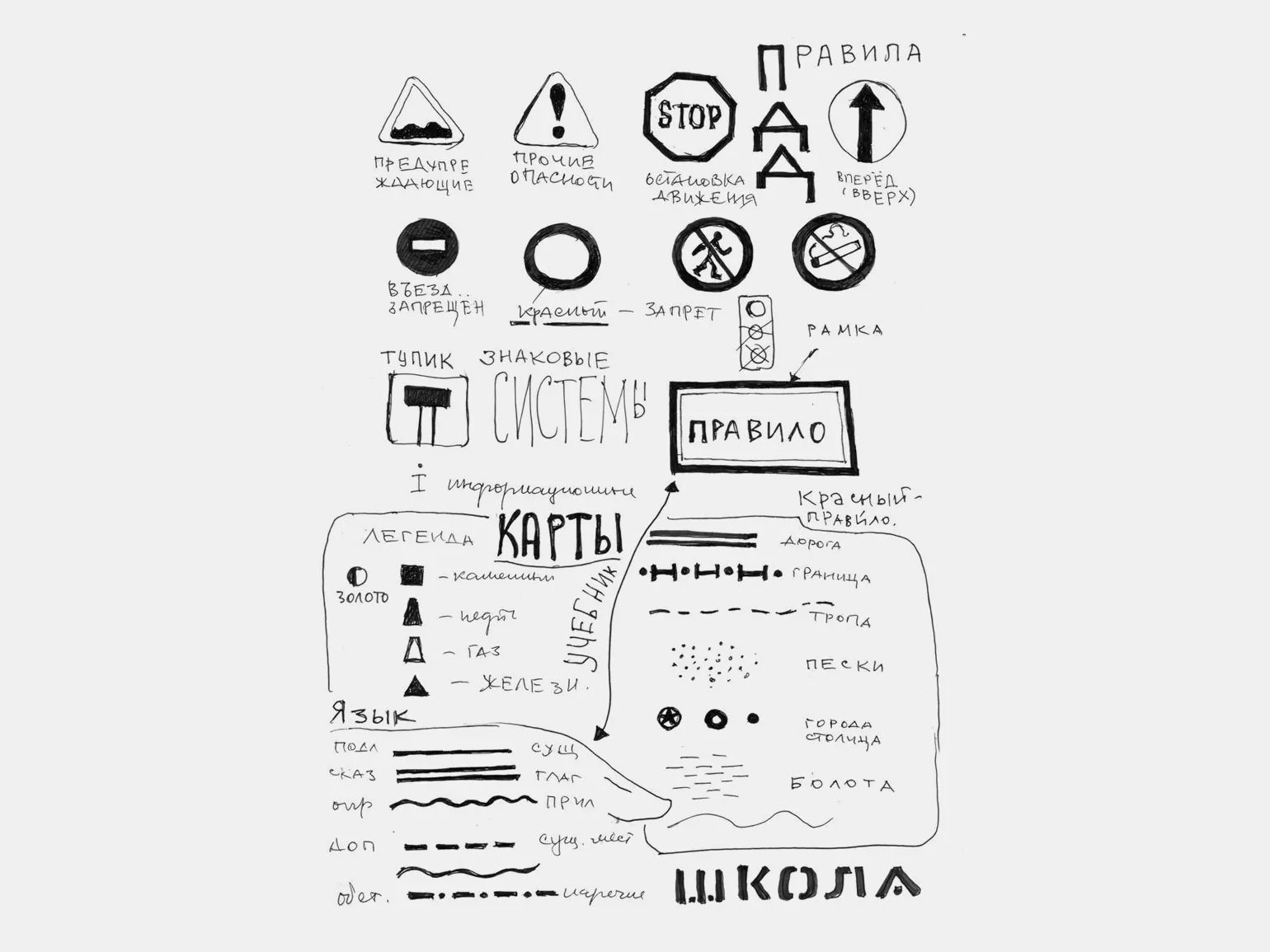
In previous materials, we have already touched on the topic of geometric shapes. Warning signals are triangular in shape and colored yellow. Yellow, combined with an exclamation mark, symbolizes a warning and attracts attention. A red ring with a diagonal line intersecting the object has become a generally accepted visual symbol of a prohibition. These elements play a key role in conveying information and ensuring safety in various situations.
Road signs introduce us to simple symbols and icons, such as simplified images of buses or trams at stops. In addition to icons, there are interesting abstract images, such as the "No Entry" sign, a bold white minus sign on a red background, commonly known as a "brick." This symbol is associated with prohibition in various visual contexts. The color blue in traffic regulations serves a neutral, regulatory, and informational function. Interestingly, movement in the "straight ahead" direction is indicated by an arrow pointing upward, which disrupts the usual visual logic to which we have become accustomed and do not notice. School textbooks on various subjects are an important source of symbolic meaning. They not only convey knowledge but also shape students' worldviews, laying the foundation for further learning and development. Through educational materials, students learn key concepts and ideas that influence their understanding of the world around them. Textbooks serve as an important tool in the educational process, providing information and promoting the development of critical thinking. A closed frame is a key element of all textbooks. Rules are placed in a rectangle, with particularly important rules highlighted with a red frame. The frame, like an arrow, acts as an indexical symbol: it does not depict the object directly, but rather points to certain characteristics of it. In this context, the text of the rule becomes the central element, and the frame symbolically emphasizes its importance and status.
The indexical functions of parts of speech designations in language textbooks have their own characteristics. One underline indicates the subject, which is represented by a noun, protagonist, or object. Two underlines denote the predicate, emphasizing the action or importance of the word in the sentence. Correct use of these designations helps to better understand the structure of the sentence and the role of each element in it.
The curvy line used to denote an adjective modifier in native language textbooks symbolizes the quality of the object. Visually, it also reflects uncertainty, associating it with a wave, instability, and doubt. This image creates polysemy and allows for a deeper understanding of the nature of the described object, emphasizing its variability and complexity.
The dotted line serves important functions in a variety of fields, including text and drawing. In sentences, it can indicate additions, creating a sense of incompleteness or uncertainty. In drawing, the dotted line is used to show invisible but significant details of form, allowing for a better understanding of the object's construction. The dashed line, in turn, serves to indicate adverbial clauses in sentences, although its semantic connection may not be obvious. It is also used to indicate axes in drawing and geometry, emphasizing its versatility in the visual representation of information.
Maps are a source of subtle symbols that play an important role in understanding a place. For example, roads are marked with a smooth, solid double line, indicating major transportation routes. Meanwhile, paths are depicted with a broken line, creating a sense of uncertainty and ease. These symbols not only inform about the types of routes but also add an artistic element to cartography, allowing for a better perception of the surrounding landscape.
The most well-known form of representing boundaries are special dashed-dotted lines that clearly delineate the territorial boundaries of states. This visualization helps schoolchildren understand the concept of psychological boundaries, symbolizing the boundaries beyond which people strive and the boundaries that should not be crossed. Depicting boundaries in this way helps children develop an awareness of social behavior and norms, and understand the importance of following established rules in society.
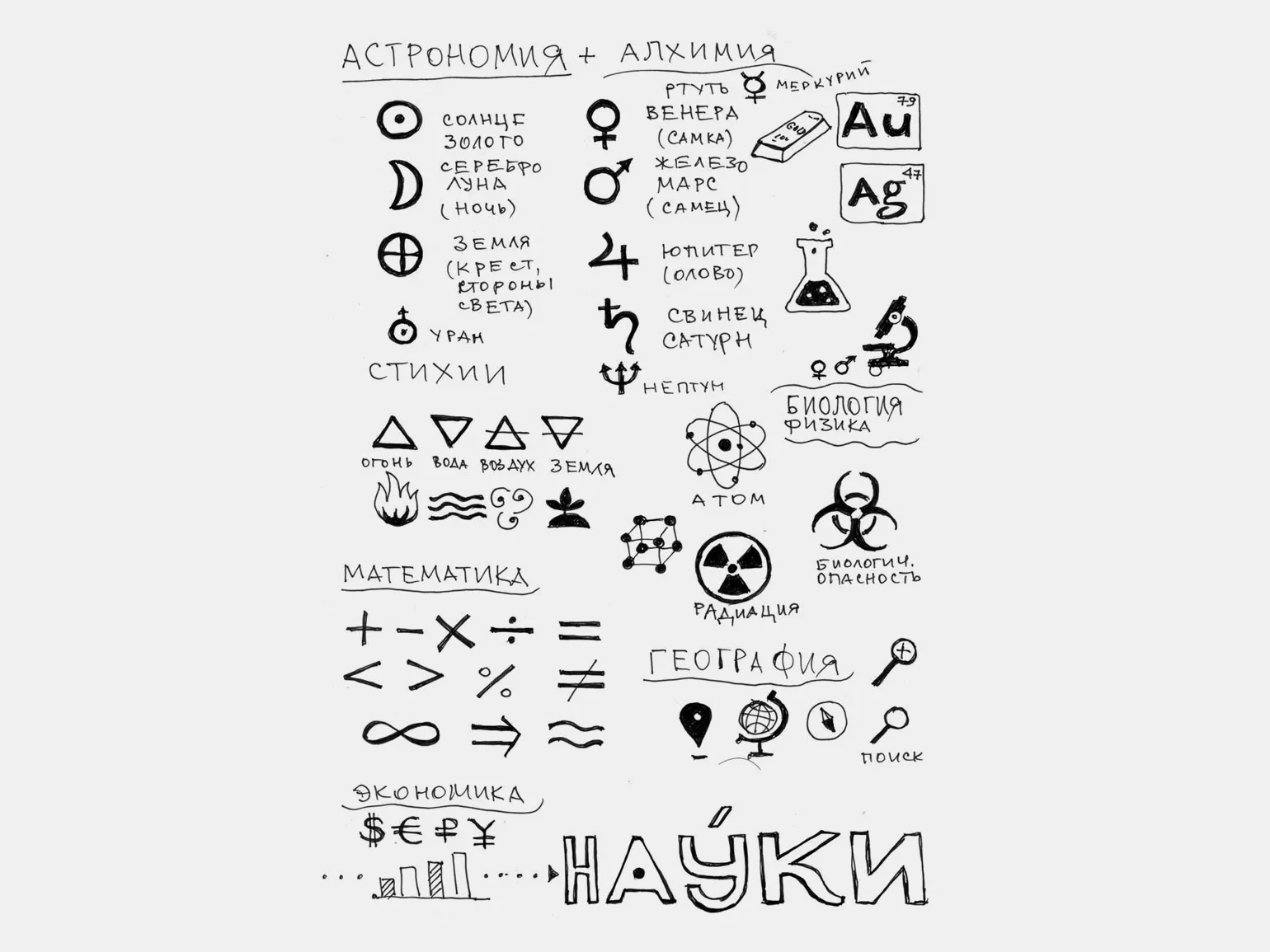
Mathematics is a universal language that includes concepts such as addition and subtraction, comparison of quantities, and infinity. These symbols and operations are not limited to arithmetic; they also reflect deep philosophical ideas and universal values. Mathematical signs such as plus and minus, greater than and less than, serve not only to solve numerical problems but also to understand the world around us, relationships between people, and processes occurring in nature. Mathematics connects people, allowing them to share knowledge and concepts that are meaningful to everyone.
Symbols of various sciences are well known to many thanks to the school curriculum. These signs are unmistakable and effectively fulfill their function. In physics, we recognize it through the structure of an atom and a molecular lattice. Economics can be identified by currency signs and growth charts. Geography is represented through a globe, and zoology through the symbols of Venus and Mars, representing female and male. Such symbols not only aid in learning but also create visual associations that facilitate the understanding of scientific concepts.
The modern mind responds to certain symbols that evoke resonance and associations. These symbols are effective in visualization only if they evoke recognition. Some symbols lose their relevance and are forgotten over time, while others continue to retain their significance and influence perception. It's important to consider that symbols that remain in people's minds have the ability to create deep connections and emotional reactions, making them important in a variety of fields, from art to marketing.
The astronomical symbols of the planets originally also had alchemical significance. The sign of the Sun represented gold, and the sign of the Moon, silver. For centuries, these symbols remained known among European scholars. In modern times, only the symbols of Venus and Mars, used to denote biological sex, remain understood and widely used. These symbols not only reflect astronomical realities but also retain a connection with ancient concepts of nature and material elements.
The sign of the Sun lost its connection with gold, and was replaced by the abbreviation Au from the periodic table. Alchemical symbols for the elements, represented as triangles, have become archaic and less understandable to modern man. Instead, symbols that reflect the immediate properties of the four elements: fire, water, air, and earth, are more relevant. These symbols help to better understand the nature of elements and their interaction in the surrounding world.
Learn more about design by subscribing to our Telegram channel. We share the latest news, trends, and useful tips in the field of design. Don't miss the opportunity to stay up-to-date with the latest developments and be inspired by new ideas.
Reworking your text for SEO is important for improving search engine visibility. The key is to preserve the original content while making it more appealing to search engines. Use keywords naturally and improve the structure of the text for better comprehension.
Read also:
- Sign and meaning: the human body
- What does the cross mean?
- What does the square mean?
- How to create the perfect logo: searching for ideas, choosing a concept, examples
Commercial Illustrator Profession
You'll learn to professionally create commercial illustrations, characters, and animation. Choose a specialization and create a portfolio. Learn how to promote your personal brand and make illustration your primary source of income.
Find out more