
Contents:

Free test: which digital profession is right for you? Find out the answer in 15 minutes and try your hand at a new specialties.
Learn moreWhy you need to plan your family budget for the year and is it possible to do without it?
Many people avoid annual planning for a number of reasons. One of the main reasons is the lack of a clear goal or understanding of their long-term aspirations. Without a clear idea of what they want to achieve, people can feel overwhelmed and unsure where to start. Additionally, some believe that annual planning requires too much time and effort, which they would rather spend on more urgent tasks.
There is also a fear of failure and disappointment when plans are not implemented as intended. This can lead to a negative perception of the planning process itself. Lack of knowledge about how to properly plan also plays a role. Many people don't know how to effectively set goals and break them down into achievable steps.
Another important factor is the lack of a system for tracking and analyzing results, which means people don't see progress and lose motivation. All of these reasons can prevent people from creating an annual plan that could help them organize their thoughts and actions to achieve success.
- They don't understand why it's necessary.
- They chose an inconvenient budgeting method.
- They don't understand how to approach it: there is no clear and consistent system.
- They don't want to control their budget because they are sure they can do without it.
- They don't have enough time.
- They are afraid to see the real picture of their finances and capabilities.
Planning is the key to financial success. Without it, the likelihood of making impulsive purchases increases, which can lead to irrational spending. As a result, important goals may fall into the background, and you risk losing sight of your priorities. Without a clear plan, it's unclear what you were trying to achieve and how close you are to achieving them. Proper planning helps you focus on the main thing and manage your finances effectively.
Budgeting provides a variety of opportunities and contributes to:
1. Optimizing expenses, which allows you to better manage cash flows.
2. Achieving financial goals, whether saving for large purchases or investing in development.
3. Resilience in conditions of economic instability, helping to avoid debt and financial difficulties.
4. Improving control over funds, which allows you to approach your spending more consciously.
5. Improving financial literacy by promoting a better understanding of personal finances and their management.
Proper budgeting is the key to financial well-being.
- Understand your finances: understand where your money comes from (if you have multiple sources of income) and where it goes. It's important not only to record your income and expenses, but also to analyze what you bought impulsively, why your expenses are increasing, and how you can increase your income.
- Achieve financial goals: plan major purchases, save for retirement, children's education, or vacation, and successfully implement these plans.
- Prepare for unforeseen situations: being laid off, urgent medical expenses, or other financial difficulties will be less stressful if you have a reserve.
- Optimize expenses: knowing your spending helps you determine where you can cut costs, correct planning errors, eliminate deviations, and make changes to your future budget.
- Reduce anxiety: understanding your financial situation and systematically planning your spending can significantly reduce stress levels. People who constantly worry about money perform lower on cognitive tests than those who are confident about their financial situation and are more likely to make poor life decisions.
Planning and setting motivating financial goals can significantly improve a family's financial situation. This is especially true for those who strive for quality recreation, expensive purchases, improved housing, children's education, and regular car replacements, while avoiding loans and debt. Effective financial management allows you not only to achieve your goals but also to create a financial safety net, which ensures stability and confidence in the future.
Planning and discussing finances in the family play a key role in creating harmonious relationships. More than 50% of family conflicts arise from financial disagreements. To build a strong and united family, it is necessary to pay attention to financial issues. Open communication about money helps avoid misunderstandings, builds trust, and jointly develop strategies for achieving financial goals. Budgeting and joint planning of expenses and savings strengthen family bonds and create the foundation for a stable future.
Andrey Frank is a renowned figure whose work spans multiple fields. He has proven himself to be a talented professional capable of solving complex problems and achieving high results. In his work, Andrey Frank emphasizes innovative approaches and modern technologies, allowing him to remain competitive in a rapidly changing world. His experience and professional skills make him a valuable asset to any team. Thanks to his commitment to continuous development and learning, Andrey Frank continues to make a significant contribution to his field, inspiring others to achieve.

Learn also:
A family budget is a system of family finance management that includes income and expense planning. Maintaining a family budget allows you to control financial flows, optimize expenses, and achieve financial goals.
The main goal of a family budget is to ensure stability and financial security. To manage it effectively, you need to list all sources of income, including salaries, additional earnings, and other receipts. Then you should record all regular and unexpected expenses, such as utility bills, food, transportation, and entertainment.
It is important to regularly analyze the budget to identify areas where you can cut expenses or increase income. Keeping a budget also allows you to plan in advance for large purchases and save for important events, such as vacations or children's education. Using special applications or spreadsheets for tracking finances can significantly simplify the process and make it more visual.
A family budget is the key to financial well-being, which helps avoid debt and provides an opportunity for future investments.
How to plan a budget for the year
Keeping a family or personal budget can have different interpretations. Usually, there are three main approaches to its management. The first approach focuses on strictly tracking income and expenses, which allows you to control your financial situation and avoid overspending. The second approach emphasizes budget planning, where funds are allocated in advance for major expense items such as housing, food, and entertainment. The third approach involves the use of financial apps and technology, which simplifies the budget tracking process and provides analytical data for more conscious financial management. Each of these approaches has its own advantages and can be adapted to individual needs and goals. Choosing the right budget management strategy will help significantly improve your financial situation and achieve your goals.
- Simply recording income and expenses without in-depth verification and analysis.
- Accounting and analyzing expenses and income, but without developing plans.
- Full financial management - analysis, planning of expenses and income forecasting.
Effective financial management lies not only in tracking current expenses and income, but also in the ability to plan for the future. To achieve financial stability, it is important to allocate funds in advance for both everyday needs and long-term goals. Budget optimization and proper planning will help create a financial safety net and ensure confidence in the future. Wise resource allocation helps not only cover current obligations but also accumulate funds for major projects and dreams.
The desire to create a long-term plan often arises suddenly, for example, after the New Year or on Monday. However, this desire can quickly fade, as the planning process requires significant effort and a conscious approach. Developing an effective long-term plan requires time, analysis, and a clear understanding of goals. The right strategy and consistent actions will help not only formulate a plan but also successfully implement it.
It's important to be honest with yourself: creating an annual plan is a complex task that requires significant time and effort. To avoid overwhelm, start with short-term planning. Set aside at least one week for preparation and ensure that nothing will distract you from your work. This approach will help you focus on your goals and create a foundation for successful long-term planning.
First, you need to gather complete information about your family's financial situation. It is important to take into account all sources of income, expenses, assets, and liabilities. This will allow you to get a clear picture of your current financial situation and identify areas that require attention. Remember to include both regular and unexpected expenses, as well as analyze debt obligations, such as loans and borrowings. This approach will help you develop strategies to improve your family's financial situation.
- how much you earn - monthly and annual income;
- how much and what you spend on - fixed expenses, unexpected expenses, large payments;
- account balances, assets, and liabilities - debt, loans, mortgage.
If you haven't been tracking your finances yet, it's worth using data from banking apps to get a complete picture of your expenses. It's recommended to analyze your expenses not only monthly but also over longer periods, such as a quarter or a year. This will allow you to identify the main areas where your funds are spent and assess the stability of your financial situation. Often, unnoticed but regular expenses can surprise you with their amounts. By understanding your income and expense structure, you can better manage your budget and plan for the future.
Pay attention to important aspects that may influence your decision. It's important to consider all details to achieve the best results. Be attentive to the quality of information and verify sources. This will help you avoid mistakes and improve the effectiveness of your actions. Always strive to analyze the situation and draw informed conclusions based on facts and data. Your attention to detail and critical approach will definitely yield positive results.
- total annual family income;
- income stability – is it regular, increasing or decreasing;
- savings made during the current period;
- times when expenses increased sharply, for example, seasonal expenses, the holiday period;
- expense items that unexpectedly exceed your expectations;
- use of active and passive income and their ratio.
When analyzing data, it is important to compare current results with those of previous periods. Pay attention to categories where excessive spending is observed. This may serve as a signal for the need to reallocate the budget or cut unnecessary expenses. Optimizing expenses will help improve financial stability and increase the efficiency of resource management.
Asset and liability analysis is a key element in financial management. Asset valuation is the assessment of those resources that have value and can be realized, while liabilities represent obligations such as loans and debts. Conducting this analysis allows you to determine your net worth, which is calculated using the following formula: Net worth = Assets - Liabilities. This metric is an important indicator of financial health and allows you to make informed decisions to improve your financial position. Proper analysis of assets and liabilities contributes to effective financial management and planning of future investments.
Equity is calculated using the formula: Assets minus Liabilities. This metric is important for assessing the financial health of a company. Equity reflects the difference between what a company owns (assets) and what it owes (liabilities). An increase in equity indicates financial stability and the company's ability to generate profits. It is important to regularly analyze this metric to understand business dynamics and make informed management decisions.
Asset growth and debt reduction are key indicators of financial well-being. Even in the absence of a detailed budget, tracking changes in equity allows you to assess the overall financial dynamics. An increase in assets indicates proper financial management, while a decrease may indicate that spending is spiraling out of control. Regularly analyzing these metrics will help you identify problems early and adjust your financial strategy, ensuring the stability and security of your funds.
After completing your accounting and analysis, be sure to record your achievements and conclusions. This will allow you not only to evaluate your progress but also to identify strategies for further development. Write down the key points and lessons learned during the process. This approach will help you better understand your strengths and weaknesses, as well as set more realistic and achievable goals for the future. Regularly analyzing your results will not only promote personal growth but also improve your work performance.
- What goals did you achieve this year?
- Where did you make financial mistakes?
- What bad financial habits did you discover?
- What went well and what financial successes did you achieve?
Don't forget to celebrate your achievements and positive results. Independently analyzing your finances, identifying weaknesses and implementing plans is significant work that helps build confidence in the future. Maintaining a positive attitude towards your successes will help you move forward and achieve new goals.
Determining the Delta. Effective budget assessment is possible using the Delta method. The essence of this technique is to manage the difference between your income and expenses. The greater this gap in favor of income, the more stable the financial situation, which is called the delta. There are two ways to achieve a positive delta: by increasing income or reducing expenses. The ideal option is a combination of both approaches. Increasing income and rational expense management will significantly strengthen the family budget. It is important to analyze the delta for the past year and plan to increase it for the next one, which will help ensure financial stability and achieve your goals.

Reworked text:
Be sure to check out the additional materials.
Saving money is an important aspect of financial management. To effectively manage your finances, you need to develop a saving strategy that will help you reduce expenses and increase savings. Start by analyzing your income and expenses to understand where your money is going. Create a budget to help you manage your finances.
It's important to prioritize: determine which expenses are essential and which can be reduced or eliminated. Take advantage of discounts and promotions to reduce your purchase costs. Consider tracking your expenses to help identify ineffective spending and optimize your budget.
Also, create an emergency fund for unexpected expenses to avoid debt in difficult situations. Regularly review your financial goals and adjust your savings strategy based on changing circumstances. Proper financial management and smart saving will help you achieve stability and financial independence.
If you're not sure where to start, follow a step-by-step approach. Systematically following the steps will help you organize your thoughts and actions, making the process much easier. Start by defining your goal and creating a plan. Then, move through each step, paying attention to detail and adjusting course as needed. This methodical approach will build confidence and help avoid confusion.
Gather all your desires and dreams into a single list. Write down everything that comes to mind, without worrying about being realistic. At this stage, it's important to gather as many ideas as possible. Then, organize the list: group similar goals and refine their wording. The SMART methodology can be helpful for this, helping make goals more specific, measurable, and achievable. This will allow you to clearly define exactly what you want to achieve and develop a plan for achieving them.
Divide your goals into categories corresponding to different areas of your life. This will help you better organize your aspirations and focus on each area. Consider areas such as career, health, personal relationships, finances, and self-development. Clearly categorizing your goals will make it easier to track your progress and achieve harmony in your life. Please note the importance of a balanced approach so that no area is left unattended.
- health and fitness,
- career and work,
- family and relationships,
- friends and community,
- hobbies and interests,
- rest,
- finances.
When planning long-term, it is necessary to maintain a balance between different areas of life. Otherwise, despite significant achievements in your career, you can lose harmony in other important aspects, such as personal relationships, health and leisure. A balanced approach to planning allows you not only to achieve professional goals but also to ensure the quality of life in general.
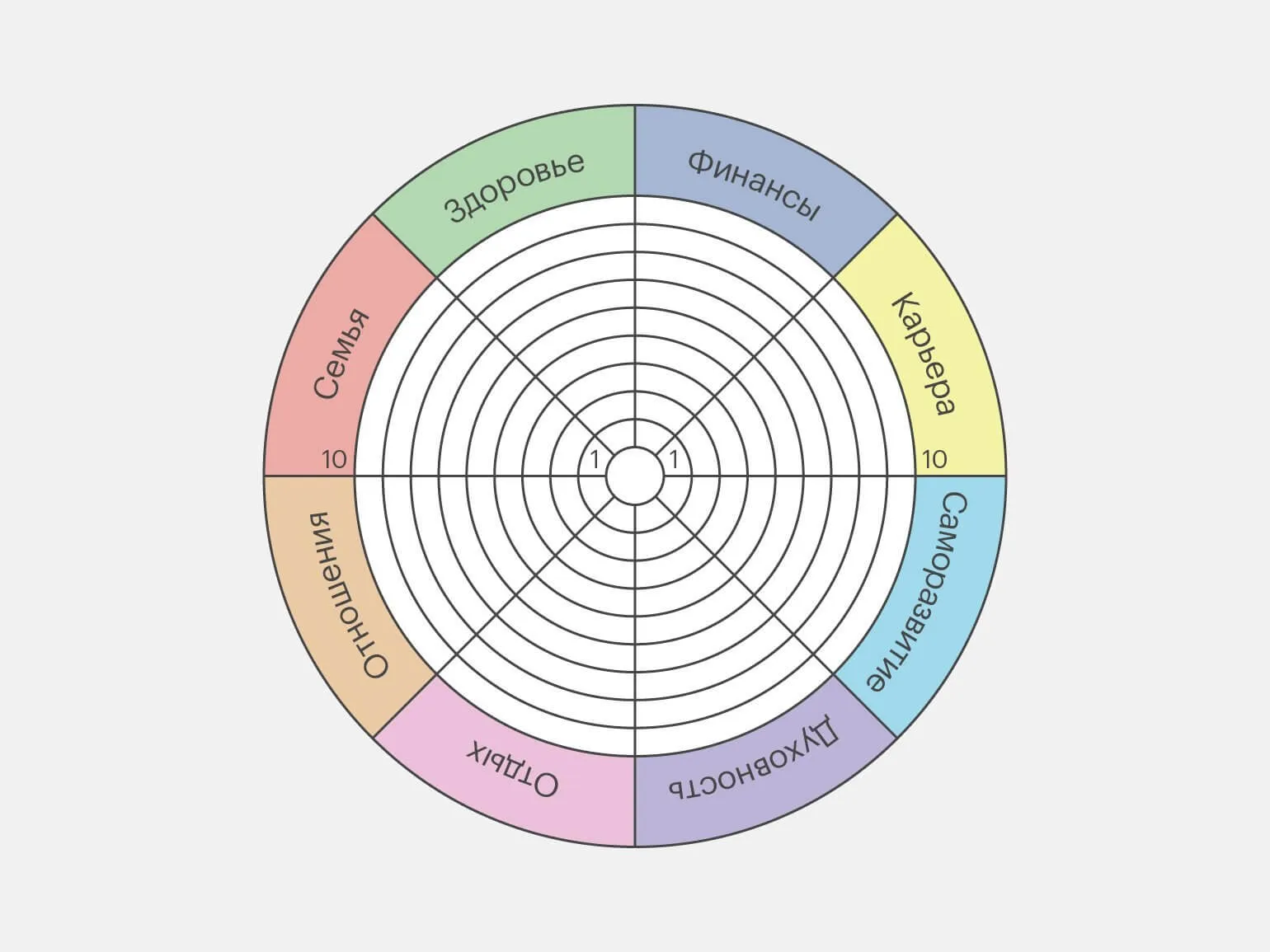
To identify areas that require more attention, use the "Wheel of Life Balance" technique. Start by drawing a circle divided into sectors corresponding to different aspects of your life. Rate your satisfaction in each area on a 10-point scale. The resulting diagram will allow you to clearly see which areas need additional attention and effort. This is an effective tool for self-analysis and personal development planning.
The YearCompass service is a free planning tool. It's designed to help you reflect on the past year and set goals for the next. Using carefully designed questions and exercises, you'll analyze your accomplishments, identify recurring patterns in your life, and form a clear vision of what your ideal year would be. Use YearCompass for deep self-reflection and effective future planning.
If you're unsure how to begin the process and the previous methods don't work for you, try this simple exercise. You will need only ten minutes, a pen and four sheets of paper.
- In three minutes, on the first sheet of paper, write down 40 small wishes that would cost up to 50,000 rubles to fulfill (for example, a massage, a theater ticket, or a new accessory).
- On the second sheet of paper, in the next three minutes, mark 20 wishes that could be fulfilled for 50,000–100,000 rubles (travel, education, technology).
- On the third sheet of paper, in two minutes, write down 10 larger wishes that would cost from 100,000 to 500,000 rubles (apartment renovation, furniture, large appliances or expensive gadgets).
- Dedicate the last two minutes to the big one: choose the 5 largest goals that would require more than a million (a car, a down payment on a house, a financial cushion).
Don't worry if you can't write down all of your wishes right away: you can add to the list later. Once completed, identify the three most important goals you want to achieve first. For each of these goals, determine the required amount and the timeframe within which you plan to accumulate the necessary funds. This approach will help you structure your dreams and make them achievable.
This method allows you to clearly define your priorities and understand what truly matters. Focusing on three main goals helps you eliminate all other tasks, which facilitates more effective achievement. This approach helps you avoid overwhelm and the feeling of a lack of resources. After achieving one goal, you should choose the next one, which ensures constant movement forward and maintains motivation.
As a result, your annual plan will turn into a clear and realistic tool for achieving goals.

Read also:
Goal setting and planning play a key role in achieving success. In the modern world, there are many tools that help you organize your goals and effectively plan tasks. Let's look at three useful tools that will help you in this process.
The first tool is task management apps. They allow you to create a list of goals, break them down into subtasks, and set deadlines. With apps like Todoist or Trello, you can easily track your progress and not miss important details.
The second tool is the SMART method, which helps you formulate goals more clearly and specifically. SMART stands for Specific, Measurable, Achievable, Relevant, and Time-Bound. Using this method will help you set more realistic and inspiring goals.
The third tool is journaling. By writing down your thoughts, ideas, and plans, you not only structure your goals but also analyze your achievements. A journal helps you track your progress and make necessary adjustments to your plan.
Use these tools for effective goal setting and planning, and you'll notice a significant increase in your productivity and motivation.
Planning all your goals at once is an attractive idea, but it's not always feasible, as resources such as time, energy, and money have their limitations. Therefore, it's important to identify a few key areas that will be most meaningful to you and your family this year. By focusing on these areas, you will be able to use your resources more effectively and achieve your goals.
Choose goals based not on the expectations of society or others, but on your own interests and desires. In each key area of your life, identify one main goal that will inspire you. This will help you focus on what's truly important to you and move towards achieving personal success.
If there are areas that require special attention, add a few extra steps to integrate them into your annual plan. It's important that your goals are interconnected and don't conflict with each other. For example, if you're aiming for a promotion in your career and planning a year-long travel retreat, it will be extremely difficult to achieve both simultaneously. Goals not included in your final list for the year can be moved to a reserve list. This will allow you to return to them in the future and assess their significance if necessary. This approach helps organize your priorities and maintain focus on the most important tasks. The Goal Tree method effectively simplifies large plans by turning them into structured tasks. For example, if your goal is to buy a phone worth 100,000 rubles, you can start by creating a savings challenge. This involves setting up regular transfers of a certain percentage of your income to this goal and opening a savings account for easy savings management. This approach not only helps you better organize the goal-achieving process but also increases financial discipline. Each goal on your list should be supported by a clear sequence of actions. Some tasks will be performed only once, while others will require regular implementation. This will allow you to effectively achieve your goals and track your progress. Proper organization and planning of actions are key elements on the path to success.
Deadlines play an important role in increasing work efficiency. Considering your long-term goals, you already have a deadline set—the end of the year. The next step is to distribute tasks and substeps across the calendar to ensure an even workload and avoid overload. Proper planning will help you achieve your goals on time and with minimal stress.
If your schedule is more flexible at the beginning of the year, and the number of events and commitments increases in the summer, such as building a summer house, it is recommended to postpone preparatory tasks until the first months of the year. This will allow you to sort out finances in advance and avoid rushing before construction begins. Advance planning and task allocation will help you effectively organize your time and resources, which will significantly simplify the construction process.
For regular monitoring, it is recommended to use trackers or planning apps. These tools will help you effectively track your tasks and manage your time, which will boost your productivity and organization. Choose reliable apps that meet your needs and integrate them into your daily routine.
Discussing your budget with family members is an important step toward financial stability. It not only helps everyone be on the same page but also strengthens family bonds. When a family has shared financial goals and considers everyone's interests, everyone understands how and why financial decisions are being made this year. This approach promotes transparency and mutual understanding, which is especially important for successfully managing family finances.
Maria Gogoleva is a name recognized for her outstanding achievements and contributions to her field. She is an expert whose knowledge and experience are valued in the professional community. Maria Gogoleva is actively involved in various projects aimed at developing and implementing new ideas. Her approach to work is characterized by deep analytics and creative thinking. Thanks to this, she has been able to achieve significant success and gain recognition among her colleagues. Interest in her work continues to grow, and her work is becoming increasingly relevant in today's environment. Maria Gogoleva inspires many with her example and commitment to continuous development. Income is divided into two main categories: active and passive. This division is based on the method of its generation. Active income requires ongoing participation and effort, such as a salary or freelance income. Passive income, in contrast, arises without active participation, such as from rental property or investments. Understanding these categories allows you to better plan your financial strategy and optimize your income sources. Active income requires human participation. This is the area in which your earnings depend on your time, effort, and skill: salary, income from running a business with personal participation, payment for completed projects, and other activities where your presence and labor play a key role. Passive income, in contrast, involves minimal participation. It usually requires upfront investment, often made from previously accumulated active income. For example, income from renting out real estate, dividends from shares, or passive projects such as selling an existing digital product do not depend on daily involvement and regularly replenish your budget.

In the early stages of their careers, many rely on active sources of income. However, it's critical to begin developing and accumulating passive income streams, especially as you approach retirement. Passive income can provide a solid financial foundation, providing stability and independence for the future. Investing in real estate, stocks, building an online business, or earning royalties from copyrights are all examples of ways to accumulate passive income and ensure long-term financial security.
When managing your personal finances, it's important to consider the specifics of your income. If your income is irregular or seasonal, it's important to analyze its cyclicality. This will help avoid unfounded optimism in your financial forecasts. Proper budgeting and accounting for temporary income fluctuations are key to achieving financial stability. It's recommended to create reserve funds and develop strategies to optimize spending, which will allow you to more effectively cope with periods of low income.
If your payments are unstable, it's recommended to focus on minimum guaranteed amounts or monthly averages. It's also important to create a reserve fund to cover unexpected expenses, which will ensure financial security and protection from potential risks. Building such a fund will help you cope with unexpected situations and maintain stability in your financial management.
If you don't have a stable income, you should focus on a minimum guaranteed income. This will ensure financial security and create a foundation for future growth. A minimum guaranteed income may include various forms of support, such as benefits, social payments, or temporary work. It's important to explore the available options and choose the ones that are right for you. Effective financial management and budgeting will help you maintain financial stability in times of uncertainty.
Plan and analyze your monthly income, taking into account both regular income and one-time payments, such as quarterly bonuses, annual bonuses, and other payments. This is especially important for those who travel frequently. Typically, after a vacation, people can go without a paycheck for 2 to 4 weeks. Therefore, having a financial reserve becomes essential to ensure a comfortable existence during this period. Manage your finances wisely to avoid difficulties and ensure stability.
Andrei Frank is a name associated with outstanding achievements in various fields. His work and ideas have had a significant impact on modern society. Frank is known for his deep understanding of complex concepts and his ability to communicate them to a wide audience. His approach to analysis and problem solving inspires many professionals in various fields. With a unique perspective, Andrey Frank continues to contribute to the development of science and culture, leaving a lasting mark on history.
Develop a strategy for each source of income and explore ways to increase it. After you've examined your current sources of income, begin considering new opportunities. Classify potential sources into two groups: those that can be implemented quickly and with minimal cost, and those that require more effort and time. This will help you optimize your income generation process and focus on the most promising options.
For effective inspiration and thought organization, use various techniques. Set aside a few hours to write down at least 15 ideas for potential sources of income. Then, select three or four ideas that you can implement within the next six months or a year. This approach will help you focus on the most realistic goals and increase your chances of successfully implementing your plans.

Rework the text with SEO in mind, maintaining the topic and avoiding unnecessary details. Make sure the structure remains clean and clear, without adding emojis or unnecessary characters. Avoid dividing into sections such as 1, 2, 3, or *.
Read also:
Life depends largely on financial resources, and the amount of money that can change your life varies for each person. For some, this may be an amount sufficient to pay off debts or buy a home, while for others, it may be the means to realize dreams and endeavors.
It is important to understand that "life-changing money" does not always mean millions. For many people, an amount sufficient to ensure financial stability, create an emergency fund, or start their own business is enough. The key is not only the amount, but also how this money will be used.
To truly change your life, you need to allocate your financial resources wisely. Investing in education, health, and personal development can bring much more than simply saving money. The amount that can dramatically change your life depends on your goals and ambitions. Set specific financial goals for yourself, determine how you can achieve them, and use your available resources to improve your well-being.
Ultimately, it's not just the amount of money that matters, but how you use it wisely, which will be the key to qualitative changes in your life.
Determine your savings allocations based on your financial goals. There are two main methods for doing this. The first method is to set a fixed percentage of your income to be spent on savings. The second method involves allocating funds based on the priority of your goals, such as buying a home, education, or creating an emergency fund. Both approaches will help you effectively manage your finances and achieve your desired savings results.
- Set a fixed percentage of your income, for example, 10%.
- Determine a specific amount that you will regularly allocate each month for savings and investments.
Budgeting requires adhering to the basic principle outlined by Napoleon Hill in his book, Think and Grow Rich. This principle emphasizes the importance of a goal-oriented approach to financial matters. By following this rule, you will be able to effectively plan your expenses and achieve your financial goals. Successful budgeting not only helps you control your expenses but also promotes savings and increases personal wealth. It is important to understand that discipline and a clear understanding of your financial priorities play a key role in creating a stable financial foundation.
- When you receive income, first put some money aside for the future;
- Then pay off debts;
- And allocate the remaining amount to current needs.
To effectively accumulate savings, it is important to set a minimum percentage of your income in advance that you will not reduce. This approach allows you to create a financial safety net and ensure stability in the future. By determining this percentage, you will be able to better plan your expenses and avoid unnecessary spending, which contributes to savings. The minimum percentage you set will serve as a guideline, helping you maintain discipline in managing your personal finances and achieving your financial goals.
There are two more widely used methods that are worth considering.
- 80/20 from Andrew Tobias's book "The Only Investing Guide You'll Ever Need": start by setting aside a fifth of your budget, and then spend the rest as you see fit.
- The "50-30-20" system from Alexa von Tobel's book suggests starting with 20%.
If you find it difficult to start with a high percentage of your budget, try starting with 5%. This level will be comfortable for most people. The key is to ensure that the savings process is regular. Over time, you can gradually increase the percentage, reaching, for example, 10%, 20%, or even more. Regular savings will help you achieve financial stability and confidence in the future.
If your financial situation allows you to save 30-50% of your income without degrading your quality of life, it's worth aiming for higher goals. You can increase your savings not only through your regular salary but also through unexpected sources of income, such as gifts or additional funds from selling unnecessary items through online platforms. Taking advantage of these opportunities will help you quickly achieve financial stability and secure your future.
Once the budget analysis is complete, the planning stage begins. At this stage, it is important to properly structure expenses, which are conventionally divided into two main categories: essential and additional. Essential expenses include fixed costs such as rent, salaries, and utilities, while additional expenses can vary depending on current needs and projects. Proper expense classification will help ensure effective financial management and optimize your budget, which in turn will help you achieve your goals.
- Essential expenses are mandatory expenses that are directly tied to time and cannot be avoided. For example, expenses such as food, loan payments, utilities, and taxes are typically paid first, immediately after income is received. Additional expenses are more flexible and fall into two subcategories: planned and impulsive. Planned expenses are associated with large-scale or long-term goals, such as purchasing furniture, paying for renovations, organizing training, travel, or other significant events. Impulsive expenses are usually not planned in advance, but arise on the spur of the moment. Although they are unnecessary in most cases, such expenses can sometimes be beneficial, for example when purchasing a product at a discount.

For effective budget management, it is necessary to analyze the key categories of planned expenses. Identify the three to five most significant items that account for the majority of your finances in your daily life. These categories require special attention if you want to optimize your budget and reduce unnecessary spending. It's important to consider all aspects of your expenses to create a more balanced and sustainable financial plan.
When analyzing your expenses, approach this issue from a practical standpoint. There's no need to drastically cut small expenses if this could negatively impact your quality of life. Limits should be reasonable and balanced. It's recommended to reduce expenses in each category by no more than 10% to avoid discomfort and maintain motivation for managing your budget. It's advisable to primarily reduce unnecessary expenses that don't affect your core life priorities. This will help you optimize your budget while maintaining comfort and life satisfaction.
Essential expenses shouldn't be reduced. On the contrary, it's recommended to increase the allocated amounts for these items annually, at least taking into account inflation. This will help avoid shortfalls in the future, especially in critical categories like utilities and taxes. Increasing your budget for essential expenses will help ensure financial stability and protect you from unexpected situations.
To effectively plan your annual budget, it's important to account for significant annual expenses, including insurance payments, large purchases, and repair costs. There are two main approaches to managing these expenses. The first approach involves forecasting all major expenses in detail, allowing you to allocate the necessary amounts in advance. The second approach involves creating an emergency fund to help cope with unexpected expenses. Both methods will help ensure financial stability and avoid unpleasant surprises throughout the year.
- Allocate the required amount all at once in a specific month.
- Gradually save money over several months to avoid significant financial strain.
After discussing your annual spending structure with your partner, it's important to record all planned expenses, distributing them by month. Create a spending calendar in which you reflect both exact and estimated amounts. Gradually fill in the table, adding any new items that come to mind. The main goal of this process is to consider major expenses and the personal financial goals of each family member. This will allow you to determine budgetary possibilities in advance and begin saving early. This approach will help avoid financial difficulties and ensure stability in managing the family budget.
Before the start of the new year, organize a family meeting to plan major expenses and significant events, such as trips, holidays, and birthdays. Calculate the expected costs of these events. This is important, as booking tickets, hotels, and tours in advance, as well as buying gifts, can significantly save you money and reduce stress. Effective planning will help avoid unexpected expenses and make your events more enjoyable and memorable.
Andrey Frank is a renowned expert in finance and investment. He has deep knowledge of asset management and strategic planning. Frank actively shares his experience through publications and seminars, helping people understand complex financial market issues. His approach is based on analytical thinking and practical experience, which allows him to offer effective solutions for achieving financial goals. Thanks to his professionalism, Andrey Frank has earned the trust of his clients and colleagues in the financial sector, making him a leading expert in this field.
For effective annual planning, it's important to determine how much money is needed for a comfortable life under two scenarios: the minimum and the optimal. The minimum scenario includes only essential expenses, such as housing, food, and utilities, while the optimal option takes into account additional costs for entertainment, health, and unexpected expenses. This approach will help build a financial cushion and ensure long-term stability. Proper calculation will allow you to avoid unnecessary debt and accumulate reserve capital for the future.
- Minimum necessary expenses, that is, the basic level of needs that cannot be dispensed with.
- A comfortable existence, which takes into account the usual way of life without significant restrictions or savings.
What planning mistakes can be encountered?
Before starting a project, it is important to carefully plan where to start, determine the necessary budget, and develop a strategy for dealing with unexpected difficulties. The main mistakes to avoid include insufficient preparation, ignoring risks, and lack of a clear plan.
- Starting on the "right" day. Many people prefer to begin important tasks on specific dates—Mondays, New Year's, or birthdays. For example, planning the annual budget only begins on New Year's Day; February is already too late. But such decisions rarely work. Mondays often start with a rush, and on New Year's, you're busy with holidays and family chores. The best time to make plans is not when the calendar dictates, but when you're ready to take action.
- Inflated expectations. In the world of social media, it's easy to succumb to the illusion that your life must match someone else's "perfect" picture. When you see someone buying expensive cars, traveling, or launching projects every day, you can't help but think your own ambitions are too modest. This often leads to people setting unattainable goals. The result is disappointment and a drop in motivation. Remember that real life is rarely visible behind glossy photos. Your path is unique; don't look to others for guidance. Before making a plan, be sure to assess your current resources (time, finances, skills) and set realistic deadlines. Lack of priorities. Many people want to do everything at once: learn to cook a new dish, master a foreign language, visit other countries, and not forget about physical exercise. But life is limited, and trying to juggle dozens of tasks usually leads to burnout. It's not for nothing that the world has the saddest Monday of the year—the third Monday after New Year's. It's the time when people realize they've planned too much, get down to business with abandon, and face the first disappointments and the peak of the winter blues. Focus on two or three key areas that are most important to you. Ignoring balance. The desire to completely dedicate yourself to achieving a goal can greatly undermine your energy. Working in an "all or nothing" mode, people often forget about simple rest, which leads to a decrease in efficiency and motivation. Don't forget to create plans not only for work and self-development, but also for leisure.
- Resistance to change. Reality rarely stands still, and circumstances can alter your plans. For example, a change in work schedule can completely upend your usual routine. Try to regularly review your plan: which tasks are no longer relevant, what requires additional time, and what can be replaced.
- The illusion of accurate forecasts. Planning for the future is often associated with a cognitive distortion: people mistakenly believe they can accurately estimate how much time or resources will be needed to complete a task. This is especially typical for long-term planning, when many details are simply impossible to predict. To avoid this, try breaking large goals into smaller tasks.
- Ignoring unexpected expenses, such as medical care, transportation, or equipment repairs, can significantly undermine financial stability, especially if you lack discipline. Regular deviations from the established plan inevitably interfere with the achievement of long-term goals.
- Choosing the wrong financial instruments, such as using high-risk investments to build a "safety cushion," can make planning ineffective and jeopardize overall stability.
- Inefficient budget distribution between categories. Excessive spending on entertainment at the expense of savings can negatively impact your financial independence.
- Problems often arise from insufficient budget control. Failure to regularly analyze your finances, refusing to track expenses, or simply ignoring the intended plan often leads to financial difficulties.
To ensure financial stability, it is necessary to regularly review and adjust your financial plan. Flexibility and the ability to adapt to changing circumstances play a key role in successful financial management. It is important to consider current economic conditions, changes in your personal life, and potential risks. Adapting quickly to new realities will help you maintain financial control and achieve your goals.
Budgeting often leads to problems due to inflated income expectations or underestimated expenses. Unrealistic projections can lead to financial difficulties. It's also important to remember financial goals that don't provide a sense of security for your family. For example, saving for a vacation may be impractical without a financial cushion. Unforeseen circumstances, such as illness, can derail even a carefully planned budget without a reserve fund. Furthermore, it's important to factor in rising prices, as budget figures can fluctuate throughout the year. It's recommended to plan expenses with a reserve and remain flexible, adapting to changing conditions.
Maria Gogoleva is a talented specialist in her field. Her experience and knowledge allow her to successfully solve problems of varying complexity. Maria actively participates in professional events and shares her expertise with colleagues. She constantly improves her skills, following the latest trends and innovations in her field. High level of professionalism and desire for development make Maria a valuable expert who is turned to for advice and support.

Reworked text:
Check out our section to learn more about important aspects. We offer useful information and tips to help you better understand the topic. Don't miss the opportunity to check out our materials to gain relevant knowledge and increase your awareness.
Financial Habits for Success
Financial literacy plays a key role in managing personal finances. Developing good financial habits will help you achieve financial stability and independence. Pay attention to the following habits that can significantly improve your financial situation.
The first thing you should do is create a budget. A clear plan for expenses and income will allow you to control your finances and avoid unnecessary spending. The second important aspect is regularly saving money. Saving money will help you prepare for unexpected expenses and achieve your financial goals.
The third habit is keeping track of expenses. By recording every purchase, you can better understand where your money goes and adjust your spending if necessary. The fourth habit is investing. Even small amounts invested can bring significant returns over time.
The fifth habit is learning about financial instruments. Knowing about different investment options, loans, and other instruments will help you make more informed decisions. The sixth habit is regularly reviewing your financial goals. This will help you stay on track and adapt to changing circumstances.
Finally, the seventh habit is minimizing debt. Avoid unnecessary loans and try to pay off existing debts as quickly as possible. By forming these healthy habits, you can improve your financial well-being and create a solid foundation for the future.
What budgeting tips can help
- Create a written financial plan and follow it. Just as it is impossible to build a house without a plan, it is impossible to manage finances without a clear strategy. A financial plan is written out in detail, with key milestones—intermediate checkpoints that will help you track your progress.
- Take care of your health. No income can compensate for the losses that illness can cause. Regular checkups, preventative care, and timely visits to doctors are investments in your future. Don't ignore even minor symptoms, otherwise the cost of treatment can become significant. This is especially important with the rising prices of medications and medical services. Reduce debt. Loans are a tool that can both help and create a serious burden. Loan payments should not exceed 30-40% of your monthly income. If they are higher, it is a signal that it is time to reconsider your financial habits. Remember: an increase in income should not lead to an increase in expenses. The main thing is to maintain balance and invest in your future. If you have to invest more in an apartment to rent out than you earn on it, it is not an asset. Avoid impulsive decisions. Economic uncertainty can provoke people to take drastic steps, such as changing their investment strategy or buying on impulse. However, in the financial sphere, it is important to keep a cool head. For example, if mortgage rates or exchange rates are still high, it's wiser to wait for them to stabilize than to make hasty decisions. While you wait for favorable conditions, focus on available instruments, such as deposits, savings accounts, or bonds. However, be prepared for the fact that forecasts often change. Follow the news, but always verify everything and don't rely on rumors and hype.
- Don't be afraid of mistakes if your previous planning experience turned out to be unsuccessful. The world is changing, and your strategy will adapt to new conditions. The main thing is to regularly analyze your actions and improve your approach.
- Use additional income for savings. Any unplanned amount—a bonus, a gift, a part-time job—can be an excellent opportunity to replenish your financial safety net. The optimal solution is to put aside at least half of such income, leaving the rest for current needs.
- Automate your savings. Make the savings process as simple and seamless as possible. Set up an automatic transfer of a certain amount from your salary to a special account. This will help you save regularly and discipline yourself. Choose a percentage that's comfortable for you, for example, 10-15% of your income, and stick to this habit month after month.
- Involve your family. If you're planning your finances with your family, it's important to create an atmosphere of cooperation and unity. Discuss goals, hold small "meetings" to assess how each family member can contribute to achieving them. Collages, goal visualizations, and shared conversations will help everyone stay on the same page. For children, you can organize game-like financial goals, such as a savings competition. This will make the process useful and fun for everyone.
- When budgeting, it's important to find an item you'll achieve each month with pleasure and pride. This could be regular investing, saving for long-term goals, paying off a mortgage or loan early, or reducing credit card debt. These actions give you confidence in your financial situation and strengthen discipline.
- When planning your budget for the new month, don't forget to compare it with the same period last year. Perhaps this was the time you paid your annual insurance or other regular, but infrequent, expenses. It's easy to forget about them if the bank or insurance company hasn't yet reminded you of the upcoming payment. Including such expenses in advance will help avoid unpleasant financial surprises.
- When creating a budget, base it on your real capabilities. It's better to initially plan with a surplus than with a deficit. Life is full of unpredictable situations, and additional expenses happen much more often than unexpected income. Even a temporary deficit can be a serious stress on the budget.
- Effective family budget management is impossible without a clear division of responsibilities and agreed-upon rules. For example, partners can agree to put 20% of their income into a joint fund. However, the system will not work if one of the participants contributes a smaller percentage or decides to spend the money on something else entirely. To avoid misunderstandings, it's worth establishing a rule: transfer a set amount to a general account on payday.
- It's important to set aside at least a few minutes every day to analyze your expenses and plan for the next day. This will help you stay within your planned budget.
- Summarize your budgeting every month. Even with careful planning, the end of the month may reveal a difference between your expectations and actual expenses. This is a normal situation that requires adequate budget adjustments before the start of the new month. If you have a surplus, think about how to manage these funds effectively. If you are faced with a deficit, reconsider your financial approaches.
An annual budget plan is a dynamic document that requires constant updating. Life circumstances can change, so it is important to regularly review and adjust the budget in accordance with the current situation. This will allow you to manage your finances more effectively and achieve your goals.
Motivation is just the beginning, but achieving your goals requires discipline and self-organization. Set a simple rule: record your achievements and tasks at a specific time, such as at the end of the day or once a week. This will help you organize your thoughts and track your progress. Regularly reviewing your actions will help you better understand your goals and improve your effectiveness.
It's important to remember that the title of a task can significantly impact your motivation and attitude toward it. If you list a task in your planner as "that awful budget," working on it will become burdensome. However, if you reframe it in a more positive light, such as "time to love money," "time to be friends with finance," or "romance with finance," the process will become more enjoyable and productive. This approach will not only improve your attitude toward finances but also help you achieve better budgeting results.
At the end of the week or month, don't forget to reward yourself and your family. If you've achieved your financial goals and have some extra money left over, celebrate together. Celebrating an accomplished result will not only strengthen family bonds but also create motivation to repeat the success in the future. This approach will contribute to the growth of your family's wealth and make the process of achieving financial goals more enjoyable and inspiring.
Maria Gogoleva is a talented specialist in her field, possessing significant experience and knowledge. She is actively involved in the development and implementation of projects, making her a valuable team member. Thanks to her qualifications and commitment to professional growth, Maria successfully solves complex problems and finds effective solutions. Her dedication and ability to work in a rapidly changing environment contribute to her high results. Maria Gogoleva is constantly improving her skills to meet current market demands and remain competitive.