
Contents:

Course with employment: "The Profession of Methodologist from Scratch to PRO"
Find out moreWhat is the company?
Coursera is an American educational technology (EdTech) company founded in 2012 by Stanford University computer science professors Daphne Koller and Andrew Ng. The platform offers a wide range of online courses on a variety of subjects, including physics, computer science, design, medicine, biology, mathematics, linguistics, economics, business, and marketing. All courses are developed by leading educational institutions, ensuring high-quality educational content. Coursera provides the opportunity to study at your own pace and master new skills, making it an ideal choice for students and professionals looking to advance in their field.
On our website and in the app, you can complete training, pass an exam, and earn a certificate. Courses typically last 6 to 9 weeks and include video lectures, text materials, and daily assignments. The primary language of instruction is English, but courses are also available in Russian, Chinese, Spanish, French, and other languages. In 2021, our platform reached over 77 million users, demonstrating the high demand for our educational programs. Join us and discover new opportunities for personal development and career advancement.
Why does the company partner with universities?
Since the launch of Coursera, the company has been actively pursuing partnerships with higher education institutions. The first partners—Stanford, Princeton, Michigan, and Pennsylvania—were among the first to join the project. In 2012, 33 universities joined Coursera. In 2013, the number of partners increased by 29. By 2014, the total number of partner educational institutions reached 108. Among them are such prestigious institutions as Johns Hopkins University, the California Institute of Technology, the University of Edinburgh, the University of Toronto, Columbia University, the Moscow Institute of Physics and Technology, and the Higher School of Economics. Coursera continues to expand its network of partnerships, providing access to high-quality education for students around the world.
The platform has more than 200 partners from 29 countries, including both higher education institutions and large corporations. Among them are such giants as Google, Facebook, Mail.ru Group, Goldman Sachs, and others. This confirms the high level of trust in the platform and its importance on the international stage.
Coursera users have the opportunity to complete online educational programs and receive an official diploma. The average price of courses on the platform is under $2,000, making them significantly more affordable than traditional in-person classes at the same universities. Coursera's online courses offer flexibility and a variety of topics, allowing everyone to find the right path for professional growth.
Since 2017, Coursera has offered users the opportunity to earn a master's degree online. For example, students can study the Master of Arts in Innovation and Entrepreneurship (OMIE) program at HEC Paris or the MBA (iMBA) program at the University of Illinois. These online programs offer flexibility in learning and access to a high-quality education from leading universities around the world.
The American Council on Education has approved five courses for credit in U.S. colleges. These courses meet high quality standards and can be an excellent supplement to the academic program of students seeking an education at the country's leading educational institutions. These courses help students prepare for the demands of colleges and universities by providing the necessary knowledge and skills for academic success.
- Algebra from the University of California, Irvine;
- Preliminary Calculus from the University of California, Irvine;
- Introduction to Genetics and Evolution from Duke University;
- Bioelectricity: Quantitative Methods from Duke University;
- Calculus, Functions of One Variable from the University of Pennsylvania.
Students have the opportunity to take an in-person online exam with accredited partners. The cost of this service ranges from $60 to $90. Successfully passing the exam allows you to be exempt from taking a similar course at your educational institution. This is a convenient way to accelerate the learning process and improve your qualifications by receiving a document confirming your knowledge and skills in a specific field.
Universities that are not Coursera partners can also post their courses on the platform. However, access to such materials will be limited to students of these institutions, while other users will not be able to view them. Currently, more than 3,700 universities and colleges from around the world partner with Coursera, providing a wide selection of educational programs on the platform.
While technically any higher education institution can use the Coursera platform to post courses, in order to be included in the general catalog, approval is required from an advisory board consisting of representatives of partner universities. This voting process ensures high quality standards and the relevance of educational programs to market demands.
We strive to carefully select the educational institutions with which we partner. Our unique selling point is the high quality of our universities and colleges, as confirmed by Jeff Maggioncalda, CEO of Coursera. We believe that providing access to quality education is the key to successful learning and development.
The company is still unprofitable, but is that really that bad?
According to documents provided to the US Securities and Exchange Commission (SEC), Coursera remains unprofitable. Currently, the platform generates revenue from three main sources.
- the consumer segment - payments and subscriptions made directly by students on Coursera;
- the corporate segment - subscriptions and payments from businesses and government customers training their employees;
- the segment of universities providing online courses to students. This also includes partnerships with educational institutions, through which students can earn bachelor's and master's degrees.
Revenue from individual users remains the main source of revenue, despite steady growth in the corporate and university segments. In 2020, revenue from consumers reached $192.9 million, while revenue from enterprises amounted to $70.8 million and from universities - $29.8 million. The growth dynamics in these sectors indicate increasing interest in products and services aimed at businesses and educational institutions.
In 2020, Coursera achieved annual revenue of $293.5 million, which is a 60% increase compared to the previous year. This increase is due to the high demand for online education amid the pandemic. However, despite the revenue growth, the company also experienced an increase in losses, which increased from $46.7 million to $66.8 million. The main reason for such financial performance was significant advertising and marketing costs. In 2020, Coursera invested $107 million in marketing campaigns, which is almost double the amount of promotional spending in 2019.
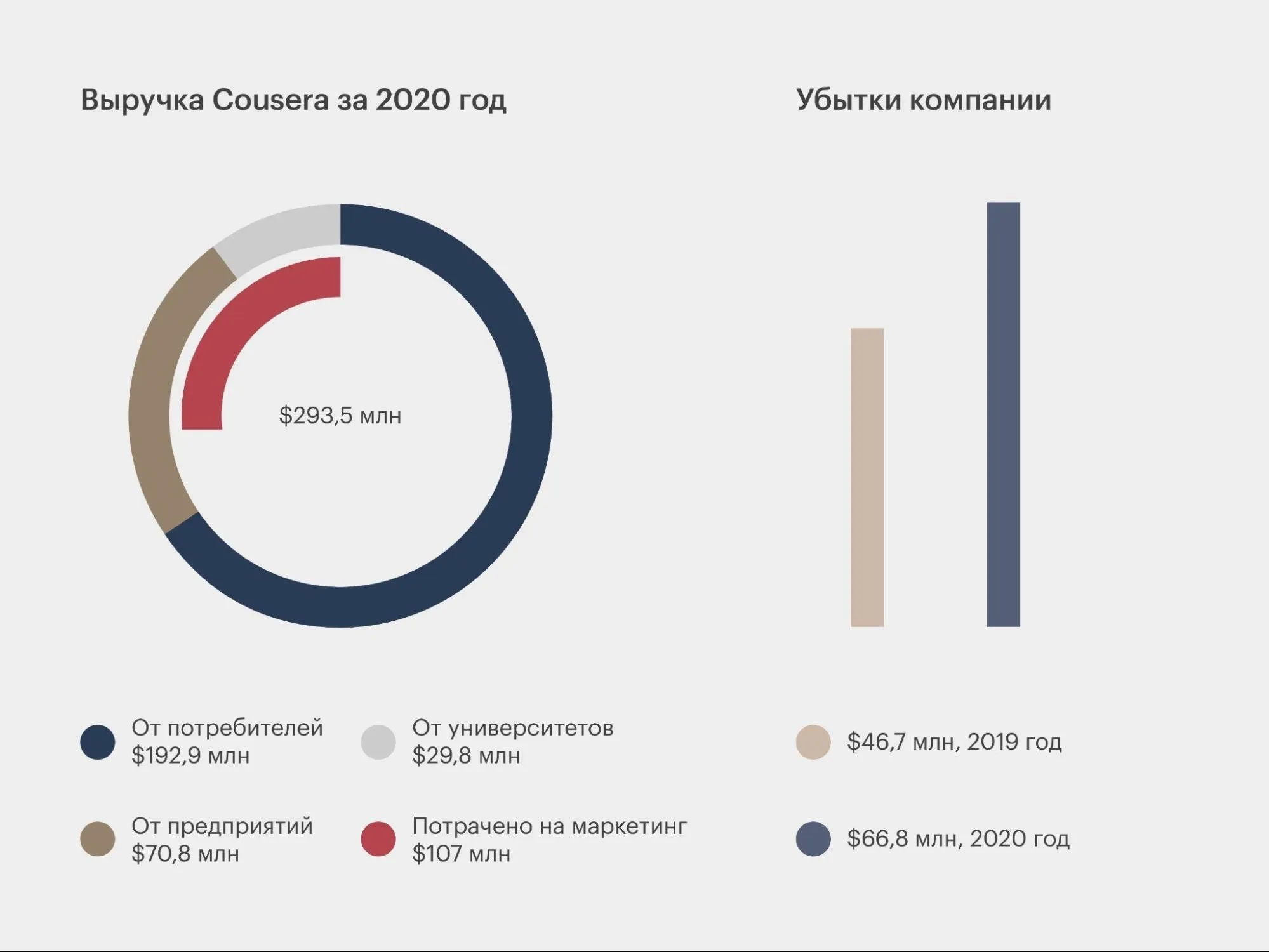
According to documents presented in According to the SEC, Coursera spends nearly 37% of its revenue on sales promotions. This finding came as a surprise to many industry experts.
One of Coursera's key advantages is its 77 million learners, which gives the company the opportunity to convert them into paying subscribers or degree-seeking students. However, the 37% of revenue devoted to marketing suggests that Coursera may face difficulty attracting students at lower prices, according to Daniel Pianko, managing director of University Ventures.
Sean Gallagher, founder of the Center for the Future of Higher Education and Talent Strategy at Northeastern University, notes that Coursera's marketing expenses are "normal" given the company's significant scale and rapid growth. This confirms the importance of marketing investments for success in the increasingly competitive online education space.
Many companies, particularly in the online education space, invest more than 50% of their revenue in sales and marketing as they scale, which often results in losses. However, over time, this percentage decreases, allowing companies to optimize their expenses and improve financial results. This approach requires careful cost analysis and effective resource management to achieve sustainable growth and profitability.
On June 1, 2020, in response to the COVID-19 pandemic, Coursera made all its educational programs free to students from all institutions. This initiative includes 3,800 courses, 150 interactive projects, and 11 professional programs. Free access is available simply by submitting a request from an email registered to a university domain. This measure allows students to expand their knowledge and skills, which is especially relevant in a changing labor market.
Many EdTech platforms have seen a surge in popularity during the pandemic, notes Trace Urdan, managing director of investment bank and advisory firm Tyton Partners. However, whether Coursera can maintain high levels of user engagement remains an open question. It's important to note that the platform's long-term success will depend on its ability to adapt to changing market conditions and student needs. Coursera CEO Jeff Maggioncalda is confident that student interest in online learning will increase significantly after the pandemic. This is due to the new opportunities offered by distance learning, as well as the changing approach to learning. Online courses are becoming more accessible and diverse, allowing students to choose programs that match their interests and career goals. In a constantly changing labor market, online learning offers a convenient way to gain new knowledge and skills, making it attractive to modern students. Learners are increasingly choosing online learning, especially international students and adults juggling studies with work and family responsibilities. This trend is driven by the flexibility and accessibility of online courses, which allows them to effectively balance their studies with other aspects of their lives. We are in the early stages of scaling. In the next 10 years, 1.3 billion people worldwide will enter the working age. This creates enormous opportunities for economic growth and the formation of new labor markets.
Jeff Maggioncald is the CEO of Coursera, one of the leading online learning platforms. Under his leadership, Coursera has expanded its offerings, providing access to high-quality educational resources from universities and organizations around the world. Maggioncald is a passionate advocate for accessible education and strives to make learning more personalized and effective. His vision promotes the development of the skills needed for successful careers in the modern world, making Coursera a significant player in the online education market.
What is the company's outlook after the IPO?
In the first quarter of 2021, Coursera's revenue reached $88 million, up 64% year-over-year. The company's net loss was $18.7 million. This revenue growth underscores the continued interest in online education and the courses offered by Coursera, making it a significant player in the education technology market.
The startup successfully completed an initial public offering (IPO) at a valuation of $4.3 billion. The IPO included 15.7 million common shares for a total of $517 million. Leading financial institutions, including Morgan Stanley, Goldman Sachs, Citigroup, and UBS Investment Bank, participated in the IPO. This event attracted the attention of investors and marked a significant step in the company's development, opening up new opportunities for growth and capital raising.
On its first day of trading, Coursera shares jumped 17%, rising from $33 to $38.6 per share. This increased Coursera's market capitalization to $5.13 billion, and is currently approaching $6 billion. A successful start on the stock market indicates high investor interest in educational technologies and the company's growth potential.
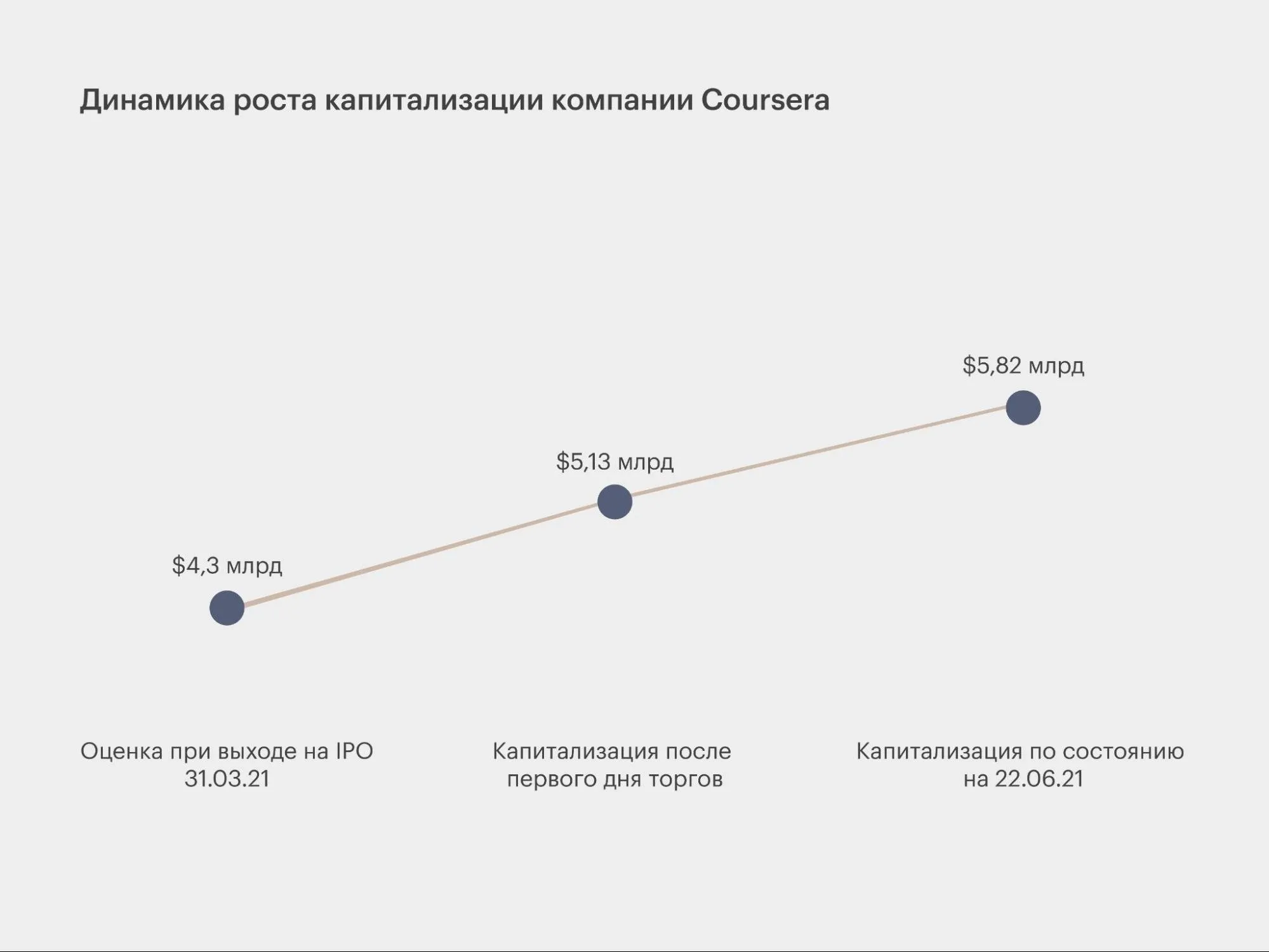
Coursera's IPO has become one of the most anticipated events in the world of finance in recent years. Since Coursera lacks a strategic buyer, going public represents a natural path for shareholders to return their investment. Wall Street actively seeks high-growth, consumer-focused companies, and Coursera fits this criteria perfectly. The IPO's success was also made possible by the popularity of its freemium business model, which attracted investor attention. Daniel Pianko, managing director of University Ventures, an investment firm specializing in global higher education, emphasizes that Coursera demonstrates growth potential and resilience in the competitive online education market.
Cost reduction may lead to breakeven, but this will negatively impact growth rates and multiples. Cost reductions often come with reduced investment in development, which can ultimately slow a company's momentum. Therefore, it is important to find a balance between cost efficiency and maintaining growth.
Artem Inyutin is the co-founder and managing partner of the investment fund TMT Investments. He is actively involved in the development of technologies and startups, as well as in the fund's strategic management, ensuring its successful investments in promising companies. With his experience and expertise, TMT Investments has become a well-known player in the venture capital market, as evidenced by successful investments and the growth of portfolio companies.
An IPO does not immediately ensure a company breaks even. Several factors could hinder this: decreased demand for the platform, increased competition, slower market growth, or saturation with similar products. Coursera predicts that the project will continue to experience financial difficulties in the near future, with expenses only set to increase.
According to information from Skillbox Media, Artem Inyutin, co-founder and managing partner of TMT Investments, noted that Coursera's financial losses are temporary. These costs are necessary to maintain the company's high growth rates. By investing in growth, Coursera is focused on long-term success and strengthening its position in the online education market.
The project is demonstrating annual growth not in the range of 5-10%, but as much as 60%, which is significant, especially given its already high base. Therefore, marketing expenses are fully justified. Although the team can reduce these costs and achieve breakeven, this will immediately impact growth rates and multiples.
According to expert Inyutin, Coursera's main goal is to increase market share and eliminate competitors. If the company succeeds in achieving these goals, it will be able to significantly reduce marketing expenses and move towards sustainable profitability in the future.