
Contents:
- "Psychometrics is the only possible way to measure learning today"
- "Educational projects are faced with the fact that students do not seem to complain, but they “drop out”"
- "Stop surveying these poor students, start calculating transparent metrics"
- "Nothing is universal, and this also applies to metric indicators"

Course with employment: "The Profession of a Methodologist from Scratch to PRO"
Find out more"Psychometrics is the only possible way to measure learning today"
The book "Psychometrics in EdTech" is devoted to the current topic of using psychometrics in the field of educational technologies. Before delving into the concept of psychometrics, it is important to understand who will benefit from it. First of all, this work is focused on educational online platforms that are part of the EdTech business segment. Psychometrics helps these platforms effectively assess the knowledge and skills of students, as well as adapt educational materials to the individual needs of users.
In the title of the book, I used the term EdTech not to denote a specific business segment, but to describe technologies aimed at improving education. Although the book is based on the material from Yandex Praktikum, I did not limit myself exclusively to the educational business. By EdTech, I mean educational applications, websites, and projects that collect data and can use it to analyze metrics.
The psychometrics discussed in this book is intended for educators and specialists seeking to improve the quality of educational products. It is based on the collection and analysis of data, which allows for tailoring learning to the needs of students. This approach contributes to improved educational outcomes and makes the learning process more effective.
I hoped that this book would be useful for everyone who uses educational technology. It is intended for teachers working in the tutoring format on various online platforms, as well as for university professors and specialists in the corporate online learning sector. Judging by the feedback I have received, the book truly meets the needs of these groups.
Your book is intended for specialists involved in the analysis of data obtained from educational platforms, learning management systems (LMS), educational applications, and other sources. It will be useful for both beginners and experienced analysts seeking to deepen their knowledge in this field.
The book is aimed at a wide range of readers. It consists of two parts. The first part is a practical guide for educational projects, dedicated to data logging and calculating metrics based on it. This is a practical tool for those who are directly involved in digital data in the field of education.

The second part of the book is intended for those who Interested in the theoretical aspects of measuring student performance and assessing the complexity of educational content? These readers may not yet have their own educational project or data, but they will be able to develop an understanding of methods for assessing educational outcomes. They will learn how to easily collect and analyze data to obtain objective indicators of academic performance and the effectiveness of the educational process.
Psychometrics is the science that studies the measurement of human psychological characteristics, such as intelligence, personality, and emotional state. The most important thing to know about psychometrics is its ability to objectively assess and quantify mental processes. This allows not only for a better understanding of individual differences between people but also for the development of effective diagnostic and intervention methods in psychology. Psychometric methods play a key role in various fields, including education, clinical psychology, and organizational development, providing a scientific approach to the assessment and analysis of psychological data.
Psychometrics is the science that deals with the measurement of unobservable constructs. In education, these constructs include knowledge, skills, and abilities, while in psychology, they include abilities, personality traits, and characteristics. Psychometrics plays a vital role in the assessment and development of both educational and psychological processes, enabling the accurate measurement and analysis of individual characteristics. This allows for improved teaching methods and psychological support, which is key to success in any field.
To measure invisible phenomena, two key elements must be used. The first is to transform these phenomena into observable data that can be quantified. This gives rise to the field of psychometrics, which is associated with the creation of various instruments such as tests, questionnaires, surveys, tasks, interview guides, and assessment systems. These instruments enable objective measurement and analysis of people's psychological characteristics and behavior. Psychometrics plays an important role in scientific research, educational testing, and psychological practice, providing reliable and valid results.

Rework the text, keeping the main topic. Make sure it is optimized for SEO by adding keywords. Avoid adding unnecessary elements and symbols, and do not include sections with numbers or bullets. The text should be clean and clear.
Read also:
Creating effective tests requires a careful approach and an understanding of the goals they are intended to achieve. It is important that tests are not only a test of knowledge, but also a tool for increasing student motivation and engagement. To achieve this, it is necessary to consider the level of difficulty of the questions, their variety, and their relevance to the educational materials.
Good tests should include a variety of question types, such as multiple choice, open-ended questions, and matching tasks, which will assess student knowledge from different angles. It is also important that tests are structured logically and consistently, which will help avoid confusion and improve the quality of assessment.
Don't forget about the need for feedback. After taking the test, students should receive detailed answers and recommendations for improvement. This increases their interest and promotes better assimilation of the material.
In conclusion, creating tests that really work requires careful preparation and analysis. Focus on learning objectives and try to make testing not just a test of knowledge but also a way to deepen it.
The second aspect is what mathematics and statistical methods can be used to calculate metrics based on the collected information. Initially, it may seem logical to simply count the number of correct answers. However, it is important to consider that three correct answers out of five and three correct answers out of three hundred are completely different values. Next, consider calculating the average number of answers or the proportion of correct answers. The history of psychometrics shows how approaches to performance assessment have evolved: from the simple count of correct answers pioneered by Francis Galton to more complex metrics and methods such as factor analysis. This progress underscores the importance of choosing the right statistical tools to obtain accurate and meaningful conclusions.
Psychometrics is one of the most effective methods of learning assessment today. Unlike psychophysiological methods such as electroencephalogram analysis and tomographic studies, psychometrics provides more accurate data on students' knowledge, abilities, and skills. Modern approaches to psychometrics allow not only to measure the level of material acquisition but also to identify the individual characteristics of each student, making this method particularly valuable for education.
During in-person instruction, an experienced teacher has the opportunity to directly observe their students. They can assess their abilities, identifying those who struggle with the material and those who handle tasks too easily. In this situation, the use of psychometric methods becomes unnecessary.
Teachers certainly adapt to their audience. However, it is impossible to create a universal model of a good teacher that would be equally effective for all groups of students studying their subject. Therefore, in psychometrics, we abandon in-depth expert assessment in favor of developing a universal, standardized procedure that ensures fairness in assessment. This allows for the diversity of study groups to be taken into account and creates more objective conditions for all participants in the educational process.
The concept of fairness is fundamental in psychometrics. Psychometric assessments can clearly explain why Petya receives a 5 and Masha a 4. Teachers strive to assign objective grades, but the risks of subjective perception remain. This underscores the importance of using psychometric tools to improve the accuracy and fairness of assessment. The systematic use of such methods helps minimize the influence of personal factors and ensure a more objective approach to assessing student knowledge and skills.
At highly selective universities such as Harvard and Stanford, the freshman selection process is based on a variety of psychometric methods that assess students' knowledge, abilities, and preparedness. However, these methods are not the only ones. In addition, so-called "culture fit" is taken into account, which is assessed during an interview with the applicant. It is important to find out the candidate's personal characteristics, such as participation in volunteer projects, athletic achievements, and other unique qualities. This comprehensive approach provides a more complete picture of a potential student and their ability to integrate into the university environment.

Reading is an important part of our lives. It not only broadens our horizons but also promotes the development of critical thinking. In this article, we'll explore how reading influences our perception of the world and personal development. Reading books allows us to delve deeper into various topics, develops our imagination, and improves our vocabulary. Research shows that regular reading has a positive effect on cognitive skills and aids in learning. Read more to enrich your knowledge and improve your quality of life.
How can university admissions processes be made fairer? One solution could be to implement a contextual approach. This method takes into account the individual characteristics of each applicant, which facilitates a more objective assessment of their knowledge and skills. Contextual admissions includes an analysis not only of academic achievements but also of personal qualities, social background, and motivation. This approach will help universities form more diverse and balanced groups, which, in turn, will improve the quality of education and student engagement. It is also important to develop transparent assessment criteria so that applicants can clearly understand how admissions decisions are made.
"Educational projects face the problem of students not complaining, but still "dropping out."
It is important for EdTech projects to begin collecting data and assessing student behavior from the very beginning. Even with a small number of students, say ten or twenty, early analytics can identify key trends and preferences. This allows for timely adaptation of educational materials and teaching methods, which ultimately improves the quality of learning and student satisfaction. Furthermore, the accumulated data can form the basis for more in-depth analysis in the future, as the number of students increases. Early data collection also helps to establish a culture of evaluation and improvement, which is an important aspect of the successful development of an EdTech project.
The data I mention in the book represent the initial steps that should be collected from the very beginning of the project. It is important to immediately record how students interact with the content and how they complete tasks. I believe there should be no excuses like, "We won't collect data until we have a startup." Collecting data early on allows us to better understand user needs and optimize the learning process.
When should I start collecting marketing information along the sales funnel? It seems that any project records it from the very beginning, and I see no difference in this regard in the educational sector. It's important to understand when it's worth investing in an expensive CRM or cloud data storage. However, for starters, it's enough to use free solutions to log basic data from the very beginning. This will allow you to more effectively track and analyze the sales process, improving your marketing strategy and customer engagement.
According to the results of the M-Checkup project, companies in the Russian EdTech market largely focus on student feedback rather than specific measurable metrics. The main reasons for this phenomenon may be related to the need to create a more personalized educational experience. Feedback helps identify student needs and preferences, which contributes to improving the quality of educational programs. Furthermore, measurable metrics may not always fully reflect student engagement and satisfaction, making a focus on qualitative indicators more relevant. In a rapidly changing educational landscape, understanding student opinions is becoming a key factor in the successful development of educational products and services.
When it comes to educational quality and the effectiveness of the learning process, we rely entirely on student feedback. We constantly solicit their opinions on the learning process, rather than collecting objective data on its results. This allows us to better understand how our product meets the expectations and needs of students.
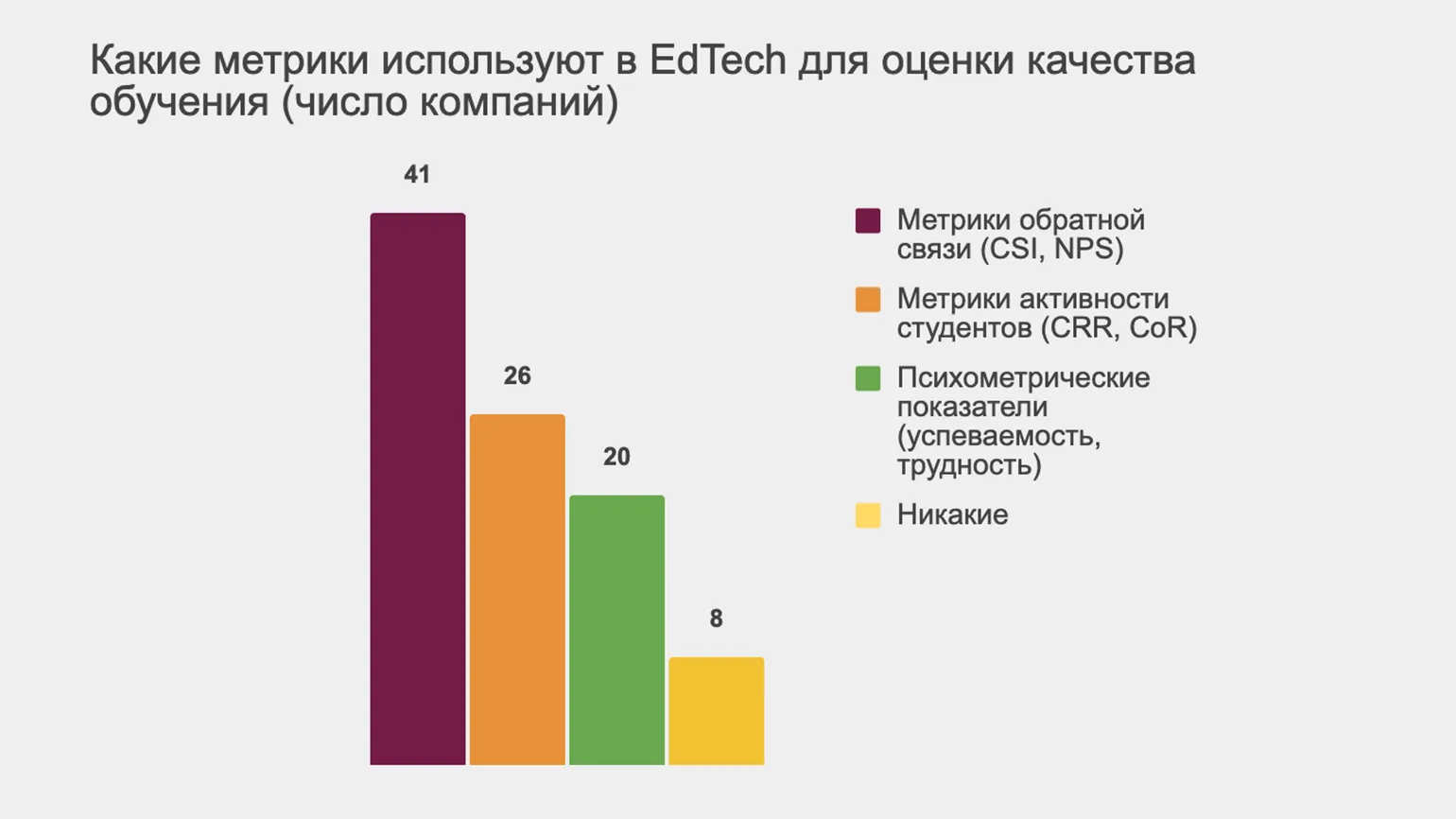
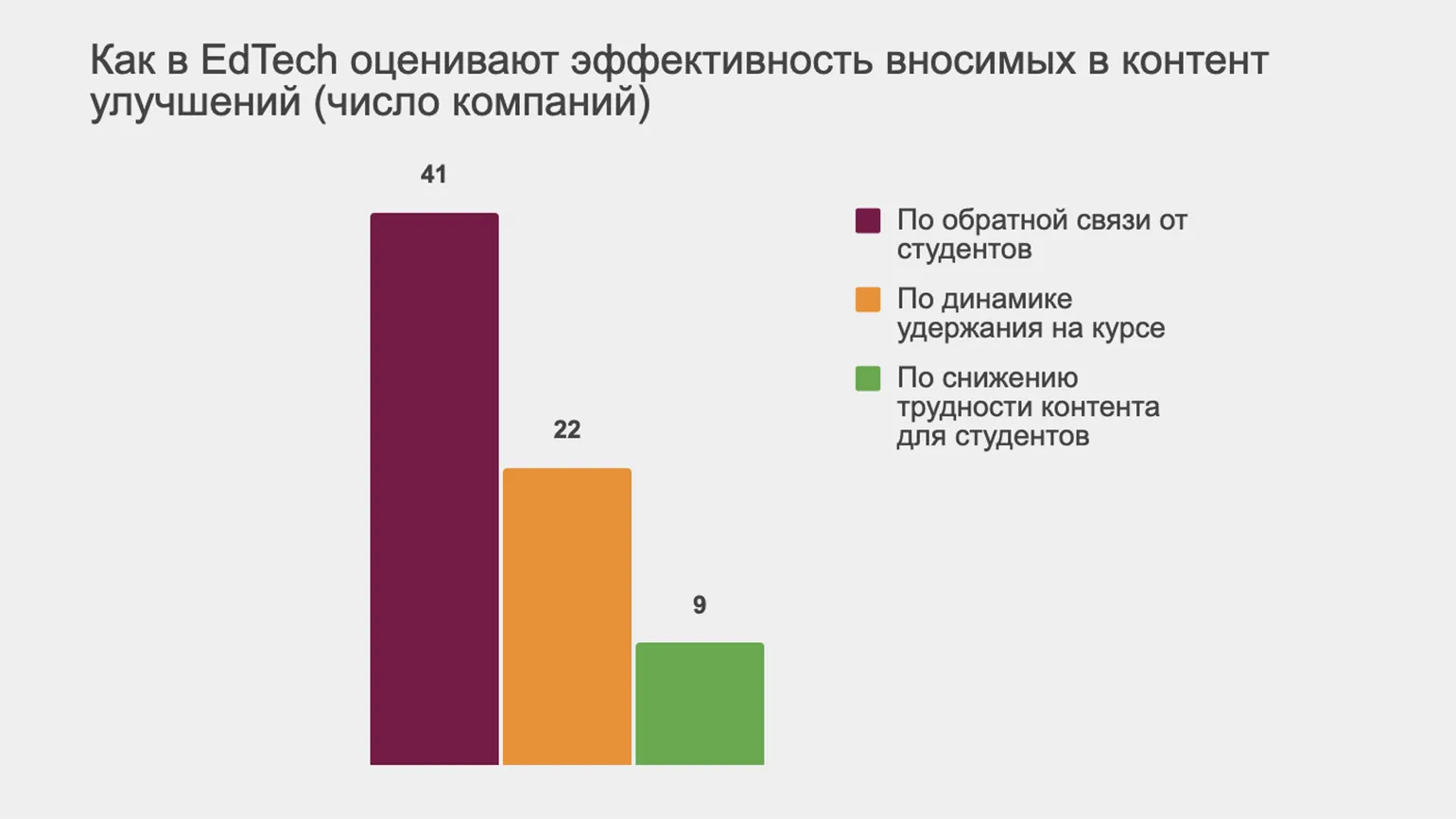
I have a hypothetical explanation for this phenomenon. The founders of the Russian and global EdTech market were not teachers and methodologists, but marketers and businessmen. If you study any article about key metrics in EdTech, for example, on the Skillbox Media website, you will first see indicators such as NPS, retention, LTV, and others. We analyze what is familiar. EdTech was initially launched as a business project, and its development required an emphasis on financial and marketing metrics.
Product quality is often assessed from a common sense perspective. As part of any development concept, it is important to conduct interviews to identify customer priorities and formulate a value proposition based on them. The issue of quality is considered similarly: if users leave the product and the retention rate is low, this may indicate its poor quality. But how can we better understand what exactly is wrong with quality? One way is to conduct user surveys to gather their opinions and suggestions.
I want to emphasize that my thoughts are not value judgments or assertions that everyone acted incorrectly. Everyone did the best they could. However, as time passes and the market evolves, the need for accurate measurements, data comparisons, and results evaluation arises. It's important to understand how content quality relates to product metrics such as user retention. This allows you to more effectively analyze the impact of content on overall performance and make informed decisions to improve it.

Be sure to read the additional materials:
Unified standards for assessing the quality of online courses: results Research
Online courses are becoming increasingly popular in today's educational environment, highlighting the need for uniform evaluation standards. This study aims to identify key criteria that will help determine the quality of online education.
The key aspects influencing the evaluation of online courses include course content, student engagement, accessibility of materials, and instructor support. These elements play a significant role in creating a positive learning experience and achieving educational goals.
The study results show that a clear course structure, relevance, and practical applicability of the material significantly enhance its quality. It is also important to consider student feedback, which can provide valuable information about course perception and effectiveness.
The introduction of uniform evaluation standards will not only improve the quality of online courses but also improve overall learning outcomes by creating a more transparent and structured assessment system. This will also help potential students better navigate their choice of courses based on objective criteria.
The request for changes to the feedback system did not arise by chance. Although we previously collected student feedback, a need for more effective and structured approaches emerged. This is driven by a desire to improve the quality of learning and tailor educational processes to students' current needs. It's important to consider student opinions to create a more comfortable and productive learning environment, which is why we strive for updates and improvements. Student feedback often suffers from subjectivity. Educational projects frequently encounter situations where students, while not expressing dissatisfaction, ultimately leave the course. For example, out of a hundred students who leave, only three are able to complete the feedback survey, and only one of them will identify specific problems. This creates difficulties for analyzing and improving the educational process. A more effective feedback collection system is needed that can identify the reasons for student attrition and help address them. Feedback often suffers from survivorship bias: not all participants complete it, and not everyone who does is able to adequately assess their feelings. I can give a clear example from TripleTen's practice. Students expressed dissatisfaction with the difficulty of the module, but upon analyzing the data, we discovered that most of them successfully completed the assignments, moving quickly and solving most problems on the first or second try. So what was the problem? It turned out that students who complained about difficulty were attempting to master the weekly module in a single day, instead of spreading the workload out over the entire week. If we had decided to simplify the module based on such feedback, it could have negatively impacted the learning experience for all students.
In the university's course data on Coursera, we observed an interesting phenomenon: some students passed tests on their tenth try but reported no difficulty. Meanwhile, top students who successfully completed assignments on the first try began to complain about difficulty if one of the assignments was graded 97% instead of 100%. This highlights that perceptions of difficulty can vary greatly depending on a student's level of preparation.
To obtain accurate and high-quality results, it is important to rely on reliable data collected from all students. Feedback should be requested only after analyzing the collected information, and not vice versa. This can be compared to medical practice, where a doctor first collects a medical history and only after conducting tests and X-rays makes a diagnosis. This approach helps avoid errors and make informed decisions based on factual data.
In an ideal educational project, it is important to use student feedback, but it should not replace objective metrics. Feedback helps understand student needs and expectations, but quantitative metrics are also necessary to evaluate the effectiveness of the program. Combining these two approaches will create a higher-quality educational space and increase its effectiveness. By using both student feedback and objective data, the project will be able to more accurately adapt to the needs of its audience and improve educational outcomes.
Feedback is an important source of quality data that aids in the analysis and improvement of educational processes. Quantitative metrics allow us to cover a broad audience of students, making it possible to segment them into groups. For example, we can identify those who dropped out at a certain point or those who encountered the greatest difficulties. Afterward, we need to conduct detailed interviews with representatives of each group to not only collect feedback but also ask specific questions based on the data obtained. For example, we could ask, "Did you encounter difficulties while completing the assignment? Would a hint have helped you at that point?" These targeted questions allow us to gain a deeper understanding of students' needs and identify aspects that cannot be covered by quantitative data.

Find out more:
In the modern educational process, there is a lack of an evidence-based approach in the daily practice of teachers. This creates barriers to effective learning and student development. To improve the quality of education, it is important to implement research-based methods that will help educators make informed decisions. The use of data and evidence in teaching contributes to a more effective learning environment, which, in turn, has a positive impact on student achievement and motivation. It is necessary to actively develop a culture of applying evidence-based methods in educational practice, which will enable teachers to better cope with the challenges of modern education.
"Stop surveying these poor students, start calculating transparent metrics"
Given the increasingly complex situation in the Russian EdTech market, companies are beginning to actively compete in demonstrating the effectiveness of their educational courses. In this context, psychometrics can play a key role. Using psychometric methods, companies can more accurately assess the knowledge and skills of students and track their progress. This not only improves the quality of the educational process but also convincingly demonstrates learning outcomes to potential clients. Psychometrics provides objective data that can become a significant competitive advantage in the educational technology market.
Psychometrics helps improve the efficiency of various processes. Here are three examples of its application.
Previously, companies could afford to massively improve content by analyzing feedback, identifying problems, and then reworking the entire material. Today, the need for operational efficiency is growing, and psychometrics plays a key role in this context. It allows for the identification of specific elements of educational content that require improvement, making the process more targeted. It's no longer necessary to interview students or analyze their feedback—relying on quantitative data and metrics is sufficient to achieve significant efficiency gains. This approach not only saves time but also optimizes resources, making the content improvement process more streamlined and effective.
Student support is one of the most costly tasks for any company, as it always requires the involvement of qualified specialists. Psychometrics plays a key role in identifying groups of students in need of additional support. Using psychometric methods allows for the effective identification of those facing difficulties and the provision of the necessary assistance. This, in turn, contributes to improved academic performance and student satisfaction, which is essential for the success of educational institutions.
Psychometrics plays a vital role in identifying needs for new products. For example, psychometric analysis may reveal that a programming course has a significant group of students who frequently make mistakes in the simulator. This indicates the need to develop a specialized sandbox course to help this category of students improve their skills. This approach will not only improve learning effectiveness but also meet student needs, which, in turn, can increase their engagement and satisfaction with the course.
The Russian market is seeing an increase in the number of EdTech companies actively implementing psychometrics. This demonstrates that educational technologies are beginning to focus on a deeper understanding of learner needs and abilities. The use of psychometrics not only improves the quality of the educational process but also increases the effectiveness of learning. Integrating such methods into educational platforms facilitates the creation of personalized programs, which, in turn, makes learning more targeted and effective.
Psychometrics is becoming increasingly well-known, but it still requires further development. One of the findings of the M-Checkap study is that psychometrics has not yet reached the level of an industry standard. For example, how can test items be developed without considering such important parameters as difficulty, reliability, and validity? An analysis of the EdTech landscape reveals that these aspects are often ignored. Efforts are needed to educate and inform professionals about the basics of psychometrics. One review of my book stated, "We tried to deduce all this intuitively, but it turns out there's a whole science!" Therefore, it is important to continue teaching and sharing knowledge about psychometrics to improve the quality of educational testing and assessments in the EdTech environment.
There are reasons why this science remains poorly understood. Since 1936, it has been in the process of being forgotten. This isn't necessarily a negative, but Russian pedagogy is characterized by a high theoretical load and a significant role for theorists. We often mention such approaches as "Elkonin's pedagogy" or "Tubelsky's school of self-determination," but there is insufficient evidence to illustrate the differences between these approaches. In-depth study and analysis are needed to provide illustrative examples and figures that will help better understand and evaluate these pedagogical concepts.
Revised text:
Studying various aspects of a topic is an important step in understanding its essence. In-depth knowledge allows you not only to broaden your horizons but also to apply this knowledge in practice. It is important to regularly update information and monitor new trends. This will help you stay ahead of the curve and make informed decisions in your work. Immersion in the topic promotes the development of analytical thinking and a critical approach to information. Exchanging opinions and discussions with like-minded people also play a significant role in expanding your horizons. Regularly reading specialized literature and attending relevant events will keep you abreast of current issues and trends.
Read also:
Russian initiatives aimed at improving student performance lack a sufficient evidence base. This raises doubts about the effectiveness of the methods and approaches used. The need for scientific research and analysis of program results is becoming clear to ensure high-quality education. Without clear data on the effectiveness of such programs, it is difficult to assess their real impact on student achievement.
My mission is to convey the idea of a more effective approach to measuring learning. Instead of surveying students, we should use logs to calculate transparent metrics of content complexity. Using these metrics, we can significantly improve the quality of education and adapt educational materials to the real needs of students. This approach will create a more effective educational environment and improve student outcomes.

During the conference "Trends in Education Development" A question was asked in Shaninka about how to convince businesses of the importance of psychometric measurements if they believe that using only marketing metrics to analyze their products is sufficient. If I had the opportunity to answer this question, I would note that psychometric measurements provide a deeper understanding of user needs and behavior. They allow us to identify hidden motives, assess emotional reactions, and evaluate customer satisfaction levels, which is impossible to obtain using traditional marketing data alone. Psychometric approaches help formulate more precise and targeted strategies, which ultimately leads to improved product quality and increased competitiveness in the market. The importance of transferring knowledge and values in the educational sphere cannot be overstated. This path is not easy, but it is necessary. If I had begun writing my book before working with Yandex Praktikum, the result would have been a voluminous work resembling a dissertation. However, thanks to this experience, I found the appropriate structure and content to convey my ideas.
The next step will be the launch of the course "Tools of Learning and Psychometric Analytics for Evidence-Based Education" at the School of Education. Participants, including representatives of both large EdTech companies and startups, will master the skills of calculating metrics, creating dashboards, and making informed decisions in educational practice.
Thus, developing this knowledge and skills will form the basis for writing a sequel to my book, which will deepen understanding of the topic and make it accessible to a wider audience.
Communicating the value of metrics can be challenging, but at Yandex Praktikum, we succeeded thanks to several key approaches. First, we began by creating a common language with marketers and methodologists, which allowed us to better understand their needs and objectives. We organized regular meetings to discuss how metrics can help achieve business goals.
Secondly, we used illustrative examples and case studies that demonstrated how the use of metrics led to improved results. This allowed the team to see the concrete benefits of using data. We also held several training sessions to explain the basics of analytics and the importance of metrics in decision-making.
Furthermore, we implemented a reporting system that allowed all team members to see the results and the impact of their work on the overall metrics. This increased interest in using metrics and created a data-driven culture. As a result, collaboration between teams became more productive, and we were able to achieve significant success in project implementation.
I'll be honest: it was a challenging experience. In the first months, I had to adapt to business jargon and learn to effectively "take requests" from the business and formulate a response to them. In the beginning, I performed complex probabilistic assessments, for example, determining the likelihood of a student completing an assignment. However, such decisions were not understood by my colleagues, and they often asked: "Tell me in simpler terms, should we improve this or not?" Recognizing the need to deliver solutions that deliver real value, I gradually found common ground with the team.
Your book provides examples of linking psychometric data with marketing and product metrics in EdTech. One such example is using trial course performance to predict the likelihood of purchasing a full course. Product psychometrics is currently rapidly developing and is beginning to play a key role in EdTech companies' strategies. It enables a more accurate analysis of user behavior, their needs, and preferences, which in turn helps improve marketing strategies and increase conversion. In an increasingly competitive educational technology market, the use of psychometric data is becoming essential for achieving success and optimizing business processes.
Last year, at the Psychometric Society conference in Prague, I presented a paper on product psychometrics. During my presentation, I noted that, in my opinion, we, as psychometricians and scientists, are not investing enough in being useful to the educational business. This issue requires attention because psychometric research can significantly improve the quality of educational products and services.
In a scientific approach, the development and refinement of metrics is accomplished through a thorough analysis of existing data and the identification of gaps in the scientific literature. For example, if most studies measure a certain coefficient with an accuracy of 0.9, this may indicate the need for a more detailed study or improvement of this metric. Researchers should strive to increase the accuracy and reliability of measurements, which may involve developing new methods, using modern technologies, or conducting additional experiments. Thus, the process of improving metrics becomes a key element of scientific progress, allowing for a deeper understanding of the phenomena under study and the achievement of more relevant results.
A scientific problem can be formulated as follows: it is necessary to achieve an accuracy of 0.95. However, it is often not taken into account whether such a high degree of accuracy is truly required, whether anyone will use the obtained results, and whether this makes practical sense. It's important to understand that achieving high metrics isn't always justified by real-world applications and needs.
It's not necessary to write every article from a pragmatic perspective, but if our goal is to impact the EdTech market, which clearly requires psychometrics, we need to approach this issue from a product perspective. At the moment, product psychometrics does not have a clear systematization or manifesto, but my colleagues and I are actively working on creating a set of practices and methods that will help us structure and develop this area.

Product psychometrics is widely applied in various fields. One prominent example is the use of psychometric tests to assess consumer preferences. Companies analyze customer behavior and motivations to better understand their needs and tailor their products and services to target audiences.
Another example is the use of psychometrics in marketing research. Surveys and questionnaires can reveal consumers' emotional reactions to products, which helps create more effective advertising campaigns.
Furthermore, many companies implement psychometric approaches in the development of new products to predict how potential users will react to them. This helps minimize risks and increase the likelihood of a successful product launch.
It is also worth noting that psychometric data is actively used in the hiring and assessment processes. Employers use such methods to create teams with the optimal combination of skills and personality traits, which in turn contributes to increased productivity and efficiency.
Thus, product psychometrics is a powerful tool for understanding consumer behavior and optimizing business processes.
The field of product psychometrics is relatively new, but it is already attracting the attention of professionals in this field. One prominent representative is Alina von Davier, Director of Assessment at Duolingo. Previously, she served as Director of Science at Educational Testing Service, the organization that develops such well-known tests as the TOEFL and SAT. Under her leadership, all educational-related AB tests at Duolingo are conducted using psychometric methods. This includes a thorough analysis of task difficulty and word memorability. The results of these studies are actively integrated into the product, which contributes to improved product metrics and the overall effectiveness of the educational process.
Read also:
Duolingo shared a strategy for effectively increasing user numbers. This methodology includes the use of gamification, which makes language learning more engaging and motivating. The platform offers users a user-friendly interface and interactive tasks, which helps maintain interest and increase engagement. Regular content updates and tailoring courses to audience needs are also important. These approaches help Duolingo not only attract new users but also retain existing ones, which in turn contributes to the growth of the language learning community.
"Nothing is universal, and this applies to metrics as well."
In your book, you mention important metrics such as student performance and task manageability. As you note, in effective courses, the optimal values for both metrics are in the 70–90% range. Can you explain why this range is most effective?
In this text, I draw attention to key points related to errors in learning tasks. In the book, I refer to an article that states that the error rate, or error probability, in a given learning task should be 0.15. This means that the optimal level of content difficulty should be such that 85% of students successfully complete the task, which corresponds to a value of 0.85. Maintaining a balance between the complexity and accessibility of materials is an important aspect of learning, as it promotes effective knowledge acquisition.
According to research, the optimal proportion of successful assignments for students, known as the learning rate, should be 0.85. This means that a student should solve 85% of assignments correctly, making errors in 15% of cases. This proportion is considered ideal for achieving high academic performance and effective learning.
To achieve an optimal academic performance of 0.85, the difficulty of the educational content must also be at 0.85. These indicators are interrelated and influence the overall educational process. Students studying in such an environment demonstrate better results, complete courses faster, and experience greater satisfaction with their learning. An effective combination of difficulty and academic performance contributes to a positive learning experience, which in turn increases the overall effectiveness of the educational program.
The boundaries of optimal academic performance zones and the feasibility of assignments are universal for various educational courses. They help determine the level of task difficulty at which students can effectively master the material without feeling overwhelmed. These boundaries take into account the individual characteristics of students, their level of preparation and motivation, which allows the learning process to be adapted for maximum effectiveness. Thus, correctly defining these zones contributes to improved educational outcomes and increased interest in learning.
The authors of the aforementioned article note that this is a universal concept based on Lev Vygotsky's zone of proximal development. According to them, when the proportion of successfully completed tasks reaches 85%, the student begins to adequately assess their chances of success in the next stages of learning. This creates optimal conditions for further development and motivation, which, in turn, contributes to more effective learning.
In this book, I do not emphasize universality; my goal is to help readers establish optimal values for their course. It is important to note that the optimal indicators obtained based on Yandex Praktikum data coincide with the results of other researchers. Feedback and projects I have worked on confirm that these values are often applied in practice. Many people note: "Indeed, this is so!"

Is there a future for niche courses with low-achieving tasks, designed so that most students can't complete them on the first try? The core concept of such courses is that learning is challenging, yet progress is measurable. This may attract a certain category of students who seek challenges and are willing to overcome difficulties. Such courses can be successful if the value of learning difficulties is properly emphasized and how overcoming obstacles contributes to personal and professional growth.
Yes, it is possible. Firstly, there are no universal solutions, including metrics and indicators. Secondly, everything depends on the paradigm in which we organize learning. My book focuses on approaches based on optimality, care, and comfort for students, as well as caring for them. At the same time, Alexander Nikolaevich Poddyakov, professor at the Higher School of Economics and the author of the concept of complicology, explores the creation of developmental, diagnostic, and destructive learning difficulties. His theory analyzes the various teacher intentions and methods they employ. This demonstrates that teaching approaches can vary, and it's important to choose those that are best suited to a specific situation and target audience.
In teaching, one can choose a gentle approach or a more rigorous method. For example, walking into the classroom and declaring, "You're all underachievers, but I'll turn you into Olympic champions! 100 push-ups for everyone!" This approach requires a high learning rate, where 80% of attempts will fail and only 20% will succeed. However, it's important to understand that this method can negatively impact student motivation and self-esteem. Effective teaching requires a balance between rigorous demands and support, which helps create a more productive and positive learning environment.
Personal experience shows that different teaching approaches can produce different results. When I was learning to play guitar, my teacher would often tease me, saying, "Your fingers are like sausages; you'll never succeed." This motivation worked, and two years later, I won a music school competition. However, when I was playing sports, specifically karate, the same approach didn't work. I'd come home and tell my mother I didn't want to continue. Although the method was similar in both cases, the results were radically different. This highlights the importance of an individualized approach to learning and motivation, as what may inspire one person may be a hindrance to another.

Read also:
Learning from mistakes is a common belief, but research Studies show that this is not always the case. Many people fail to learn from their failures, which can hinder personal growth and development. It is important to understand how to properly analyze your mistakes and use them as opportunities for improvement. An effective approach to mistakes involves recognizing the reasons for failure, analyzing your actions, and developing new strategies. By applying such methods, you can significantly increase the likelihood of future success. Thus, conscious learning from mistakes is indeed possible if you approach this process wisely. An optimal approach to teaching requires careful consideration of student interests and the level of difficulty of the materials. In some cases, a gentle approach with an appropriate number of challenging tasks can be effective, but in other situations, this can lead to students not experiencing sufficient challenge and, as a result, losing interest in learning. There are many teaching methods, and we do not seek to impose a single correct approach on teachers or methodologists. It's important to remember that a course can be designed as a serious challenge, and that's certainly true.
The opposite assertion suggests that for recreational courses designed for general development and broadening horizons, the level of task difficulty should be significantly higher. For example, you could assume that 95% of students should successfully complete the tasks on the first try. This is because participants in such courses are typically unprepared for challenges and don't seek intensive learning. It's important to create a comfortable learning environment where participants can easily absorb new material and enjoy the process. This approach helps maintain student interest and motivation, which, in turn, increases the likelihood of their successful participation in the course.
I completely agree with you. However, it's important to remember that even in courses where the content is adapted to students' level of knowledge, the material shouldn't be oversimplified. Explanations that are too simple can lead to a loss of interest. For example, if you want to learn how to cook borscht, you shouldn't start by explaining how to open a faucet for water, as this may seem unnecessary. It's important to find a balance between accessibility and content to ensure learning remains engaging and rewarding.
There is a hypothesis, supported by research, about the impact of optimal content difficulty levels on student performance. In the early 2010s, Dutch researchers conducted an empirical study and found that the optimal task difficulty level is 0.75. At this level of difficulty, students who solve a problem correctly don't perceive it as a fluke, and those who make mistakes don't feel demotivated. This finding underscores the importance of properly setting the difficulty of educational materials to enhance learning effectiveness and maintain student motivation.
In less than ten years, a new scientific article has found that the optimal task difficulty value is 0.85, which is also supported by empirical data. This indicates inflation in this area of research. I emphasize that this is just my opinion, since while it is possible to conduct a comparative analysis between the two studies, no actual longitudinal experiments have been conducted on this issue.