Contents:
Learn: Educational Programs Methodologist
Learn More
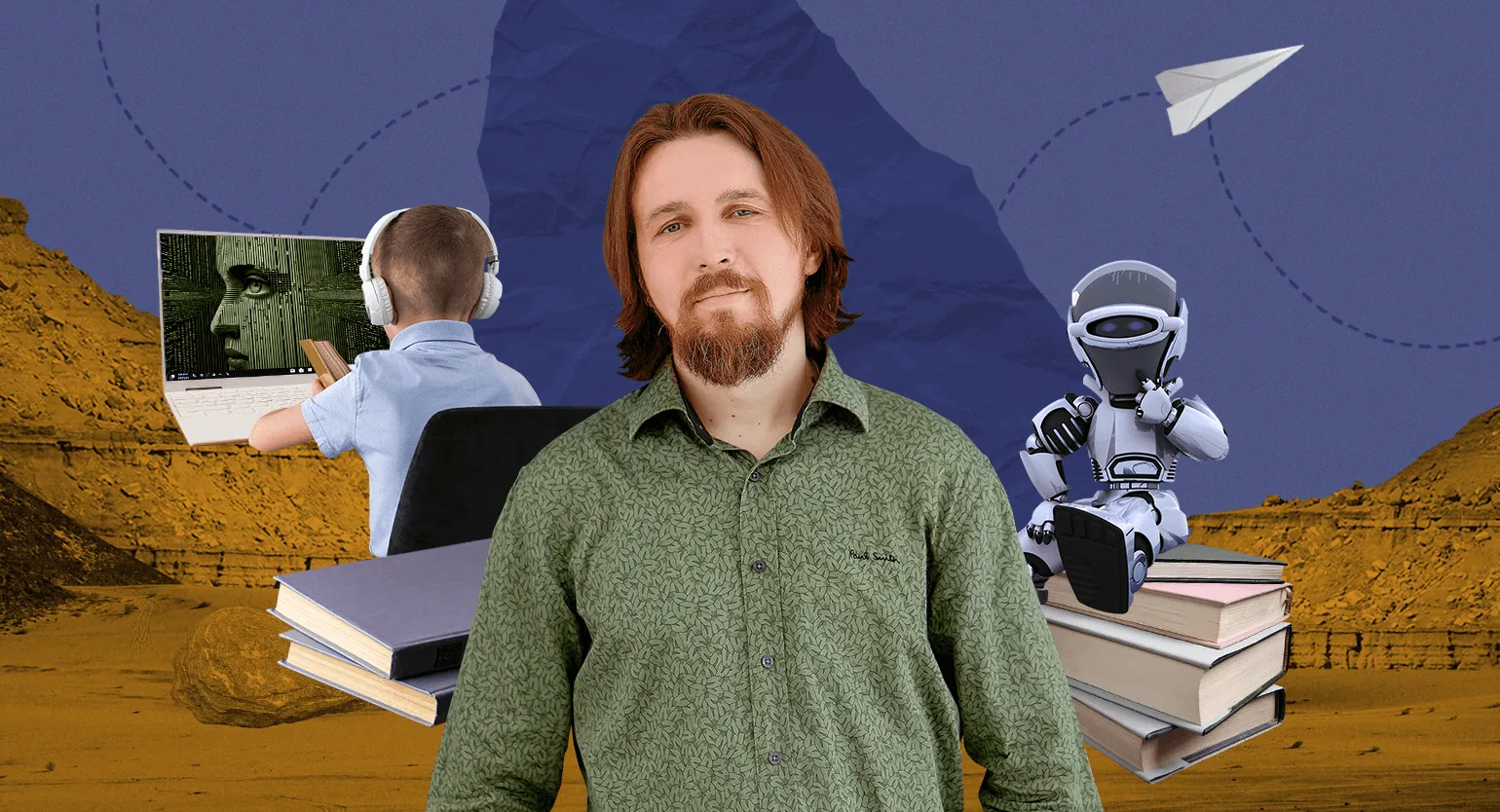
Head of Digital Products at the Samoletum educational ecosystem, part of the Samolet Group of Companies, is a leading expert in the field of digitalization of education at University 2035. In his role, he is responsible for the development and implementation of innovative digital solutions aimed at improving the educational process and enhancing the quality of learning. The expert is actively involved in the design and implementation of strategies that facilitate the integration of modern technologies into the educational environment, thereby ensuring access to relevant knowledge and skills for students.
At Samolet Group, Andrey Komissarov is working on a digital tool for educational institutions based on artificial intelligence, which will be called "Digital Tutor." This tool is designed to facilitate the homework process for schoolchildren without interfering with the educational process in the classroom. We spoke with Andrey about this project, how exactly it can help students, what reaction he expects from parents to the implementation of an AI tutor, and whether communicating with a robot is acceptable for children.
Why "Digital Tutor" and not "AI Teacher"
The AI tutor development project arose in response to the need for more effective and accessible teaching methods. Modern technologies and advances in artificial intelligence have opened up new possibilities for creating personalized educational experiences. The AI tutor can adapt to each student's learning style, providing individualized recommendations and support. The project's primary goal is to improve the quality of education and increase student engagement, making it an essential tool in the modern educational process. The AI tutor is being developed with the latest trends in pedagogy and educational psychology in mind, enabling the creation of an effective solution for various user groups.
Since July of this year, I began working in the education vertical of the Samolet Group of Companies. This new direction for the developer is significant, as in addition to residential complexes, Samolet also builds schools. One of the main challenges of modern school education is large class sizes. In such conditions, children cannot receive individualized attention, which often leads to difficulties with homework. This creates a sense of pedagogical neglect and forces parents to resort to tutoring, which, of course, negatively impacts the family budget. It's important to find solutions that ensure high-quality education and individual attention for each student.
I was asked to develop a digital solution to these problems using a set of algorithms based on generative neural networks. These algorithms were originally created by my lab for corporate training purposes. Using such technologies allows us to effectively address issues related to employee training and development, as well as optimize processes within companies.
We chose to develop a digital tutor because it offers unique opportunities for individualized student learning. A digital tutor provides a personalized approach, adapting to the needs and knowledge level of each student. Unlike a teacher's assistant, which can make teachers' work easier, a digital tutor actively engages students in the learning process, helping them master the material at their own pace. We strive to improve the educational process by ensuring access to quality education for everyone, regardless of their starting level or location.
The direct implementation of generative algorithms based on artificial intelligence into the educational process may be inappropriate and may even negatively impact the quality of education.
Teachers should not interfere with their space—they need to carry out their duties calmly, without fearing for their position and authority. In turn, we strive to facilitate the work of teachers by providing them with detailed reports on how a child interacts with an AI tutor during homework. This allows teachers to better understand student progress and effectively support them in their learning.
There is a well-known two-sigma problem, proposed by Benjamin Bloom, which consists of a significant difference between the educational outcomes obtained with a tutor and the results of students in a standard school classroom. This difference amounts to two standard deviations, meaning that in a school setting, students perform twice as poorly. By the time they finish primary school, many children face pedagogical neglect and accumulated errors in understanding the curriculum. It is important to find a solution to bridge this gap between the individual and the mass approach to education. This is precisely the task we set for ourselves, striving to improve the quality of education and help every child achieve their maximum potential.
Artificial intelligence as a tutor is intended for a wide audience, including students, professionals, and individuals seeking self-education. Using an AI tutor involves interactive learning, where users can ask questions and receive tailored answers in real time. This allows each user to develop their skills on an individual schedule and at their own pace. The AI tutor will be available through various platforms, including mobile apps and websites, providing easy access to educational resources. The platform will analyze user progress and offer personalized recommendations, increasing learning effectiveness. This approach will make the educational process more accessible and effective for everyone.
Our pilot project offers tutoring support in social studies for students in grades 8 and 9. We will focus on the "teen-teacher" interaction. The process will be organized as follows: the teacher registers with the AI tutor, which is available both on the website and as a chatbot in messengers. The teacher provides students with homework, including several options with varying levels of difficulty. The standard level is suitable for most students, the advanced level is for those preparing for the Unified State Exam, and the most challenging level is for Olympiad participants. The teacher can choose the assignment level for each student and, if necessary, upload their own materials, combining them with the resources offered by the AI tutor. In this way, we create a personalized approach to learning that takes into account the needs of each student.
Students will be able to receive homework directly through the new tool and also complete it within the same platform.
In general, working with the digital tutor will be possible in two modes. The first mode is a conversation. It involves interacting with the AI tutor on a topic assigned by the teacher. The program automatically formulates problematic questions related to the topic and promotes the development of critical thinking in the student. The main goal is not simply to retell the material, but to use guiding questions to help the student develop independent understanding and a deep comprehension of the subject. This approach helps develop analytical skills and stimulates interest in learning.
The conversation mode will be available in both audio and text formats. This will allow users to choose the most convenient communication method depending on their preferences and the situation. Audio provides a more lively interaction, while text correspondence allows for more careful consideration of their responses.
The AI tutor operates in audio format, encouraging children to verbalize their responses instead of writing them. My experience using AI algorithms in education confirms that visual components in such tools are not in demand, as users do not seek to see "digital people." Furthermore, children are often reluctant to write or type long texts, and speaking skills are underdeveloped at school. Our primary goal is to develop students' thinking and speech, which is a key aspect of their educational process.
The first mode of working with the tutor is conversation. What is the second mode?
The second component of the system is homework. The AI tutor's architecture includes an "Examiner" module, which allows students to submit completed assignments for assessment. This process includes feedback in the form of formative assessment. If the assignment is completed in written form, the student reads their text out loud, after which the digital tutor asks questions that encourage reflection and in-depth analysis of the material. This not only helps assess the quality of the completed assignment but also develops the student's critical thinking.
Will the dialogue continue at this stage?
The AI tutor adapts to the student's thinking and speech patterns, allowing it to ask additional questions and consider the answers. The AI tutor includes neural network ensembles, the key among which is Llama 2, trained on a specialized dataset. A key element of the system is advanced prompt engineering, which allows the digital tutor to accurately determine which questions it can and cannot answer. For example, the tutor doesn't provide answers to homework questions so the child can solve them independently. This ensures more effective learning and the development of critical thinking in students.
The tool provides a grade ranging from 2 to 5 points with detailed formative feedback. If the child is dissatisfied with the grade received, they can retake the homework up to seven times. Thanks to the adaptability and flexibility of large language models, the AI tutor doesn't repeat the same questions during retakes, but rephrases them, which promotes a deeper understanding of the material and improves results.
How will the tool develop?
Does your AI tutor have similar products? If so, is there already evidence, based on experience, that learning with a digital tutor produces results comparable to lessons with a human tutor? Research shows that using an AI tutor can be as effective as working with a live teacher, thanks to a personalized approach and adaptive learning methods. Comparisons of results show that students using digital tutors achieve high academic success, supported by numerous positive reviews and statistical data.
Our digital tutor is similar to the Khanmigo chatbot used by Khan Academy. Khan Academy is the largest online platform for school education in the world. However, to fully evaluate the results of the Khanmigo AI tutor, more time and observations are required.
There is An interesting approach, based on developments by DARPA (the Defense Advanced Research Projects Agency), involves game-based simulators powered by artificial intelligence. These simulators are particularly effective in areas such as mathematics, physics, and chemistry, where tasks can be presented as puzzles. They operate in a flipped classroom format: first, the student attempts to solve the problem independently, and then a GPT-based system provides an explanation of the theory that was missing. However, as with Khanmigo, this process also involves accumulating a research base and collecting data on educational experiences. At this point, it is premature to draw definitive conclusions about the results of using such technologies. Are there any conclusions yet? The Chinese tool Squirrel AI demonstrates a high level of effectiveness in preparing schoolchildren for the Gao Kao, a national exam similar to the Unified State Exam. It begins its work in the second grade, providing students with a structured educational path. Despite the lack of an individualized approach and flexibility in learning, the use of neural networks can significantly improve results. The Gaokao is a complex exam that plays a key role in the future of Chinese students. Groups trained with Squirrel AI show 30-40% higher pass rates compared to those who did not use this artificial intelligence tool. This is a significant achievement, especially considering the number of children taking the Gaokao.
The question of a child's freedom of action in the context of using an AI tutor remains relevant. If a teacher independently determines the difficulty level of an assignment from three proposed options, does the student have the opportunity to take initiative and choose the option that suits them best? It is important to consider the extent to which such a system allows the child to develop critical thinking and decision-making, which is a key aspect of the educational process. Providing flexibility in choosing assignments can contribute to a deeper understanding of the material and increase motivation for learning.
Our AI tutor effectively interacts with the thinking and individuality of each child. It analyzes how a specific student solves problems and provides appropriate assistance. This allows us to tailor the learning process to the unique needs and knowledge level of each student, ensuring a deeper understanding of the material.
We plan to integrate gamification elements into our digital tutor, similar to gaming applications. The system will feature a progress bar that will display user achievements. Upon reaching certain progress bar levels, users will be able to receive various prizes, including merchandise, trips, unique opportunities, and cash scholarships. This will significantly increase user motivation and engagement, making the learning process more engaging and productive.
Gamification of the learning process can be applied to assignments of varying difficulty. If a teacher assigns standard homework, a confident student can approach the AI tutor with a request for a more challenging task. This will allow the teacher to evaluate both the completed assignment and the student's initiative, which contributes to the development of their skills and motivation for learning. Gamification not only makes learning more engaging but also instills in students a sense of responsibility for their own education.
We plan to introduce the AI tutor to schools through a phased process that includes teacher training, integrating the technology into the curriculum, and testing it with small groups of students. We will first conduct workshops for teachers to familiarize them with the capabilities and benefits of using AI in the educational process. Next, we will integrate the AI tutor into existing educational materials, allowing students to receive personalized recommendations and assistance. In the final stage, we will organize pilot projects to evaluate the effectiveness and adapt the AI tutor to the needs of specific educational institutions. This approach will ensure a smooth and effective implementation of the AI tutor into educational practice.
The pilot project will be presented at the AI Journey conference at the end of November. It is intended for students in schools already built by Samolet. These educational institutions include School No. 51 in Lyubertsy, the Start School in Vidnoye, the Lyubertsy Engineering and Technology Lyceum, the Vershina School, and the private Samoletum School in the Sputnik residential complex. The project aims to introduce modern technologies into the educational process, improving the quality of education and preparing students for future challenges.
We plan to expand the use of the AI tutor to all academic subjects, including primary school. Initially, we will focus on pilot testing to identify potential issues, collect UX feedback, and analyze user behavior. This will allow us to evaluate the system's effectiveness, identify vulnerabilities, and make any necessary improvements. We plan to conduct open piloting for six months, during which we will regularly update the public on the research progress and results achieved.
Neural networks will be trained in parallel across various subjects. Training the Llama model requires significant amounts of data, making the use of large datasets critical to achieving high results.
Sizes vary depending on the specific object or item. For example, in the case of furniture, sizes can range from compact models for small spaces to large sofas for spacious living rooms. When it comes to buildings, sizes can reach significant scale, from single-story houses to multi-story complexes. It's important to consider the context to properly assess size and its impact on spatial perception.
The collected dataset on social studies comprises 1.8 gigabytes of high-quality text with correct proportions for the topics studied. All materials are current and no older than 2020. A variety of text types are included: textbooks, creative assignments, articles, and regulations. A team of six professional methodologists collected this dataset. The final stage was prompt engineering, which is a manual process that cannot be automated.
Why did you choose social studies as a pilot subject? Digital tools are typically used in areas that require regular practice of individual skills, such as mathematics and foreign languages.
As a researcher, I believe it is crucial to conduct a feasibility study before beginning serious work. In this context, a feasibility study involves examining all the potential vulnerabilities of large language models. One of the key vulnerabilities is the so-called "dementia" of artificial intelligence, which manifests itself in a decrease in the quality of the generated material. This may create the impression that the neural network is losing its intellectual abilities.

Reasons for problems in work Artificial intelligence can have various disadvantages. One of them is the use of datasets created by other neural networks, which limits the quality of training. However, the most common cause of AI "dementia" is a phenomenon known as "dataset leakage". This occurs when data within a dataset is mixed and represents different topics, which can negatively affect the results. Social science, as a field of knowledge, is very diverse and covers sociology, philosophy, religious studies, economics, and other disciplines. As part of the analysis, I can examine how effectively technologies work with such a variety of topics, which will allow us to evaluate their applicability in different contexts.
Why you shouldn't be afraid of communicating with a digital tutor
You noted that teachers are reluctant to introduce artificial intelligence-based tools into the educational process. Do you think parents will perceive a tool that helps children with homework positively?
We are currently running an experiment to understand attitudes toward an AI tutor. This complex system requires careful preparation, including collecting data on the educational experience and digital footprint. As part of our work in schools, we primarily collect and analyze the child's digital footprint. This allows us to better understand the individual needs of students and adapt learning using artificial intelligence.
The primary goal of school education is to offer children opportunities for socially useful activity that can bring them happiness. This is achieved through the harmonious realization of their potential. The educational process should be aimed at developing the abilities and interests of each student, which in turn contributes to their personal and professional growth. Thus, the school plays a key role in shaping future citizens who will be able to contribute to society and find their place in life.
It is necessary to collect data on the student's thinking and behavior, as well as their interests. This will allow us to more accurately describe and visualize its potential. Analyzing these aspects will help identify strengths and areas for further development.
Are you collecting additional data on children's learning?
Our experiment is exploring the potential of artificial intelligence in the educational process. In the future, AI tutors will become an important source of data, but currently schools do not record enough information. To change this situation, we developed a Telegram chatbot that collects data on formative, role-based, and criterion-based assessments provided by teachers to individual students. The chatbot is called "Teacher's Navigator," and its main task is to analyze the collected data and provide teachers with recommendations for each student. This will improve the quality of the educational process and make it more personalized.
Three schools are participating in our experiment to collect digital footprint data, and this is happening exclusively with the consent of students' parents. We are analyzing criterion-based assessments and formative feedback provided by teachers via audio messages. Artificial intelligence processes every message, generating personalized recommendations for students. This approach allows for more effective progress tracking and identification of areas requiring additional attention.
Some parents are unaware of what data is being collected and for what purpose. It's important to understand that until a clear career path is established that aligns with their child's unique potential, it can be difficult to see the value of the information being collected. That's why I share my project experiences at various conferences to explain this process and its importance for children's development.
Discussion of the psychological consequences of students' interactions with artificial intelligence is becoming increasingly relevant. Frequent interaction with AI can lead to changes in students' social behavior and personality traits. One possible consequence is a decrease in emotional intelligence, as students may begin to rely on AI in situations requiring emotional responses and empathy.
Furthermore, there is a risk of developing technology addiction, which can negatively impact interpersonal relationships and communication skills. Students may begin to prefer interacting with AI over interacting with their peers, which can lead to social isolation.
It is also important to consider that interaction with artificial intelligence can impact self-esteem and self-confidence. Students may begin to perceive AI as a source of authoritative information, which can reduce their critical thinking and ability to solve problems independently.
It is necessary to carefully monitor how technology impacts students' psychological health and development to minimize potential negative consequences and support healthy interactions with the environment.
Children who do not communicate sufficiently face serious psychological consequences. This phenomenon is noted not only by neuroscientists but also by speech therapists and educators. A lack of communication can negatively impact the development of language, social skills, and emotional intelligence. Ensuring meaningful interaction and communication in childhood is key to developing a healthy personality and successfully adapting to society.
Humans are social beings, and this assertion is based on how our brain processes information. We primarily perceive social interactions by paying attention to other people's appearance, their body language, and facial expressions. It's undeniable that a significant portion of the brain's cognitive resources is focused on these aspects. Therefore, individual learning may be less effective than group learning, as interaction with others plays a key role in our learning and development.
Learning children in a group setting is essential for their development. In this context, it's worth noting unique educational systems such as the Jiddu Krishnamurti Foundation Schools in India, which eliminate the traditional classroom system. Here, learning occurs spontaneously in groups, which facilitates deeper learning. Graduates of these schools become highly qualified specialists. Our experience at the School of Digital Transformation at University 2035 has confirmed that adults' comprehension of information in an online format is, on average, 15% higher in group learning than in individual learning. This underscores the importance of interaction and collaborative learning for improving educational outcomes.
Communication with artificial intelligence should not be seen as a substitute for face-to-face interaction. Artificial intelligence is an effective tool that can facilitate the process of learning and information delivery. However, no interaction with AI can fully recapture the value and emotional depth of live human communication.
The use of AI tutors in group learning offers the opportunity to personalize the educational process. AI tutors can adapt to the knowledge level and needs of each student, improving overall group learning. Furthermore, such technologies can analyze student interactions and suggest tasks that promote more effective collaboration and knowledge sharing among participants. As a result, the use of AI tutors creates a more dynamic and productive educational environment, which positively impacts learning outcomes in groups.
We specifically plan to use AI tutors not in lessons, but during homework assignments. When using an AI tutor, the teacher receives a dashboard with detailed information about how the majority of students coped with their homework and what difficulties they encountered. This allows the teacher to save time in class, eliminating the need for a 20-25 minute homework discussion with the class. Thus, the AI tutor not only optimizes the learning process but also increases the effectiveness of lessons, allowing you to focus on more important aspects of the educational process.
In this free time, teachers will be able to focus on group work, for which we will provide teaching materials. These materials will cover topics such as station rotation, project-based learning, game-based learning, STEAM, and case studies. Thus, the knowledge and skills that students developed with the help of an AI tutor at home can be effectively applied in group lessons.
Many experts believe that in the future, in-person education may become elitist and difficult to access, while mass education will be offered only in the form of online courses and programs. Do you agree with this point of view?
I completely agree with this forecast, but with some clarifications. Firstly, I do not see this future as negative. Currently, there are many online goods and services, as well as a large number of infopreneurs. With the development of neural networks, the number of such entrepreneurs will increase even more, as will the volume of content they produce. At the same time, the quality of their products will improve, as GPT-based tools will enable the creation of materials of a higher level than those currently available on the infobusiness market. This opens up new opportunities for both creators and consumers of information.
The difference between mass education and elite educational programs lies in the individualized approach to the needs of each student and how effectively we develop their meta-subject skills. This primarily concerns thinking, which enables the transformation of knowledge into personal understanding. Secondly, the development of verbal skills is an important aspect. And finally, a key element is self-actualization, which promotes the full development of the individual and helps each student realize their potential.
Self-actualization is not simply a set of skills, but a profound process of personal growth and the realization of one's potential. It is the desire for self-improvement and an understanding of one's true desires and goals. Self-actualization includes the development of both professional and personal qualities, such as creativity, self-confidence, and critical thinking. This process allows a person to recognize their strengths, overcome internal barriers, and achieve harmony with themselves, which ultimately leads to a more fulfilling and satisfying life.
I believe that the most important soft skill that determines a person's success in life is a combination of mindfulness, willpower, initiative, and adaptability. These qualities help them effectively cope with challenges, make informed decisions, and successfully interact with others. Developing these skills facilitates personal and professional growth, which, in turn, opens up new opportunities and perspectives.
Self-actualization plays a key role in the process of forming personal identity and helps move from dreams to concrete actions. It includes the stages of planning, implementation, and analysis of results. Completing this cycle brings satisfaction from what has been achieved, which in turn initiates a new stage of aspirations and goals. This ongoing process of self-development not only promotes personal growth but also improves the quality of life, allowing a person to more consciously approach their desires and achievements.
Self-actualization is the key factor that makes us effective people. Its development should be a priority in the educational process. Elite education is not always associated with high costs; what is more important is how it unlocks students' potential. Education should promote the development of thinking, speaking, and self-actualization, which goes beyond traditional educational outcomes such as knowledge and practical skills. The right approach to education allows students not only to master the necessary knowledge but also to achieve a deep understanding of their capabilities and goals.
Let's consider modern schools and universities from the perspective of elite education. In a rapidly changing world, it is important to understand that elite education is characterized by a high-quality educational process, access to unique resources, and the opportunity to gain knowledge at an international level. This education provides students with the necessary skills and competencies that are in demand in the labor market. It is important to note that elite educational institutions often offer a personalized approach to education, allowing each student to reach their full potential. Thus, modern elite education is not only prestige, but also a real opportunity to achieve success in life.
Read also:
- What AI assistants have learned to do in education
- “The most effective AI solutions reproduce proven pedagogical practices”
- 5 key findings on the development of independence in learning
- “Neural networks help to develop and use fundamentally new formats”
Educational Programs Methodologist
You will go through the full cycle of creating an educational product from scratch. Learn to design curricula for online and offline courses. Become a universal specialist - you can launch your own project or get a job as a methodologist in a large company.
Find out more