Contents:

Learn: Educational Methodist
Learn moreWho is Richard Mayer, the author of the theory of multimedia learning?
Richard Mayer is a prominent American psychologist and professor at California State University. For several decades, he and his team have been studying the perception of verbal and visual information. Their work in the field of cognitive psychology helps to understand how people process and assimilate information, which is of great importance for educational technologies and the development of effective educational materials. Mayer's research contributes to the improvement of teaching methods aimed at optimizing the perception of information using words and images.
Richard Mayer and his team argue that the combination of visual and verbal elements is the key to creating effective educational content. It is important to follow principles based on cognitive load theory to avoid overloading the learner's working memory. This allows for more effective assimilation of new knowledge. The core idea of the cognitive theory of multimedia learning is to optimize the presentation of information to enhance learning.
Mayer's theory emerged from his many years of research, in which he drew on the discoveries and hypotheses of other psychologists and physiologists. Among these fundamental ideas is the concept of human sensory systems proposed by Academician Ivan Pavlov. Mayer also drew inspiration from more modern theories, such as Allan Paivio's dual coding theory. This combination of various scientific approaches has created a unique theory that continues to be relevant in the fields of psychology and physiology.

Mayer presented his theory of multimedia learning in the book "Multimedia Learning," which was first published in 2001 in Cambridge. A second edition was published in 2012, and a third in 2020. The book has not yet been translated into Russian. Mayer also published the "Handbook of Multimedia Learning," which has also been reprinted twice. He co-authored with other scholars and practitioners "E-Learning and the Science of Instruction: Proven Guidelines for Consumers and Designers of Multimedia Learning." These publications highlight the importance of a scientific approach to multimedia learning and its impact on educational practices.
What is multimedia and how is it related to multimodality?
Multimedia learning is often associated with multimodal learning, which is considered a synonym for it. In 2023, the Institute of Educational Technology of the Open University in the UK identified multimodal pedagogy as one of the most promising innovations in education. This direction includes the use of various media formats and ways of perceiving information, which contributes to more effective learning and skill development. Multimodal learning makes it possible to adapt the educational process to the individual needs of students, increasing their engagement and interest in the educational material.
The connection between the concepts of "media" and "modality" is obvious. For a better understanding, it is necessary to understand the meaning of these terms. "Media" refers to means of communication that serve to transmit information. The word "media" comes from the Latin "medium", which is translated as "intermediary". Multimedia, in turn, refers to the integration of various means of transmitting information into a single whole. This allows for the creation of richer and more diverse forms of communication that can be used for educational, entertainment, and advertising purposes. Thus, multimedia expands the possibilities for perceiving and interacting with information.
The concept of multimedia originally emerged in the context of the media industry and is most clearly explained using its example. Previously, there was a clear division of formats: print media provided information in text and images, while radio was divided only into oral information. However, with the advent of television, it became possible to simultaneously receive information in three formats: video, audio, and text scrolling. This unification of visual and verbal means created new horizons for conveying information and interacting with the audience. Multimedia has thus become an important aspect of modern media, enabling the creation of richer and more diverse content.
With the advent of the internet, traditional media began to migrate to electronic formats, leading to a significant blending of various media. On newspaper websites, users can not only read articles but also watch video reports, listen to podcasts, and browse photo galleries. Additionally, interactive elements allow the audience to interact with the content, making it more engaging and informative. Multimedia materials in this format are becoming an integral part of the modern media landscape, enhancing the user experience and expanding the possibilities for information transfer.
Multimedia is rapidly permeating all aspects of information transfer, including learning. An online course, in which the learner simultaneously listens to a lecture and views a presentation with text summaries, static and dynamic images, and diagrams, is an example of a multimedia format. This approach not only improves information comprehension but also makes the learning process more interactive and engaging, which facilitates better assimilation of the material. Multimedia elements such as animations and graphs help visualize complex concepts, making them easier to understand.

Modal Modality and multimodality are complex concepts, particularly in the context of information transmission and perception. These terms are used in various fields, such as physiology, psychology, linguistics, and semiotics, each of which gives them their own unique meanings. In particular, in multimedia learning theory, the concept of modality is considered in terms of physiological aspects. Understanding these terms is important for the development of effective communication and learning methods, as they influence how we perceive and process information.
The concept of modality is associated with the human first signal system, which is reminiscent of the basics of school biology. A person perceives information about the surrounding world through various sensory systems, each of which functions thanks to specific senses. The signals that a specific sensory system processes and transforms them into sensations are called modalities. These include vision, hearing, taste, smell, and touch. In other words, modality represents the physical way of perceiving information through specific senses, which plays a key role in our interaction with the environment. Understanding modalities is important for the study of human perception and psychology.
Multimodality is the process by which humans simultaneously process information across multiple modalities. This means we perceive and interpret signals from the external environment using multiple sensory channels. This approach allows us to more effectively absorb information by combining visual, auditory, and other types of perception. Multimodality plays a key role in learning and communication, as it allows us to see a situation from different perspectives and gain a deeper understanding of its essence.
It is important to note that, unlike animals, humans have a second signaling system in addition to the primary signaling system, which complicates the perception of different modalities. The second signaling system represents conditioned reflex connections in the brain based on our thinking, where the primary signals are words, symbols, and images. These elements allow us to meaningfully perceive information coming through visual and auditory channels, first "decoding" it and giving it a specific meaning.
We have studied the complex aspects of media and modality to understand that media serves as a means of transmitting information, and modality is a way of perceiving it. It is important for instructional designers to correctly combine different means of transmitting information with the corresponding ways of perceiving it. Thus, multimedia and multimodality represent two interrelated sides of the same process. Effective use of these concepts contributes to the creation of more attractive and accessible educational materials, which in turn improves the learning process.
What is Multimedia Learning Theory Based on?
Multimedia learning theory is based on the principles of cognitive load, in particular, on an understanding of the work of working memory. It's important to note that research in the field of working memory continues to evolve, and new data on its functioning, as well as the factors that facilitate or hinder its performance, continually update our knowledge. This means that multimedia learning theory can evolve, adapting to new discoveries and practical methods. As a result, some of its principles may be subject to change in the future, making this theory dynamic and relevant in the context of educational technology.
Multimedia learning theory is based on the concept of dual coding developed by Allan Paivio. In its simplest form, its essence is that to improve the comprehension and retention of verbal information presented in words, it is beneficial to use visualization, that is, to represent it in images. Paivio explains that the cognition process involves two distinct subsystems: the verbal subsystem, which is responsible for processing words, and the nonverbal, or figurative, subsystem, which processes non-linguistic objects, including images. This reflects the work of the second signaling system, emphasizing the importance of combining text and visual materials for effective learning.
When a person perceives words, whether through hearing or reading, as well as visual objects, they form an internal representation. This representation can manifest itself in the form of inner speech, when a person reads silently, or in the form of images. The process of representing words, which is also called verbalization, involves various modalities, such as visual, auditory, and even kinesthetic. This means that perception can involve tactile, gustatory, and other sensations, enriching the experience of understanding and interpreting information.

When reading a word, we can not only pronounce it silently but also visualize the associated image. This illustrates the unique properties of language and the peculiarities of human thought. Language serves as a powerful tool for forming images and associations, which allows for a deeper understanding and perception of information. The connection between word and image plays a key role in the learning and communication process, enriching our experience and expanding our horizons of perception of reality.
Allan Paivio emphasizes that human cognition occurs through the integration of verbal and nonverbal systems. He believes that to increase the effectiveness of new information acquisition, it is important to combine verbal and visual images, presenting information in both formats simultaneously. Visual images, in his opinion, are easier to remember than text data, which makes this approach more productive for learning and information perception.
Three Main Postulates of Multimedia Learning
According to the research of Richard Mayer and his colleagues, the theory of multimodal learning is based on three key assumptions. These principles emphasize the importance of integrating various forms of media and learning to improve the efficiency of perception and memorization of information. Multimodal learning involves the use of visual, auditory, and textual components, which contributes to a deeper understanding of the material. The application of this theory can significantly improve educational processes and increase the level of knowledge acquisition.
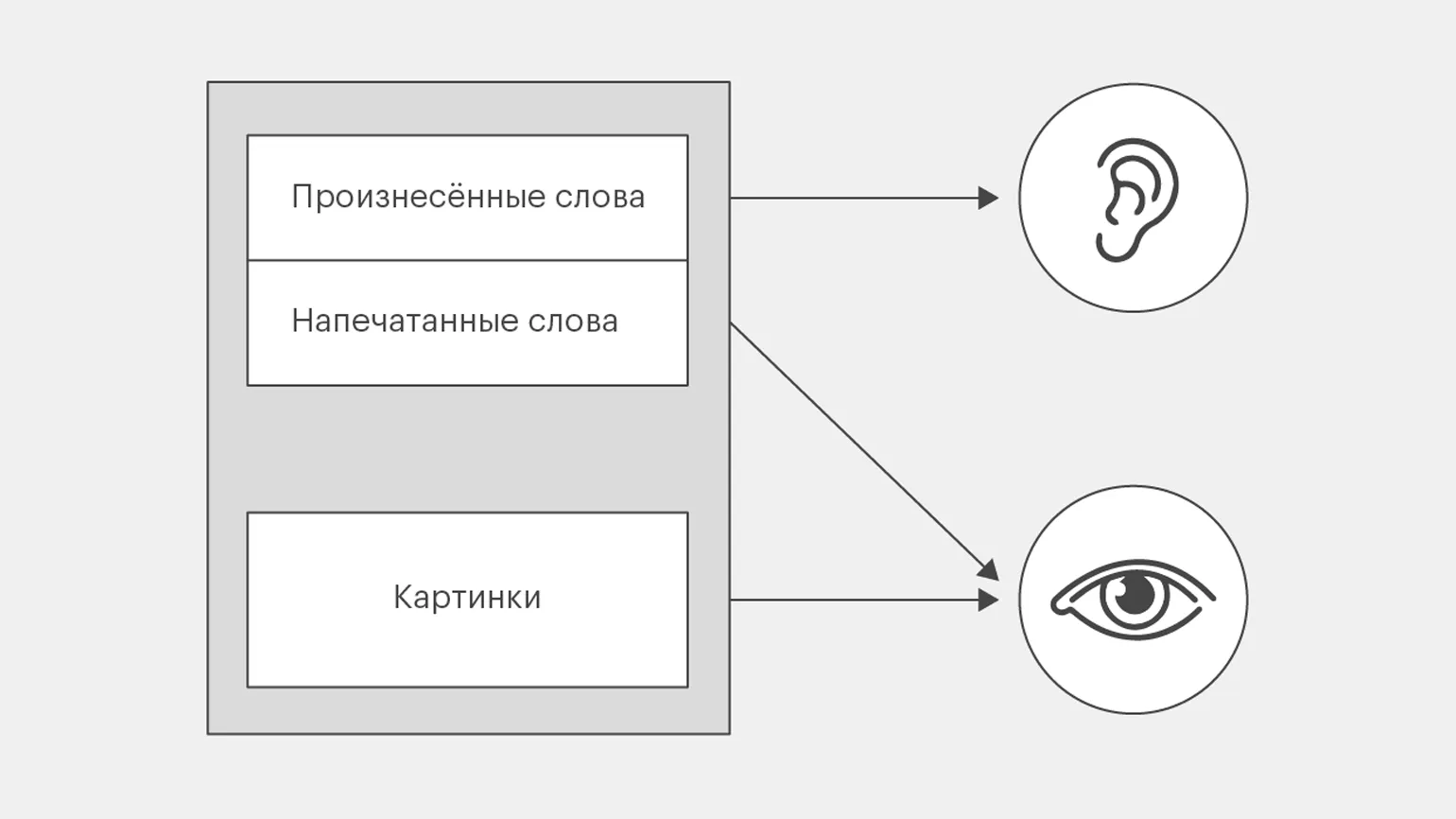
By channels we mean the modalities mentioned earlier. Mayer, like the author of the dual coding theory Paivio, argues that the simultaneous use of visual and auditory channels does not overload short-term memory, but, on the contrary, contributes to better memorization. When information is presented visually with a coherent verbal explanation, it is more easily perceived, and the brain more effectively transfers it to long-term memory. Using combined learning approaches, such as visualization and auditory perception, can significantly enhance the learning process and improve material retention. Mayer emphasizes that verbal information presented in text is perceived not only visually but also auditorily. When you read this article, you not only see the text but also, perhaps, mentally pronounce it. In this case, your auditory canal is as active as your visual one. Therefore, it is important to avoid auditory overload. This means that listening to a verbal explanation is effectively combined with viewing visual materials, such as images and animations, but not with reading the text. Thus, for optimal perception of information, it is better to separate visual and auditory sources.
The brain and working memory can only process a limited number of "cognitive units" of new information at a time. Try reproducing this short paragraph verbatim in a few minutes. You'll find it's a challenging task.
When a person receives new educational information, it enters their short-term working memory. At this point, the brain undergoes active processing: the person filters relevant data from the general flow, organizes it into visual and verbal mental models, and then integrates it with existing knowledge in long-term memory. This process promotes deep understanding and assimilation of new material, which is essential for effective learning.
When a person listens to or watches an explanation of a new topic, their brain is actively working. Multimedia learning materials should facilitate this process, improving information retention and deepening understanding. It is important that such materials are structured and understandable, without overloading the student with unnecessary information. Effective multimedia resources can create an interactive learning environment, where every element contributes to better assimilation of the material and encourages active participation in the learning process.
If the information flow contains many irrelevant elements, this can hinder the learning process. For example, if a presentation includes many brightly colored illustrations that do not facilitate understanding of the topic, this distracts attention. As a result, the brain must expend more resources filtering important information from unnecessary information, which can overload short-term memory. This, in turn, can negatively impact the integration of necessary information into long-term memory. Optimizing the flow of information and minimizing distractions contribute to more effective assimilation of material.
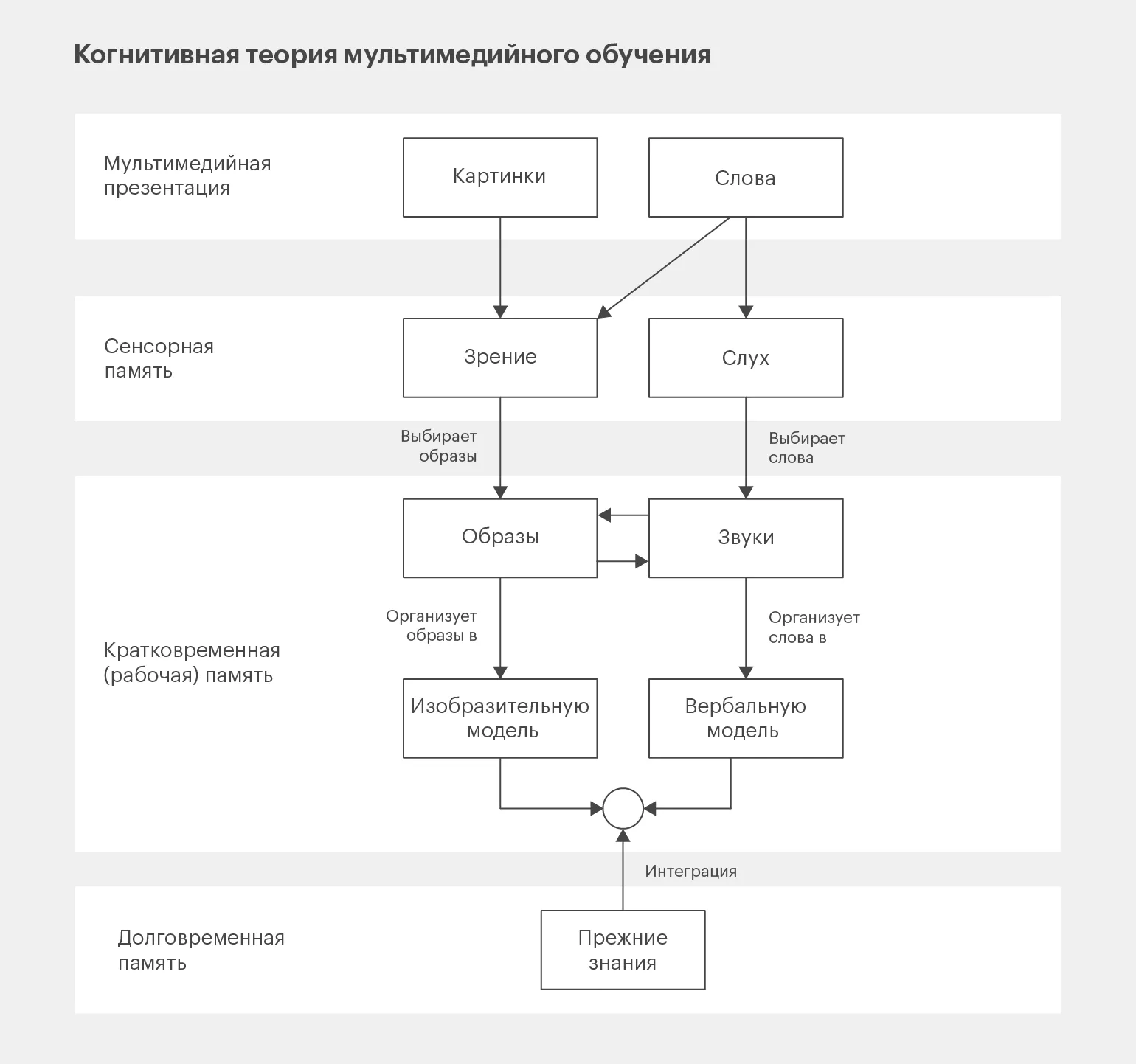
The three main assumptions of Richard Mayer's cognitive theory of multimedia learning formed the basis for the development of applied principles for designing educational content. In this article, we will examine these principles in detail and their application in the creation of effective educational materials.
Why Mayer's Theory Is Not Well Known in Russia
Russian scientific publications actively discuss the theory of multimedia learning, as well as examples of its application in various educational fields. For example, at Tver State University, the principles of multimedia learning developed by Richard Mayer were used to select educational video materials for a foreign language course. At the St. Petersburg State University of Architecture and Civil Engineering, these principles were applied in the development of presentation lessons on foreign languages. These approaches confirm the effectiveness of multimedia resources in the educational process, promoting deeper learning and increasing learner motivation.
In the field of informal online education (EdTech) and corporate training, Richard Mayer's theory of multimedia learning is more actively applied than in traditional educational content for schools, colleges, and universities. Alina Sandarova, Head of Educational Content at Skillbox, noted that the principles of Mayer's theory formed the basis for the creation of educational materials for versions 2.0 and 3.0 of the Skillbox platform. This methodology encompasses various content formats, including longreads and video tutorials. E-learning Center, a company specializing in corporate training, also actively follows Mayer's principles. Elena Tikhomirova, CEO of the company and author of the blog "Living Learning," emphasized the importance of these theoretical foundations for the successful development of educational content. The application of multimedia learning theory enables the creation of more effective and engaging learning materials, which improves information acquisition and increases learner engagement. Multimedia learning theory has not yet been widely adopted in Russian practice, likely due to the lack of Russian translations of Richard Meier's works. As a result, information about his research and findings is available only to a limited number of specialists. They are typically learned about through instructional and didactic design studies, such as courses for online learning methodologists or through professional methodological communities. Disseminating this theory in Russia could significantly improve the effectiveness of educational processes, but this requires overcoming the language barrier and making Mayer's works accessible to a wider audience.
Educational Programs Methodologist
You will go through the full cycle of creating an educational product from scratch. Learn how to design curricula for online and offline courses. Become a versatile specialist – you can launch your own project or get a job as a methodologist at a large company.
Find out more