
Course with employment: "The profession of a Methodologist from scratch to PRO"
Find out moreWhat happened
At the end of July 2023, the State Council of China announced a large-scale reorganization of the educational technology (EdTech) sector. The main goal of this measure is to protect students' rights to leisure, improve the quality of school education, and reduce the burden on parents. Private companies providing supplementary classes in core subjects will be prohibited from making a profit. Furthermore, they will be prohibited from listing on the stock market, soliciting investment, and offering tutoring services on weekends and holidays. This reform aims to create a more balanced educational environment and reduce the financial burden on families.
Chinese authorities continue to actively regulate the supplementary education market, as evidenced by recent measures. In April, the Beijing municipal government fined four major edtech companies—GSX Techedu, New Oriental Education, TAL Education, and Gaosi Education—for "fraudulent pricing" and misleading marketing practices. These actions followed an order to temporarily suspend offline instruction at local tutoring schools. A month later, at a meeting on healthcare and education, Chinese President Xi Jinping criticized the "disorderly development" of the sector and pledged to rectify the situation. In June, the regulator fined another 15 companies, including Yuanfudao, Zuoyebang, and New Oriental Education & Technology Group. These steps highlight the Chinese authorities' desire for stricter oversight of the education sector and greater market transparency. Many experts associate the tightening of regulation in China with government initiatives aimed at increasing the birth rate. In May 2021, Chinese authorities allowed married couples to have a third child. However, the high cost of private tutoring creates a significant financial burden for young families, which, in turn, reduces their desire to have children and hinders demographic growth. In late April 2021, the Financial Times reported that China's population had declined in 2020, now standing at less than 1.4 billion. The following day, the Chinese government denied this information. The demographic situation in the country remains critical, and authorities continue to look for ways to stimulate the birth rate.

It is not in Beijing's interests for a large number of citizens to seek higher education, noted the co-founder and managing director Evgeny Timko, partner at the investment company Xploration Capital, told Skillbox Media. The Chinese economy requires workers capable of working in factories, which is driving the active development of the country's secondary vocational education system. Given the current economic reality, Chinese authorities are focusing on training specialists who can effectively work in the manufacturing sector, which meets market needs and contributes to sustainable economic development.
EdTech is considered one of the most profitable sectors of the economy, but its growth may be disadvantageous for governments seeking to create a more balanced economic structure. According to Timko, this circumstance affects the pace of development of educational technologies and their implementation in the education system. Given the rapid progress in this field, it is important to consider the interests of various stakeholders to ensure the harmonious development of both EdTech and the entire economy.
Prominent investor and founder of the hedge fund Bridgewater, Ray Dalio, argues that the West is mistaken in believing that what is happening in China is due to the Communist Party's pressure on capitalism and financial markets. Specifically, in the education sector, Chinese authorities are seeking to reduce inequality and make educational services more accessible to a wider audience, even if this does not suit shareholders. Dalio emphasizes that such measures are aimed at improving social justice and supporting economic growth in the country.
The reference provides the necessary information and support on various issues. It can include instructions, guides, and frequently asked questions (FAQs), helping users quickly find the information they need. Help is useful for both novice and experienced users, providing access to up-to-date information. Proper use of help facilitates more effective problem solving and improves overall user satisfaction. Updating help content is important to keep it current and in line with new requirements and technologies.
Prior to the COVID-19 pandemic, the extracurricular education sector in China was experiencing steady growth of 10% per year. In 2017, the total market size reached 393 billion yuan (US$61.4 billion), according to a Deloitte report. The pandemic led to the closure of educational institutions across the country, which contributed to the increased popularity of private tutoring among parents dissatisfied with the quality of distance education in traditional schools. Macquarie Research forecasts that China's private tutoring sector could double in size, growing from 619.1 billion yuan ($96.8 billion) in 2019 to 1.17 trillion yuan ($183 billion) by 2023. China's primary education market attracted more than $10 billion in 2020, up 150% from the previous year. The sector accounted for 63% of global venture capital funding in the field, according to EdTechReview.
Market Reaction
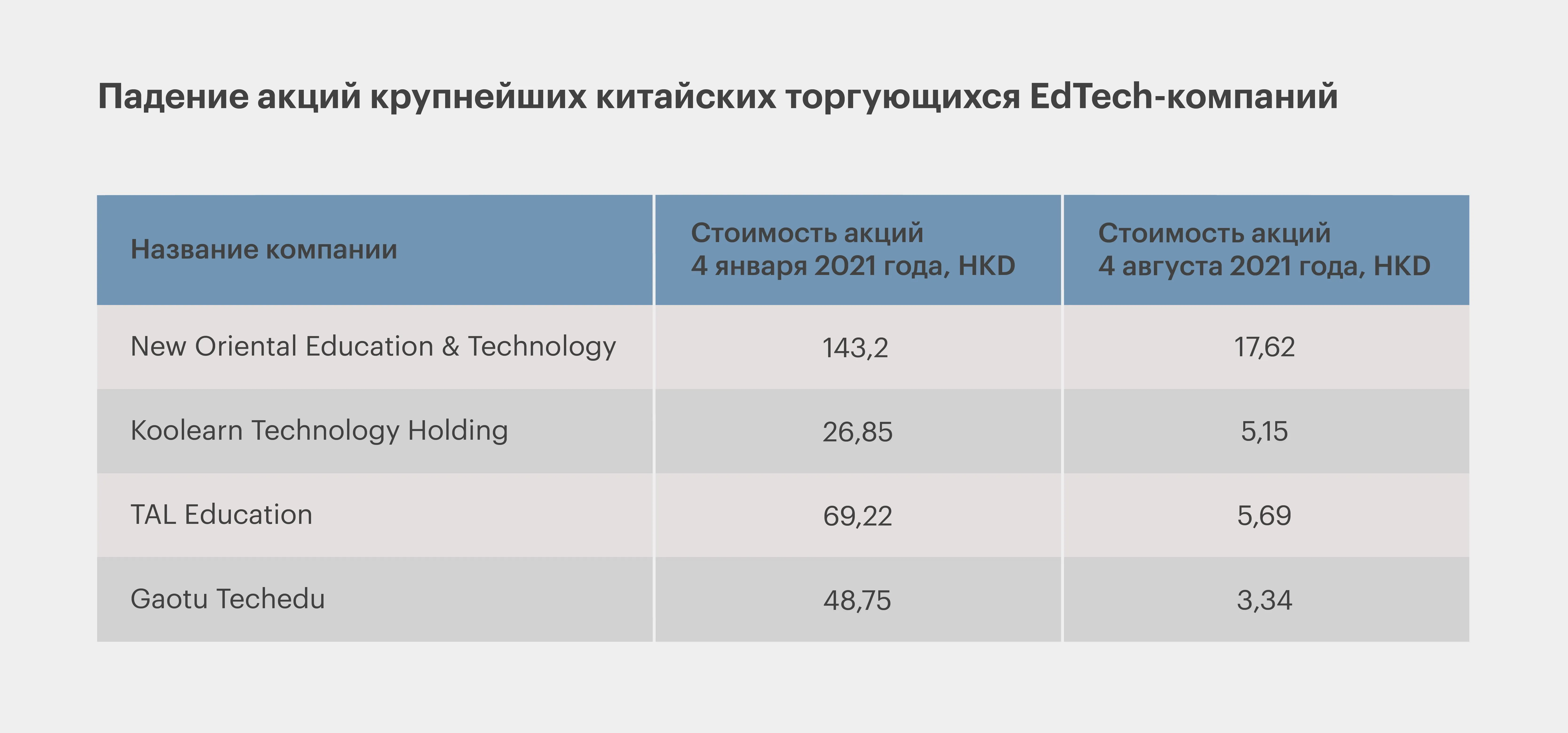
The Chinese government's decision has caused shares of the country's largest edtech companies to plummet. Shares of New Oriental Education have fallen 60% on the New York Stock Exchange since Friday, July 23, when rumors of tighter regulations first surfaced. At the start of trading on July 26, shares fell again by 14%. TAL Education's market value fell from $59 billion in February 2021 to less than $4 billion by August. Gaotu Techedu's market cap declined significantly, falling from $38 billion in January to $850 million. This situation highlights the impact of government regulation on the edtech market in China and its implications for investors.
Goldman Sachs analysts predict that the Chinese tutoring market will shrink by 76%, reaching $24 billion. Bloomberg previously estimated its size at $100 billion, while Reuters estimated it at $120 billion. The regulatory measures adopted will have a significant impact on the entire Chinese economy. Hundreds of thousands of teachers and specialists work in the commercial tutoring industry. Investment in online education has increased significantly during the coronavirus pandemic, and the industry is a significant advertiser for major internet companies such as Baidu and Tencent. For example, TAL Education spent $421 million on marketing in 2020, underscoring the scale and significance of the tutoring sector in China. Given current trends, further regulatory changes in this market could have even more profound consequences for the country's economy and its education system.
An expert from a major Hong Kong-based private equity firm working in the Chinese EdTech industry described the current situation as extremely unfavorable. According to him, the sector will face the need to adapt within three to six months. After this, each investment company will have to re-evaluate its projects to determine which ones should be written off. This process will be an important step for all market participants, given the current challenges and uncertainties.
Implications for International Investors
Recent changes indicate China's growing willingness to restrict foreign investment in its companies. In particular, foreign funds have lost the opportunity to invest in Chinese projects focused on supplementary education for schoolchildren. However, they can retain their stakes if the companies change their focus to a different audience. The new rules apply primarily to extracurricular supplementary education and do not affect adult education or vocational education. This creates new challenges and opportunities for investors in the Chinese education sector.
Chinese EdTech is seeing a significant influx of foreign investment. As of November 2020, 5% of New Oriental's shares were owned by the American investment fund BlackRock, which is also the third-largest shareholder in TAL Education. However, funds that have invested in private Chinese EdTech companies may face the risk of losing their funds if these startups do not go public. This situation highlights the importance of IPOs for raising additional capital and ensuring a return on investment.
The lack of clear deadlines and procedures for foreign investors to exit projects negatively impacts the ability of private equity and venture capital funds to raise funds for investment in Chinese tech companies, according to the Financial Times. This creates market uncertainty and complicates investment planning, which could reduce China's attractiveness as a destination for foreign investors. Given the growing competition in the tech sector, it is important to establish transparent regulations to ensure stability and confidence for investors.
Chinese authorities have taken steps to reassure anxious investors. Shortly after the new rules were introduced, the securities regulator held a telephone meeting with leading investment banks. During the discussion, officials emphasized that the crackdown on private education was aimed at addressing problematic practices in a specific sector, rather than being a general measure affecting other sectors of the economy. This statement, confirmed by Bloomberg sources, is aimed at restoring confidence in the country's investment climate.
On August 3, the Chinese state-run media outlet Economic Information Daily published an article discussing children's addiction to online games. The article described video games as "spiritual opium." The announcement sent shares of major gaming companies such as Tencent and NetEase down more than 10%. This event highlights growing public concern about the influence of video games on young people and could have serious implications for the gaming industry.
Who will win?The challenges facing the Chinese EdTech industry will inevitably lead to investors looking for more stable, albeit less Profitable markets. This was reported by Artem Inyutin, co-founder of the venture fund TMT Investments. In such critical moments, investors often turn to more stable and protected assets, such as the US stock market. It is American companies that most often become beneficiaries in a crisis, the expert noted.
The American company Udacity, with revenue comparable to Udemy and Coursera, is absent from the Chinese market, making its shares in demand during the upcoming IPO. At the same time, interest in another company with ties to China—Udemy, in which China's Tencent invests—has significantly declined recently, as Mikhail Krylov, head of projects in the investment unit of Sistema Capital Management Company, noted in an interview with Skillbox Media.
Faced with losses in China, venture funds will be forced to redirect their investments to countries where online education is growing and the risks of strict regulation are minimal. In this context, particular attention will be paid to the United States and the European Union. Investors will also begin to consider India, where educational projects traditionally compete with Chinese startups for funding. Inyutin emphasizes the importance of these changes for the global venture capital market.
Russian projects will benefit from the current changes as they actively develop their activities in Europe and Asia, noted Alexander Chachava, Managing Partner of the LETA Capital venture fund. These regions are becoming important for Russian companies, which opens up new opportunities for growth and cooperation in the international arena. The dynamics of developing foreign markets contribute not only to strengthening the position of Russian startups but also to expanding their influence in the global economy.
This is an opportunity for international expansion. I am confident that a number of Russian projects, such as Skyeng and Skillbox, have the potential to successfully enter global markets and can replicate the achievements of Russian gaming companies.
Inyutin emphasizes that the share of Russian projects in the global EdTech industry is less than 1%, which is significant. The Russian market in this sector is also characterized by a high level of risk due to current and potential sanctions. However, there are also positive examples. Novakid, an online English school that recently raised $35 million in investment, has received support from both Russian and international foundations. This demonstrates the potential and interest in Russian educational technologies, despite the existing challenges.