

Course with employment: "The profession of a methodologist from scratch to PRO"
Find out moreCompletion Rate (COR) is a key metric and a significant challenge for massive open online courses (MOOCs). Even the most successful courses have low completion rates, typically hovering between 5 and 15 percent. However, if the course certificate is a paid one, this rate can increase: among those who invest in Harvard online course certificates, the attrition rate reaches 50% or less.
Academic publications on learning focus on the dismally low completion rates of courses by graduates and students. Research shows that there are many factors that contribute to dropout, and not just laziness or procrastination. The reasons can range from a lack of motivation and support to problems with time management and social factors. Understanding these reasons is key to developing effective strategies aimed at increasing course completion rates and improving the educational process.
In 2014, researchers from the University of Warwick in the UK identified the main reasons why many students drop out of online courses. These reasons can be divided into two groups: factors related to the quality of the course itself and the personal characteristics of the participants. Understanding these factors can help both course developers and learners improve the effectiveness of online learning and minimize the likelihood of early course completion.
Typical reasons why students do not complete a course can vary. One of the main reasons is a lack of motivation. Often, students lose interest in the material or do not see its practical value. Lack of time also plays a significant role. Many students combine studying with work or other responsibilities, which can make it difficult to complete assignments and participate in classes.
Another important reason is the difficulty of the course material. If a course is too difficult or not suited to a student's level, this can lead to frustration and a desire to quit. A lack of support from instructors or peers can also have a negative impact. Learners who do not receive timely feedback or help may feel isolated and hopeless.
Furthermore, financial difficulties can be a significant barrier to course completion. Students experiencing financial difficulties may be forced to drop out of their studies. It is also important to consider personal circumstances, such as health or family problems, that may distract from the learning process.
To increase the likelihood of course completion, it is necessary to take these aspects into account and create a supportive learning environment where students can receive the necessary help and motivation to achieve their goals.
- lack of time for classes;
- difficulty of the course and insufficient support from teachers and organizers;
- lack of necessary digital skills;
- poor quality of learning materials and forums;
- unreasonably high expectations from the course;
- inability to “catch up” with the course for those who started it late;
- unwillingness to evaluate other people's work or submit their own for evaluation by peers.
There is another approach: some students do not plan to complete the course in full. Some enroll solely to access materials on specific topics, while others do it simply for fun.
Students who complete MOOCs (massive open online courses) are also of interest to researchers. There is a lot of research aimed at identifying the differences between those who successfully complete courses and those who do not.
Characteristics of Those Who Complete a Course
A key characteristic of a student who successfully completes a course is their activity. They regularly study the course materials, complete homework assignments, and check the work of other students. Numerous scientific studies confirm that a high degree of engagement in the learning process has a positive effect on success and course completion. Active participation in learning promotes not only the assimilation of information, but also the development of the skills necessary to achieve the ultimate goal.
Let's explore less obvious aspects. How do learners who successfully complete a MOOC differ from those who didn't?
A study conducted by researchers at the University of Exeter in the UK compared the results of two categories of learners in eight courses hosted on the FutureLearn platform in 2018. Participants were categorized by their level of interaction: sociable and unsociable. This isn't about personality types, such as extroverts and introverts, but rather a simple behavioral trait—a willingness to interact with other participants on the educational platform.
Sociable participants were defined as those who left at least one comment on the learning forum throughout the course. Uncommunicative participants were those who did not make a single comment. The topic of the message did not play a significant role: even students who never discussed the course content but mentioned a technical issue at least once were classified as sociable.
The researchers compared the learning outcomes of sociable and uncommunicative participants.
The number of sociable participants was only one-eleventh that of "silent" participants.
Sociable participants successfully complete more stages in each course. Communication and interaction with other students contribute to better assimilation of the material and increase the chances of successful completion. Active participation in discussions and group assignments helps strengthen knowledge and skills, which is key to achieving high course results.
The "Climate Change: Solutions" course showed that active participants who left comments completed the course successfully at an average rate of 70%, while those who were inactive completed the course at only 32%. This suggests that not all non-commenters are "dead souls" who completely ignore the material. However, among them, there may be a higher proportion of people with low levels of engagement in the learning process.
Communication helps increase participant motivation. Knowing that classmates are facing similar challenges and successfully overcoming them inspires them to continue learning. Research conducted by scientists from the University of Exeter shows that introducing small collaborative activities at the initial stages of a MOOC can significantly improve interaction between participants and create a positive atmosphere for work.
Research shows that communication on MOOC forums has a significant impact on learning success. In 2017, a team of scientists from the United States and Romania analyzed participant comments using natural language processing methods. The results of the study confirmed that students who are actively involved in discussions and whose comments match the communication style of the topic are more likely to complete the course and receive certificates. This underscores the importance of interacting with peers and actively participating in the learning process on MOOC platforms.
Sociability on online platforms, regardless of the topic of discussion, is an indicator of participant engagement. However, when communication is focused on the course topic, this indicates a high degree of engagement. Students who actively participate in discussions related to the course content are more likely to complete the course. Student engagement plays a vital role in the success of their learning and increases the chances of achieving their goals. Online course participants have varying goals. Some do not initially plan to complete a course and are interested in only one specific topic. There are also differences in those who intend to complete the course: for some, obtaining a certificate is an important step to improve their portfolio, while others do not attach such importance to this formal result. Aiming for a certificate significantly increases the likelihood of successful course completion. A certificate not only serves as confirmation of acquired knowledge and skills but can also be an important factor in employment. Participation in courses with certification motivates students to delve deeper into the material and actively participate in the learning process. This drive to achieve results promotes better absorption of information and the development of professional competencies. The terms of the certificate, whether paid or free, matter. Opinions on this issue vary. Some experts believe that the cost of the certificate can influence its perception and value. Free certificates may be perceived as less reputable, while paid options are typically associated with a higher level of preparation and professionalism. However, it is important to consider other factors, such as the quality of the program and the reputation of the issuing organization. Ultimately, the choice between a paid and a free certificate depends on the goals and needs of the individual.
A 2016 review of 236 massive open online courses (MOOCs) from Harvard University and MIT revealed interesting statistics. Only 7.7% of participants applying for a free certificate actually received one. Meanwhile, among those who paid for a certificate, the course completion rate was 60%. These results highlight the importance of financial investment in learning and its impact on student motivation.
The results of this study contradict previous findings. In 2017, researchers from Northern Illinois University and Istanbul University conducted a survey of 779 online course participants worldwide. The study asked respondents about their intentions to earn a paid or free certificate when they started their most recent online course, as well as whether they successfully completed the course.
The analysis found that the intent to earn a free certificate increased the likelihood of course completion by 2.38 times, while the intent to sign up for a paid certificate increased the odds of course completion by 2.79 times. This suggests that the financial aspect does influence course completion rates, albeit modestly.
A 2019 study by researchers at MIT provided more objective data on the relationship between earning certificates and completing massive open online courses (MOOCs). An analysis of data from several courses on the edX platform found that while certificates are most often paid, they can also be obtained for free through marketing promotions or employer support. These findings highlight the importance of certificates as a motivational tool for students seeking to complete courses and improve their skills.
At the high end of the price range, where a certificate costs $3,900, an interesting trend is observed: students who self-funded their studies completed the course 77% of the time, compared to 50% of those who received employer funding. While a 50% completion rate is a relatively high rate for online learning, researchers note that students who had the opportunity to earn a certificate without paying perceived it as a unique opportunity and were eager to maximize their chance.
Research has shown that in some cases, users were able to participate in courses without signing up for a paid or free certificate, simply by listening to lectures. However, those who chose this option were less active and completed the course less frequently than those who received certificates. This highlights the importance of the motivation that a certificate provides, promoting higher levels of engagement and success among learners.
In 2018, researchers from the University of Texas at Austin surveyed 15,000 edX users to identify factors that influence online course participation and completion. Participants were asked about their age, gender, education level, and learning goals. Survey results were combined with data on participants' progress in the courses. Instead of the traditional metric of completion, the researchers assessed the number of course materials and assignments participants started, allowing for a more accurate measurement of their engagement. These studies highlight the importance of understanding the factors that influence online learning success, which can help design more effective educational programs.
Most respondents were taking courses in the humanities, while a third were studying in the sciences. The results of the study showed a variety in academic performance and perception of the material depending on the field of study.
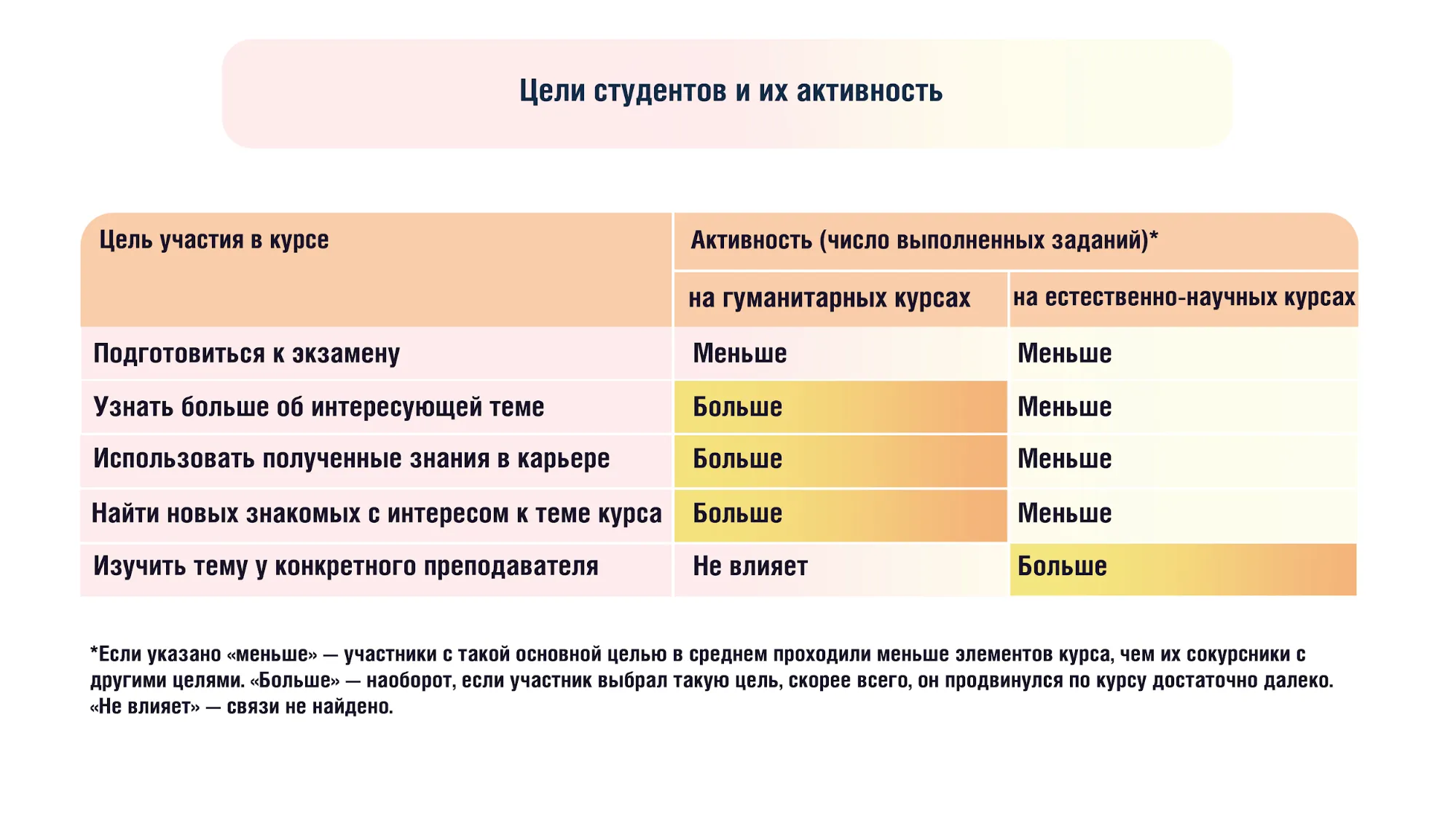
Analysis of the data from the table shows that the researchers found consistent and logical results in the humanities courses.
Active promotion on Humanities courses are aimed at students who already have a basic understanding of the subject and are eager to deepen their knowledge. These participants demonstrate interest in the subject and are open to deeper exploration, which contributes to their development and broadening their horizons.
The results of a study on science courses revealed mixed results. The authors of the study noted that student success in science MOOCs depends not only on their prior knowledge. The question remains: does a student's experience in a given topic actually influence their success, or can novices achieve the same results?
Science courses require students to have prior knowledge, which significantly impacts their success. This is confirmed by a study conducted by the Education Division of the Harvard-Smithsonian Center for Astrophysics. The study analyzed data from 10,000 participants in an online course on exoplanets. Results showed that the level of prior knowledge of the participants was directly related to their success in learning complex scientific topics.
Before the course, all participants took a test aimed at assessing their knowledge of exoplanets and astronomy in general. They also answered questions about their motivations for participating in the course. Upon completion of the course, the test results were compared with attendance and performance data. This revealed a link between motivation and level of material mastery, which may be useful for further improving the educational process.
Research has shown that students with prior knowledge of astronomy drop out of the course less often than those new to the field. This is not related to the level of formal education; therefore, interest in the topic is the key factor. A master's degree in astrophysics is just as likely to successfully complete the course as a recent high school student who has long been interested in amateur astronomy. Interest in astronomy plays a significant role in student motivation and success in studying this science.
The study revealed an important pattern: participants who scored low on the pre-test were more likely to drop out than others. A low score indicates that the participant has significant misconceptions about the course topic, which can negatively impact their motivation and comprehension of the material. Therefore, the pre-test can serve as an indicator of readiness for learning and identify areas requiring additional attention.
Participants without the necessary knowledge have difficulty understanding the issues raised by instructors. Without a basic understanding of astrophysics, students may have difficulty assessing the complexity of studying distant exoplanets. This can lead to misunderstanding of the course materials and difficulties in absorbing the information. To successfully master astrophysics, it's important to have a solid foundation of knowledge, which will allow for a deeper understanding of complex concepts and their relevance to the modern scientific world.
These two patterns highlight that a personal interest in the topic and basic knowledge in the field contribute to successful completion of online courses. At the same time, people who enroll in a course purely out of curiosity about a new topic are more likely to drop out. This underscores the importance of prior preparation and motivation for success in online education.
Researchers from Mexico and Spain have established a link between digital literacy and course completion success. Their work highlights the importance of digital skills for achieving educational goals. The higher the level of digital literacy among students, the more likely they are to successfully complete their courses. This finding highlights the need to develop digital skills in educational systems, which can significantly improve learning effectiveness and student satisfaction.
The digital literacy study was conducted by researchers using a survey. Participants taking 12 different energy courses rated their skills in using the internet and specific digital tools. They also assessed their ability to successfully complete the course on an online platform, find necessary information, and use social media during the learning process. The results of this survey provide valuable information about the level of digital competencies among course participants and can be useful for the further development of energy educational programs.
The study showed that participants who rated their digital literacy as high were more likely to complete the course. Meanwhile, the older group of learners, who reported a lack of information search and online communication skills, demonstrated the lowest completion rate. The study's authors suggest that courses rich in interactive elements require more developed digital literacy skills. Watching video lectures is a simple task, but completing group assignments requires the use of various communication tools, material sharing, and collaboration. This underscores the importance of developing digital skills for successful participation in educational programs.
Learning in open online courses (MOOCs) requires a high degree of student independence. Ksenia Vilkova, a researcher at the Higher School of Economics, notes that successful course completion largely depends on the learner's level of self-regulation. Self-regulated learning includes the ability to manage one's time, set goals, and evaluate one's own achievements, which are key factors for successful mastery of material in an online format. Thus, readiness for self-regulated learning significantly impacts the effectiveness of the educational process in online courses.
A 2019 study analyzed data from more than 2,800 participants in 24 online courses at the Higher School of Economics (HSE). All respondents completed a questionnaire designed to assess their self-regulated learning skills. At the initial stage of the educational process - the preparatory stage - the following skills are important:
- the ability to set clear goals for studying the course (goal setting);
- confidence in one's ability to influence events and achieve results (self-efficacy);
- a sense of the value of learning - simply put, the reason why a person is taking the course.
Clear problem-solving strategies, an active search for help when difficulties arise, and an objective assessment of one's performance are critical for achieving success in the subsequent stages of self-regulated learning. Effective use of these methods promotes increased self-awareness and improved learning outcomes.
The survey results were compared with participants' progress in the online courses. As expected, course completion rates were low, averaging 8%. For a more in-depth analysis, participants were assessed not only by this indicator but also by the number of points they earned in weekly quizzes. Accumulating at least 60 points out of 100 was considered successful course completion for the purposes of this study.
The study showed that the number of quizzes completed and course completion were associated only with the skills developed in the first stage of self-regulated learning—the preparatory stage. This underscores the importance of this initial phase in the process of acquiring new knowledge and skills.
Survey participants who demonstrated high levels of goal setting and self-efficacy, and who also viewed learning as an important value, were more likely to complete the course at a level of at least 60%.
Skills acquired in subsequent stages had no clear connection with quiz scores and were not dependent on full course completion.
Research conducted at the University of Houston in the United States revealed significant differences between students who successfully completed MOOC courses and those who were unable to complete the course. The main indicator that distinguished successful students was higher scores on the goal setting criterion. These results highlight the importance of purposefulness in online learning and can serve as a basis for further research into the effectiveness of educational programs.