
Contents:

Learn: How to change habits and improve Quality of life
Learn moreIt may seem that intensive learning always leads to better results, and that workload is beneficial for the intellectual development of schoolchildren and students. However, in practice, this is not always the case. Often, students receive a large amount of information, but are unable to remember and assimilate it. The reason for this imbalance is the cognitive load theory, which explains how we perceive knowledge and why excessive amounts of study material can be harmful. This theory emphasizes the importance of an optimal amount of information for effective learning, which avoids overload and promotes better knowledge acquisition.
What is this theory?
Cognitive load theory was developed by Australian educator and psychologist John Sweller. In 1988, he formulated the basic principles that should be considered when creating educational programs based on problem-based learning. The central idea of this theory is that students can effectively absorb information only if it does not overload their cognitive resources, which is associated with the peculiarities of memory. This emphasizes the importance of optimizing the learning process to achieve maximum learning results. Sweller built on generally accepted scientific assumptions about the mechanisms of information processing and storage in the human brain. To fully understand his concept, it is important to first understand how our memory functions. Studying the processes of memorization and retrieval of information will help better understand Sweller's main ideas and their application to educational practices. Scientists distinguish two main types of memory: short-term and long-term. Short-term memory, also known as working memory, is responsible for the temporary storage of information that we are currently using. It allows us to process and manipulate data necessary for task completion and decision making. Long-term memory, in turn, is responsible for storing information over a longer period of time. It includes facts, skills, and experiences that we accumulate throughout life. Understanding these two types of memory allows us to better understand how we learn and remember information, as well as how to improve the learning and remembering processes. Working memory. Also called RAM, it is the cognitive system that receives new data, processes it, and stores it for the short term. Working memory functions as a temporary storage of information, allowing the brain to work with it in the moment. It plays a key role in the processes of perception, learning, and decision-making, ensuring the necessary speed and efficiency of information processing. Working memory plays a key role in the process of thinking, reasoning, decision-making, and behavior modeling. However, its capacity is limited. According to research, the amount of information that can be held in working memory at one time varies: some scientists argue that this number is between five and nine items, while others believe that the optimal capacity is even lower – between three and five items. Understanding these limitations is important for studying cognitive processes and optimizing learning.
- Long-term memory.
This system accumulates all the knowledge and ideas learned by the brain, resulting in a significant amount of stored data.
Research shows that information stored in long-term memory is organized into cognitive schemas. These schemas are structures that the brain forms to use data efficiently. For example, the word "restaurant" combines a variety of knowledge: an idea of the restaurant's appearance, the range of dishes, their preparation methods, service features, and the payment process. Thus, cognitive schemas help us quickly navigate the world by structuring and simplifying the perception of information. Schemas vary in complexity: more complex schemas incorporate simpler ones and are formed gradually. For example, learning to read begins with creating schemas for individual letters. As children master the material, these schemas are combined into more complex structures that represent words and sentences. This approach promotes a deep understanding of language and the development of reading skills in children. Automaticity is a key element in the process of skill formation. It develops through extensive training and practice. The more a skill is honed, the easier and faster it is for information to be processed without conscious effort. For example, readers of this article are able to perceive the meaning of written text without much difficulty because their reading skill is developed to the point of automaticity. This allows them to focus on understanding the content rather than on decoding symbols. Developing automaticity in various skills, such as reading, writing, or solving mathematical problems, significantly improves learning efficiency and promotes a deep understanding of the material being studied.
In a joint article with Maastricht University professor Jeroen van Merriënboer, Sweller emphasizes the importance of schemas in the learning process. Schemas perform several key functions, such as organizing and storing knowledge and reducing the load on working memory. Since working memory is limited in the number of elements it can simultaneously perceive, schemas, regardless of their complexity, act as a unified unit, facilitating more efficient information acquisition. Using diagrams in learning can optimize the memorization process and facilitate the understanding of complex concepts.

Revised text:
Study additional materials:
Ten principles of effective learning and teaching, developed by brain researcher John Medina, are based on scientific evidence about how the brain functions and how to optimally use it in the educational process. These principles help improve the absorption of information and enhance the quality of learning.
The first principle is the importance of attention. Successful learning requires that students be focused on the material. The second principle emphasizes that emotions play a key role in memorization. Learning accompanied by positive emotions contributes to better knowledge acquisition.
The third principle states that actively involving students in the learning process significantly increases its effectiveness. The fourth principle emphasizes the importance of context; information is better remembered when it is related to specific situations or examples.
The fifth principle states that repetition is the basis of learning. Regular repetition of information helps to consolidate knowledge. The sixth principle emphasizes that a variety of learning methods contributes to better understanding and memorization of the material.
The seventh principle emphasizes the importance of sleep for the learning process. Good sleep helps improve cognitive function and memory. The eighth principle states that physical activity has a positive effect on mental performance.
The ninth principle indicates that instruction should be tailored to the individual needs of each student. The tenth principle emphasizes the importance of socialization and interaction among students, which promotes knowledge sharing and improves the learning process.
By following these principles, educators can create a more effective learning environment that promotes better learning and retention of information.
What is cognitive load and what types are there?
Cognitive load is the amount of information that must be held in working memory at the same time. Psychologist John Sweller identifies three main types of cognitive load:
1. Conditional load, associated with new knowledge and skills that need to be mastered.
2. Immediate load, which arises due to the complexity of the task or material that must be processed.
3. Automatic load, which occurs when information has already been learned and does not require additional effort to process.
Understanding these types of load helps optimize the learning process and improve material acquisition, which is especially important in educational and professional contexts. Managing cognitive load makes learning more effective, reduces stress, and increases learner motivation.
- Intrinsic cognitive load.
The quality of learning material is determined by a number of requirements. The load experienced by the student depends on the complexity of the concept being studied and their prior knowledge. A topic that may seem difficult for a novice will be simple for an expert, which will affect the effort expended. Success in learning depends on the ability to adapt the material to the level of preparation of each student, thereby ensuring effective assimilation of knowledge.

Changing the workload is impossible, but it can be reduced by using methods that simplify the assimilation of complex information. The principles of "from simple to complex" and "from part to whole" are fundamental in curriculum development and help organize the learning process effectively. These approaches allow students to gradually master the material, which promotes better understanding and retention of information.
- External (extraneous) load.
This concerns the method of presenting new information. External factors are not related to the content of the educational material, but can distract attention from the learning process. For example, mastering a topic becomes more difficult if the teacher explains it in an overly complicated manner, and the structure of subsections within the topic appears chaotic. This can lead to a decrease in learning effectiveness and difficulty understanding key points. For best results, it is important that the presentation of the material is clear and logical, which will help students focus on the subject being studied and more easily assimilate the information.
External load on the student can arise not only from physical factors but also from excessive mental effort associated with studying the material. For example, when a student encounters a diagram, it may take a lot of time and effort to understand its content if they are forced to constantly flip through the pages of the textbook to decipher the data. This significantly increases the expenditure of energy and time. However, if an explanation is provided next to the diagram, the student will be able to absorb the information more easily and quickly, which will improve their learning effectiveness. External factors that contribute to unnecessary load include loud music, road or construction noise, and any other extraneous stimuli that distract from the learning process. These irritants negatively affect concentration and learning, making learning less effective. To improve the quality of learning, it is important to minimize the influence of such factors and create a comfortable environment for concentration. Relevant load. This includes components that facilitate information processing and the formation of schemas in long-term memory. For example, the algorithm a student uses to solve a complex math problem can serve as relevant load. Systematically organizing this load simplifies the learning process and improves memorization. The correct structure and sequence of actions allow students to more easily acquire new knowledge and skills, which in turn contributes to a deeper understanding of the material and its long-term assimilation.

Until recently, it was believed that the three types of cognitive load were cumulative and contributed to the overall cognitive load during learning. However, in 2019, John Sweller, along with colleagues Jeroen van Merriënboer and Fred Paas, published a scientific article highlighting changes in cognitive load theory over the years. These changes highlight the complexity of the interactions between different types of load and their impact on learning effectiveness.
Research has shown that appropriate cognitive load does not increase the overall load on working memory. On the contrary, it promotes the reallocation of memory resources, allowing one to focus on the intrinsic aspects of the task and minimizing the influence of extraneous activities. This shift in understanding the role of cognitive load opens up new opportunities for optimizing educational processes and improving performance.
The scientists reached these conclusions based on numerous empirical studies that have demonstrated that overall cognitive load decreases when extrinsic load is reduced. This is observed even when the external load is replaced with more relevant tasks. These results highlight the importance of optimizing external factors to enhance cognitive performance.
With high cognitive load, due to the complexity of the material and extraneous distractions, students may experience cognitive overload. This condition leads to decreased brain performance: productivity declines, and the likelihood of errors increases. In some cases, thought processes may completely stop, making it difficult to perceive and absorb information. As a result, students experience increased fatigue and stress. Learning under such conditions becomes ineffective and futile. To avoid cognitive overload, it is important to optimize the learning process, take into account the individual capabilities of the student and minimize distractions.
Learn also:
Neuroscience of education: what it is and how it helps in learning?
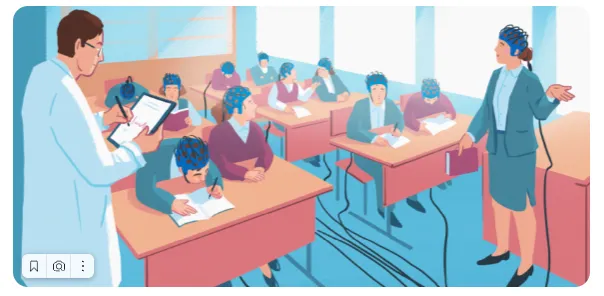
Educational neuroscience is an interdisciplinary field that studies how the brain functions during learning. This field incorporates research from fields such as psychology, neuroscience, pedagogy, and cognitive science. Understanding the neurobiological foundations of learning allows educators to develop more effective teaching methods and tailor them to student needs.
Insights from neuroscience help teachers better understand how various factors, such as motivation, attention, and emotional state, influence learning. This understanding contributes to the creation of a more supportive educational environment where every student can develop their abilities.
Using neuroscience principles in education also opens up opportunities for the implementation of innovative technologies and methodologies, such as neuropedagogy, which focuses on the individual characteristics of students. As a result, the implementation of neuroscientific approaches in the educational process contributes to its increased effectiveness and improved learning outcomes.
Thus, educational neuroscience plays a key role in shaping a modern approach to teaching, providing educators with tools to achieve better educational outcomes and a deeper understanding of their students' needs.
How to Use Cognitive Load Theory in Teaching
Cognitive load theory finds its application in various academic disciplines and topics. Originally developed for the educational process, it has gained wide popularity in other areas, such as advertising, information processing, website creation, and presentation preparation. Understanding the principles of cognitive load allows us to optimize learning and increase the effectiveness of information perception, which is a key aspect in both educational institutions and business. Cognitive load helps determine how best to structure material to avoid overload and ensure knowledge acquisition.
Scientists offer two main recommendations for education specialists. First, it's important to actively utilize modern technologies and innovative teaching methods, which contribute to improved student engagement and higher quality education. Second, it's essential to emphasize an individualized approach to each student, taking into account their unique needs and characteristics, thereby promoting more effective learning. Implementing these recommendations will help create a more productive learning environment and improve student knowledge. Minimize external cognitive load when developing a lesson plan or curriculum. This means eliminating anything that distracts from the learning material. This applies not only to the content itself, but also to its presentation. The greater the external cognitive load, the greater the risk that learning will be ineffective and knowledge will not be absorbed. Redirect students' attention to internal cognitive processes. This means paying more attention to appropriate cognitive load and what promotes schema formation when developing materials.
Sweller and colleagues' recommendations regarding the learning process are important and relevant for students and teachers. They emphasize the importance of active engagement in the learning process, suggesting methods that promote deep understanding of the material. Sweller emphasizes the importance of organizing information, using cognitive load principles to optimize knowledge acquisition. Teachers should design learning materials with these principles in mind to facilitate the learning process and increase its effectiveness. It is also important to create conditions that encourage critical thinking and independent work by students, allowing them not only to retain information but also to apply it in practice. These recommendations will help improve the quality of the educational process and make it more focused and effective.
- Avoid complex and confusing explanations. It's best to break complex topics into small chunks and move on to the next section only when the previous one has been mastered.
- Make explicit references to students' prior knowledge so they can use the cognitive schemas they already have in their long-term memory and build new ones based on them.
- Integrate information from different sources of the same type so students don't have to expend energy searching, comparing, and verifying on their own.
- Reduce the number of distractions. While it's best to use a variety of methods for presenting information, they shouldn't be excessive. Ideally, you should also reduce extraneous stimuli (mobile phone calls, unnecessary images, etc.).

Reworked text:
Also study:
Smartphones at school: rules of use and Restrictions
Modern smartphones have become an integral part of teenagers' lives, including school. However, the use of mobile devices in the educational process is controversial. It is important to clearly define what is allowed and what is prohibited with smartphones at school.
Smartphones can be useful for searching information, quickly accessing educational resources, and interacting with classmates. Teachers can use apps for teaching and increasing student engagement. However, smartphones can be distracting and disruptive to the learning process, so schools establish certain rules.
The use of smartphones during lessons is prohibited unless specifically authorized by the teacher. Taking photos or recordings without permission is also inappropriate. It is important to remember that following these rules will help create a comfortable and productive learning atmosphere.
Thus, the appropriate use of smartphones at school can benefit both students and teachers. However, adherence to established norms and rules is a prerequisite for effective learning.
Sweller, Merrienburg, and their team conducted a series of experiments aimed at studying various teaching techniques and their impact on cognitive load. Their work identified so-called effects, which are a variety of methods that help not only reduce cognitive load but also effectively distribute it during the learning process. These findings have important pedagogical implications and can significantly improve the effectiveness of educational processes.
Let's consider several effects described in cognitive theory. Some of these were already known in the 1990s, while others were added to the updated version of the theory in 2019. These effects play an important role in understanding perception and decision-making processes.
The researchers suggest considering a physics problem: "A car accelerates uniformly from rest for 1 minute, reaching a final speed of 2 km/min. What distance has it traveled?" To solve this problem, the student must break it down into steps and create several equations, focusing on the final goal. Additional subgoals may arise during the solution process, such as determining the average speed to calculate the final distance. This increases the load on working memory, as the student must keep multiple variables and equations in mind while simultaneously thinking about the final result. This approach emphasizes the importance of structured thinking and cognitive resource management when solving problems in physics.

Scientists argue that the situation changes if you eliminate the explicit goal of the problem. For example, instead of the question "How far did the car travel?" you can use the formulation "Calculate the value of as many variables as possible." Since the problem has no specific solution, there are no subgoals. In this case, the student focuses not on finding a single correct answer, but on mastering the knowledge and skills necessary to solve a variety of problems. This allows them to arrive at the same results, but more naturally, without additional "pushes" from the outside. This approach promotes the development of critical thinking and a creative approach to problem solving, which is an important aspect of modern education.
However, it is not a universal remedy, since if the number of possible actions is too large, most of them will not have a positive impact on the learning process.
Sweller argues that studying examples with detailed solutions can be a more effective way to master the material than attempting to solve similar problems independently. This approach emphasizes understanding the principles and methods used in solutions, which promotes deeper learning. Using real-world examples allows students to better navigate complex concepts and apply their knowledge in practice.
After learning the theory, students are required to independently complete problems, which requires significant cognitive effort and can lead to excessive workload. It is important that the transition from theoretical to practical learning be smooth and thoughtful. This will allow students to better absorb the material and reduce stress during the learning process.
While eliminating problems is not advisable, it is important to provide students with plenty of examples to reference when taking their first steps. Practice without available solutions becomes truly beneficial once the material has been thoroughly mastered. In this case, the effort to find answers becomes relevant and brings real learning benefits. Providing students with clear examples and problems promotes a deeper understanding of the material and the development of independent problem-solving skills.
This teaching method is similar to the previous one, but instead of providing a complete, ready-made solution, students are given a partial one. Sweller points out the potential drawbacks of using worked examples: students don't always pay due attention to them or only study them when they encounter difficulties while solving problems. This can hinder a deep understanding of the material and reduce the effectiveness of learning.

When studying an example and solving a problem simultaneously, the cognitive load increases. Using a pre-built solution helps reduce this load, allowing students to focus on key aspects of the task. This is an effective approach that optimizes learning and improves comprehension.
When using multiple sources of information, students must cope with increased cognitive load, which negatively impacts their working memory. The brain must integrate data from various sources, which complicates the information processing. For example, when a student simultaneously studies a graph and refers to individual legends, this can cause confusion. If they see a graph with green and red bars and read the legends, their attention is distracted. To facilitate the learning process, it is recommended to avoid using multiple sources of information simultaneously. In our example, the graph can be improved by integrating the legends directly into its elements, allowing the student to focus on a single source of data and improve information acquisition.
According to the working memory model, the brain processes auditory and visual information separately, using different mechanisms. Joint use of the auditory and visual processors of working memory allows for an increase in the volume of processed data. This approach helps to assimilate information more effectively, which is especially important in educational and professional contexts. Using audiovisual materials can significantly improve the quality of perception and memorization of information.
Hearing two explanations simultaneously means that a person experiences increased cognitive load, which is why they cannot focus on one of them. As a result, they perceive only individual fragments of information. However, if an oral explanation is accompanied by visual materials, this significantly increases the effectiveness of information assimilation. Visual elements help to better organize and consolidate knowledge, which makes the learning process more productive.
When working with educational concepts, it is important to exercise caution. If the material is too complex, using different channels to convey it can create a redundancy effect. This is especially true when information sources are self-sufficient and can be perceived separately without losing their significance. To avoid this, it is necessary to carefully consider the structure and method of presenting information, ensuring its logical and consistent perception.
Sweller and his colleagues describe many effects associated with cognitive load theory. This theory focuses on how human attention and memory influence the learning process. For those interested in a deeper understanding of this theory, several modern examples illustrate its application and impact on educational practices. These examples help to better understand how optimizing cognitive load can improve information retention and enhance learning effectiveness. Interactivity is an important aspect of web design that increases user engagement. Interactive elements, such as buttons, links, and images, create dynamic interactions, making a website more engaging and easier to navigate. Proper use of effects, such as hover animations or color changes, can significantly improve the user experience. Interactivity not only helps retain visitors' attention but also promotes better information comprehension. Elements that respond to user actions create a sense of control and involvement, which can increase website conversion. To achieve optimal results, it is important to consider the balance between visuals and functionality to avoid overloading the interface and distracting from the main goal.
Using CSS and JavaScript to create interactive effects allows developers to implement unique solutions that highlight brand style and characteristics. It is important to test different approaches and monitor user feedback to continuously improve interactive elements.
Learning materials contain a variety of elements that must be learned to fully master the topic. These elements are interrelated, requiring them to be processed simultaneously in working memory. An increase in the number of elements leads to an increase in cognitive load, which is critically important to consider when developing educational programs. Effective training should be organized with these factors in mind to facilitate the process of information absorption and improve the quality of learning.
The reversal effect of expertise is a phenomenon in which experts in one field can unexpectedly demonstrate a high level of knowledge or skill in another, seemingly unrelated field. This can occur due to a deep understanding of the fundamentals of their field and the ability to apply this knowledge in new contexts. This effect is often observed in innovative industries, where cross-disciplinary approaches become key to success. Deploying expertise not only enables new solutions to complex problems but also facilitates the creation of unique products and services. Importantly, developing this effect requires continuous learning and openness to new ideas, which in turn can significantly enhance the competitiveness of professionals and organizations.
Learners' cognitive load is affected not only by the complexity of the learning material and accompanying instructions but also by their level of prior knowledge. When developing training programs, it is necessary to consider the target audience: novices, people with a certain level of knowledge, or experts. This will optimize the learning process and make it more effective by adapting the content to the needs and skill level of learners.
As learners gain experience, individual interacting elements of the topic begin to organize and link into schemas in long-term memory. This means that processing information requires varying amounts of working memory resources. Cognitive load reduction techniques aimed at novices become less effective with increasing experience. Understanding this process allows us to develop more targeted teaching strategies that take into account the level of learners and promote effective learning.
The leadership fade effect is a phenomenon in which management effectiveness declines due to a lack of attention, resources, or motivation from managers. This effect can lead to decreased employee performance and a decrease in the quality of decision-making. It is important to recognize that this situation can occur in both small and large organizations, where leaders lose interest in their responsibilities or are unable to adequately respond to changes in the external environment.
To minimize the fading effect, it is necessary to implement regular performance reviews of leaders, provide them with the necessary resources, and maintain a high level of motivation. It is also important to develop interpersonal and leadership skills in leaders so that they can effectively interact with their team and maintain their engagement.
Understanding and overcoming the leadership fading effect is key to achieving sustainable success and improving the overall effectiveness of the organization.
The training process involves gradually reducing the amount of advice and prompts that students receive as their knowledge of the topic deepens. For beginners, additional information and specific actions, such as studying worked examples, can be very useful. However, as experience is gained, excessive prompts can become burdensome and distract from independent problem-solving. Therefore, it is important to gradually reduce the level of assistance provided, allowing students to develop their skills and confidence.
This principle is especially relevant for long-term educational programs, where students gradually accumulate knowledge in a particular area. This allows them to deepen their skills and understanding of the subject, ensuring more effective learning and preparation for future professional work. Gradual mastery of the material contributes to better assimilation of information and the formation of sustainable competencies, which is especially important in the current context of rapid change in various fields.
The transient information effect is an important concept in the field of data processing and information visualization. It describes how changes in data or visual elements can affect user perception. Transient information helps improve the understanding and perception of data by creating smooth transitions between states or values.
The use of transient information in web design and user interfaces can improve the usability of interaction with resources. This can include animations, color changes, or shape changes that make the process of perceiving information more intuitive and natural.
When used correctly, transitional information can significantly improve user experience, which in turn can increase time spent on the site and reduce bounce rates. It is important to remember that excessive use of animations or effects can be distracting to users, so a balance between visual appeal and functionality is essential.
Incorporating transitional information into web pages and applications can be key to improving their effectiveness and appeal. It makes content more accessible and understandable, which helps users better absorb the information.
When a teacher explains a topic solely orally or using videos and animations, transitional information can occur. This is temporary information that appears and disappears within a few seconds. In this situation, the learner must actively retain the information in their working memory for further processing. This leads to increased cognitive load and decreased learning efficiency. In contrast, non-transitive information, such as written text with illustrations, provides the learner with the opportunity to perceive all the information simultaneously and re-view it as needed. This approach promotes better assimilation of the material and reduces the level of stress associated with learning.
To overcome this effect, it is recommended to provide audio information in short fragments or in text format. This approach promotes better perception of information and increases its assimilation. The use of brief and clear audio messages allows listeners to focus on the content more easily, and written forms of information provide the opportunity to re-refer to the material for deeper understanding.
What is the criticism of cognitive load theory?
In his numerous works accumulated over more than thirty years, Sweller emphasizes that the effectiveness of his methods is based on the results of a significant number of randomized controlled trials. Most of these studies focus on the application of his theory to the teaching of exact and natural sciences, such as mathematics and physics. For example, in the late 1990s, scientists from California conducted experiments that confirmed that the use of well-developed techniques from cognitive load theory leads to positive results in teaching statistical problem solving. These results highlight the importance of using evidence-based methods in the educational process to improve learning effectiveness.

In the field of humanities, it is also possible Research examples can be found, although their number is smaller. For example, a study was conducted in Korea on the impact of using worked examples on English language learning in the context of English Literature. The authors conducted three experiments involving 62, 63, and 129 students for whom English is a foreign language. Students in the experimental group learned to write essays based on prepared, worked examples. The results of the experiments demonstrated the positive impact of this method on the learning process. The researchers noted that the effectiveness of using worked examples increases depending on the level of students' initial knowledge and skills. The lower the level of students' proficiency, the more significant the effect of this approach.
Cognitive load theory raises many questions and criticisms among experts. Some educators point out that studies related to this theory often focus only on short-term results, without providing information on long-term effects. This limitation makes conclusions about its effectiveness incomplete. A more in-depth study of the impact of cognitive load on learning is needed to better understand how it can be used to optimize educational processes and improve learning.
The question of how to measure cognitive load is important for critical theory. It is necessary to determine how much information is optimal for a student's working memory and how much is excessive. Various methods exist, including student self-reports and measuring physiological responses such as pupil size and heart rate variability. However, researchers consider these methods too complex for practical application. This highlights the need to develop more accessible and effective tools for assessing cognitive load in educational processes, which will help improve learning and enhance learning effectiveness.
Each person is unique, and therefore it is inappropriate to rely on general standards. Estimating the workload that a specific student can handle is virtually impossible. While it is possible to determine the limits of a student's working memory in individual work, optimizing educational material for a class of 30 students presents significant challenges. This approach requires careful analysis and understanding of the individual characteristics of each student, which makes the task even more complex.
- Howard Gardner's Theory of Multiple Intelligences
- What is the flow state and how to use it in teaching
- Metacognition methods: how to teach children and adults to learn
- What is the forgetting curve and how to help them remember information for a long time
- 5 TED talks on the role of mental health in education
How to Change Habits and Improve Your Quality of Life
You will learn how to change your lifestyle and achieve your goals with new habits. You will understand how to stay motivated on the path to change and achieve sustainable results.
Find out more