
Contents:

Learn: The Profession of a Methodologist from Scratch to PRO
Learn MoreThe twentieth century saw significant development in pedagogical approaches that link learning with human psychology. Among the most well-known are behaviorism, cognitivism, and constructivism. These approaches remain relevant, but they were developed in the pre-Internet era and do not take into account the impact of modern technologies on the learning process. In the 21st century, a new theory has emerged that can respond to modern challenges and adapt the educational process to the conditions of the digital age.
Connectivism is an approach that explains how computers, the Internet, social media, and other achievements of the digital age are transforming education. This concept emerged in the early 2000s and is based on an important idea: digital technologies connect people and open new horizons for learning. At first glance, this may seem like a simple idea, but behind it lies a complex theory. Connectivism emphasizes that in the modern world, knowledge is not static but dynamic and distributed. Learning is becoming a continuous process, where it is important not only to absorb information but also to be able to find, connect, and apply it in various contexts. This underscores the importance of networking and collaboration in the educational environment, which in turn enriches the student experience and promotes their development.
In this article, we will examine in detail a topic of interest to many readers. We will analyze key aspects related to the issue under discussion and offer useful recommendations. Read on to learn more and get valuable tips on this topic.
- the essence of connectivism and who invented it;
- why another learning theory was needed and how its authors represent knowledge;
- what are the main principles of connectivism;
- why not everyone considers connectivism a real learning theory.
What is connectivism?
Connectivism, derived from the English word "connect", is a theoretical framework for analyzing learning in the digital age. This theory emphasizes the importance of information technology in the educational process, focusing on its role in forming connections between knowledge and information. Connectivism views learning as a process in which knowledge is formed not only individually but also through interaction with other participants in the educational process, which is especially relevant in the context of rapid advances in technology and access to information. Connectivist theory is based on concepts borrowed from mathematics and physics, such as chaos theory, network theory, self-organization, and complexity. These concepts help understand how networks are formed and the connections between them. Connectivism emphasizes network interaction, emphasizing the importance of connections and interactions in the learning process and information exchange. Connectivist theory advocates that learning extends beyond the student's internal activity and can occur externally, in computer systems and databases. According to the concept of connectivism, knowledge is not an exclusively individual property, but exists in interactions between participants, is distributed across a network, and is stored digitally. Thus, learning becomes a collaborative and dynamic process that actively utilizes available technologies to optimize information absorption.
Connectivism conceptualizes knowledge as a distributed network of information. This school emphasizes that learning and understanding occur through interaction with various sources and nodes of information. The importance of network connections and data exchange becomes a key aspect in understanding knowledge. Thus, connectivism emphasizes the interrelations between elements of information, which allows for deeper understanding and adaptation in a rapidly changing world.
Researchers use the terms "node" and "link" to describe how people connect data within a network. A node is an individual element that contains information, while a link serves as a link between different nodes, allowing users to navigate and interact with the data. This interaction forms a complex structure, where each node can be linked to several others, creating a network of interconnections that facilitates access to and analysis of information. Understanding these terms is key to studying networking technologies and their application in various fields, including marketing, social media, and data management.
A node is any object that can be connected to another object. These can include learning communities, people, books, web pages, mobile applications, and thoughts or ideas. The connections between nodes form a network, with each node playing a unique role. Nodes can take many forms, and their interactions create complex structures and relationships. Understanding nodes and their connections is an important aspect in fields such as information technology, social sciences, and knowledge management.
- internal - they are located in a person's mind (for example, their ideas and thoughts);
- external - these are, for example, books and other people.
According to connectivist theory, learning occurs through establishing and maintaining connections between different "nodes" of information. This concept emphasizes the importance of interaction and a networked approach to learning, emphasizing that knowledge is not static but is formed through dynamic connections between information elements. Thus, effective learning requires active participation and information sharing, which facilitates deeper understanding and retention. Connectivism theory was developed by Canadian researcher and learning theorist George Siemens. In 2004, he first outlined his theory on his personal blog, and then in 2005, he published the main ideas in the article "Connectivism: A Learning Theory for the Digital Age." Connectivism views learning as a process based on networked interactions and knowledge sharing in a digital environment, making it relevant to the modern educational context.

Siemens argues that major learning theories, such as behaviorism, constructivism, and cognitivism, treat knowledge as a static phenomenon that is transferred through explanations or practical experience. These approaches emphasize the learning process, but ignore the importance of knowledge itself and the characteristics of its assimilation. It is important to consider that knowledge is not a constant value, but develops and changes depending on the context and experiences of the learner.
Over the past two decades, technology has dramatically changed our lives, ways of communicating, and approaches to learning. Contemporary educational needs and theoretical frameworks explaining the principles and processes of learning must take into account social changes and the context in which we find ourselves. This requires us to reconsider traditional teaching methods and adapt them to new realities so that educational processes are more effective and meet the current demands of society. Siemens emphasizes the need for a new pedagogical approach due to the exponential growth of knowledge in the modern world and the high rate of information obsolescence. In the context of constant data updates, the skills and competencies that are in demand today may lose their relevance in just a few years or even months. This makes it important to reconsider educational methods to ensure they meet the demands of a rapidly changing world. The connectivist paradigm emphasizes the student's ability to acquire new knowledge that may be needed in the future, rather than focusing on existing knowledge. This emphasizes the importance of information search skills and connecting to a variety of sources. The ability to find the right data at the moment of need is becoming a key skill in the modern educational process. Connectivists emphasize the importance of developing the skill of filtering secondary and redundant information. In the context of today's information flow, the ability to filter out unnecessary data and highlight key information is becoming especially relevant. This skill promotes more effective learning and decision making by allowing you to focus on what is truly meaningful and useful.
Connectivism is based on the understanding that decisions are formed on the basis of rapidly changing fundamentals. In today's world, information is constantly arriving, and the ability to distinguish between relevant and irrelevant information is critical. Furthermore, the ability to identify moments when new information changes previously made decisions plays a key role in making informed choices. This understanding helps adapt to a changing environment and ensures more effective use of knowledge.
The researcher emphasizes the importance of corporate training and leadership development, emphasizing that connectivism can become the basis for effective knowledge management and organization. He argues that this approach is capable of connecting the knowledge base with the right people at the right time, which can be considered true learning. Traditional learning theories, in his opinion, are not designed to transmit such knowledge, which makes connectivism an important tool in the modern educational process.
In the knowledge economy, the flow of information plays a similar role as an oil pipeline in the industrial economy. The effective creation, storage, and use of this flow of information is the main factor determining the success of organizational activity. A healthy learning environment within an organization depends largely on the effective management of information flows. This management not only enhances productivity but also fosters innovation, employee skill development, and improved internal communications.
Canadian philosopher and researcher Stephen Downs has had a significant influence on the development of connectivism, becoming one of its founders along with Gay Siemens. Through his research and publications, Downs contributed to the formation of a theory that emphasizes the importance of networking and knowledge sharing in the modern world. Connectivism views learning as a process based on connections and interactions between people and information, making it relevant in the digital age.

According to Downs, knowledge is distributed across a network of connections, and learning consists of the ability to build and cross these connections. This is the basis of connectivism, a concept that emphasizes the importance of interaction and information exchange in the educational process. Connectivism emphasizes that learning occurs not only as a result of individual experience, but also through interaction with other participants in the network, allowing us to create new knowledge and skills.
Downs argues that knowledge can be divided into three categories. Each of these categories plays an important role in understanding and applying information in various areas of life. Understanding these types of knowledge helps to better organize learning and skill development.
- Qualitative - knowledge related to the physical characteristics inherent in an object: for example, its color, shape, and the sounds it makes. A person usually receives this type of knowledge through the senses: what we see, what we hear, and what we feel are all qualities of an object.
- Quantitative - that is, obtained from counting and measurements.
- Distributed or connective - knowledge that arises as a result of the connections between objects and their properties.
The first two types of knowledge, according to the philosopher, have been known to humanity since ancient times and make up a significant part of our understanding of the world around us. The third type, proposed by Downs, reflects the concept of connectivism, which is intended to describe this type of knowledge. Connectivism explores what this type of knowledge is, where it is located, what mechanisms create it, how we study it, and how we can apply it in practice.
Siemens and Downs are like-minded in the field of connectivism, but their emphases differ. Siemens focuses on the social aspects of connectivism, emphasizing the importance of human interactions and network relationships. Downs, for his part, focuses on technical aspects, including the use of modern devices and machine learning. Despite these differences, both researchers make a significant contribution to the understanding of connectivism, considering it a key concept in the age of digital technologies and information networks.

Read Also:
Adaptive learning: concept and necessity
Adaptive learning is an educational method that allows for individualization of learning according to the needs and characteristics of each student. This approach ensures more effective assimilation of material, as it takes into account the level of preparation, speed of information perception, and preferences of the student.
The main goal of adaptive learning is to create comfortable conditions for knowledge acquisition, which is especially important in the context of a variety of study groups and individual learning styles. The use of technologies and algorithms makes it possible to automate the process of selecting educational materials and assignments, which makes learning more personalized.
Adaptive learning is necessary for increasing student motivation and improving results. It helps to avoid information overload, maintains interest in the learning process, and promotes a deeper understanding of the subject. It is important to note that adaptive educational platforms are becoming increasingly popular due to their ability to effectively integrate into various educational systems.
The implementation of adaptive learning in educational institutions opens new horizons for the development and improvement of the quality of education. This is not just a trend, but a necessity in the modern world, where each individual has unique needs and abilities.
The Basic Principles of Connectivist Theory
George Siemens developed eight key principles that underlie connectivism. These principles help understand how learning and knowledge sharing take place in today's digital world. Let's consider them in more detail.
Learning and knowledge are formed on the basis of a diversity of opinions. Different views on the same topic from various sources deepen the understanding of the material being studied. A striking example of this principle is Wikipedia, where articles are created and edited by a wide and free community of users. Each participant can contribute their information and interpretation, which helps expand and update the content. The integrity and reliability of articles are maintained through information verification and peer review mechanisms, making Wikipedia a valuable resource for learning and knowledge acquisition.
Learning is the process of integrating specialized nodes and sources of information. Researchers emphasize that learning in the modern information world means connecting data and its sources and extracting meaning from them. This is not limited to online learning; any source of knowledge, whether a person or a book, is an important part of the overall educational ecosystem. It is important to recognize that effective learning requires active interaction with various sources of information, which facilitates deeper understanding and assimilation of the material.
Learning is not limited to humans. Computers and other devices are also capable of learning from their users. Modern text editors, for example, assist the user in the writing process by remembering their lexical preferences and punctuation features. This allows them to predict in advance which words, expressions, or constructions may be needed. These technologies make the writing process more efficient and convenient, improving the quality of the content created.
The ability to learn and absorb new knowledge is becoming more important than existing knowledge. This principle is closely related to the concept of the half-life of knowledge—the period during which information loses its relevance. Connectivists argue that in the 21st century, this period has significantly shortened compared to previous decades and continues to decrease every year. With rapid technological progress and constant information updates, the ability to adapt and learn new things is becoming a key factor for success in the modern world.
Developing and maintaining professional networks are key factors for lifelong learning. In today's world, to keep knowledge relevant, it is necessary to constantly update and deepen your skills. Establishing connections with educational and professional communities facilitates informal learning, creating opportunities for the exchange of experiences and information. Active participation in such communities not only helps broaden one's horizons but also gains access to new resources and opportunities for professional growth. The ability to recognize patterns and identify connections between different areas of knowledge, ideas, and concepts is an essential skill in the educational process. This skill transforms students from passive consumers of educational content into active participants in their own learning. Developing this skill promotes a deeper understanding of the material and allows for the application of knowledge in various contexts, which, in turn, improves the quality of education and facilitates successful mastery of new topics.
According to a connectivist perspective, the goal of learning is to acquire accurate and relevant knowledge. Connectivism emphasizes the importance of the connection between information and its sources, which allows learners to effectively adapt to a rapidly changing world. In this context, learning is viewed not only as a process of assimilating facts but also as developing skills in finding, analyzing, and interpreting information. Thus, the key aspect is not simply the accumulation of knowledge, but the ability to apply it in various situations, which ensures the relevance and usefulness of the information received.
Decision making is an important learning process. The choice of a subject for study and the evaluation of information received depend on a changing reality. What may be considered the right decision today may prove incorrect tomorrow due to new conditions influencing our choices. This dynamic process emphasizes the need for constant adaptation and rethinking of knowledge, making it a key aspect of personal and professional development.
What are learning networks in connectivism
Learning networks occupy an important place in connectivist theory. Connectivists identify four key characteristics that learning networks should have. These characteristics include interoperability, adaptability, the ability to share knowledge, and support for self-education. Learning networks ensure effective interaction between participants, facilitating collective learning and the creation of new knowledge. In a rapidly changing world, learning networks are becoming an essential tool for developing skills and competencies, making them an important element of the modern educational process.
- Autonomy. Learners should manage their own learning - choosing connections and sources of information, not guided by the traditional educational process. At the same time, teacher control is reduced, and teachers act more as facilitators. Learners gain autonomy over their own knowledge, its distribution, and speed. Connectivity. Connectivism suggests that knowledge is built on the networks of people and computers, so learning occurs when peers are connected and exchange opinions, viewpoints, and ideas through collaboration. Diversity. Teachers are no longer the sole sources of knowledge and experience, and learners should explore opinions, suggestions, and ideas from a variety of sources, including those of other learners. Therefore, connectivists believe that the educational system and its resources should be directed toward ensuring the maximum diversity of materials and views. Openness. Individuals should be able to interact with the learning network at their own pace, interests, and preferences.
Stephen Downes believes that connectivism reflects a pedagogy that seeks to describe, first, successful networks with certain characteristics, and second, practices that facilitate the formation of such networks at both the individual and societal levels. Connectivism emphasizes the importance of interaction and knowledge sharing, which enables the creation of sustainable and productive learning communities. This pedagogical model emphasizes the importance of networked thinking and collaboration in the learning process, which is key to success in the modern world.

Reading is an important part of personal and professional development. It helps broaden your horizons, improve critical thinking skills, and enrich your vocabulary. Reading books, articles, and research papers allows you to gain new knowledge and ideas that can be applied in various areas of life. It's important to choose a variety of sources to gain a more complete understanding of the world. Regular reading also helps improve concentration and memory. Investing time in reading will definitely pay off in the form of new opportunities and perspectives. Networking in an online course is an important aspect that facilitates knowledge sharing and professional networking. For effective networking, it is recommended to create special groups on social media or instant messaging apps where participants can discuss course topics, share experiences, and ask questions. Using video calling platforms such as Zoom or Skype allows for virtual meetings and more personal connections between participants. It is also important to organize interactive sessions where students can present their projects and receive feedback from colleagues. This not only improves understanding of the material but also helps build trust. Additionally, forums and chats can be used to exchange ideas and recommendations, which further strengthens the course community.
For maximum networking effectiveness, it is worth encouraging participation in joint projects or competitions, which will help participants not only get to know each other better but also gain practical experience. It is also useful to include time for informal communication, where students can discuss their interests and professional goals. Organizing such activities helps create a productive and supportive atmosphere, which makes the online course more valuable and memorable.
How Connectivism Views the Roles of the Teacher and the Learner
In connectivism, the learner becomes not only a consumer of knowledge, but also its creator and researcher. Instead of standard problems with ready-made answers, they will face unsolved and complex questions. In conditions of uncertainty, they must be able to identify hidden patterns to find solutions, which requires collaboration with other participants in the educational process. Connectivism emphasizes the importance of interaction and knowledge sharing, which fosters deeper understanding and innovative approaches to learning. Teachers play a key role in the educational process. They are not simply a source of knowledge, but an experienced mentor who is constantly developing and learning. Teachers help their students adapt to society by imparting not only knowledge but also the skills necessary for successful life. Their task is to guide, inspire, and support students on their path to knowledge and self-improvement. In the modern world, teachers become a link that helps students navigate the information flow and develop critical thinking. In connectivism, the traditional roles of student and teacher become less clear. Successful learning and knowledge creation are impossible without taking into account the breadth and accessibility of information in the digital age. The community becomes a key source of content and an important cognitive element that can process, direct, filter, and evaluate relevant information. This opinion is supported by experts from Pepperdine University (USA), emphasizing that in the context of modern education, interaction and collaboration play a crucial role in the process of knowledge acquisition.
How Connectivism is Applied in Education
Connectivism finds its practical application in massive open online courses (MOOCs), which have become increasingly popular in recent years. Most modern MOOCs comply with the basic principles of connectivism, such as interaction between participants, knowledge sharing, and the ability to self-organize. These courses create a learning platform where students can not only receive information but also actively participate in the process, establishing connections with other learners and instructors. Thus, MOOCs serve as a prime example of the implementation of connectivist ideas in an educational environment, promoting the exchange of knowledge and the development of skills in the digital space.
The term MOOC, which is also known as MOOC in Russian, was first introduced by Siemens and Downs. In 2008, they launched an online course called "Connectivism and Connected Knowledge," using this new concept in its description. Since then, traditional MOOCs have been referred to as xMOOCs, while courses based on connectivist principles have been called cMOOCs. This development in terminology highlights the diversity of approaches in online education and opens new horizons for learners around the world.
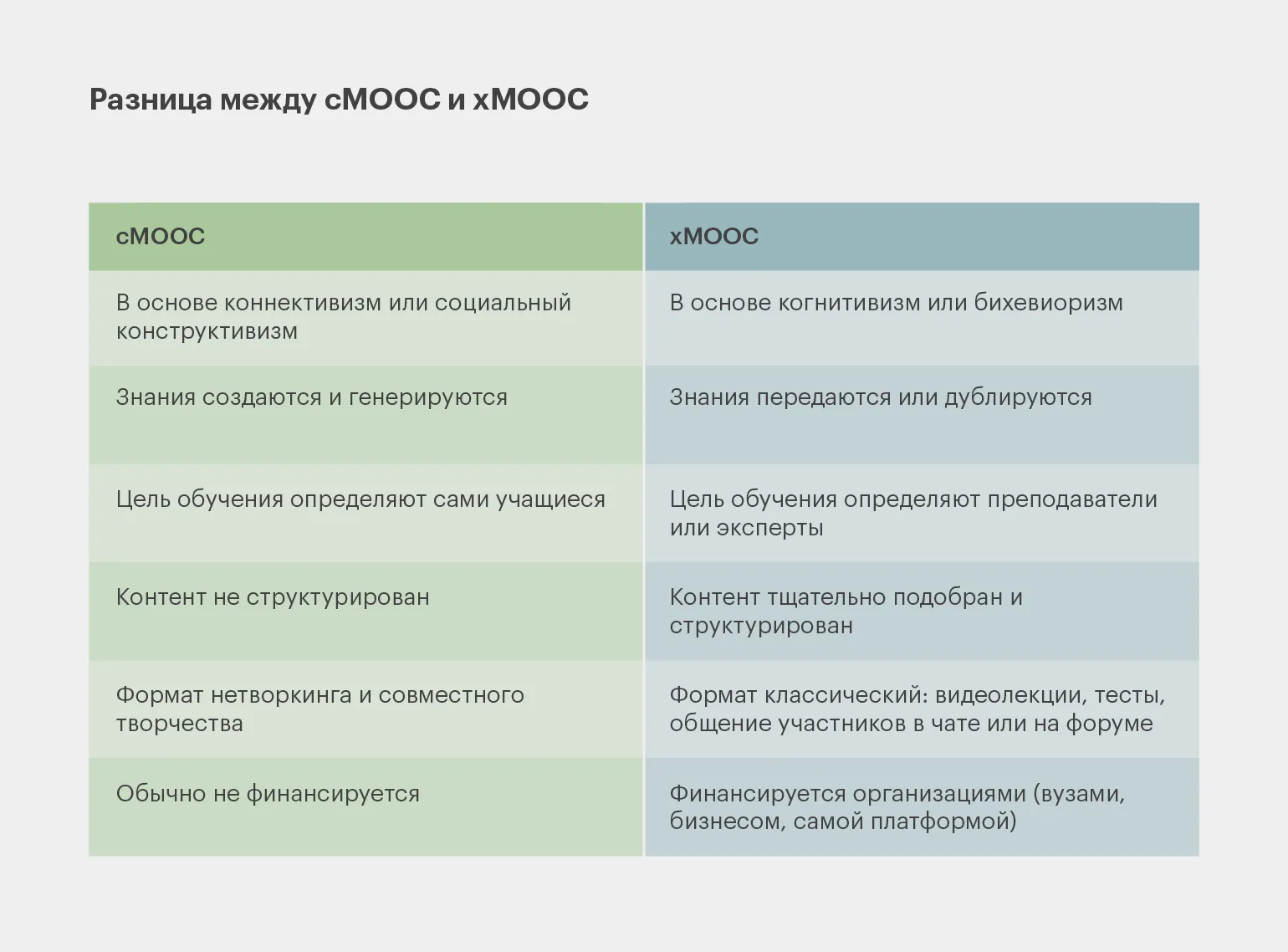
The four principles of connectivism are evident in MOOCs as follows: first, an emphasis on interaction between participants, which promotes the exchange of knowledge and ideas. Second, the use of diverse information sources, allowing learners to discover and integrate different perspectives. Third, supporting learner self-organization and autonomy, which enables each learner to create their own educational path. Fourth, continuous knowledge renewal, which is related to the dynamic nature of the information field and the importance of adapting to new data and technologies. These principles play a key role in creating an effective online learning environment.
- Autonomy: Instructors in MOOCs act as facilitators, but are not the sole source of knowledge in the learning process. Learners are given complete freedom and a choice of technological tools to use (RSS feeds, threaded discussions, blog posts, virtual games, online meetings, and the like).
- Connectedness: Learning occurs primarily on digital platforms, including blogs and social media, that are designed and encourage sharing, interaction, and networking.
- Diversity: Learners can exchange opinions, share knowledge and experiences.
- Openness: Many online courses are free and attract thousands of participants from all over the world, and they often allow students to learn at their own pace and on their own schedule.
Research shows that the learning effectiveness of MOOCs (massive open online courses) increases significantly when participants exchange ideas about learning topics and course content. In one experiment conducted by American researchers involving two thousand students, participants were asked to either share personal information or discuss their ideas about the learning process. The results showed that discussing learning aspects promotes engagement and improves knowledge retention.
Research has shown that learners' engagement increases significantly when they have the opportunity to share their opinions about the learning process. Under such conditions, students begin to view lessons more often and complete more assignments, which in turn leads to improved performance. It is important to create a platform for exchanging opinions to promote active participation and improve learning effectiveness.
You don't necessarily have to create your own online course to incorporate elements of connectivist learning into your curriculum. There are various ways to integrate connectivist approaches, such as using educational platforms, participating in online communities, and using digital tools for collaborative learning. This allows students to interact with each other, share knowledge, and develop critical thinking. It is important to adapt existing methods and resources to maximize the potential of connectivist learning in the educational process.
The main task of the teacher in this approach is to help the student become an active participant in their own learning and personal growth. This includes creating a unique educational experience, developing and optimizing learning connections, and developing independent decision-making skills. This approach promotes not only the deepening of knowledge but also the development of critical thinking and responsibility for one's own learning.
In instructional design, effective learning is achieved through a variety of methods. These include active communication, peer learning practices, the creation of communities and knowledge bases, and providing an open learning environment. It is also important to offer a variety of information sources and different points of view. Project activities, analysis, and evaluation of both the process and its results play a key role in forming a deep understanding of the educational material. This approach promotes the development of critical thinking and collaboration skills in students, which is the foundation of modern education.
Connectivism, as an educational theory, is closely linked to the use of technology. The first step toward creating a connectivist classroom is to expand opportunities for digital learning. This includes the use of online platforms, webinars, social media, and blogs. These tools not only facilitate interaction between participants in the educational process but also enrich the learning experience, allowing students to share knowledge and build connections online. The use of modern technologies in teaching creates a dynamic environment that promotes deep understanding and assimilation of information.
One of the key features of this approach is freedom. Granting students autonomy in their learning activities fosters a sense of belonging and also enhances collaboration and teamwork among them. This approach allows students to develop skills in independent thinking and responsibility, which ultimately has a positive impact on their learning and interactions within the group.
Learning communities are not limited to the traditional "teacher-student" system. They can form between colleagues and researchers, which also plays an important role in professional development. Experts emphasize the importance of such communities for educators. It is important that they are organized according to the principles of connectivism, which implies a desire for self-development, openness, and the creation of a space for the honest exchange of experience and knowledge. Such communities contribute to the improvement of qualifications and the expansion of professional horizons, which ultimately affects the quality of education.

Read also:
Peer-to-peer (P2P), or mutual Peer-to-peer learning is a method of educational process in which participants learn from each other. This approach is actively used in various fields, including schools, universities, corporate training, and online platforms.
Peer learning promotes the development of communication skills, critical thinking, and collaboration. Students and employees can share their knowledge and experiences, making the learning process more interactive and engaging. Furthermore, this approach allows for tailoring training to the individual needs of participants, increasing its effectiveness.
Peer-to-peer learning in educational institutions can be implemented through group projects, seminars, and discussions. In a corporate environment, this method can be used to share knowledge between employees, which helps create more cohesive teams and increases overall productivity.
Thus, peer learning is a valuable tool that promotes not only knowledge acquisition but also the development of social skills, making it an important element of the modern educational process.
Why Connectivism Is Criticized
Since the first publications of Siemens and Downs, their concepts have been the subject of considerable criticism. The main question asked by opponents is whether connectivism can be recognized as a new learning theory. This theory, based on the use of network technologies and social media, offers a fresh perspective on the learning process in the digital age. The debate about its value and effectiveness continues, and many researchers are seeking to find out how connectivism can change traditional approaches to learning.
Some researchers consider connectivism only an alternative view of education, rather than a full-fledged theory of learning. They argue that this concept does not explain the mechanisms underlying the learning process. Furthermore, many of the ideas of connectivists are already known and can be found in other educational approaches, such as constructivism. Connectivism emphasizes the importance of networking and knowledge sharing in the digital age, but its core principles require deeper analysis and comparison with existing educational theories.
Some researchers recognize the influence and potential of connectivism, but believe that it still lacks a significant research base to achieve the status of an independent theory. This is explained by the fact that this theory is relatively young and is still in the process of self-definition, which can create an impression of ambiguity and uncertainty. It is important to note that the development of connectivism requires further study and systematization, which in the future may strengthen its position in the scientific community.
Despite criticism, connectivism continues to actively develop and gain popularity. The use of digital technologies to create learning environments has become standard, especially since the COVID-19 pandemic, which has pushed educational systems to shift from traditional forms of teaching to more flexible and adaptive methods. This approach opens up new opportunities for interaction and knowledge sharing, making learning more accessible and effective in the modern world.
In today's educational environment, the need for a pedagogical approach that takes into account the importance of technology is becoming obvious. Connectivism has the potential to become such an approach and take a key position in the field of education. However, we will only be able to assess its impact and effectiveness over time.
Read also:
- Main learning theories: behaviorism, cognitivism, and constructivism
- Scaffolding: what is scaffolding theory in learning
- What is transformative adult learning
- How do people learn and teach? 20 answers from 2021 research
The Methodologist profession from scratch to PRO
You will improve your skills in developing curricula for online and offline courses. Master modern teaching practices, structure your experience, and become a more sought-after specialist.
Find out more