Contents:
- What kind of engineers does the modern economy need?
- What competencies should engineers have?
- How universities are restructuring the training of engineers?
- What hinders the effective training of engineers?
- Who will teach future engineers?
- "Carrot and stick, otherwise nothing will happen": how businesses can get involved in personnel training?

Learn: Training and Development Manager
Find out moreIn this article, you will get information about:
- what seven groups of engineering specialties are identified by experts and what competencies are most important now;
- is it normal if a future engineer is taught fashionable soft skills, and then he hears: "You are a driller";
- what is the model for adapting the engineering training program to the new needs of the economy;
- what skill must first be developed in university teachers so that they can grow innovative personnel.
At the beginning of June, the acceptance of applications for participation in the federal project "Advanced Engineering Schools" ended. The project is organized by the Ministry of Education and Science, the Sirius educational center and high-tech companies. Within the framework of the initiative, it is planned to create 30 engineering schools on the basis of selected universities. The project's main goal is to train 40,000 specialists by 2030, who are in demand in high-performance economic sectors such as mechanical engineering, nuclear energy, electric and thermal power, as well as the aviation and rocket and space industries. Participation in the project will improve the quality of education and enhance the competitiveness of graduates in the labor market. The project is distinguished by its unique feature – active collaboration between universities and large enterprises. According to the official website, "the instructors will be practicing engineers who regularly improve their skills at high-tech companies." The main goal of the program is to assist graduates in finding employment. This interaction provides students with relevant knowledge and skills necessary for a successful career in the modern labor market.

On The 4th educational conference "We in the Future," organized by Gazprom Neft, discussed current issues related to training a new generation of engineers. Experts highlighted key differences in training approaches necessary for developing qualified specialists capable of addressing modern challenges. They discussed training methods for both young professionals and experienced engineering leaders. Participants also touched on the interaction between higher education institutions and businesses. The discussion, entitled "Engineering Schools of the Future: Integrating Science, Business, and Education to Adapt to Present and Future Challenges," is available on the conference website. We present the key points from the experts, which will help us understand how to change educational practices to effectively train the engineers of the future.
What Kind of Engineers Does the Modern Economy Need?
Russia has always had a need for modern engineering personnel, but in recent years this need has become especially pressing. The departure of foreign technology providers has significantly increased the need for local development, especially in the industrial sector. Given the country's changing economic situation, it is essential to actively develop domestic engineering resources to ensure competitiveness and sustainable economic development. Engineers play a key role in creating innovative technologies and modernizing production processes, making them highly sought after in the labor market.
Moderator Ilya Alyabushev, a federal expert in implementing a systems approach in management and employee teams, initiated the discussion by asking what kind of engineers are needed in the modern economy. Given rapid technological progress and changes across various industries, it is important to identify the key competencies and skills that engineers must possess to meet market demands. This will not only improve the quality of work but also enhance the effectiveness of teams.
Denis Gulin, Director of the Eurasian Polytechnic School of the Ufa State Petroleum Technological University (USPTU), announced the establishment of seven groups of engineering specialties at the institution. This diversity of areas allows students to receive a high-quality education and develop in-demand skills in various fields of engineering. Each group of specialties is focused on the modern requirements of the labor market, which ensures a high level of graduate training. USPTU strives to train specialists capable of solving complex problems in energy, mechanical engineering, information technology and other key industries.
- Research Engineer;
- Design Engineer;
- Project Engineer;
- Process Engineer;
- Operations Engineer;
- Digital Engineer;
- Transfer Engineer.
Denis believes that, based on these categories, it is possible to develop educational tracks and programs, as well as form competency blocks for students. This will allow us to create more structured and effective training that meets the modern requirements of the labor market.

Read also:
It is possible to retrain for another profession for free if you follow several recommendations. First of all, it's worth exploring available online courses and educational platforms that offer free training programs. Many universities and colleges also offer open courses that you can take free of charge.
Also, it's worth paying attention to government programs and initiatives for staff retraining. Some countries offer subsidized courses that can help you master a new profession without financial outlay.
It's also useful to use the resources of libraries and professional communities, which can offer free seminars and master classes. Don't forget about internships and volunteer opportunities that can provide practical experience in a new field.
It's important to actively seek information and be open to new opportunities to successfully transition to another profession without additional costs.
Mikhail Nikulin, CEO of Gazpromneft - Industrial Innovations, emphasized that a clear set of roles is essential for the successful development of industrial technologies. This process begins with idea generation and prototyping, and then continues through to the production stage and implementation of ready-made solutions. This approach ensures the effective creation and implementation of innovative technologies in industry.
What competencies should engineers have?
There are difficulties with the employment of university graduates, even if they have a degree in a sought-after specialty. An important factor is the quality of student training. What skills and knowledge does a new generation of engineer need for a successful career?
Firstly, modern engineers must have deep technical knowledge in their field. This includes an understanding of the latest technologies and trends, such as automation, artificial intelligence, and sustainable development.
Secondly, the ability to work in a team and communicate effectively with colleagues and clients is becoming increasingly important. Projects are becoming more complex, and successful work depends on the interaction of various specialists.
Thirdly, critical thinking and problem-solving abilities play a key role. Engineers must be able to analyze situations and find optimal solutions in the face of uncertainty.
Finally, continuous learning and a willingness to adapt to industry changes are also critical. The next generation of engineers must be prepared to update their knowledge and skills to remain competitive in the labor market.
Therefore, to successfully find employment, graduates need not only to obtain a diploma but also to develop key competencies that meet the demands of the modern labor market.
Mars Khasanov, Director of Science at Gazprom Neft, emphasized the importance of systems engineering thinking. This approach allows for the effective solution of complex problems in the oil and gas industry by integrating various aspects of science and technology. Systems thinking promotes a better understanding of the interrelations between system elements, which in turn leads to more informed and sustainable solutions. In an environment of increasing competition and constant market changes, the use of such methods is becoming especially relevant for achieving the company's strategic goals.
An engineer must possess specialized skills, but there are general concepts, technologies, and approaches in engineering that are united under the term "systems engineering." Knowledge of systems engineering is mandatory for all engineers. Unfortunately, in Russia, this subject is not taught in educational institutions, and many specialists master it only through practical experience, encountering difficulties. Systems engineering has already been applied in complex projects such as the creation of the atomic bomb and the development of the nuclear industry, but its use in other areas, such as road construction, remains limited. Expanding the application of systems engineering across various fields will lead to increased efficiency and improved quality of work in engineering.
The expert identified key knowledge required by engineers, including mathematics, mechanics, physics, and chemistry, as well as artificial intelligence, operations research, and optimization methods. Khasanov also noted the importance of soft skills, such as emotional intelligence, leadership, and passion, which implies an active drive for action and the ability to inspire others. This trend is characteristic of the training of specialists in the technical and IT fields: modern employers are not satisfied with strong hard skills; attention is also being paid to developing soft skills. Regina Karachurina, Head of the Education Development Department at USPTU, announced the creation of the Network Energy University consortium as part of the Priority 2030 program. The consortium has already developed a model of engineering competencies and is currently developing assessment methods. Regina Karachurina emphasized that new assessment tools should consider not only professional competencies but also soft and digital skills. This includes creativity, teamwork, and knowledge of modern technologies. Developing such assessment methods is an important step toward training highly qualified specialists in energy and related disciplines.
Ilya Alyabushev raised the important question of how an engineer with leadership and creativity skills can excel if, at the beginning of their career, they are assigned narrow tasks, such as: "You're a driller. Your job is to drill." This restrictive role can stifle a specialist's potential and prevent them from realizing their full potential. It's important to create conditions that allow young engineers to develop their skills and innovate processes, rather than becoming stuck on routine tasks. This will benefit not only them but the entire industry as a whole, fostering growth and development.
Regina Karachurina noted that during their training and internships, young specialists have the opportunity to work on projects of interest to them under the guidance of experienced experts or their employer. In this process, not only professional competencies but also developed soft skills are particularly important. If the intern proves successful, he has a chance to implement his projects in real production, which will significantly increase his value in the labor market.

Reading is an important part of our lives, which helps to broaden our horizons and improve our skills. It promotes critical thinking and allows for deeper exploration of various topics. Books, articles, and research can enrich your experience and give you new ideas. Regular reading improves concentration and memory, and helps you cope with stress. Don't forget to devote time to reading to enrich your knowledge and improve your quality of life.
Digital intelligence is a set of skills and knowledge necessary for the effective use of digital technologies in various areas of life, including education. With the rapid development of technology and its integration into educational processes, digital intelligence is becoming an essential component of learning.
Modern education requires students to be able to not only work with information but also critically analyze it, create content, and interact with various digital platforms. Digital intelligence includes information management skills, an understanding of the basics of cybersecurity, and the ability to effectively communicate and collaborate in an online environment.
The development of digital intelligence in the educational environment helps students develop the necessary competencies for successful professional careers in the future. In the context of global digitalization, the ability to adapt to new technologies and utilize them in the educational process is becoming a key factor for success. Therefore, the implementation of digital intelligence development programs in educational institutions is a crucial task for improving the quality of education in the modern world. Natalia Shumkova, Deputy Dean of the Graduate School of Business and Director of the Corporate Training Center at HSE, emphasizes the importance of universal competencies for modern professionals. In a rapidly changing labor market, technical skills such as Python programming are not enough. Professionals must understand how their code integrates into the overall digital product and the value it brings to a specific organization. Failure to explain decisions in managerial or accessible language, as well as the inability to analyze the financial impact of their work, can become serious obstacles to career advancement. Competencies at the intersection of various functions are becoming key to successful professional activity in any field. We base our approach on the concept of soft, hard, digital, and managerial competencies. It is important to understand that depending on the level of the manager or specialist, an individual set and scope of these competencies is required. This allows for the optimal development of skills that meet the requirements of a specific position and ensure the effective performance of professional tasks.
She agreed with Mars Khasanov’s opinion on the importance of systems thinking and emphasized that it is critical for modern engineers to develop a client-centric approach and focus on long-term results.

You'll find a wealth of interesting and useful materials on our blog. We regularly update the content to provide up-to-date information on a variety of topics. Subscribe to our updates to be the first to learn about new articles and recommendations. Your attention to our materials will help you stay informed about the latest trends and events.
Read also:
Developing cross-disciplinarity in students is an important task for educational institutions. This quality allows them to combine knowledge from different fields, promoting a deeper understanding of complex problems and improving critical thinking skills. To achieve this goal, it is necessary to introduce projects that require the integration of various disciplines into the educational process. For example, you can organize interdisciplinary seminars and workshops where students can work in teams, combining their knowledge and skills.
It is also important to encourage students to participate in research projects that transcend traditional disciplinary boundaries. Such initiatives contribute to the development of flexible thinking and a creative approach to problem solving. Using problem-based learning, where students solve real-world problems, can significantly increase their interest and engagement.
Furthermore, faculty should actively engage students in research and practical assignments that require the application of knowledge from different fields. This may include joint courses with other departments, which will allow students to see how different disciplines interact.
Thus, developing cross-disciplinarity in students helps prepare highly qualified specialists capable of adapting to a rapidly changing world and solving complex problems.
How Universities Are Restructuring Engineering Training
Students studying to become engineers expect their programs to provide them with relevant knowledge and skills necessary for a successful career. They seek practical experience that will help them adapt to the demands of the modern labor market. It's important for educational institutions to address the needs of students and businesses by providing modern curricula, access to the latest technologies, and internship opportunities. Universities should actively engage with industry representatives to update their courses in line with the latest trends and new technologies. This will allow students to not only gain theoretical knowledge but also develop practical skills that are in demand by employers. Students also value flexibility in their studies and the opportunity to choose additional courses that match their interests and career goals. Therefore, it's important for higher education institutions to adapt to the needs of students and businesses, creating the conditions for training qualified specialists capable of successfully competing in the labor market. Denis Gulin noted that a clear educational trajectory is important for students of all specialties. Students strive to understand the career opportunities available to them after completing their studies, the positions they can expect, and the potential salaries in their field. Understanding these aspects will help them more consciously approach their choice of specialty and career planning.
During their studies, students express a desire to individualize their educational paths and utilize advanced technologies, including pedagogical ones, at universities. They seek a practical approach that allows them to solve real-world problems. Therefore, an important aspect of modern education is the integration of innovative teaching methods that will help students not only acquire theoretical knowledge but also apply it in practice.

To achieve the best results in search engine optimization, it is important to create high-quality content. Pay attention to keywords and phrases that can attract the target audience. Strive for the natural inclusion of these words in the text to improve the visibility of your site in search engines. Use headings and subheadings to structure your content, making it easier for users to digest the information. Remember to update your content regularly to maintain relevance and interest in your resource. Creating unique and valuable content helps build trust with users and search engines.
The Dale Pyramid posits that learning by doing is more effective than learning by theory. According to this concept, people remember and absorb information better when they actively engage in the process, rather than simply receiving knowledge passively. Research shows that the practical application of knowledge promotes deeper understanding and long-term retention. Importantly, a combination of theory and practice can yield the best results in the educational process. Thus, effective teaching includes a variety of methods that allow students to apply theory in practice, which ultimately leads to greater learning success.
The speaker notes that such requirements are relevant not only for bachelor's degree graduates entering master's programs but also for specialists seeking additional professional education. Employers also have similar expectations: they need to quickly find a specialist who easily integrates into their work system and understands how other elements of the team function. This emphasizes the importance of practical training and teamwork skills for a successful career.
Denis Gulin presented a model developed at USPTU for adapting the educational program for engineers in accordance with current economic requirements. The model is presented in the form of a cube with three key axes.
- subject area - for example, oil and gas, chemical engineering, mechanical engineering;
- cross-cutting technologies, such as 3D modeling, big data, prototyping;
- additional skills, which include project management, leadership and goal-setting, technological entrepreneurship, and so on.
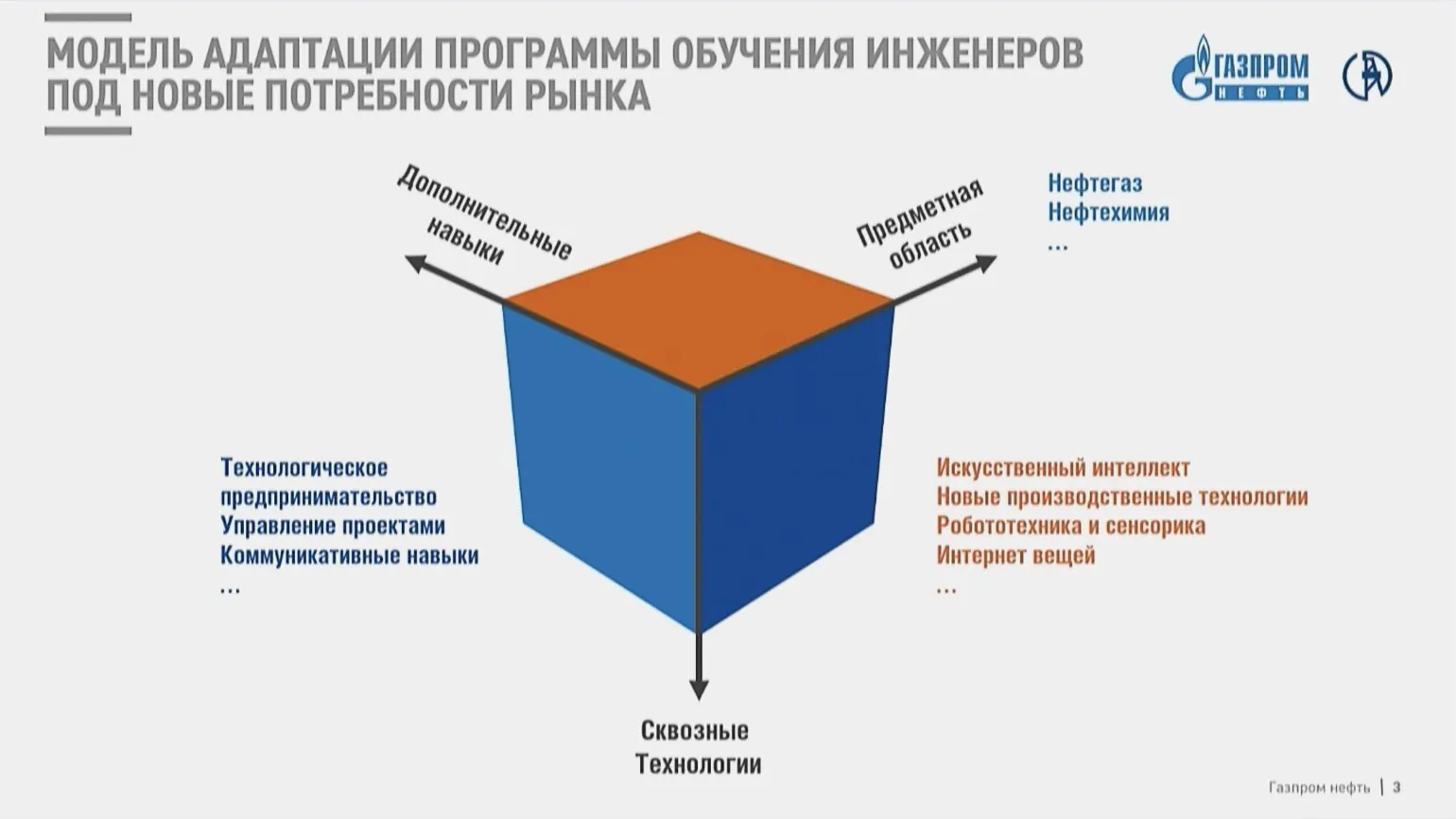
According to Gulin, USPTU is developing new educational programs based on this model. English: Graduates can be roughly classified into three categories:
- engineer-technologist (professes a specific end-to-end technology and can apply it in different fields);
- technological arbitrator (professes a specific technology in a specific field, has deep relevant knowledge);
- systems engineer (covers the entire professional field and all the technologies used in it).
The speaker noted that this model provides the opportunity to develop a diverse set of competencies, and also allows it to be adapted to the needs of each student.
Revised text:
Study additional materials:
Soft skills and hard skills: what is more important for employment?
When looking for a job, it is important to understand the difference between soft skills and hard skills. Hard skills are technical skills that can be measured and assessed. This knowledge, abilities, and competencies, for example, programming, working with certain tools, or knowledge of languages. These skills are often confirmed by degrees, certificates, or work experience.
Soft skills, in contrast, refer to personal qualities and social skills that help you interact with others. These include communication skills, teamwork, critical thinking, and emotional intelligence. These skills are difficult to measure, but they are crucial for successful teamwork and effective task completion.
The question of which is more important for employment does not have a clear answer. Companies are looking for specialists who possess both hard and soft skills. Technical skills enable you to perform specific tasks, while soft skills help you interact effectively with colleagues and clients.
In a rapidly changing labor market, employers increasingly value soft skills because they promote employee adaptability and resilience. At the same time, having hard skills remains a prerequisite for fulfilling professional responsibilities.
Therefore, for successful employment, it is important to develop both soft and hard skills. This will ensure a competitive advantage in the labor market and enable career advancement.
Regina Karachurina emphasized the importance of finding common interests between universities and businesses when developing educational programs. The main problem is that companies focus on their current needs, while universities prepare specialists for the future. To ensure that graduates' knowledge and skills meet employer requirements in five or six years, it is necessary to strategically plan the content of educational programs. This requires a forward-looking approach that involves the active participation of the expert community. This includes representatives of both industrial partners and the university's academic community, who jointly shape a relevant research agenda. This approach will help create in-demand personnel capable of successfully integrating into the changing labor market.
USPTU is actively developing corporate departments, where business representatives and academics from scientific schools jointly create competency models and conduct educational program reviews. According to Regina Karachurina, this allows for better adaptation of curricula to labor market requirements and improves the quality of specialist training. The introduction of such departments promotes deeper interaction between education and industry, which in turn enhances the competitiveness of graduates.
Read also:
An employer in the field of education is not an active participant in the market if It does not provide financial support. The lack of investment from employers reduces the quality of educational programs and limits opportunities for students. It is important for employers to invest in the development of educational initiatives, which contributes to the creation of qualified personnel and improves the overall situation on the labor market. Only with the active participation of employers in the financing of educational projects can sustainable development be achieved and the level of professional training improved.
What hinders the effective training of engineers
In addition to the already mentioned complexity of interaction between universities and businesses, there are many factors hindering the implementation of new approaches to the training of engineers. According to Mars Khasanov, the main problem is the destruction of the public education system that occurred after the collapse of the Soviet Union. This destruction led to the loss of the integrity of the educational process, a decrease in the quality of specialist training, and insufficient funding for educational institutions. As a result, universities are unable to adapt to rapidly changing labor market demands and emerging technologies, making it difficult to train qualified engineers capable of working effectively in a modern business environment.
The problem lies in the existence of the Russian management model, which also encompasses the education system. A key aspect of this model is centralization. As a result, the state has been effectively excluded from the educational process, and society has failed to assume this responsibility, as Russia, unfortunately, lacks organization at the societal level, and the market does not function properly. Returning to the state's previous role in education is likely impossible. However, large companies, such as oil corporations, must take the initiative in creating an educational system that addresses not only their own needs but also the interests of the entire country.
The second problem, according to the expert, is that radical changes lead to the loss of the valuable elements of the old systems. Mars Khasanov expressed concern that abandoning the Bologna process could lead to a repetition of previous mistakes: "They could once again destroy what has already been achieved."
The speaker also emphasized the excessive emphasis on theoretical training and identified the problem of a lack of a systematic approach to education. He noted the importance of explaining to students the significance of various sciences, teaching through practical examples, and posing complex problems. This approach will help students better understand the material and connect theory with the practical aspects of their future professional work.
The key aspect is that the process of developing and implementing educational programs is aimed at quality and effectiveness, and is not simply a formal event. This will create real conditions for the successful training and development of program participants, ensuring their relevance and compliance with modern requirements.

Read also:
"You're going to give birth": barriers that prevent girls from entering Engineering and IT
In today's world, women's roles in technology and engineering continue to expand, but many girls face biases and stereotypes that hinder their career advancement in these fields. One common phrase young women hear is "You'll go and have a baby," which implies that their future in the profession may be limited by family obligations. Such attitudes create psychological barriers that discourage girls from choosing a career in engineering and IT.
Furthermore, a lack of role models and mentors in these fields also plays a significant role. When girls don't see successful women in engineering and IT, they find it more difficult to envision themselves in these professions. This leads many of them to choose more traditional specialties that are considered more "feminine."
It's also worth noting that educational institutions and companies must create a more inclusive environment to attract and retain women in technical professions. Internship programs, community support, and actively promoting women in STEM can help make a difference.
Overcoming barriers faced by girls in engineering and IT is an important step toward creating a more equal and diverse world of technology. Eliminating stereotypes and creating a supportive environment for women in these fields will open up new opportunities and help realize the potential of future generations.
Who will teach future engineers?
Training highly qualified specialists requires highly qualified teachers. It is important to find ways to close the gap between university education and real-world challenges in industry. This can be achieved through the implementation of practical courses, collaboration with companies, and updating curricula to meet current labor market demands. Teachers must be actively involved in professional activities to impart up-to-date knowledge and skills to students that meet industry requirements. Furthermore, it is important to develop a system of internships and practicums, which will allow students to gain real-world experience and better prepare for their future careers.
Regina Karachurina again emphasized the need for universities to adapt to labor market demands and promptly inform faculty about ongoing changes. She noted that not all teachers are prepared for such changes, as insufficient attention is paid to change management skills. Developing these skills in teachers is a key task for the education system, as it will help improve the quality of education and prepare students for modern challenges.
Natalia Shumkova noted the importance of continuous development for teachers within the framework of the lifelong learning concept. Without this, they will not be able to effectively prepare students for a rapidly changing reality. Continuous learning and adaptation to new conditions are key factors for success in the educational process.
It is important to consider that teachers have a variety of competencies and occupy various roles in the educational process. As Shumkova noted, the Graduate School of Business has developed three career tracks for faculty, allowing them to develop in their chosen professional field and deepen their knowledge. These tracks provide the opportunity for flexible adaptation to changes in the educational environment and contribute to improving the quality of education. Academic track — for scientists who conduct fundamental research and publish in scientific journals; Practical track — for experts with significant managerial, professional, and entrepreneurial experience; Methodological track — for faculty who develop educational technologies and solve complex methodological problems. src="https://blog.skillbox.by/wp-content/uploads/education/rektor-obyazan-kazhdye-pyat-let-otpravlyat-professorov-rabotat-na-proizvodstve/81e04b51960449239020e2bc3777a01e.webp" class="attachment-full size-full" alt="" decoding="async" />
Read also:
The quality of an educational program cannot be assessed without taking into account the abilities and methods of teaching. The effectiveness of the program directly depends on the level of professionalism and pedagogical skills of the teacher. Thus, to fully evaluate the educational process, it is necessary to analyze both the program content and the approaches used by the instructor to implement it.
"Carrot and stick, otherwise nothing will happen": how businesses can get involved in personnel training
Regina Karachurina and Mikhail Nikulin discussed the importance of corporate master's programs, competence centers, and corporate universities created at universities. The speakers noted that such initiatives contribute to the timely updating of educational programs, which, in turn, meets the current demands of the labor market. Such projects help integrate theory and practice, providing students with access to relevant knowledge and skills necessary for a successful career.
Nikulin emphasized the importance of businesses providing universities with real-world cases and projects that students can use as a basis for training. By working on such problems, future engineers will gain practical experience in technology, economics, and manufacturing. This will allow them to systematize their knowledge and develop the necessary professional skills, which in turn will increase their competitiveness in the labor market.
The speaker emphasized that the interaction between business and education begins at the strategic planning level. Companies incorporate the integration of new technologies, materials, and products into their strategies, which serves as the basis for the formation of a personnel development system. At this stage, organizations select appropriate tools for training qualified specialists, which contributes to the effective development of the business and increased competitiveness.
Mars Khasanov emphasizes that many ideas appear much simpler in words than in practice. Implementing plans often faces numerous complexities and nuances that are not always obvious at first glance. This difference between theory and practice requires in-depth analysis and careful preparation to successfully overcome emerging challenges.
To develop an effective strategy, the CEO or president of the company must make the decision to implement it. However, this requires a certain amount of pressure or motivation. In our country, where state-owned companies play a significant role, it is necessary to introduce mandatory measures for the implementation of strategies. Incentives should be developed in the private sector, for example through tax breaks. This will create conditions for companies to actively work on strategic plans. Regarding higher education, university rector should send their faculty on internships at manufacturing companies every five years, which will help them gain practical experience. It is also important to provide financial compensation for such activities. A combination of mandatory measures and incentives is necessary to achieve results. Natalya Shumkova noted that educational products always have their customer—the market. At the Graduate School of Business, an academic council consisting of 7-10 top managers from leading Russian companies has been established for each of the 20 undergraduate and graduate programs. These experts are interested in ensuring that graduates receive a high-quality education and meet the demands of the modern labor market. Business leaders actively participate in the educational process, inviting students for internships. Many student projects move into the implementation phase, allowing companies to identify and evaluate talented young professionals at an early stage. As a result, they can offer them permanent employment, which contributes to the formation of a highly qualified team and business development.
Read also:
- Who is a DevOps engineer: a programmer, a system administrator, or both?
- How to teach students and young employees team skills?
- New competencies for teachers: why and how universities are implementing pedagogical design?
- "Artificial Intelligence in Education", Wayne Holmes and others.
- How the government and business are trying to solve the problem of personnel shortages.
Training and Personnel Development Manager
You will learn how to build corporate training programs for employees and evaluate their effectiveness. You will be able to start a career in the HR department and implement a working personnel development system in the company.
Find out more