
Contents:

Learn: Profession Methodist with from scratch to PRO
Learn moreEven though methodologists do not require knowledge of marketing and product management, they need to conduct research. This is especially important when developing extensive courses for mastering new professions and specialties. In this article, we will consider the key aspects of creating such courses and methods that will help methodologists cope with this task effectively.
A methodologist conducts research that is not product-based in the traditional sense. It focuses on aspects that influence the content and structure of the curriculum. Preliminary analysis will allow you to develop a course that meets the needs of both future students and the requirements of the labor market. This approach ensures the relevance and competitiveness of the educational program, which in turn contributes to the successful training of specialists.
Before starting to develop a program, a methodologist carefully analyzes the needs of the target audience and defines the main goals and objectives. It is important to conduct research to understand what knowledge and skills users need. The methodologist also develops the program structure, including key topics and content, and selects appropriate teaching methods. Taking into account modern trends and technologies, he or she adapts the program to improve its effectiveness and attractiveness. An important stage is the development of a detailed plan, which includes the timeframe and resources necessary for the successful implementation of the project. This approach contributes to the creation of a high-quality educational program that will meet the needs of students and ensure high learning outcomes.
- analyzes the scope and topics of the course, vacancies in the profession it is dedicated to, and competitors' products;
- segments the target audience (TA);
- formulates course objectives and hypotheses of educational outcomes.
As a result of this work, it is possible to create a draft competency map, as well as formulate hypotheses regarding the unique selling proposition of the course, its objectives, and expected results. Primary attention should be paid to forming an understanding of the target audience and its needs. This will allow us to more accurately adapt the course to student needs and increase its attractiveness in the educational services market.
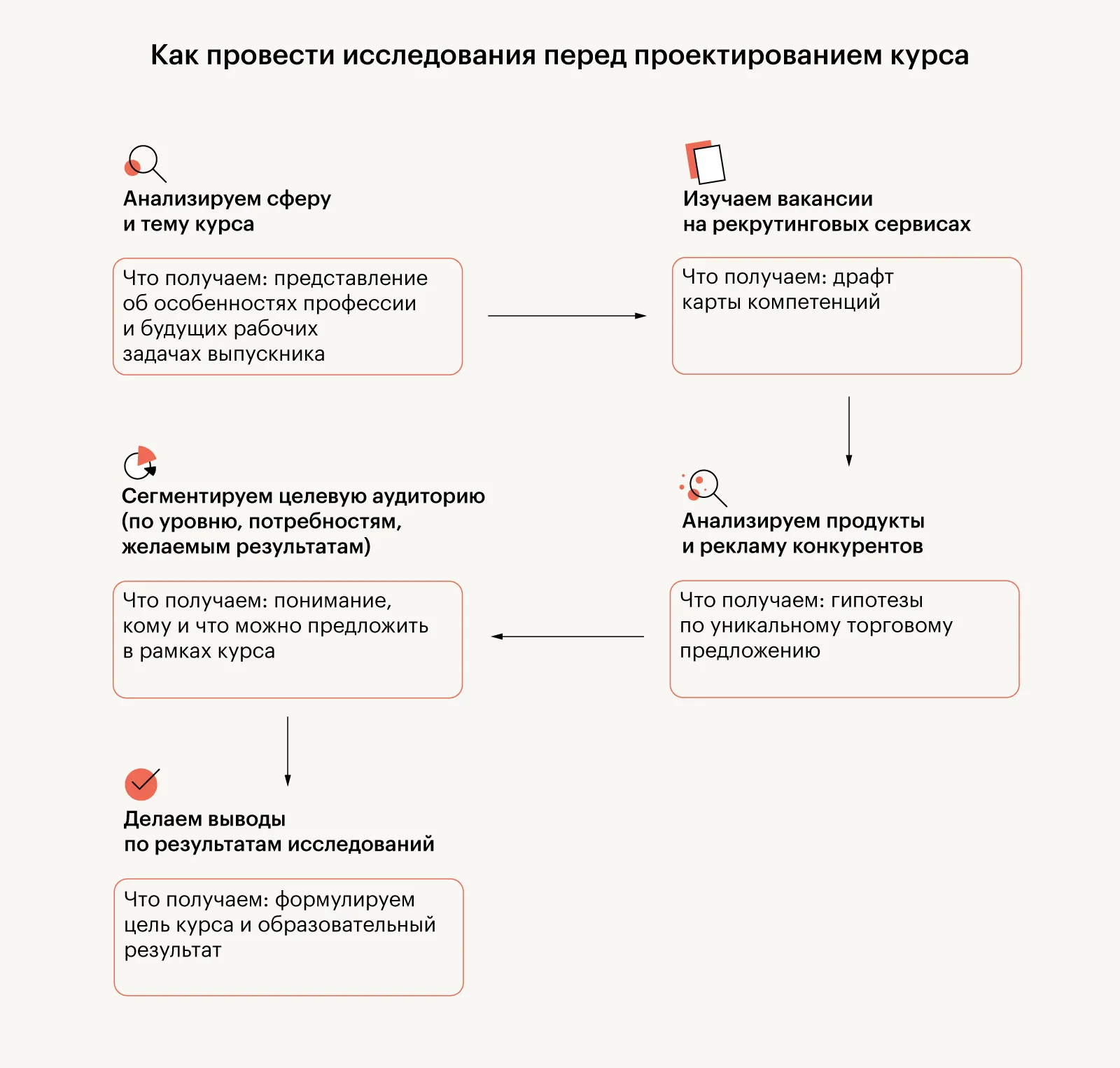
These steps will help you clearly define the program content and design methodology. A deeper understanding of the topic will streamline the workflow and significantly improve interaction with the expert, which will positively impact all aspects of your project.
Let's examine each stage of the research in more detail, using a sommelier course as an example. In this course, students explore key aspects of winemaking, tasting, and pairing wines with food. The course emphasizes developing skills in analyzing and evaluating various wine varieties, enabling future sommeliers to become experts in their field. Each stage of the course includes theoretical lessons, practical tastings, and interaction with professionals. This allows students not only to gain knowledge but also to learn how to apply it in practice, which is an important aspect of training qualified sommeliers.
Analysis of the Course Topic
The purpose of this study is to determine what responsibilities the graduate will be burdened with, what tasks he or she will solve, and what role he or she will take in the team. This will provide a better understanding of the professional prospects and the integration of the graduate into the work environment, which is an important aspect of a successful career.
To successfully master the course, it is necessary to thoroughly study the available resources on the relevant topic. This will help deepen your knowledge and better understand the material. It is recommended to familiarize yourself with a variety of information sources, including textbooks, articles, and video tutorials. This approach will not only improve your understanding of the topic but also prepare you for the practical application of the knowledge gained.
This research stage is often ignored, which is a mistake, especially for novice methodologists and those who are unfamiliar with the course topic. For example, you may have only a general understanding of the sommelier profession: a specialist who tastes and understands wine. However, it's important to delve deeper into the topic to gain a more complete understanding. Research will help you identify key aspects of the sommelier's work, their responsibilities, and their role in the industry. This knowledge will form the basis for further study and will help you better prepare course material.
Analysis of the topic involves interacting with two main types of information sources: primary and secondary. Primary sources are original materials, such as research, interviews, and surveys, that provide direct data. Secondary sources, in turn, involve the analysis and interpretation of primary data, such as scientific articles, books, and reviews. Effective use of these sources allows for a deeper understanding of the topic under consideration and the formation of informed conclusions.
- Professional forums. This includes large platforms (for example, vc.ru and habr.com), thematic Telegram channels, and blogs of subject-matter experts on social media. They clearly demonstrate the work of the specialists in question, the problems they solve, and the challenges they face.
- Academic articles. These can be found in Google Scholar or on the websites of scientific libraries and some universities. For example, in CyberLeninka and the National Electronic Library. Publications will help determine the qualification criteria for a course expert and gain a deeper understanding of the specifics of their work.
At this stage, it is important to understand how different interpretations of the profession can influence your choice of course. For example, if you are interested in a course on targeted advertising, having at least a basic knowledge of the work of a marketer will significantly simplify the learning process. However, with a course for project managers, the situation is more complex, since their responsibilities vary depending on the specific industry. In this case, an in-depth study of the specifics of the profession is necessary to successfully master all the nuances and requirements.
It is important to pay attention to the job titles of specialists in the field of interest. In the educational community, there's ongoing debate about the differences between methodologists, methodologists, and instructional designers. For example, in a corporate environment, employees with the same functions may be called "methodologists," while in universities, they're called "instructional designers." Similar confusion can arise in other professions as well. Understanding these nuances can be helpful in subsequent stages of research.
We're exploring a course for beginning sommeliers. At the outset, this topic may seem obvious: a sommelier is a restaurant specialist who helps guests choose wine. They must be well-versed in wine, have excellent communication skills, and be able to recognize subtle notes, such as oak in the finish. However, this understanding is incomplete. A sommelier is more than just a consultant; they are a professional who combines knowledge of wine with the ability to create a unique experience for guests. It's important to note that a sommelier also contributes to the restaurant's wine list, conducts tastings, and trains staff, making their role more multifaceted and meaningful.
Analysis of the topic reveals that a wine specialist is sometimes called a cavist. The main difference between a sommelier and a cavist lies in their scope of work: a sommelier serves customers in restaurants, while a cavist advises buyers in wine boutiques. Furthermore, a sommelier isn't limited to wine; they also taste other alcoholic beverages. This detail, at first glance, may seem unimportant, but it plays a vital role in defining the target audience and focusing the topic, which significantly affects the quality of the information provided.

Learn more:
Launching an online course can be a successful endeavor if done correctly approach the process organization. To begin, it is important to define the target audience and understand which topics will be most relevant and in-demand. Market research will help identify the needs of potential students and tailor the course to their needs.
The next step is to create high-quality content. Courses should be informative, structured, and engaging. Using a variety of formats, such as videos, text materials, and interactive assignments, will increase student interest and engagement.
Choosing a platform to host the course is equally important. There are many options, from specialized platforms to creating your own website. When choosing, consider functionality, user experience, and opportunities for course promotion.
Once the course is launched, it is necessary to actively promote it. Effective strategies include the use of social media, content marketing, and email newsletters. Building a community around the course will help maintain student interest and engagement.
Finally, it is important to collect feedback and analyze the results. This will allow you to make timely changes and improvements to the course, which, in turn, will increase its value and student satisfaction. With the right approach, launching an online course can become not only successful but also a profitable business.
Job Analysis
The purpose of this study is to identify the key competencies and knowledge required by a specialist in a specific field. This will allow us to develop a preliminary competency map, which will subsequently help in systematizing and assessing professional skills. Identifying the necessary skills and knowledge is an important step in developing a highly qualified specialist capable of effectively solving problems and achieving goals.
For a successful job search, it is important to analyze job openings on major and specialized online recruitment platforms. This will help identify relevant offers that match your skills and labor market requirements. During the analysis, pay attention to the keywords used in job openings to optimize your resume and cover letters. In addition, studying the specifics of job openings will help you understand which skills and qualifications are most in demand in your field. Don't forget to also analyze salary levels and working conditions to make an informed choice in favor of a particular vacancy.
Researching job postings is an important step in labor market research, as a specialist who has completed the course must meet the required requirements. Analyzing current job postings helps identify the necessary skills and competencies valued by employers. This allows you to better prepare for employment and increase your chances of successful employment.
To effectively search for job postings, it's worth using both large and well-known platforms, such as hh.ru and superjob.ru, as well as specialized resources popular in specific industries. These can include freelance exchanges and Telegram channels offering vacancies for professionals in specific fields. Using a variety of sources will increase your chances of finding a suitable job.
When conducting an analysis, it's important to consider a number of key aspects. First and foremost, it's crucial to define the goals and objectives of the study to focus on relevant data. It's also important to consider the analysis methodology, which should be appropriate to the chosen topic and ensure reliable results. Data collection and processing is equally important, requiring a thorough approach and verification of information sources. In addition, it is necessary to consider the context in which the analysis is conducted, which will help to avoid distortions and obtain more accurate conclusions. A comprehensive approach to these aspects will make the analysis more profound and effective.
- The specialist's duties, that is, their work tasks and areas of responsibility.
- Candidate requirements. This applies to both professional competencies and soft skills. If the candidate is required to know any specific services or programs, it is also best to record this.
- Candidate experience. Requirements for beginners and experienced specialists differ, so it is worth focusing on the specifics of the course.
- City where the vacancy is posted. This will help understand whether there are differences in requirements and understanding of the specialty in different regions.
- Salary. Useful for understanding regional differences and the financial prospects of the graduate.
- Types of cooperation. For example, a copywriter may work in-house, freelance, or join an agency—each will have its own requirements, and these should be taken into account.
- Specific requirements. Job postings may also feature rare skills, but their relevance to the course's purposes is questionable. It's worth simply recording them and then discussing them with an expert to adjust the competency map if necessary.
For effective research, it is recommended to analyze at least 10-15 job postings on various platforms. If the analysis reveals no new information and the job postings remain similar, you can stop studying the postings.
After completing the work, you can create a draft of the specialist competency map. This document will contain information on the necessary knowledge, skills, and abilities that a course graduate must master to successfully find employment. A competency map plays a key role in preparing specialists for the demands of the labor market, helping to identify the key areas to focus on during training.
There is no universal competency map template, as each methodologist customizes it to suit individual needs and course specifics. However, there are several general aspects that should be considered when developing a competency map.
- task — what a specialist should be able to do;
- knowledge — what theoretical knowledge is needed to complete a work task;
- skills — what practical actions are needed to complete a task;
- tools — services and programs that are necessary to solve the task or will help in this;
- soft skills — what soft skills are needed.
The wording in job vacancies is often unclear, which makes it difficult to fully understand the required competencies based solely on their analysis. A course expert, who will actively participate in the creation of the final version of the competency map, will help fill these gaps. This map will form the basis of the entire program, providing a structured approach to learning and developing the necessary skills.

Read also:
8 Reasons Why Your Online Course Wasn't a Success
There are many factors that influence Online Course Success: If your course isn't attracting students or delivering the results you expect, there are a few reasons you might want to consider.
First, a lack of a clear target audience can be a major obstacle. If you haven't defined who exactly your audience will be, your course may be irrelevant and confusing to potential students.
Second, content quality is paramount. If course materials aren't informative, relevant, and engaging, it can lead to a decrease in student interest and motivation.
The third reason is a poor marketing strategy. Even if your course is excellent, without proper promotion, it will go unnoticed. Use SEO, content marketing, and social media to increase your course's visibility.
The fourth reason is a lack of interaction with students. If students don't receive feedback or can't ask questions, it can reduce their engagement and satisfaction.
The fifth reason is a poorly designed platform. If your course interface is difficult to use or takes a long time to load, it may discourage students.
The sixth reason is a lack of relevance. If a course isn't updated, it may lose its value in a rapidly changing world.
The seventh reason is insufficient post-course support. If students don't have the opportunity to continue learning or apply their acquired knowledge, this may negatively impact their course evaluation.
Finally, the eighth reason is a lack of clear objectives and learning outcomes. If students don't understand what they will receive at the end of the course, this may reduce their motivation to learn.
Pay attention to these aspects to increase the likelihood of success for your online course and attract more students.
When analyzing sommelier vacancies, it turns out that a beginner in this field can only count on a cavist position. To successfully start in the restaurant business, you need at least one year of experience as a sales consultant or a certificate from a sommelier school. Therefore, newcomers should either focus on a career as a cavist or complete training and obtain a license to issue sommelier certificates. This will not only improve their skills but also increase their competitiveness in the gastronomy job market.
Describing a sommelier's skills fully without an expert's input is difficult, as job postings often contain vague phrases such as "knowledge of wine" or "operate the cash register." Someone without experience in the field is unlikely to be able to accurately interpret these general phrases and break them down into more specific and detailed aspects. A sommelier must have a deep knowledge of wine, including its variety, region of production, winemaking methods, and ideal food pairings. Effective customer interaction and the ability to recommend drinks are also important skills for success in this profession.

Learn also:
Creating a course that will help beginners achieve a professional level requires careful planning and understanding the needs of the target audience. It's important to start by defining the main learning objectives and key competencies students should master. Ensure a sequential flow of materials so that each module flows logically from the previous one, starting with basic concepts and progressing to more complex topics. Integrate practical assignments so students can apply theoretical knowledge in practice. This will help strengthen their skills and confidence. Regular feedback from the instructor also plays an important role in the learning process, allowing students to correct their mistakes and better understand the material. Don't forget about creating a community around the course. This could be an online forum or a social media group where students can share experiences and support each other. Including additional resources, such as video lectures, articles, and interactive exercises, will make learning more varied and effective. It's also important to regularly update the course in line with the latest trends and changes in the field. This will allow your students to remain competitive in the job market. By creating such a course, you will not only train beginners but also prepare them for a successful career in their chosen field.
Competitor Analysis
The goal is to formulate hypotheses for the unique selling proposition (USP) of the course, as well as to refine the competency map and create an initial image of the target audience. This will allow you to better understand the needs of potential students and adapt the course content to their needs, which in turn will increase its attractiveness and competitiveness in the educational services market. Clarifying the USP and target audience will also help in developing an effective marketing strategy aimed at attracting and retaining students.
To successfully promote your product, you need to compile a list of competitors and conduct a thorough analysis of their landing pages. Study what design elements, content, and user experience they use to attract customers. Pay attention to the page structure, headings, course descriptions, calls to action, and visual elements. By analyzing your competitors, you can identify their strengths and weaknesses, allowing you to create a more effective landing page for your courses. This will not only help attract more clients but also increase your competitiveness in the market.
Competitors are an important source of analysis and valuable information, so it's worth studying them carefully. It's important to pay attention not only to large and well-known players but also to smaller educational institutions, especially if they offer specific courses. Understanding the competitive landscape will help you identify strengths and weaknesses and identify opportunities to improve your own offerings.
Course rating sites such as eddu.pro, LeDigital, Kursy-online.ru, Sravnyator, TutorTop, and Katalog-kursov are effective for identifying competitors. These resources partially serve as a methodologist, providing information on prices and course duration. Additional information can be obtained through the pages and advertisements of programs you're interested in. Using these websites will help you better understand the market and competition in the online education sector.
To make the information more easily digestible, it is recommended to create a comparison table presenting key data. This approach will allow you to easily compare various parameters and make a more informed choice. A comparison table is an effective tool for analysis and will help users quickly find the information they need.
- Price and duration of the course. Here, you can consider not only the cost, but also installment plans.
- Training format. How are competitors' courses organized and what formats do they offer?
- Target audience. That is, who are the courses designed for and what should students know at the start. Using this information, you can create a high-level profile of your own future target audience.
- Course requirements or prerequisites. Some courses require additional materials that the student must purchase independently.
- Syllabus. That is, the topics listed in it. It is worth paying attention to blocks that were not mentioned in job openings and professional sources. If any, this can be discussed with an expert later and the competency map can be refined.
- Employment. Do competitors offer internships or assistance with employment?
- Speakers. You can compile a list of specialists and "star" experts participating in competitors' programs.
A key source of information for analysis is the key elements of competing course landing pages. It's important to pay attention to the emphasis competitors place on their programs, as well as what they consider important for potential students to make a decision. Various factors, such as gifts, bonus programs, or job guarantees, can serve as unique selling propositions (USPs). Understanding these aspects will help you create a more attractive offer for your target audience and stand out from the competition.

Methodists Pay special attention to the methodological and content aspects of educational programs. They are interested in non-standard learning formats, comprehensive case studies, and simulators that help students better absorb the material. Topics that are not often found in traditional courses but are highly relevant to certain specialties are also in demand. For example, an English module for IT specialists in a programming course can become a key element in developing qualified personnel in this field.
Analyzing the unique features of competitors is an important step in developing initial hypotheses for your product's unique selling proposition (USP). By studying your competitors' tricks and strategies, you can adapt them to your specific needs or, conversely, create something original that stands out in the market. This approach will not only help you strengthen your position but also increase the appeal of your offer to your target audience. By considering the competitive environment, you will be able to better understand customer needs and offer them a solution that will truly be in demand.
It is important to remember that the offer must be understandable to the client. Therefore, it is necessary to formulate it as simply and clearly as possible. Clarity and clarity of wording will help better convey the essence of the offer to the client, which will increase the likelihood of its acceptance. Make sure that the words and phrases used are easy to understand and also meet the expectations and needs of the target audience.
The methodologist is developing hypotheses, but the unique selling proposition (USP) will be further refined by the producers before the launch of the course. This is an important stage that allows you to take into account opinions and ideas to create a more attractive product for the target audience.
During a detailed analysis of competitors offering sommelier courses, it was revealed that the main focus is on the following aspects:
- additional classes on etiquette, communication with clients and cigar selection;
- flexible training with the opportunity to choose a specialization;
- classes in a hybrid format.
In this situation, you can use the unique selling proposition (USP) of competitors as a starting point, shifting the emphasis towards new ideas. Instead of cigar selection courses, consider offering lessons on unusual alcoholic drinks. Consider also creating a hybrid course format that combines both theoretical instruction and an online training module for practicing communication skills. This approach will attract a wider audience and meet the diverse needs of customers.

Reworked text:
Study additional materials:
Synchronous or asynchronous learning format: which one to choose for your course?
When choosing a learning format for your course, it's important to consider the needs of your audience and the goals you want to achieve. A synchronous format delivers lessons in real time, allowing for interaction between instructor and students. This is especially relevant for courses that require immediate feedback and active student participation.
An asynchronous format, on the other hand, provides the opportunity to study at a convenient time, allowing participants to manage their own learning process. This is especially suitable for busy people or those who prefer to learn at their own pace.
The choice between a synchronous and asynchronous format depends on the specifics of your course and the preferences of your target audience. If your course requires constant interaction and discussion, a synchronous format will be more effective. If the emphasis is on independent study of the materials, an asynchronous approach will be more suitable.
Consider your goals for the course and what learning format will help you achieve them.
Segmenting the Target Audience
Defining the target audience (TA) of a course is an important step for successful promotion and achieving the desired results. Key TA segments may include students, professionals wishing to improve their qualifications, as well as people seeking a career change or new opportunities for self-development.
Students, as part of the TA, are interested in gaining new knowledge and skills that will help them in their further education and employment. Professionals seeking to improve their qualifications will look for courses that will help them deepen their knowledge and advance their careers.
People wishing to change careers are looking for courses that will help them master new professions and adapt to changes in the labor market. The target audience may also include individuals interested in self-development, striving to improve their skills and quality of life.
It is important to consider the different motivations and needs of each segment in order to effectively tailor course content and marketing strategies. Properly defining the target audience will help not only in creating relevant content but also in attracting interested listeners.
To effectively prepare student-focused content, it is necessary to conduct a comprehensive target audience (TA) analysis. Basic target audience information should include demographic data such as age, gender, education level, and location, as well as psychographic characteristics, including interests, values, and educational goals. It is important to consider which topics and content formats are of greatest interest to students, as well as what problems they seek to solve with the knowledge they gain.
By analyzing student preferences and needs, you can identify the most relevant topics, such as career prospects, skill development, and exam preparation. This will allow you to create content that will not only attract attention but also be useful to students in their learning process.
Based on the collected data, you can adapt the style and tone of the content to make it more relatable and understandable to the target audience. Thus, clear information about the target audience will form the basis for the development of targeted and effective content that will meet the specific needs of students.
The audience is often segmented by criteria such as gender, age, interests, and income level. This information is indeed useful, especially when choosing a training format and preparing educational materials. However, for a methodologist, the primary task is to identify students' pain points and needs that lead to their choice and purchase of a course. Understanding these aspects allows you to create a more targeted and effective educational process, which in turn contributes to increased student satisfaction and their success in learning.
For a deeper understanding of the target audience (TA), it is recommended to create a table presenting the different audience types and their corresponding criteria. On one side of the table, indicate the name of the audience type, for example, "Beginner Analyst" or "Head of Marketing". On the other hand, consider key criteria such as age, professional experience, interests, and needs. This approach will not only help you better understand your audience's needs but also optimize your marketing strategies for maximum effectiveness.
- Students' level. What do they already know, can do, or have at least heard about the course topic.
- Students' "pain" or need. What exactly makes them think about studying? Perhaps a boring office, a low salary, or a career ceiling.
- What students are doing now. Typically, people try to somehow "cover up the pain": some read professional articles and simply look into a new profession or field, others try to learn using free resources, and so on.
- What results do students want to see. For example, what position do they want to occupy and when do they intend to achieve their first results.
- How will the course help students. How do students see the learning outcome, what do they want? Some people seek new perspectives, while others simply need to navigate the boundless sea of diverse information.
The list of criteria can be expanded by adding aspects such as potential students' experience in offline or online learning, as well as the amount of time they are willing to devote to the learning process. This will allow for a more accurate assessment of their readiness and motivation for learning, which, in turn, will increase the effectiveness of the educational process.
It is important to recognize that these segments represent hypotheses that need to be tested. Most often, due to time constraints and a lack of resources, this can only be done through communication with course experts. Testing hypotheses allows us to determine their true effectiveness and applicability in practice. Therefore, interaction with professionals in this field becomes a key stage in the process of verifying these segments.
If the analysis stage fails to formulate hypotheses for at least two or three segments of the target audience, it is necessary to approach this issue in more detail and apply more precise methods of hypothesis testing. Using qualitative and quantitative research will help you better understand the needs and preferences of your target audience, which in turn will improve your hypothesis generation and increase the effectiveness of your subsequent actions. Using methods such as surveys, interviews, and data analysis can significantly expand your understanding of target segments and contribute to the development of more accurate and well-founded hypotheses.
- conduct surveys in thematic chats;
- talk to representatives of the potential audience;
- organize a free webinar on the topic and analyze the audience;
- attract additional experts, especially those with experience in hiring specialists of the required level.

Read also:
The ideal student, capable of successfully completing an online course, possesses a number of characteristic traits. First, they demonstrate high motivation and interest in the material being studied. The desire for knowledge and the willingness to overcome difficulties are important qualities that contribute to successful learning. Second, effective time management allows them to distribute their workload and not put off assignments until the last minute.
The third trait is active participation in discussions and interaction with teachers and classmates. Such a student understands that communication and the exchange of experiences enrich the learning process. The fourth important aspect is the ability to set clear goals and objectives, which helps maintain focus on the result.
The fifth trait is self-discipline, which allows them to stick to a schedule and complete assignments on time. Finally, the sixth trait of the ideal student is openness to new knowledge and a willingness to self-improvement. These qualities not only help students successfully complete the course but also apply the acquired knowledge in practice.
The target audience segment table for sommelier courses will present a structured analysis of potential participants interested in wine education. It will consider key groups such as wine enthusiasts, restaurant professionals, wine experts, and beginners seeking to learn more about the world of wine. Each segment will include information on motivations, preferences, and needs, allowing for better tailoring of educational programs to the needs of participants. Creating such a table will help in the effective promotion of sommelier courses and improve their visibility in search engines.
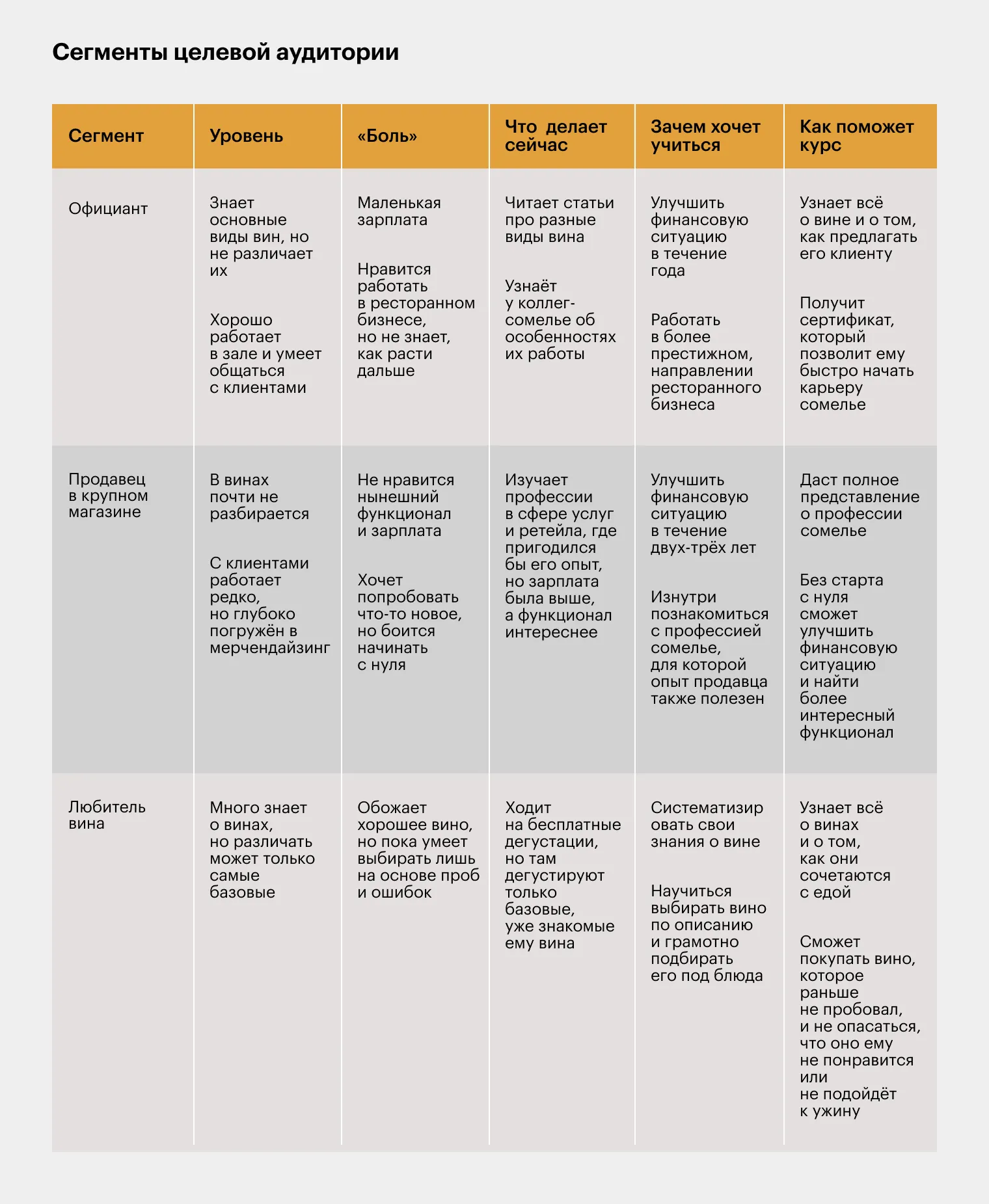
The "wine lover" segment differs significantly from other groups, and the course may seem excessive for them. However, this topic will certainly attract the attention of wine lovers. Information about wine regions, different wine varieties and their characteristics can be very useful for expanding horizons and deepening knowledge of the world of wine.
There are ways to retain clients by offering them alternative solutions. For example, you can offer a short track without additional modules aimed at professionals, as well as without a sommelier certificate. This will attract and retain clients who do not need in-depth training, and also make the offer more accessible and attractive.
Definition of the goal and educational outcomes
The course is aimed at developing in-depth knowledge and practical skills in a specific field, which will allow students to successfully adapt to the demands of the modern labor market. During the training, participants will master the key concepts and methods necessary for professional work. Upon completion of the program, students will be able to apply their acquired knowledge in practice, solving real-world problems and making informed decisions. They will confidently navigate current trends and technologies, which will enhance their competitiveness and open up new career opportunities.
To successfully complete the program, it is necessary to carefully analyze the findings of the previous stages. This will allow the student to formulate clear conclusions that will help them understand their achievements and areas for improvement. The learning outcomes should include key skills and knowledge acquired during the process, as well as recommendations for further development. This approach not only promotes deeper understanding of the material but also helps students set goals for future learning and professional growth.
The final stage of training brings together all the previous steps. At this stage, we analyze the findings and determine the specific outcomes the student will achieve upon completion of the course. A special focus is placed on the results of job posting and target audience analysis, which allows for a better understanding of labor market requirements and tailoring the training accordingly. This ensures that students are prepared for real-world challenges and can effectively apply the knowledge they gain in their professional work.
The course objective is determined based on the competency map and the student's background knowledge, as outlined in the target audience description. The course objective should clearly reflect the key competencies and skills that the student will acquire during the course. This will create a structured and effective educational process that meets the needs and expectations of students.
We are developing a course on personal brand promotion, focusing on creating an effective strategy. The main objective of the course is to develop a clear understanding of the methods and tools for successful personal brand promotion. Participants will gain the necessary knowledge and skills to help them develop a personalized strategy that will contribute to increased recognition and authority in their field.
Refining goals using the SMART method includes specification, measurability, achievability, relevance, and timeframe. This will allow you to clearly formulate the goal so that it is clear and understandable. A specific goal should clearly define what exactly you want to achieve. Measurability allows you to evaluate progress and results. Attainability means that the goal is realistic, so you have the necessary resources and opportunities to achieve it. The relevance of the goal should be in line with your personal or professional priorities. Finally, setting a time frame will help focus and create a sense of urgency, which contributes to more effective achievement of your goals. Using the SMART methodology will make your goal more structured and achievable.
- Specific,
- Measurable,
- Achievable,
- Relevant,
- Time-bound.
An example of a clear and relevant goal for a personal branding course might be: "The student will master the creation of a personal brand promotion strategy on social media and professional platforms within seven months. This strategy will increase the client's number of followers by 10% within the first two months." This approach will ensure the effective development of a personal brand and will help you stand out from the competition.

After formulating the goal, it is necessary to clarify, What knowledge and skills the student needs to achieve it. This will form the basis for a step-by-step program plan and define the expected educational outcomes. A clear understanding of the requirements will enable the creation of an effective training program and ensure that students are successfully prepared to achieve the assigned tasks.
When developing a competency map and segmenting the target audience, it is important to keep in mind that the stated goals and educational outcomes at the analysis stage represent preliminary hypotheses. In the next step, these hypotheses should be discussed with an expert, who will be able to make adjustments based on their professional experience. This will increase the relevance and accuracy of the developed goals and improve the educational outcomes.
The goal of the sommelier course is to teach students the art of pairing wines and other alcoholic beverages to match specific dishes and customer taste preferences. Students will master the skills necessary to create harmonious food and beverage pairings, thereby enhancing service and guest satisfaction.
To improve goals using the SMART methodology, it is necessary to include measurability, for example, setting a minimum percentage of customer satisfaction with the wine selection suggested by the sommelier, or linking the goal to specific restaurant business metrics. It is also important to define a time frame within which the student must achieve the course objectives. This will allow for the creation of a clear plan and evaluation of progress, which will significantly increase the effectiveness of the learning process and improve the quality of service in the restaurant.
The educational outcomes of the course will be presented in the form of clearly defined skills and knowledge that participants can apply in practice. Upon completion of the course, students will master the fundamentals of theory and practice necessary for successful completion of tasks in their field. They will learn to analyze information, make informed decisions, and apply acquired knowledge to solve real-world problems. Furthermore, the course will help develop critical thinking and increase confidence in their actions, which is an important aspect of professional growth. Participants will be able to use the acquired skills for further education and career development.
- the student understands the types of wine and knows their taste and other specific characteristics;
- knows what dishes pair with different types of wine;
- can competently and politely offer a selection of goods to a client and recommend items;
- knows at what temperature and decantation different types of wine are served, and monitors these parameters when serving to a client;
- knows how to effectively serve wine to a client;
- monitors the filling of the client's glasses and politely requests feedback on the product;
- can serve up to four clients simultaneously;
- can generate checks and work with the main payment and order recording systems in a restaurant.
After completing all stages of the analysis, the general thematic structure of the course and the characteristics of the target audience will be clear. This data will be useful in the next stages of development, allowing for more precise adjustment of the course content and format to meet the needs of the audience.
Read also:
- How to create a high-quality online course: 6 conditions
- How to organize networking in an online course
- How to evaluate the effectiveness of an online course
- How to improve an existing course
Profession Methodologist from scratch to PRO
You will improve your skills in developing curricula for online and offline courses. Master modern teaching practices, structure your experience, and become a more sought-after specialist.
Find out more