

Learn: Online Course Producer from Scratch to PRO
Learn MoreIf you've developed your own online course, the next step is to effectively promote it. You need to convey the value of your course to your target audience and attract your first students. To do this, it is important to define the target audience, create a compelling offer, and use a variety of marketing channels. Consider social media, content marketing, and email newsletters. Also, focus on creating high-quality content that showcases the unique benefits of your course. Make sure your course information is easily accessible and understandable so potential students can quickly assess its value and make a purchasing decision.
Promoting a course involves several key stages, from developing a landing page to launching sales. Information gathered during target audience and market research is especially important in this process. This data will help you determine the most effective channels for attracting students, highlight the main benefits of the course, and choose the appropriate communication style with potential participants. A proper understanding of audience needs will make the course more appealing and increase sales.
Create a Landing Page
When your course is almost ready, it's important to think through a strategy for informing your target audience and motivating them to learn. One of the most effective ways to promote an online course is to create a landing page—an advertising page that attracts attention and encourages action. The landing page should contain key information about the course, its benefits, as well as testimonials and success stories from previous participants. This will not only help generate interest but also increase conversion among potential students.
The online course landing page should present key information to attract the target audience and increase conversion. It's important to clearly state the course topic, its objectives, and the benefits for participants. Describe the structure of the training, including the class format, course duration, and interactions with instructors. It's also worth including testimonials from students who have completed the course to demonstrate its effectiveness. Be sure to indicate the course price and any discounts or promotions. It's important to include a clear call to action so visitors can easily register or obtain additional information. Optimizing the text for search engines will help increase the visibility of the landing page and attract more potential participants.
- The course title and brief description, containing basic information about its objectives. For example: "Floristry from Scratch." You will learn how to create floral arrangements, select suppliers, and work with clients to ensure they return. You can get a job in a flower shop or start your own business."
- Course registration form.
- The main USP of the course is its competitive advantage over other courses on the market.
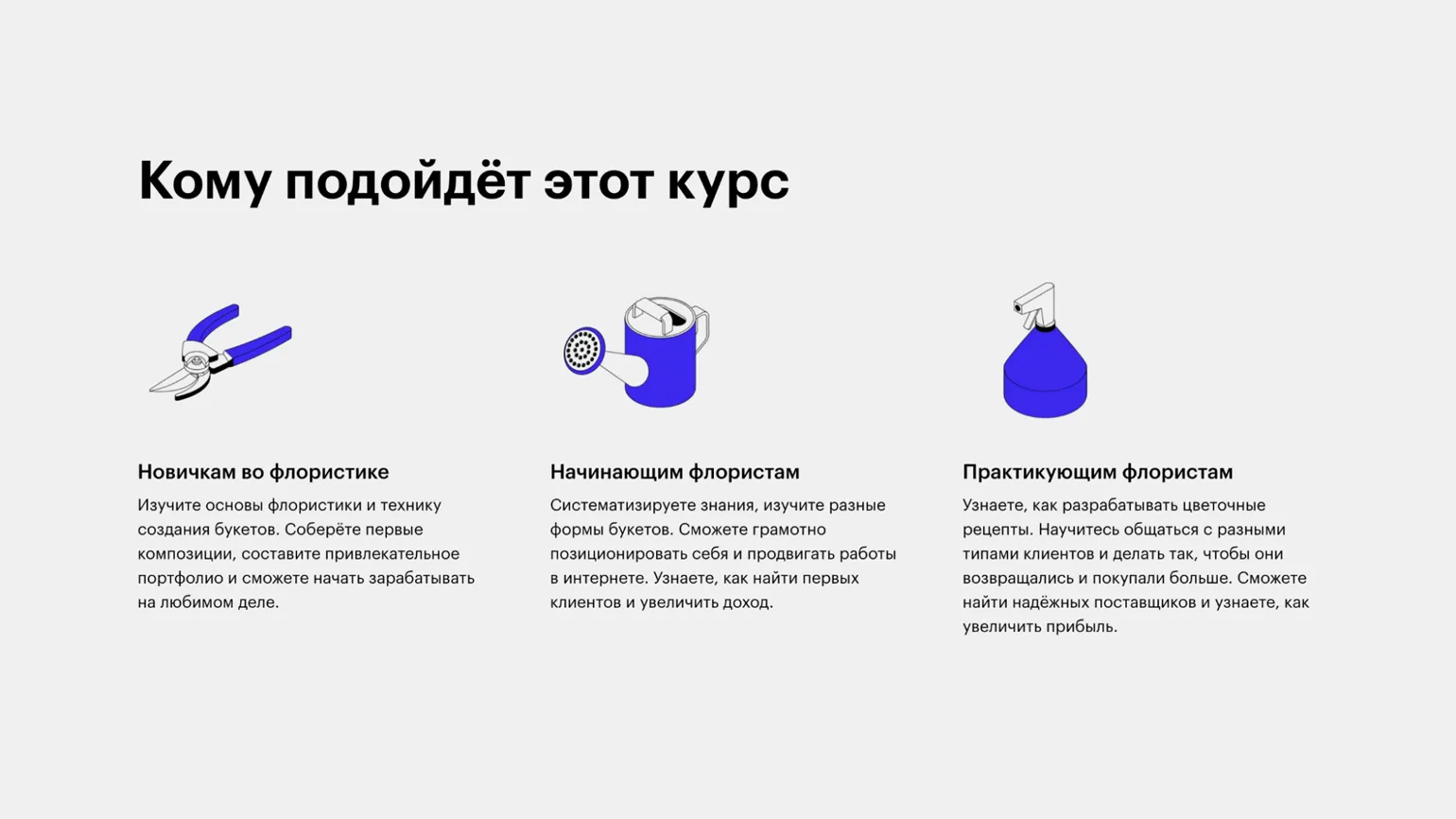
- TA — who your course is intended for and how it will help them.
- Learning outcomes - what students will get after completing your course.
- Course syllabus. The more detailed it is described, the better. This way, students will see what to expect during the course and will be able to make an informed choice.
- Information about the instructors.
- Other information you would like to convey to the audience: additional USPs, promotions and discounts, and so on.
You can create a landing page using any free website builder, for example, Tilda. However, a more convenient option is to engage professionals who can do this task for you. The cost of such services is significantly lower than the cost of filming the course.
Think over a marketing strategy
There are many marketing tools that can effectively promote your business. In this context, we will consider two approaches: no-cost and budgeted.
Free promotion takes time and rarely leads to quick sales. However, if your course is designed primarily to promote your personal brand rather than generate immediate income, you may be able to get by without significant marketing costs. It is important to remember that effective promotion requires patience and a strategic approach. Creating high-quality content and actively engaging with your audience will help you strengthen your brand and achieve long-term success.
In this situation, we recommend using the following methods and approaches. This will allow you to effectively overcome any challenges that arise and optimize the process. Pay attention to key aspects that will help you achieve the desired result. Using proven strategies and tools will ensure maximum productivity and minimize risks.
- Affiliate promotion without payment. Essentially, this is mutual PR. Together with another market expert, you exchange information about each other's products on your channels, organize joint activities - interviews, broadcasts, contests, marathons.

- Free publications On third-party resources. These could include reviews from your clients or students on various aggregator sites, posts announcing the course in thematic social media groups, or expert articles in specialized publications. It's also a good idea to engage in commentary—for example, you can provide expert answers to participants' questions or add interesting people as friends.
- Gaining subscribers through online activities and public events. Participating in thematic discussions, speaking at conferences, and so on will be very helpful for promoting the course. It's important to always leave your contact information, and if the format of the event allows, it's a good idea to announce your course on the topic of the presentation.
Paid marketing tools are generally highly effective and provide faster results than free alternatives. If you're looking to successfully promote your product and start earning a stable income, it's important to budget for marketing campaigns. Investing in high-quality promotion will help you attract your target audience and increase sales.
- Affiliate promotion. This method involves having another expert who works with your target audience, but is not your competitor, talk about your product on their channels. In this case, a commission is usually paid—a percentage of sales made when customers come from a specific channel.
- Targeted advertising on social networks. This involves customizing advertising posts (for example, on VKontakte) to an audience that meets selected criteria—socio-demographic parameters, interests, subscriptions to certain resources. If you have your own customer base, you can target it directly or a similar audience.
- Contextual advertising—is placed on Google or Yandex search platforms.
- Paid publications in social media groups, with bloggers, and on professional and thematic resources.
Marketing funnels, which are pre-configured chains of products and communications, are actively used in online education. These funnels help clients navigate the journey from their initial encounter with a product—in this case, a course—to their final purchase. An effective marketing funnel increases conversion and allows for more precise targeting of audience needs, streamlining the sales process and improving engagement with potential students.
A sales funnel is formed as follows: first, a product or service is offered for a free trial, then the reasons for purchasing are explained, which helps establish a trusting relationship with the client, and finally, the sale is made. This approach allows for effective customer acquisition and increased conversion.
To effectively promote the main product, additional tools such as a lead magnet and tripwire are often used in the marketing funnel. A lead magnet is a free, useful product, such as an open lesson, webinar, checklist, or manual. It helps demonstrate your expertise and establish a connection with the target audience. After this, a tripwire—a product offered for a small fee—is used in the funnel. The idea behind a tripwire is to get a potential client to make a small initial purchase, such as paying for a masterclass at a nominal price. This allows them to be convinced of the high quality of the content, significantly easing the decision to purchase the main online course. Using a lead magnet and tripwire helps build trust in your brand and increases sales conversions.

Reworked text:
Read also:
Selling an online course using video content is an effective way to attract students and increase revenue. Videos allow you to better convey information, make learning more accessible and interesting. To successfully market your online course, start by creating high-quality video content that clearly demonstrates the value of your course. It's important that your videos are professionally produced and include helpful tips, examples, and practical exercises.
Remember to optimize your video content for search engines. Use keywords that potential students might search to find your course. Create engaging titles and descriptions for your videos to increase their visibility.
Also consider posting video content on popular platforms like YouTube or Vimeo to expand your audience. Developing a strategy for promoting video content through social media and email marketing will help attract more students.
Don't forget about audience interaction. Responding to comments and questions will help establish trust and increase interest in your course. Use student feedback to create new videos and improve existing ones. Continuously analyze the performance of your video content to make necessary adjustments and improvements.
Thus, creating and selling an online course using video content requires careful preparation and a strategic approach, but with the right plan, you can achieve success.
Organize Distribution
If you plan to sell your online course, it is important to integrate a payment system. Many learning management platforms (LMS), such as GetCourse, offer this feature. Using these solutions, you can automate the process: the platform will accept payments from students, issue electronic receipts, and automatically provide access to educational materials. This not only simplifies course management but also improves the level of service for your customers. Choosing a payment system is a key step in successfully commercializing your online course.
If you don't plan to use an LMS or your platform doesn't support a payment system, you can integrate an external payment service, such as ЮKassa. This will allow you to place a payment form directly on your landing page, providing convenience for users and simplifying the transaction process.
If selling the course is not your current goal, you can focus on publishing content in formats that are convenient for your audience. Consider creating a YouTube channel where you can post recorded lessons and conduct live streams. Alternatively, you can create a group on social media or use cloud storage to access all educational materials. It is important to set up restricted access so that only registered students can view the content. Free placement in learning management systems (LMS) is also available. For example, the educational platform Stepik allows non-commercial courses to be added to its catalog without charging a fee. This approach will help you effectively share knowledge and build your audience without worrying about financial aspects.
Read also:
- How to evaluate the effectiveness of an online course
- How to launch your online course and not burn out
- 5 useful functions of communities around educational products
Online Course Producer from Scratch to Pro
You'll learn how to launch profitable courses and webinars with minimal investment. You'll understand how to turn existing EdTech projects into profits and make money from online learning.
Find out more