
Contents:

Learn: Profession Methodist from scratch to PRO
Learn MoreIn this article, you will learn about:
- what are the adult learning styles classified by David Kolb;
- how knowledge of styles can be useful for students and teachers;
- how styles differ from each other and why there were four and now nine;
- why you shouldn't perceive learning styles as a perfect guide.
In 1984, David Kolb introduced his concept of experience-based learning for adults in his book "Experiential Learning: Experience as a Source of Learning and Development". Since then, he has tirelessly developed and deepened this model, publishing several books and numerous articles. He also founded the Experience Based Learning Systems (EBLS) Institute, which continues to promote the idea of experience as a central element in the learning and development process. This concept has become the basis for many educational programs and approaches that emphasize the importance of practical experience for the effective acquisition of knowledge and skills.
The basic principles of the educational concept have remained unchanged over the years: the process of learning and knowledge formation occurs individually for each student, based on the transformation of their personal experience. Knowledge cannot simply be transferred; it can only be created by providing the appropriate conditions for its formation.
Kolb's concept of learning operates on two levels. The first level, familiar to most curriculum designers, is a cycle consisting of four stages: concrete experience, reflective observation, abstract conceptualization, and active experimentation. This approach promotes a deep understanding of the learning process and allows for the effective development of curriculum, as well as the improvement of participants' skills. Using the Kolb cycle in educational practice allows for the integration of theory and practice, which makes learning more dynamic and effective.
The second level of learning is less well known, but it plays an important role in the educational process. This level assumes that each student navigates all stages of the cycle along their own unique path, driven by their individual characteristics. One of the key factors influencing this process is learning style, which represents a person's habitual way of acquiring knowledge. Initially, Kolb identified four main learning styles, but their number has increased significantly over time. The diversity of learning styles emphasizes the importance of an individualized approach in education, allowing each student to find the most effective learning methods. Let's consider what learning styles are and why the educational community is still skeptical about them. Learning styles represent different approaches to the process of acquiring knowledge and skills. Despite their popularity, many experts point to a lack of scientific evidence for their effectiveness. This skepticism stems from the fact that learning styles are often viewed as fixed categories, ignoring the individual characteristics of each student. It is important to understand that learning is a dynamic process that requires flexibility and adaptation to changing conditions and student needs. Therefore, educational styles require more in-depth research and critical analysis to achieve maximum effectiveness in teaching.
What are Kolb's learning styles?
It is important to pay attention to the peculiarities of the translation of the term "learning styles." In Russian practice, it is translated as "instructional styles" and "learning styles." There are also other translation options that can be used in different contexts. The correct understanding and use of these terms is important for pedagogical practice and the development of effective educational programs.
Sonya Smyslova, head of the Center for Academic Quality and Creative Pedagogy at Universal University and co-founder of the School of Education, presents an updated version of Kolb's concept in her book "Designing the Educational Experience." This publication is the first on the Russian market to describe in detail the educational strategies proposed by Kolb. Smyslova thus seeks to prevent confusion between Kolb's learning styles and the VARK model, which classifies people as visual, auditory, and kinesthetic learners. This book will be a useful resource for educators seeking to improve the quality of the educational process and adapt it to different learning styles.
A learning style is a unique pattern of behavior that characterizes a student's approach to the learning process, as defined by David Kolb. Each student has their own preferences and habits that influence how they perceive and process information during the learning process. Understanding your learning style allows you to optimize the learning process, making it more effective and tailored to your individual needs. By identifying your style, students can choose appropriate methods and strategies, which will help improve results and enhance learning.
Sonya Smyslova explains the connection between the stages of the Kolb cycle and learning styles as follows: the stages of the Kolb cycle emphasize learner actions, that is, what they do during the learning process. At the same time, learning styles describe the internal states and approaches of a student, reflecting how they act in the process of acquiring knowledge. This distinction allows for a deeper understanding of how to effectively organize the educational process, taking into account both the actions and internal preferences of students.
A learning style is a set of habitual strategies and approaches that a person uses to assimilate information. These strategies may not always be applied consciously, as some learning methods seem more convenient and effective, while others can cause difficulties. Individual learning preferences shape each person's unique learning style. According to David Kolb's theory, the number of learning styles is limited, indicating that learning methods may be typical and not unique to each individual. Understanding your learning style can significantly improve the learning process and increase its effectiveness.
According to Kolb, a tendency toward a certain learning style is determined by genetic predisposition, but can change depending on life experiences and environmental influences, including school and university studies, as well as professional activity. It is important not to confuse learning styles with fixed psychological traits. Kolb argued that they are dynamic characteristics that can change under the influence of new knowledge and experience.
Why is knowledge about individual learning styles useful?
David Kolb, discussing the need for classifying learning styles, identified three key goals. The first goal is to improve the understanding of the individual preferences of participants in the learning process. The second goal is aimed at optimizing educational programs, which allows you to adapt materials and methods to different learning styles. The third goal is to increase the effectiveness of learning, which allows you to maximize the assimilation of information and skill development. Classifying learning styles helps to create a more personalized and effective educational process.
- To more effectively achieve learning goals.
Classifying learning styles allows each person to determine their individual approach to acquiring knowledge. Understanding your learning preferences helps you identify the most effective strategies and methods that produce the best results. Knowing which aspects of learning come easier and which require more effort allows you to consciously plan your learning and adapt it to your needs. This promotes deeper learning and improves overall learning effectiveness.
Scientists at the Institute for Experiential Learning developed the KELP (Kolb's Experiential Learning Profile) test. This tool helps determine your dominant learning style, which can be useful for optimizing your learning. However, it's worth keeping in mind that interpreting the test results is a paid service.
- For new learning opportunities.
Kolb argued that every student should strive to expand their range of learning styles. Using only your dominant style is not enough; it is important to try new approaches and master different learning strategies. According to the scientist, this is the key to successfully solving the problems students face. Diversity in learning methods not only promotes a deeper understanding of the material but also develops critical thinking and adaptability, which is especially important in today's educational environment.
- To learn more effectively.
Knowing your dominant learning style and the characteristics of your movement through the learning cycle allows a person to choose the most effective methods for mastering the material. Having mastered various learning styles, they are able to adapt their approach to learning, which contributes to a deeper understanding and memorization of information. This knowledge helps not only optimize the learning process but also make it more productive.
The fourth purpose of applying the classification of learning styles is its use in the design of educational programs. Although this purpose is not directly mentioned in Kolb's original work, it is often discussed in other sources devoted to this topic. This direction focuses on how to create effective teaching materials and methods that take into account different learning styles. Thus, knowledge of the classification of learning styles can significantly improve the quality of the educational process.
Knowing the dominant learning style of the target audience for a course allows methodologists and instructors to significantly improve the effectiveness of instruction. For example, if students prefer an initiating learning style that emphasizes acquiring knowledge through practical experience, then a methodologist developing a program based on the Kolb cycle should begin classes with a concrete experience. This approach promotes better assimilation of the material and student engagement in the learning process, which ultimately leads to more successful outcomes.
Sonya Smyslova emphasizes the importance of adapting learning strategies, citing an experiment conducted by David Kolb and his colleagues at MIT. The study showed that students who are faced with unfamiliar learning methods begin to sabotage the process. For example, if a group of students begins their training with a concrete experience, while some participants expect theoretical information before practical actions, these students may "drop out" of the learning process. This highlights the need to take into account individual preferences and habits in educational methods to improve the effectiveness of learning.

Read also:
Students are leaving the course - what to do?
Students dropping out of a course is a common problem in the educational process. The reasons can be varied, ranging from lack of motivation to the complexity of the material. To address this situation, it is important to analyze the causes and take appropriate measures.
First, it is worth asking students to share their impressions of the course. This will help identify key problems and shortcomings. Second, it is important to create a supportive atmosphere where students can ask questions and receive help.
Also, consider introducing interactive teaching methods, such as group assignments and discussions, which can increase student engagement. Regular feedback and adjustments to the learning process will help retain students in the course and improve their success.
Focus on motivation: emphasize the importance of the course for students' future careers and personal growth. Finally, analyze the results and adapt the course based on the information gathered to make it more engaging and effective.
The 4 Learning Styles Kolb Originally Identified
In his 1984 classification, known as Kolb’s Learning Styles Inventory 1.0, David Kolb identified four primary learning styles that follow naturally from his learning cycle: accommodative, divergent, assimilative, and convergent. We’ll explore each of these styles in detail below, but first, let’s explain their relationship to the learning cycle. Kolb’s learning styles help us better understand how individuals perceive information and apply it in practice, which is essential for effective learning and development.
Kolb’s cycle describes two primary processes a person goes through during learning: gaining experience and transforming it. These processes alternate continuously, as illustrated by the internal axes with arrows in the diagram below. Therefore, understanding these stages is key to effective learning and skill development.
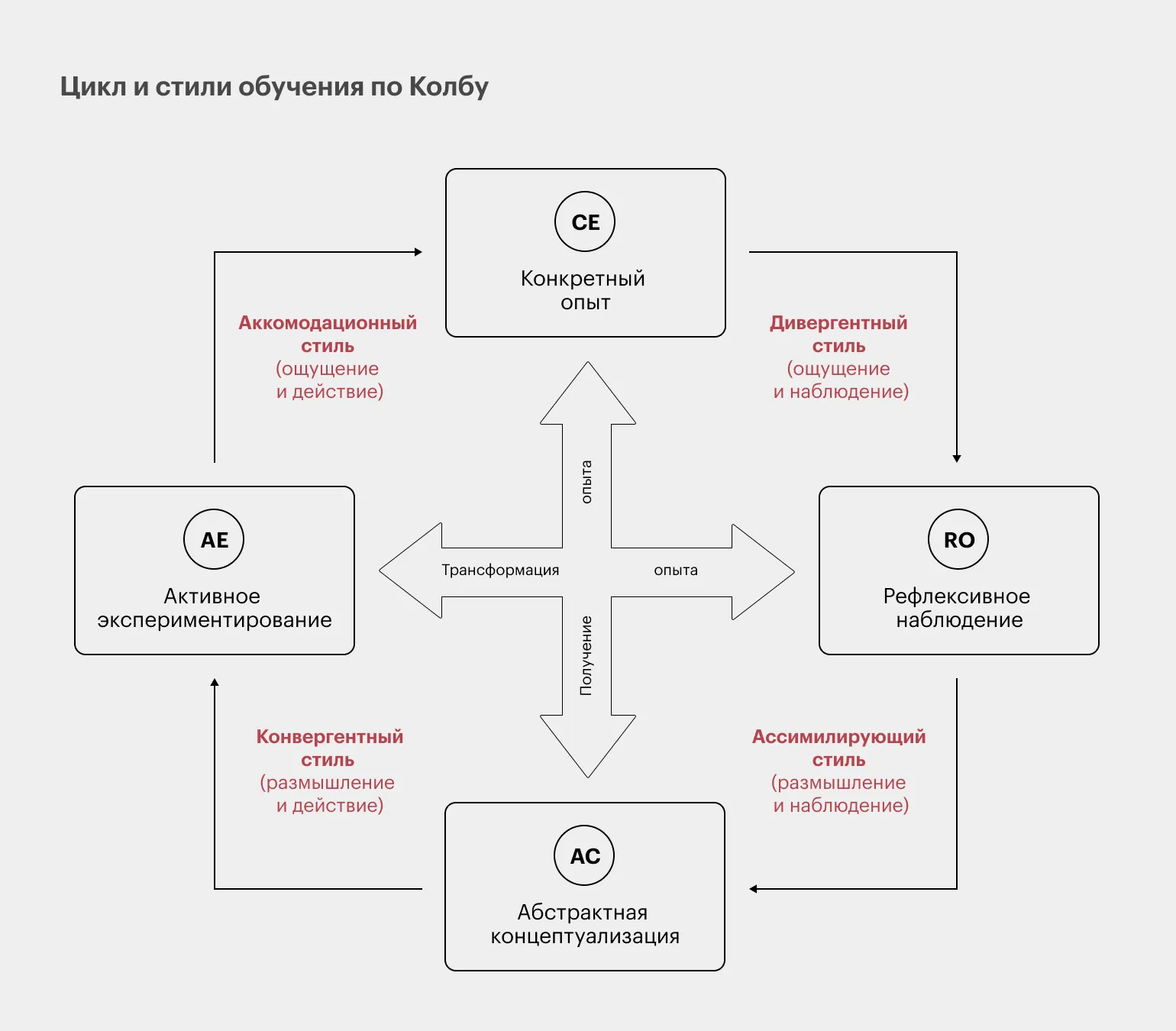
Kolb argued that every key process has two aspects.
- gaining experience - can be expressed in concrete experience (a person does or feels something new) or in abstract conceptualization (a person reflects, as a result, forming generalizations or concepts);
- transformation of experience - that is, a reaction to the experience. Can be expressed in reflective observation (understanding the experience) or in active experimentation (when a person tries to apply the formed concepts in practice).
Kolb's diagram illustrates the interaction of concrete experience, abstract conceptualization, reflective observation, and active experimentation. These four elements represent the key stages of the Kolb cycle, which is widely used in educational processes to improve the acquisition of knowledge and skills. Each stage plays a vital role in developing meaningful learning, enabling students not only to acquire information but also to actively apply it in practice.
Kolb argued that students fully grasp knowledge after completing all four stages. In his concept, learning is continuous, and the learning cycle can begin at any stage. Therefore, in the diagram, the connections between stages are represented by arrows moving clockwise, demonstrating the interconnectedness and sequencing of learning.
During the learning process, each person develops unique preferences, which, in turn, leads to a choice between sensing and reflecting, acting and observing. This combination of preferences determines an individual's learning style. Understanding your learning style helps optimize the learning process, making it more effective and comfortable. Each style has its own characteristics and can influence the perception of information, which is important to consider when choosing teaching methods.
Learning styles are most effectively perceived in a table format. This approach allows for a clear comparison of different teaching methods and highlights their key characteristics. Tables facilitate understanding and simplify the analysis process, which is especially important for students and teachers. Using tables in educational materials helps organize information, making it more accessible and structured.
David Kolb proposed four main learning styles, each with its own unique characteristics. These styles help understand how people perceive information and learn. Understanding these styles can significantly improve the learning process and increase the effectiveness of educational programs. Each style reflects different approaches to learning, allowing you to adapt teaching methods to student needs.
The accommodative style is an approach that emphasizes sensations and actions. This style of learning and perception of information promotes adaptation and behavioral changes in response to external factors. An important aspect of the accommodative style is interaction with the environment, which allows people to more effectively assimilate new knowledge and skills. It is actively used in educational processes that emphasize practical experience and emotional perception. People who prefer an accommodative style are typically open to new ideas and willing to experiment, which makes them successful in dynamic and changing environments. The student applies their practical experience and actively experiments. When solving problems, they rely more on intuition than logical conclusions. They also collaborate with others to set goals and complete tasks. This approach promotes teamwork skills and improves creative thinking, which is an important aspect of the educational process. The divergent style is characterized by an emphasis on sensations and observations. This approach allows for a deeper perception of the surrounding world, analyzing details, and finding new perspectives. Divergent thinking supports creativity and innovation, promoting the search for unconventional solutions. In the context of creativity and art, this style opens up opportunities for self-expression and original vision. The ability to observe and perceive the world around us is a key element of the divergent style, which helps develop critical thinking and expand our horizons. The student analyzes specific situations from multiple perspectives, gathering a variety of information about the problem. They adopt a similar approach when communicating with others: actively participating in study groups, listening to different opinions, providing feedback, and generating multiple ideas for solving problems through brainstorming sessions. This approach promotes the development of critical thinking and creativity, which is an important aspect of the educational process. The convergent style combines elements of reflection and action, making it an effective tool for problem solving and decision making. This style implies the ability to analyze information, identify key points, and apply acquired knowledge in practice. People with a convergent thinking style are able to quickly adapt to change and find optimal solutions in complex situations. They are able to integrate different approaches and methods, which contributes to a deeper understanding of the problem and its effective solution. The convergent style is especially valuable in today's environment, where it is necessary to quickly respond to changes and actively participate in decision-making. This makes it indispensable in business, science, and other fields that require a combination of theoretical knowledge and practical skills.
This person is inclined to solve technical problems, preferring them to the humanities. They demonstrate an interest in tasks that require a specific solution. Furthermore, this approach allows them to apply various concepts and theories in practice, making the process more effective and focused.
The assimilative style, based on reflection and observation, is an approach to learning that emphasizes a deep understanding of information and its analysis. This style allows students to integrate new information with existing knowledge, which contributes to a more complete assimilation of the material.
When using the assimilative style, students actively process and analyze data, which helps them form well-founded conclusions and concepts. This approach is especially effective in scientific and humanities disciplines, where it is important not only to remember facts but also to understand their meaning in a broader context.
It's important to note that the assimilative style requires students to think critically and engage in self-reflection. This promotes the development of the skills needed to solve complex problems and make informed decisions. As a result, the assimilative style not only improves the quality of learning but also builds students' confidence in their knowledge and abilities.
The student is prone to abstract thinking, preferring to work with concepts and ideas over interpersonal interaction. They enjoy lectures, reading specialized literature, and individual assignments. The ability to analyze vast amounts of information allows them to transform data into logically structured conclusions. This approach promotes a deep understanding of the material being studied and the development of critical thinking.
Almost 20 years have passed since this classification was published. During this time, Kolb and his team have conducted numerous studies among students, which have shown that there are many more learning styles than originally thought. These studies have deepened our understanding of the diversity of learning approaches and the importance of adapting educational methods to the individual needs of students.
How Learning Styles Came to Be 9
During their research, Kolb and his colleagues discovered that the learning styles of some students did not lend themselves to a strict classification into one of the four main types. They encountered borderline and unique patterns that require deeper analysis and understanding. These observations highlight the complexity and diversity of learning approaches, which is important to consider when developing educational programs.
Kolb concluded that students' learning preferences are not limited to just one pole of the axis in its cycle. Initially, he believed that each person has a clear inclination either toward concrete experience, or abstract conceptualization, or active experimentation, or reflective observation. Kolb believed that it is impossible to be a little bit of an experimenter and a little bit of a reflective observer at the same time. However, he later realized that intermediate variations are quite real. A single learning style can combine elements of experimentation and observation, as well as sensing and reflection. Thus, a learning style represents a combination of preferences across all four dimensions, not just two, as previously believed. This discovery led to the expansion of Kolb's classification of learning styles.
Each learning style can be represented as a figure resembling a kite. The coordinate systems remain unchanged: one axis represents the acquisition of experience, where abstract conceptualization is combined with concrete experience, and the other axis represents the transformation of experience, where active experimentation is contrasted with reflective observation. Thus, the characteristic patterns inherent in each learning style form the outline of this figure.
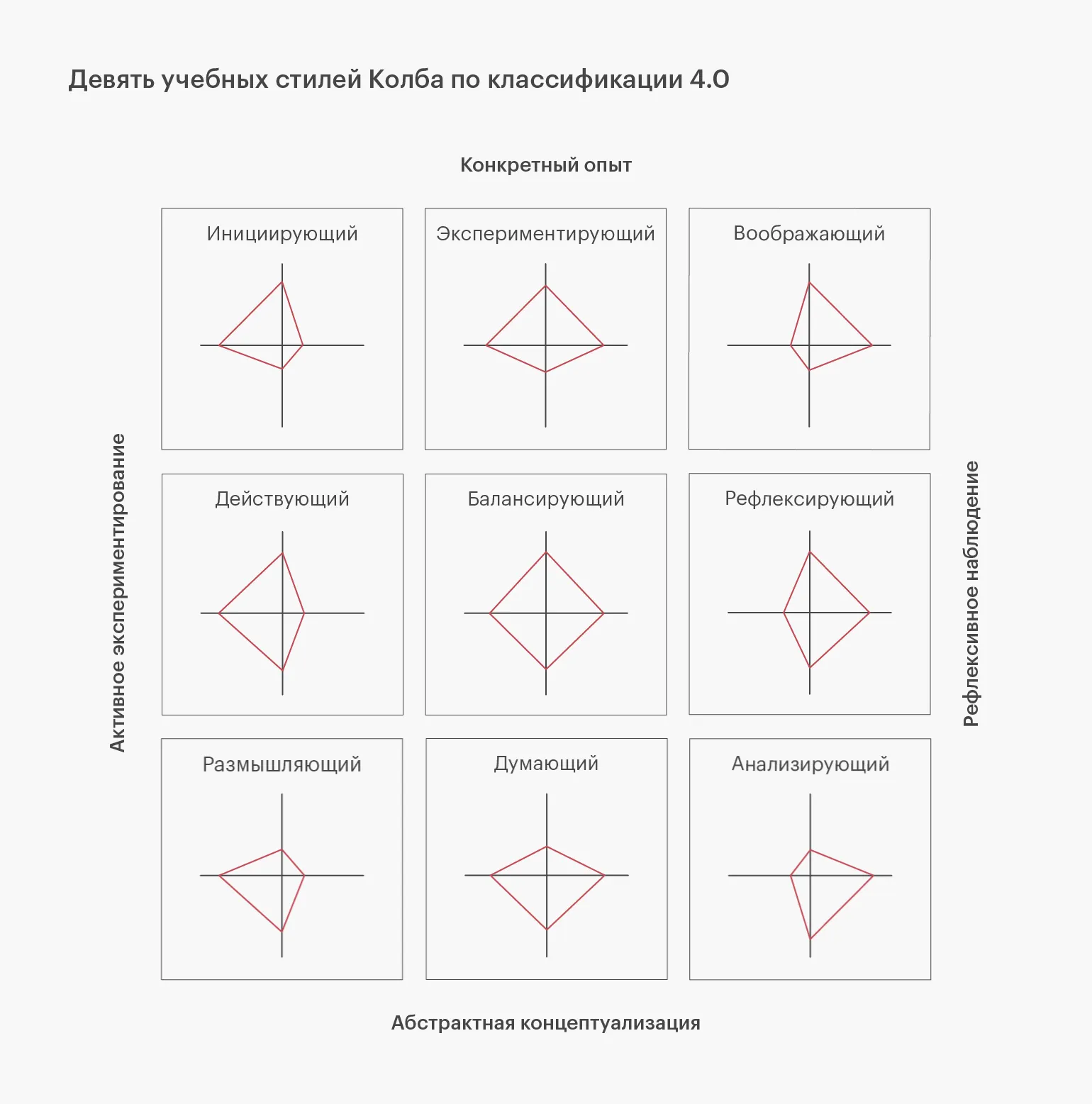
The fourth classification of learning styles, published by Kolb in 2011, identified nine different types. These styles help better understand how people perceive and process information, which can be useful both in the educational environment and in professional activities. Understanding these styles contributes to more effective learning and skill development.
We will list them and add explanations from Sonya Smyslova from the book "Designing the Educational Experience." In this work, the author emphasizes the importance of creating an educational experience that takes into account the individual needs and characteristics of students. Sonya Smyslova emphasizes that effective design of the educational process should be based on the interaction of theory and practice, which promotes deep assimilation of the material. Key aspects include the adaptation of teaching methods, the use of modern technologies, and the development of an active position of students in the learning process. These approaches not only improve information comprehension but also develop critical thinking and independent work skills, which are essential in the modern educational context.
The initiating stage is a key moment that sets the tone for the entire subsequent process. At this stage, initial ideas and concepts are formed that will be further developed. It is important to carefully analyze the goals and objectives to ensure the successful implementation of the project. Effective interaction between team members at this stage helps to create a solid foundation for further work. The initiating stage requires careful planning and a strategic approach to achieve the desired results.
Sonya Smyslova characterized this style with the phrase "straight off the bat," emphasizing its peculiarity in initiating actions to gain experience. According to Kolb, this style represents a balance between active experimentation and practical experience. This approach allows for the effective development of skills and the acquisition of new knowledge through direct participation in the process.
The experimental approach involves the active exploration and implementation of new ideas. This method allows for unconventional solutions and improvements to existing processes. It's important to continually test various hypotheses, analyze the results, and draw conclusions. Experimentation is beneficial not only in academia but also in business, where innovation plays a key role in success. By adopting an experimental approach, one can significantly improve work efficiency and create a competitive advantage. This style is characterized by the ability to derive meaning from deep immersion in practical experience. A person using this strategy is able to quickly draw conclusions based on specific actions, as Smyslova emphasizes. This style is a combination of concrete experience, active experimentation, and reflective observation, which allows for a deeper understanding and awareness of what is happening. Using this strategy can significantly enhance the effectiveness of learning and personal growth, promoting better information absorption and the development of critical thinking. An imaginative personality type displays a rich inner world and creative thinking. People of this type often have the ability to see the world differently, finding inspiration in everyday things. Imaginative individuals are prone to creative self-expression and often use their ideas to create unique projects or solutions. Imaginative individuals may be artists, writers, or musicians, as their creativity allows them to create works of art that resonate with audiences. They are also capable of generating unconventional ideas in business or other fields, making them valuable employees and partners. Developing imagination is important for personal growth and professional success. Practices such as meditation, journaling, or participating in creative workshops can help unleash the potential of an imaginative person. Understanding their strengths and applying a creative approach to various situations allows imaginative individuals to find new ways to solve problems and achieve their goals. This style manifests itself in the ability to observe and analyze a variety of experiences. It helps students retain several approaches to solving a problem in their minds, even if they may conflict with each other. This style combines practical experience and reflective observation, which promotes a deeper understanding of the learning material and the development of critical thinking.
The reflective approach involves deeply understanding one's own experiences and actions. This process involves analyzing thoughts, emotions, and behavior, allowing one to better understand one's motivations and reactions to various situations. Reflection helps identify strengths and weaknesses, as well as identify areas for personal growth and development. Reflective practice helps improve self-regulation and decision-making skills, making it an important tool in learning and professional activity. Awareness of one's actions and their consequences helps not only in solving current problems but also in planning future steps, ensuring a more conscious approach to life and work.
A person forms conclusions by connecting their experiences with new ideas through a continuous process of reflection. Reflective observation is a key aspect of this approach, which is complemented by concrete experience and abstract conceptualization. Effective reflection deepens understanding and develops critical thinking, which contributes to personal and professional growth.
The analytical type is an approach that emphasizes the detailed study of information and data. This personality type is prone to deep analysis, critical thinking, and careful evaluation of facts. Analytical people typically process information, collect evidence, and form well-founded conclusions. They are excellent at finding patterns and identifying connections between different elements. Importantly, an analytical thinking style can be useful in a variety of fields, including business, science, and education, as it promotes informed decision-making based on evidence. Improving analytical and critical thinking skills can significantly improve personal and professional effectiveness.
This style can be considered an extension of the reflective approach mentioned by Sonya Smyslova. In this case, the student integrates new ideas using systematization and analysis based on reflective thinking. This style combines elements of reflective observation and abstract conceptualization, allowing for a deeper understanding and structure of acquired knowledge. This approach promotes a deeper understanding of the material and the development of critical thinking, which is an important aspect of the educational process.
The reflective personality type is characterized by deep analytical skills and a penchant for philosophical reflection. These individuals often ponder the meaning of life, their place in the world, and how their actions impact others. They possess strong analytical skills, which allows them to effectively solve complex problems and find innovative solutions. Reflective individuals also strive for self-improvement and continuous learning, making them valuable members of any team. Their profound thoughts and ideas can inspire others, making them valuable in both their personal and professional lives. This quality allows them not only to understand themselves but also to better perceive the world around them, which promotes harmony in relationships.
The learner is focused on thinking at the level of abstract concepts and is inclined to logically justify their conclusions. This learning style is based on abstract conceptualization and is complemented by active experimentation and reflective observation. This approach promotes a deep understanding of the material and the development of critical thinking, which is essential for the successful acquisition of knowledge and skills.
A thinking person is someone who actively analyzes information, makes informed decisions, and draws conclusions based on facts. They constantly strive for self-improvement, discovering new horizons of knowledge and skills. This approach allows not only for a better understanding of the world around us but also for finding effective solutions in complex situations. It is important to develop critical thinking and the ability to question conventional wisdom. This quality helps shape one's own views and beliefs, which in turn contributes to personal growth and professional success. By considering all aspects of a problem, a thinking person is able to find innovative solutions and overcome obstacles.
A student using this style relies on theoretical models and concepts to solve problems and develop action plans. This learning style combines abstract conceptualization and active experimentation, which allows for the effective application of theory in practice. This promotes a deeper understanding of the material and the development of critical thinking.
Action.
This learning style involves active participation, aimed at bringing people together to solve problems and achieve educational goals. The basis of this approach is active experimentation, which is complemented by concrete experience and abstract conceptualization. This method allows participants not only to master new knowledge but also to apply it in practice, which promotes a deeper understanding of the material and the development of collaboration skills.
Balancing is a term that can be applied in various contexts, including sports, psychology, and business. In sports, balancing exercises help strengthen muscles and improve coordination. In psychology, a balancing approach involves maintaining a balance between emotions and rational thinking, which contributes to improved mental health. In business, balancing management involves harmonizing the interests of various parties, which allows for the sustainable growth and development of a company. A balancing approach helps find optimal solutions and achieve goals, ensuring effectiveness in various areas of life.
Communication style is determined by a person's ability to adapt and switch between different strategies, as well as to be flexible in their actions. This style reflects the ability to find a balance between polar strategies: when it is appropriate to use a more reflective approach, and when it is better to apply proactive actions. Flexibility in the choice of strategies allows for effective interaction in various situations and achieve goals.
Learning style is a harmonious combination of concrete experience, abstract thinking, active experimentation, and reflective analysis. This approach allows for a deeper absorption of knowledge and its application in practice, which contributes to more effective learning and skill development.
Why Kolb's learning styles are criticized
Discussions about Kolb's classification of learning styles continue in the educational and scientific communities. On the one hand, some experts argue that various learning styles are neuromyths that have no scientific basis. On the other hand, there are studies and articles that confirm that people do indeed learn information differently. However, despite the theories, the effectiveness of different learning styles has not been convincingly proven, which is a major problem in this field.
One of the best ways to illustrate the real picture is a meta-analysis published in the leading scientific journal Frontiers in Psychology in 2015. The study was conducted by Phil Newton, Director of Learning and Teaching at Swansea University School of Medicine in the UK. For his research, he summarized and analyzed 105 unique articles related to learning styles from the largest scientific libraries PubMed and ERIC (Education Information Resources Center). About one-third of the articles were devoted to the classification of learning styles according to Kolb's model, another third to the VARK typology, and the remaining third to other learning models. This meta-analysis has made a significant contribution to understanding different teaching approaches and their impact on educational outcomes.
The researcher sought to determine:
- how useful students and teachers find learning style assessment for the learning process itself;
- whether the hypothesis that tailoring instruction to students' learning styles helps achieve learning goals is supported;
- whether there is a relationship between designing instruction with students' learning styles in mind and the quality of its outcomes.
The results of the study seemed to surprise its author. It turned out that 95% of students and teachers have a positive attitude toward learning style assessment and believe that it contributes to more effective learning. However, only one of the 105 studies was able to find confirmation that designing learning processes and instructions with students' learning styles in mind leads to better outcomes. In particular, research on the VARK typology suggests that the effectiveness of learning based on these styles may be greatly exaggerated, despite the fact that many students and educators continue to believe in this concept. Educational participants often report subjective benefits from identifying their learning style. The better a person understands themselves and their behavior patterns, the more consciously they approach learning, leveraging their strengths and minimizing their weaknesses. However, it is important to consider that the perception of learning success can be influenced by cognitive biases, such as the placebo effect. This effect occurs when a learner is confident of their success thanks to choosing the "right" learning style. Awareness of one's learning preferences can be an important factor in improving the effectiveness of the educational process. The lack of evidence confirming the impact of adapting educational solutions to students' learning styles on the quality of outcomes should be a concern for planners. Without empirical evidence demonstrating the positive impact of such approaches, it is important to carefully consider the development and implementation of such methods. This caveat underscores the need for research and analysis of the effectiveness of educational strategies to ensure they truly contribute to improved student achievement. Risks can come in many forms. They can be related to financial investments, market changes, legal aspects, or operational processes. It is important to recognize that each risk can impact business performance and sustainability. Therefore, it is essential to conduct a detailed risk analysis and develop strategies to minimize them. This will not only protect assets but also create the conditions for sustainable growth and development. Understanding and managing risks are key to success in any field.
- Developing or customizing a program to suit student learning styles will cost resources, but this may not significantly improve outcomes.
- Over-focusing on matching learning styles can lead to design errors.
- Students may reject learning because they believe it is not suited to their learning style, or, conversely, they may overconfidently believe that they can easily master a "suitable" course without putting in the necessary effort.
Understanding the concept of learning styles is an important aspect of effective teaching. However, targeting the learning style of your target audience does not guarantee better results. Learning is a complex and multifactorial process that requires consideration of various factors, including motivation, context, and individual learners. It is important to take a comprehensive approach to most effectively meet the needs of all stakeholders in the educational process.
Learn more about the world of education by subscribing to our Telegram channel. We share relevant news, useful resources, and interesting articles to help you stay up-to-date on the latest trends in learning and development. Don't miss the opportunity to expand your knowledge and stay up-to-date on developments in education. Subscribe to our channel!
Read also:
- "We have little evidence-based approach in the daily work of teachers"
- What adults are afraid of during training and how educational designers can cope with it
- John Keller's motivation model: what it is and how it works
- 5 Montessori pedagogy ideas that will help in teaching adults
The Profession of Methodologist from Scratch to PRO
You will improve your skills in developing curricula for online and offline courses. You will master modern pedagogical practices, structure your experience and become a more sought-after specialist.
Find out more