Contents:

Learn: Profession Methodist from scratch to PRO
Learn moreTeacher communication with students plays a key role in shaping their learning motivation. Effective motivation depends on many factors, including the way the teacher presents new material, the method of feedback, and the emphasis they place on learning. The organization of interaction in the classroom is also an important aspect, as this directly affects student engagement. The right approach to communication and interaction helps create a positive atmosphere conducive to effective learning.
Most studies focus on the influence of individual aspects of teacher behavior on student motivation. Psychologists Tamara Gordeeva from Lomonosov Moscow State University and Oleg Sychev from Shukshin Altai State Humanitarian Pedagogical University attempted to systematize these aspects. The results of their work were published in the journal Psychological Science and Education, where they analyze in detail how various pedagogical approaches and teacher behavioral strategies can shape student motivation and influence the learning process.
What Motivation Depends on
Gordeeva and Sychev's work is an adaptation of the research of Belgian scientists Maarten Vansteenkiste and Nathalie Elterman. Both studies are based on self-determination theory, which is one of the key modern theories of motivation. This theory explains how internal and external factors influence human motivation, making it relevant for understanding the processes of learning and development. The adaptation made by Gordeeva and Sychev allows us to apply these theoretical concepts in practice, which can significantly improve approaches to learning and motivation.
According to this theory, intrinsic motivation and overall human well-being directly depend on the satisfaction of three basic psychological needs. This applies not only to adults, but also to schoolchildren, who also strive to satisfy these needs. Every person wants:
1. To feel autonomy in their actions to make their own decisions and control their lives.
2. To have the opportunity to develop their skills and abilities, which promotes growth and self-realization.
3. To feel social connection and support from others, which strengthens their emotional state and promotes a sense of belonging.
Satisfaction of these needs plays a key role in the formation of intrinsic motivation, which, in turn, has a positive effect on academic success and overall quality of life.
- to act independently (need for autonomy);
- to achieve success (need for competence);
- to feel the attention of others and a connection with them (need for relatedness).
Ignoring the needs of students in the learning environment can lead to a significant loss of motivation. Creating a comfortable and supportive learning atmosphere is key to maintaining student interest and engagement. By taking individual student needs and preferences into account, educational institutions can significantly improve motivation and academic success.

Read also:
Intrinsic and extrinsic motivation play a key role in student learning. Intrinsic motivation is associated with personal interests, the desire for self-improvement, and enjoyment of the learning process. It promotes a deeper understanding of the material and the development of lasting skills.
On the other hand, extrinsic motivation involves external factors such as grades, praise, rewards, and competition. While it can be effective in the short term, it does not always promote long-term engagement with the learning process.
The relationship between intrinsic and extrinsic motivation is important for creating a harmonious educational environment. Teachers and parents can use external incentives to maintain student interest while simultaneously developing their intrinsic motivation. This can be achieved by creating engaging tasks, providing opportunities for choice, and encouraging independent learning.
Thus, understanding the relationship between intrinsic and extrinsic motivation allows us to create more effective strategies for increasing student learning activity and engagement.
Why Supporting Autonomy Alone Is Not Enough
Supporting student autonomy has a positive impact on their motivation, as confirmed by numerous studies. Providing reasonable opportunities for choice and taking into account student initiative contribute to an improved learning process. However, motivation is not determined solely by these factors. It is important to consider other aspects that influence student learning and engagement.
Researchers identify two key dimensions in the educational process: "autonomy - control" and "structure - chaos." It is important to understand that structure is not synonymous with control. It is possible to abandon strict checks and formal requirements, but still continue to set certain rules for the learning process. This creation of structure is necessary for effective learning and student development. Structure helps organize the educational process while ensuring students' freedom of expression and autonomy.
Tamara Gordeeva and Oleg Sychev emphasize that properly structuring the learning process plays a key role in satisfying the need for competence. This is especially relevant when mastering new or complex topics. Without a carefully designed learning path, as well as adequate explanations and tasks appropriate to the student's level, they can lose confidence and become lost. Effective lesson planning and attention to the individual needs of students contribute not only to their increased motivation but also to a deeper understanding of the educational material.

Study also:
The optimal approach to learning: theory or practice first? Many teachers and education specialists ask this question. Research shows that combining theory and practice can significantly improve learning effectiveness. It is important to consider that theoretical knowledge provides the basis for understanding practical tasks, while completing tasks helps reinforce the theoretical material.
By starting with theory, students gain the necessary knowledge and context, which allows them to better understand the essence of subsequent practical tasks. On the other hand, starting with a practical task can generate interest and motivation, since students immediately see the application of their actions.
A blended approach is recommended, which includes a preliminary explanation of basic concepts and subsequent application of knowledge in practice. This method helps to strengthen understanding and makes the learning process more holistic and effective.
What motivation styles do scientists identify?
Belgian authors have developed a circular model that combines various motivation styles. Tamara Gordeeva and Oleg Sychev adapted this model for the Russian context. Their approach allows for the effective application of motivational methods, taking into account the specific cultural and social background of Russia.
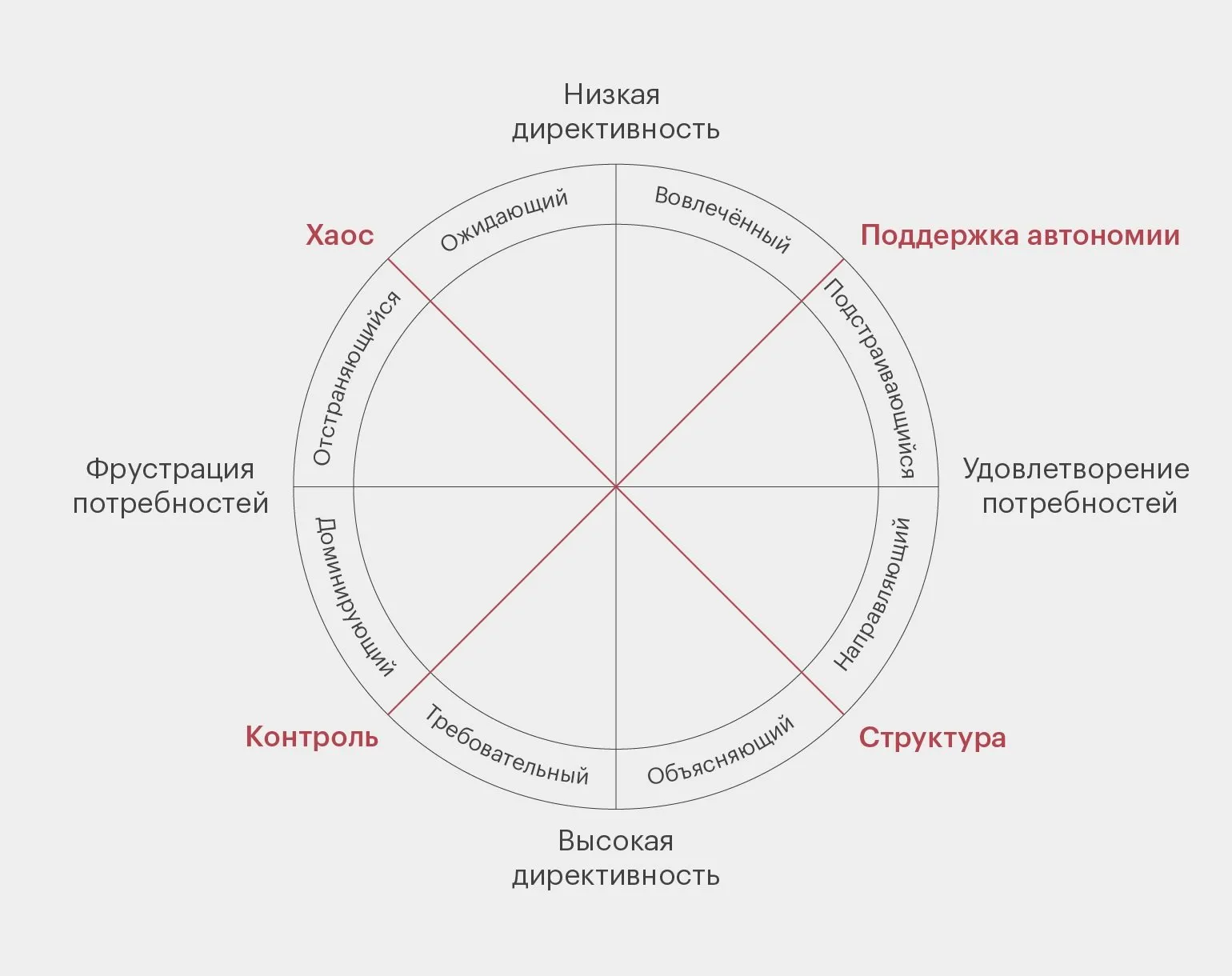
Control, structure, autonomy support, and chaos represent the main styles of interaction between teacher and students. Control implies active management of the learning process, where the teacher sets clear boundaries and expectations. Structure ensures organization of classes, allowing students to better absorb the material. Autonomy support promotes the development of independence in students, allowing them to actively participate in learning. Chaos, in turn, can manifest itself in informal approaches and spontaneous moments that stimulate students' creativity and individuality. These interaction styles help create a balanced educational environment where each student can develop according to their needs and goals.
- The autonomy-supporting style implies that the teacher strives to understand and take into account the interests of students so that they voluntarily participate in the learning process.
- The structuring style is also based on the teacher's understanding of students' capabilities, but its essence is in the provision of guidance, instructional strategies, and support.
- Within the controlling style, the teacher strives to ensure that students act and relate to learning situations only as prescribed.
- The chaotic style is also called permissive: with it, the teacher distances himself from the students.
Each of the main teaching styles has subtypes that have minor differences. For example, within the controlling style, there is a demanding subtype, where the teacher uses direct instructions and orders. In contrast, the dominant subtype is aimed at controlling students by creating feelings of guilt and shame. These differences in approaches influence student perceptions and learning effectiveness. Understanding these nuances can help educators better tailor their methods to student needs and create a more productive learning environment.
What styles are typical of teachers?
Tamara Gordeeva and Oleg Sychev conducted a study, surveying 1,400 primary and secondary school teachers in nine Russian regions. For this, they used an adapted questionnaire, "Situations at School," which was originally developed in Belgium. The full text of the questionnaire and instructions for its use are published along with the research results. This study aims to identify key aspects of the educational process and understand the situation in Russian schools.
Research shows that in Russia, as in other countries, the most common teaching styles are supportive and structuring. According to the work of the Belgian authors and other scientists, these styles have a positive impact on the development of intrinsic motivation in students. A supportive style fosters a comfortable atmosphere where students feel valued and engaged, while a structuring style helps organize the learning process and sets clear expectations. These approaches not only increase engagement but also promote a deeper understanding of the material. It is important to consider these styles in educational practice to achieve the best learning outcomes. In motivational practice, styles are rarely found in their pure form. Research by Gordeeva and Sychev shows that autonomy-supportive and structuring styles have a positive relationship, while controlling and chaotic styles have a negative impact. This means that teachers who support their students' autonomy are more likely to also structure the learning process. This approach helps create a more effective educational environment where students feel free and confident in their learning.
Why Teachers Choose Different Motivation Styles
In addition to the School Situations questionnaire, the study's authors also assessed teachers' resilience and self-efficacy. These parameters reflect their ability to cope with stress and confidence in their professional success. Studying these aspects is important for understanding the general psycho-emotional state of teachers and their readiness to overcome difficulties in the educational environment.
Analysis of the results showed that high resilience and self-efficacy of teachers are directly related to support for autonomy and a clear structure in the educational process. At the same time, teachers with low resilience tend to avoid difficulties, choosing a chaotic teaching style and distancing themselves from what is happening in the classroom. Or, conversely, they try to control all aspects of the process, which also negatively affects their effectiveness.
In his lecture at the "Transforming Education" forum, psychologist Evgeny Osin presented the results of various studies on the reasons for choosing certain motivational styles. In this context, he discussed in detail the factors influencing preferences in motivational approaches. More information about his lecture can be found in our previous article.
According to a study conducted at Belgian universities, there is a link between supporting autonomy and structure in the educational process and the concept of a growth mindset. Teachers who believe that intelligence and abilities can develop throughout life are more likely to use supportive and structuring teaching styles. This highlights the importance of creating conditions for developing a growth mindset in students, which in turn contributes to their success and self-development.

Read also:
Bookshelf: "Flexible Mindset" by Carol Dweck
"Flexible Mindset" - In this book, Carol Dweck explores the concept of fixed and growth mindsets. The author explains how our beliefs about our own abilities can influence success and development. Dweck shares examples from life and science, demonstrating how the transition from a fixed to a flexible mindset can lead to new achievements and opportunities. This work will help readers understand how developing the right mindset influences personal and professional growth. The book will be a useful resource for those seeking to develop their skills and achieve success in various areas of life. Evgeny Osin noted that research confirms that the best educational results are achieved by teachers who are intrinsically motivated. Teachers who are motivated themselves are able to inspire their students and create a more productive learning environment. At the same time, teachers with a predominance of extrinsic motivation can exercise excessive control or, conversely, lack attention to students, which negatively impacts the learning process. Teachers' intrinsic motivation plays a key role in developing effective educational practices.
According to research by Evgeny Osin and HSE Master's student Inna Rezvanova, teachers' intrinsic motivation depends on several key factors. Among these are clarity of the teacher's role and the availability of performance feedback. Role conflict, which arises when teachers face conflicting responsibilities or instructions from different supervisors, can lead to burnout. Support from management and colleagues, as well as the opportunity for autonomy in fulfilling their responsibilities, are also important for maintaining positive intrinsic motivation. These aspects contribute to a favorable work atmosphere and increased teacher satisfaction.
Read also:
- What teaching style helps develop critical thinking?
- A tutor explained how to motivate teenagers to study.
- "Drive." What Really Motivates Us, Daniel Pink
The Methodologist profession from scratch to PRO
You will improve your skills in developing curricula for online and offline courses. You will master modern pedagogical practices, structure your experience and become a more sought-after specialist.
Find out more