Contents:
Learn: The Profession of Methodologist from Scratch to PRO
Find out moreThe government presented an annual report to the Federal Assembly dedicated to the implementation of state policy in the field of education. The report covers all levels of public education and includes data on the results of the admissions campaign at universities for 2022. The document places particular emphasis on admission under a targeted quota, which is an important aspect in the context of increasing the accessibility of higher education for certain categories of citizens.
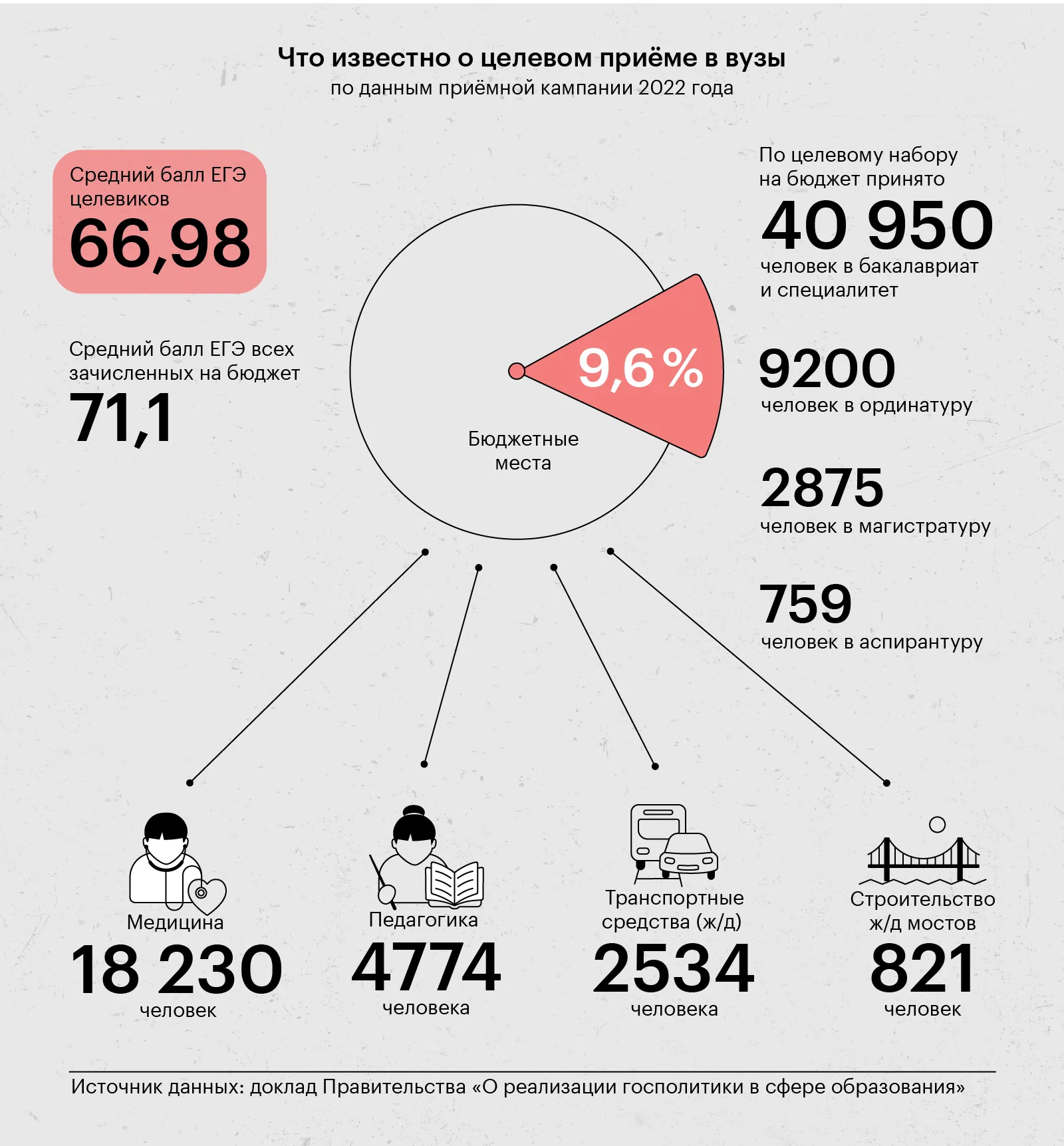
In 2022, data on targeted admission confirms the trend of previous years: the average USE score of students entering through targeted programs is lower than that of those entering through targeted programs. Who is admitted to state-funded places? This is because the competition for targeted places is conducted separately and includes only those applicants who have an agreement with the government organization that commissions the training. There is no competition at the stage of concluding such agreements, which creates an informal "gray zone" unregulated by law. As a result, when entering a university, a student with low grades but who has the connections to sign a targeted education agreement receives an advantage over a more successful applicant who lacks such connections. This raises questions about the fairness and transparency of the targeted admissions system, as well as how it impacts the quality of education and the training of specialists in the relevant fields.
The most popular areas of targeted admission have remained unchanged for many years. However, the number of applicants receiving targeted places is often lower than expected. For example, the Minister of Education and Science reported that in 2022, the quota for medical specialties was only 77.75% filled, and for teaching programs, only 43%. This indicates that many allocated spots remain unfilled, which requires attention and analysis from educational institutions and government agencies. The lack of interest among young professionals may be due to the lack of an open competition for these positions. Furthermore, many young people do not see the appeal of mandatory work after graduation under conditions that are not always favorable. This is especially true for jobs in the public sector, where working conditions and pay do not always meet graduates' expectations.
In 2023, targeted admissions will be conducted according to traditional rules for the last time. With the start of the new admissions campaign in 2024, updated admission rules for targeted students will come into effect. These changes will impact the admissions process, and applicants should prepare for the new requirements and conditions.
In 2023, the number of quotas for targeted students has increased compared to last year. In pedagogical programs, the share of targeted admissions will increase from 20% to 30% of budget-funded places. In medicine, in the specialty programs "General Medicine" and "Pediatrics," 75% and 76% of budget-funded places, respectively, will be reserved for targeted students. In residency programs in many programs, training will be exclusively for targeted students. It's worth noting that the gap between the average scores of targeted students and the average scores of all state-funded students in medical specialties has widened: 69.71 for targeted students versus 76.1 for all other state-funded students. This underscores the importance of targeted admissions for training qualified specialists in key fields such as pedagogy and medicine.
Reading is an important part of our lives, contributing to the development of thinking and broadening horizons. It helps deepen knowledge in various fields and improve skills. Regularly reading books, articles, and other materials not only develops imagination but also improves literacy. Furthermore, reading helps improve concentration and memory, which is especially important in today's distracting world. Focus on a variety of information sources: fiction, scientific articles, blogs, and specialized publications will help you gain comprehensive knowledge. Practice reading every day to enrich your inner world and improve your quality of life. Read also:
- Why targeted training in universities has become a problem
- The head of the Ministry of Education and Science spoke about the problems of targeted training in Russia
- The Cabinet of Ministers reported on the results of admission to universities in 2022
Profession Methodologist from scratch to PRO
You will improve your skills in developing curricula for online and offline courses. Master modern teaching practices, structure your experience, and become a more sought-after specialist.
Find out more