
Contents:

Learn: The Profession of a Methodologist from Scratch to PRO
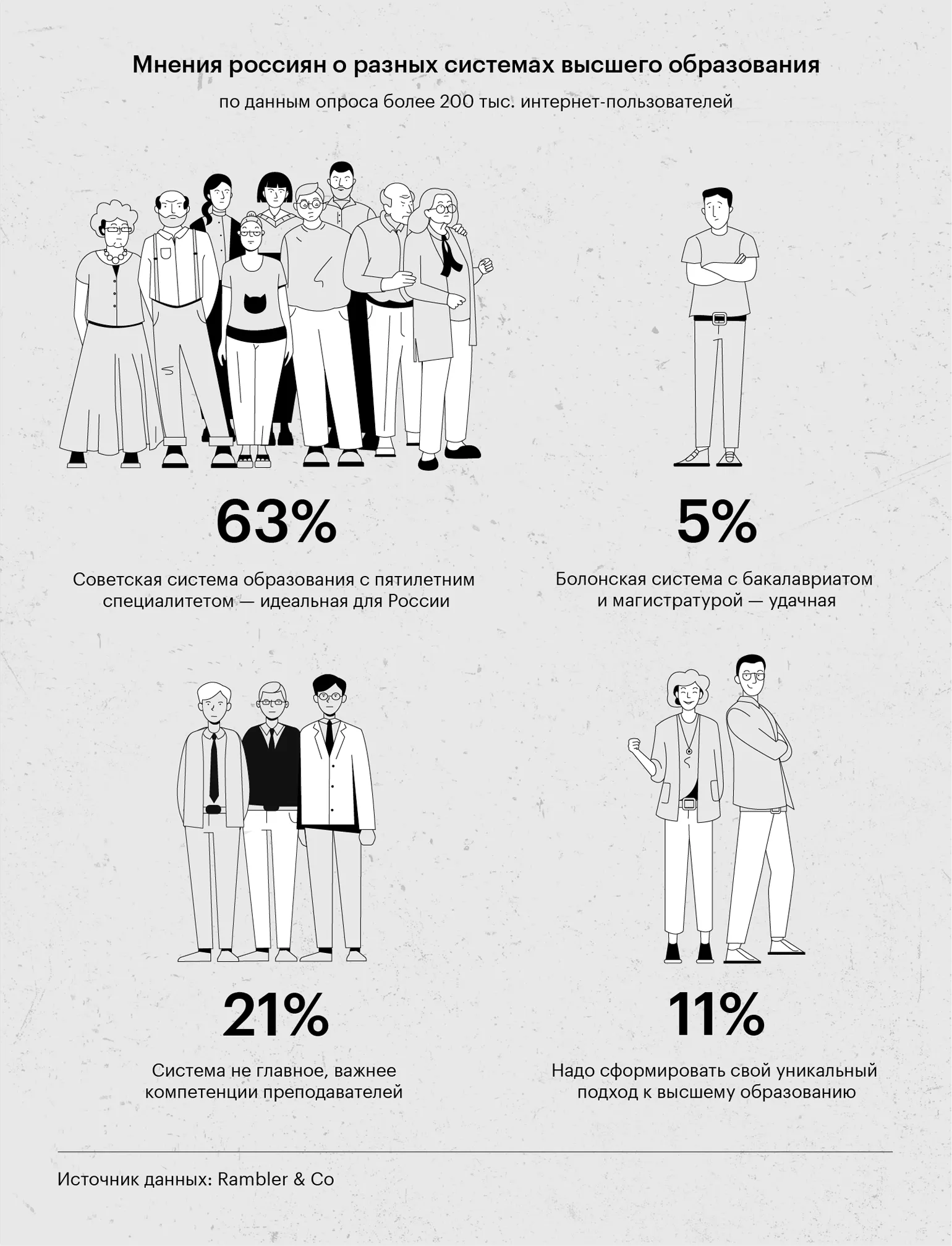
Find out moreAnalysts from the Rambler & Co media holding conducted a survey among more than 200 thousand users of their resources from July 10 to 13, 2023, examining their attitudes towards various higher education systems. The results showed that 63% of respondents consider the Soviet education system with a five-year specialist degree ideal for Russia. Meanwhile, only 5% of survey participants rated the Bologna system, which includes bachelor's and master's degrees, as successful. Eleven percent of respondents expressed the opinion that a unique approach to higher education is necessary, while 21% believe that the competencies of teachers, rather than the system itself, are most important. This study highlights the current debate about the quality and structure of higher education in Russia. The survey data does not provide information on the age groups or educational levels of the respondents. It is only known that 63% of the participants were men and 37% were women. Nevertheless, the high proportion of supporters of the five-year "Soviet" specialist degree is intriguing and underscores its relevance in the modern education system.
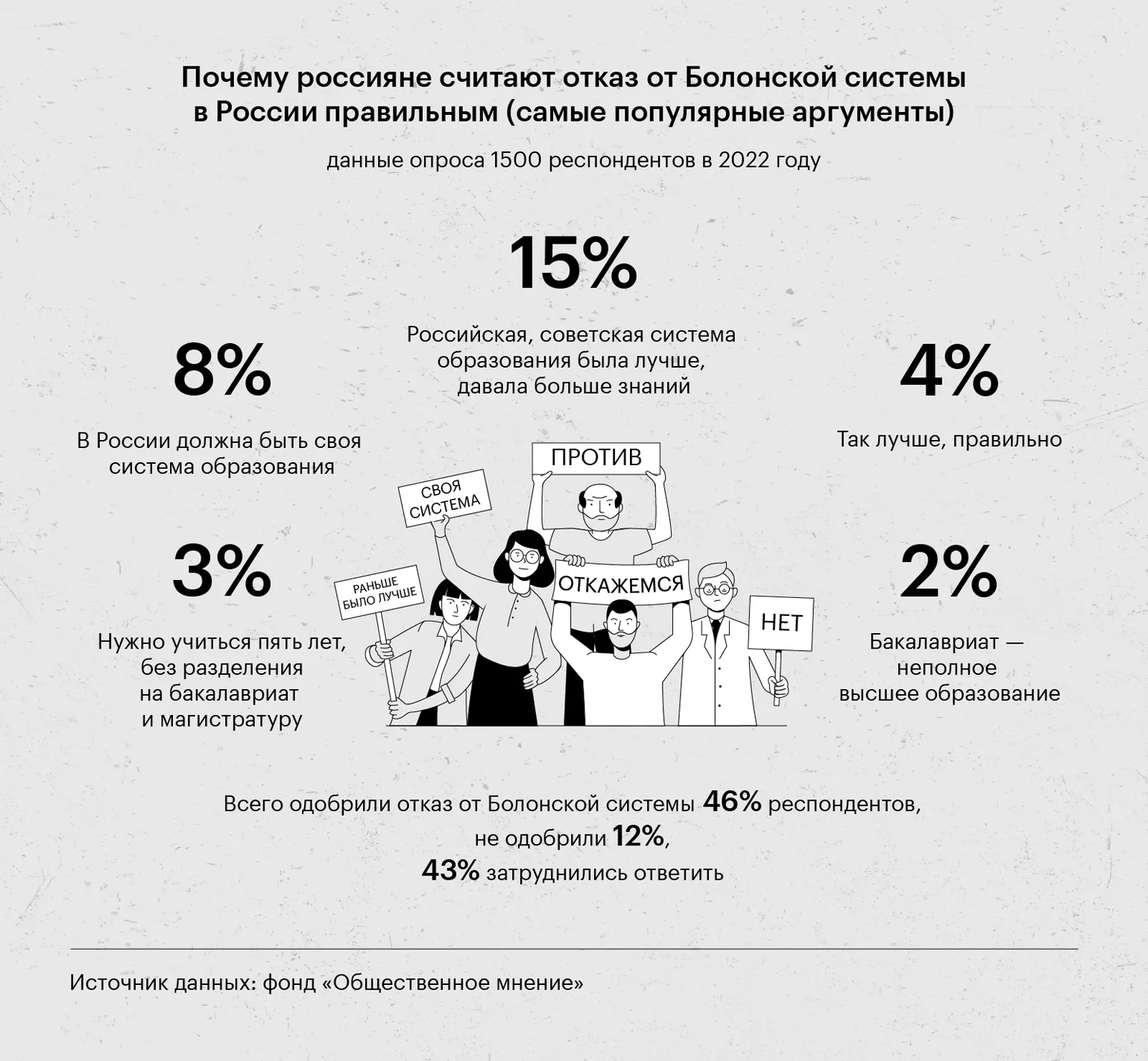
A year ago, against the backdrop of Russia's beginning to abandon the Bologna system, the Public Opinion Foundation Conducted a survey of 1,500 Russians to determine their attitudes toward this decision. The results showed that 69% of respondents were unaware of the Bologna system, and only 29% knew anything about it. Meanwhile, 46% of respondents supported abandoning the Bologna system, 12% opposed it, and 42% were undecided. The most common arguments among those in favor of abandoning it were that the Russian and Soviet education systems were superior in quality and imparted more knowledge. There were also opinions about the need to create a unique education system in Russia, the preference for five years of study without dividing into bachelor's and master's degrees, as well as general statements that this approach is more correct.
The new higher education system, according to the pilot project, is a two-tier (or three-tier, considering postgraduate studies) model. The first tier is designated "basic," replacing the traditional bachelor's and specialist's degrees. The second tier, master's degree, is classified as specialized. The duration of study at each tier varies depending on the educational program: at the basic level, study can last from four to six years, and at the specialized level, from one to three years. Even in engineering programs, where doubts were previously expressed about the sufficiency of a four-year bachelor's degree, the duration of study ranges from four to six years. This means that a full return to a five-year specialist's degree is not planned. Nevertheless, many Russians seem to expect just that, perhaps out of nostalgia for the past, when the quality of education was perceived as higher.

Reworked text:
Study additional materials:
Quote of the week: "We will never return to the Soviet education system." This phrase emphasizes the inevitable changes in the educational system that have occurred over the past decades. Modern education is adapting to new demands and challenges, such as globalization, technological advances, and changing societal needs. Despite nostalgia for the past, it's important to understand that educational reforms are essential to preparing qualified specialists capable of successfully competing in the international arena. Education must be flexible and future-oriented to meet the new realities of the labor market and student needs.
Currently, there is a trend toward shortening the length of study in higher education institutions abroad. Some American universities are already developing the concept of a three-year bachelor's degree. Recently, the ECMC Group, a nonprofit organization that invests in innovative educational initiatives, jointly with VICE Media, conducted a survey of 7,300 high school students. The results of the study indicated that universities should implement shortened curricula. It is also worth considering the possibility of integrating short courses into the standard bachelor's degree, upon completion of which students can earn certificates (micro-qualifications). Such certificates will help them apply the acquired skills in practice already during their studies, which will increase their competitiveness in the labor market.
Pay attention to the following materials:
- UNESCO called for a rethinking of higher education
- “People hope that if they return to past educational practices, it will become easier for them”
- Quote of the week: about non-core specialties and non-core master's degrees
- China has decided to restructure the higher education system
Methodologist Profession from Beginner to Advanced
You will develop skills in developing curricula for online and offline courses. You will master modern teaching practices, structure your experience, and become a more sought-after specialist.
Find out more