
Content:

Learn: The Profession of Methodologist from Scratch to PRO
Find out moreProfessor Malov, possessing stupidity, rudeness and lack of education, taught at the political faculty. The students openly despised him, often mocking him.
A trustee once asked a student in the political lecture hall: "How many professors are there in your department?"
The student replied: "Without Malov, there are nine."
The professor, who should have been expelled to leave nine, began to display increasing insolence towards the students. In response, the students decided to expel him from the lecture hall. Uniting, they sent two envoys asking for help, inviting me to come with reinforcements. I immediately assembled a group and announced our intention to confront Malov. Several people responded to my call, and we headed to the political lecture hall, where Malov was already there and noticed our arrival.
Fear was visible on the students' faces, caused by the expectation of rude remarks from the professor. However, this fear soon disappeared. The auditorium, packed with students, was tense and emitted a dull, suppressed hum. Teacher Malov made some remark, after which the class began shuffling.
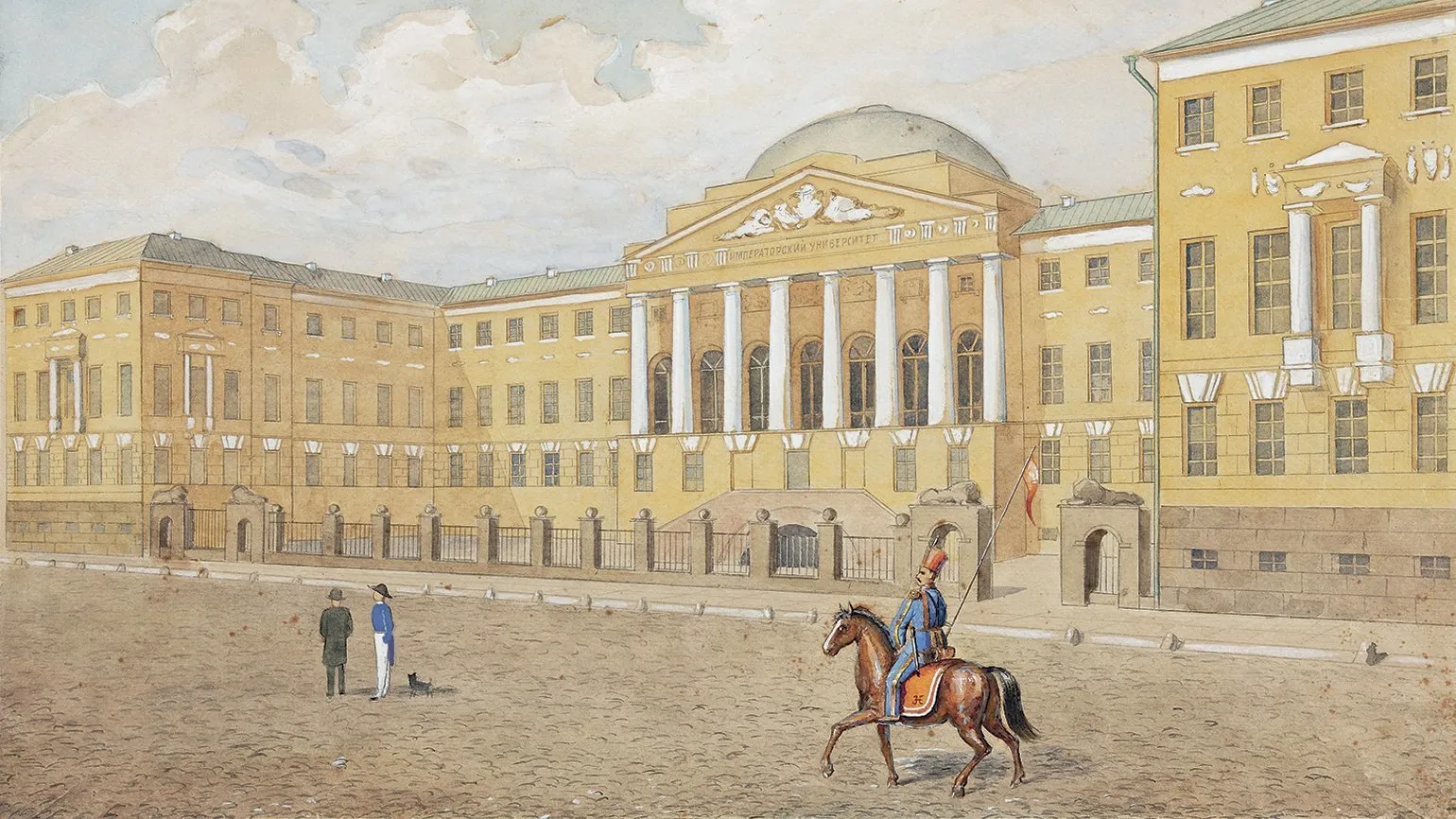
Malov noticed that the students expressed their thoughts the same way horses did – with their legs. He probably imagined that horses thought in the rhythm of a gallop and a trot. Chaos erupted in the auditorium: whistles, hisses, and shouts of "Get him out, get him out, pereat." Malov, pale as a sheet, tried to calm the crowd, but his efforts were futile. The students jumped onto the benches, and soon he quietly left the lectern, cowering from the tension, and headed for the exit. The audience followed him, seeing him to the doors of the university and leaving his galoshes behind. This moment became significant: on the street, the situation took on a completely different meaning. However, it seems that there are young people aged 17 or 18 who don't think about such things.
The University Council found itself in a difficult situation and convinced the trustee to end the matter to avoid further problems. This was a wise decision. Otherwise, it was quite possible that the Tsar could have sent an aide-de-camp, who would have turned the matter into a real conspiracy, uprising, or rebellion, which would have led to severe punishments, including hard labor, and the Tsar could only have pardoned and sent the culprits into military service. Having satisfied himself that the punishment for the offense had been meted out and morality had triumphed, the Tsar decided to limit himself to affirming the will of the students and dismissing the professor. We accompanied Malov to the university gates, and he himself left. Vae victis with Nicholas; however, this time we should not place the blame on him.
In his work "My Past and Thoughts," A. I. Herzen deeply analyzes the social and political realities of his time. He explores the destinies of people, their aspirations and disappointments, reflecting the spirit of the era. Herzen emphasizes the importance of personal experience and historical memory, making his works relevant in a modern context. The text's high philosophical and social significance allows the reader to reflect on the eternal questions of freedom, justice, and human dignity. "My Past and Thoughts" is not only an autobiographical work but also a vivid reflection of the social changes that continue to excite the minds and hearts of people. This work serves as an important source for the study of Russian history and culture, opening new horizons for understanding the past and present.
Context
Alexander Ivanovich Herzen entered the Physics and Mathematics Department of Moscow University in 1829 at the age of 17. During this period, he began to actively take an interest in the ideas of social freedoms. A circle of students formed around him and his friend Nikolai Ogarev, who were striving for social change. This period coincided with the beginning of the reign of Nicholas I, who, mindful of the Decembrist uprising, intensified repression and control over students. The emperor considered the university a "hotbed of depravity," highlighting the tense atmosphere in educational institutions at the time. The interests of Herzen and his associates became the basis for further reflection on the need for reform and change in society.
In 1831, Herzen became one of the founders of the Malovite history, described in the above excerpt. This era had a significant impact on the development of Russian literature and social thought, reflecting the political and social changes of the time. Herzen, as a prominent thinker and writer, played a key role in the formation of new ideas that subsequently inspired entire generations. The Malovite history became an important stage in understanding Russia's historical path and in the search for ways to achieve social change.
Mikhail Yakovlevich Malov is a professor at Moscow University, an expert in law and the history of Russian legislation. He gained a reputation among students as a strict and demanding teacher, which made him a controversial figure and attracted attention.
After students publicly expelled Malov from a lecture, a university trustee convinced him to resign. This situation became one of the first significant victories of the new student movement that began to form at the university. The student movement, striving for change and improvement in the educational process, received a powerful impetus from this incident, which became a symbol of the struggle for students' rights.
The instigators of the rebellion against the unacceptable professor received light punishment: Herzen and several of his associates spent a week in the university's punishment cell. University administration had the right to punish students for breaking rules and misconduct committed outside the university, using measures such as arrest. Expulsion from university was considered an even more severe punishment.

Read also:
In the Russian Empire, students were required to follow a number of rules governing their behavior and the educational process. The main requirements concerned discipline, class attendance, and respect for the teaching staff. Compliance with these rules was monitored by university authorities, deans and faculty, as well as special student committees. Violation of established norms could lead to disciplinary action, including expulsion. Academic regulations, which defined not only rules of conduct but also students' academic responsibilities, also played an important role in maintaining order. Such measures contributed to the development of a responsible student attitude toward their studies and the development of an academic environment at universities in the Russian Empire.
The punishment cell was located on university grounds, in the basement. According to the regulations of the time, the period of confinement in the punishment cell did not exceed two weeks.
Herzen recalls that he and his comrades did not experience serious suffering in the punishment cell. Despite orders to keep them on bread and water, a guard passed them cheese, game, cigars, and wine with liqueur at night. "The soldier was angry and grumbled, but he still took the twenty-grivennik coins and brought supplies." Sometimes, friends from outside the prison would join the nightly revels thanks to a guard's assistance, and during the day, the prisoners would allow themselves to relax.
Herzen demonstrated steadfastness, refusing to leave the punishment cell when the inspector offered to release him a few days before his cellmates. This action underscores his integrity and determination under the hardships of imprisonment.
This proposal seemed insulting to me, and I asked the inspector to stay. He took a step back, looked at me with that menacing and graceful expression with which tsars and heroes in ballets demonstrate anger, and, saying: "Sit down, please," he left. For this last prank, I received more reproaches at home than in my entire history.
The incident with the professor significantly increased Herzen's popularity at the university. After this event, he enjoyed great sympathy among the students. At first, he was considered a good student, and after the incident with Malov, he became not only a good student, but also acquired a reputation as an outstanding student in all aspects of the academic process. This incident became an important moment in his academic career, strengthening his position among fellow students and teachers.
During his student years, the great Lobachevsky also experienced punishment in the punishment cell, but for completely different offenses. He was punished for launching a rocket in the university courtyard as part of a pyrotechnic experiment, as well as for participating in masquerades, which were forbidden for students. This episode in his life highlights his unconventional approach to learning and passion for experimentation, which later influenced his scientific career.
Revised text:
We recommend that you explore other materials on our website. We offer a wide range of information to help you gain a deeper understanding of the topics you are interested in. Don't miss the opportunity to expand your knowledge and find helpful tips. Our content is regularly updated to provide you with the most relevant and useful information.
- What rules were students required to follow in the Russian Empire?
- Herzen: "The job of the university is to raise questions, to teach how to ask"
- When and how did the first universities appear in Europe and Russia?
- The past: how populist students opened secret schools 150 years ago.
Profession Methodologist from scratch to PRO
You will improve your skills in developing curricula for online and offline courses. Master modern teaching practices, structure your experience, and become a more sought-after specialist.
Find out more