Content:

Learn: The Profession of a Methodologist from Scratch to PRO
Find out moreThe next day, the nanny asked Nyuta to start classes with me and go over several letters and syllables daily. She wanted to be present during the training to understand how to properly teach a child. Nanny also asked my mother to dedicate at least ten minutes each evening to reviewing the material I'd learned. This would help me cope better with my studies and consolidate my acquired knowledge.
Every morning, my nanny brought me to my sister, carefully listening to every word and comment the teacher made. Although she probably would have preferred to give me a little time to rest after class, her presence for an hour and a half was constant. During this period, she accumulated a multitude of household chores. As soon as my lessons with my sister ended, she had to urgently resolve various issues—issuing provisions or running errands. However, having completed her chores, she sat me down again with a book, ensuring the continuation of my education.
Although the phonics method was not yet used at the time I was taught to read, I did not undergo the traditional instruction that had taken place before, using "az, buki, vedi, glagol." Instead, they simply told me the letters, but they also forced me to parse complex syllables. The alphabet I was taught consisted of a set of four or five consonants clustered around a vowel in the most unusual combinations, such as "mrgvy, tkpru, zhdrvu," and the like. Parsing and pronouncing these absurd combinations was pure torture, and sweat poured down my face as I finished reading pages of such tongue-twisting syllables. If not for my eagerness to please Nanny, I likely would have remained at this stage, like many children from neighboring families who couldn't overcome this difficulty and remained illiterate. Nanny attentively awaited my mother's return and immediately took me to her for a checkup. However, since I had practically memorized the syllables and could recite them quickly, my mother always sent me off with a kind word. After class, Nanny sometimes immediately began sharing her thoughts. She discussed various aspects of raising and educating children, emphasizing the importance of a personalized approach. The nanny shared her observations about how each child perceives knowledge differently and the importance of creating a comfortable environment for their development. Her insights helped parents understand that raising children isn't just a responsibility, but also an engaging process that requires patience and attention to detail.
Teaching a child to read is no easy task. Why complicate the process with difficult words? You could simply create simple words like "book" or "table." If the child started with easy words, they would master reading more quickly and enjoy immersing themselves in the world of books. Simplicity in teaching can significantly ease the path to literacy and develop an interest in reading.
“My dear, the one who writes a book is smarter than you and me,” answered Mother, not realizing that the nanny, with her natural intuition and common sense, was closer to understanding the correct method of elementary education than she, a woman with a more or less educated background.
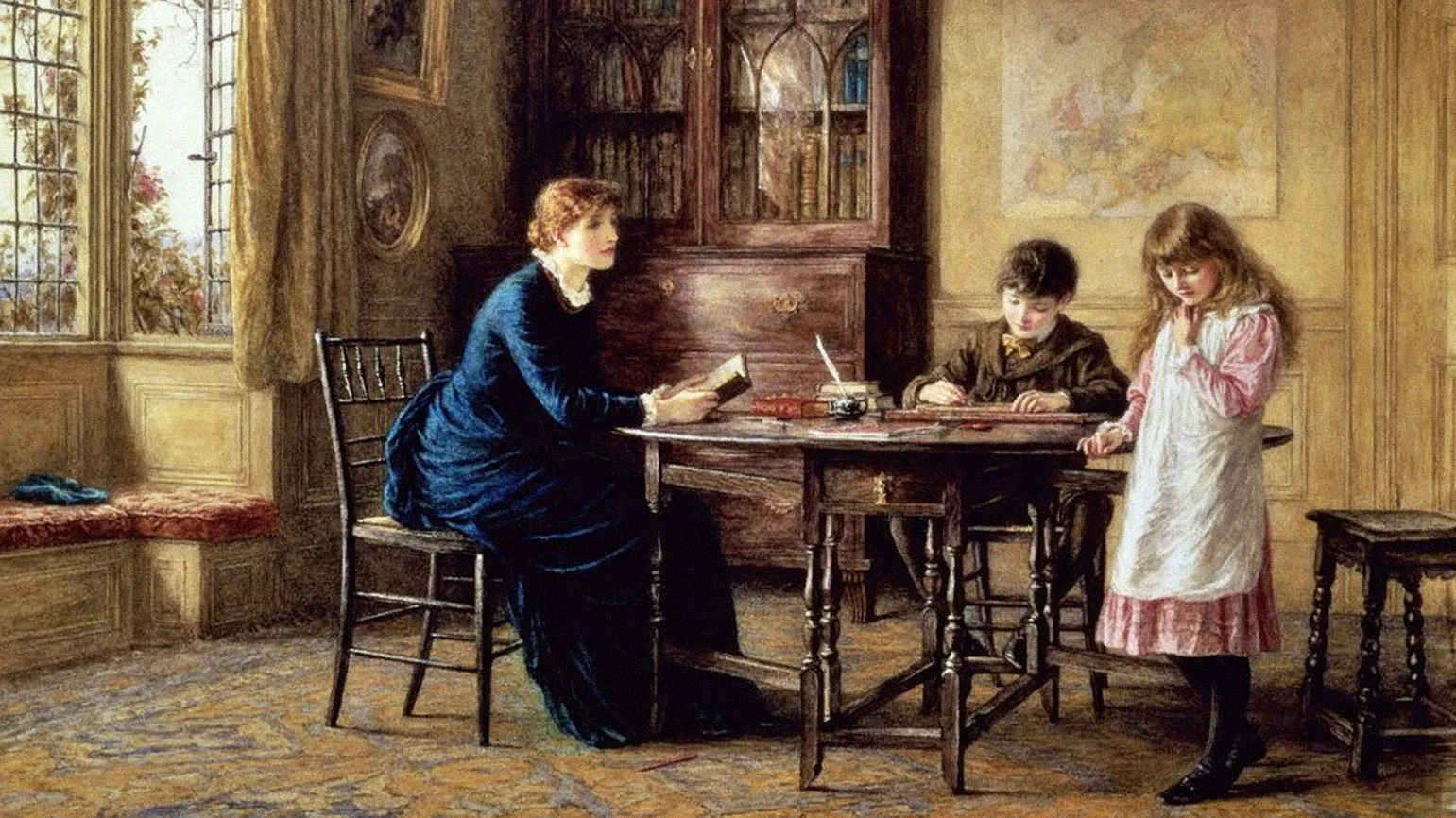
After I had trudged through the unbearable ABC book, I was taught to write, and was given Anna Sontag's "Sacred History" to read. It was pure bliss! After I got through the first few pages, I began to read quite fluently. Nanny was delighted with my progress. There were almost no children's books in our house, and at that time there were very few of them, so every day I had to read one story from Anna Sontag and a few pages from Pushkin. I read everything strictly in order: be it a lyric poem, a long poem, a novel, or a short story. Each day, the lessons brought me more and more joy, and soon my mother informed my sister that she no longer needed to supervise my reading. I was allowed to borrow any books we had at home. However, in addition to the works of Pushkin and Anna Sontag, our arsenal included books in Polish and French, which I could not understand. Nevertheless, I reread Pushkin many times and memorized his poems. At the Dawn of Life is a work by E. N. Vodovozova, published in two volumes in 2018 in Moscow by Knigovek Publishing House. The book explores the key stages in the emergence of life on Earth, examining scientific theories and discoveries that helped us understand how the first living organisms emerged. The author analyzes in detail the biochemical processes, environmental influences, and evolutionary changes that contributed to the development of life. This publication will be useful for both students and anyone interested in the origins of life and its evolution.
Context
Elizaveta Vodovozova (1844–1923) shares her memories of the home education she received in a ruined noble family. Due to financial difficulties, the family was unable to hire a governess, and under such circumstances, mothers often taught their children the basics of literacy, numeracy, and sometimes French, if they themselves had knowledge of these skills. In Elizaveta's case, her older sister took on the role of teacher while their mother was busy rebuilding the neglected farmstead on an unprofitable estate. This underscores the importance of family education in times of crisis, as well as the need to transmit knowledge within the family.
The unusual method of teaching reading described in this passage is not the result of an amateurish approach to pedagogy. If little Liza had been taught by a professional governess, the learning process would have been similar. If she had been taught by a priest or deacon, as was often the case at the time, she would have had to master more complex church texts. This approach to teaching reading emphasizes the importance of context and the teacher's level of preparation, which directly affects the quality of learning.
Teaching children to read can be extremely challenging, especially given pre-reform orthography, which was significantly more complex than modern orthography. Complex letters such as "yati," "fity," and "izhitsy," as well as the difficult-to-pronounce hard sign at the end of words, made text difficult to comprehend. As a result, many children struggled and remained illiterate. Overcoming these difficulties required true perseverance and patience.
The development of children's reading is an important event in the history of Russian education. The first adapted primers and independent reading books for children appeared in Russia in the second half of the 19th century. This became possible thanks to the efforts of Konstantin Ushinsky and Leo Tolstoy. Ushinsky, a renowned educator, developed a phonics method of teaching, which involves teaching children to first distinguish letters and sounds, and then to combine them into syllables and words. Leo Tolstoy also implemented his pedagogical ideas within the school founded in Yasnaya Polyana. Both authors created specialized books for children: Ushinsky wrote "Children's World: A Reader," and Tolstoy created his "ABC Book." These works played a key role in shaping the foundations of children's reading in Russia and remain relevant to this day.

Reading is an important part of our lives, allowing us to gain new knowledge and develop our thinking. Books, articles, and blogs open doors to new ideas and help deepen understanding of various topics. Reading is not only entertaining but also promotes personal growth, improves vocabulary, and improves writing skills. In today's world, where information is available in any format, it is important to find time to read to stay informed and expand your horizons. Don't miss the opportunity to enrich your life with literature and articles on topics that interest you.
Leo Tolstoy on the Spirit of Education and His Teaching Mistakes
Leo Tolstoy, the great Russian writer and thinker, devoted considerable attention to issues of education and upbringing. In his works, he analyzed not only literary themes but also pedagogical aspects, examining the spirit of the school, its goals, and methods. Tolstoy emphasized the importance of an individual approach to each student, believing that true education should be based on freedom and an inner desire to learn.
He criticized traditional teaching methods based on memorization and rote learning, calling for a more humane and meaningful approach. Tolstoy shared his teaching mistakes, which became lessons on the path to creating a more effective educational environment. His views remain relevant today, encouraging educators to reconsider their teaching methods and strive to create an inspiring and supportive learning environment for students.
Thus, Tolstoy's legacy in the field of education continues to influence modern approaches to teaching, inspiring a new generation of educators to search for more humane and effective methods.
In his two-volume work "Man as a Subject of Education: An Experience of Pedagogical Anthropology," published in 1868 and 1869, Ushinsky revealed to his fellow teachers facts that are obvious from a modern perspective: children are physiologically incapable of engaging in the same monotonous task for an extended period of time, and it is unreasonable to expect this of them. The learning process for children should be visual and interactive, which contributes to more effective knowledge acquisition.
Elizaveta Vodovozova received a traditional education. At the time of the publication of Ushinsky's book "Man as a Subject of Education," she was approximately 24-25 years old. During this period, she was already working as a teacher and was working on her pedagogical book, "The Mental Development of Children from the First Appearance of Consciousness to the Age of Eight," published in 1871. Vodovozova entered the profession largely thanks to Ushinsky, with whom she had the opportunity to study at the Smolny Institute for Noble Maidens. It was during his brief period as inspector that he opened an additional senior pedagogical class, where Elizaveta became one of the first students. She later married Vasily Vodovozov, her colleague and associate of Ushinsky, who was also an adherent of innovative pedagogical ideas that later became classics. Drawing on her experience in literacy teaching, Elizaveta Vodovozova emphasized the importance of developing children's native language. She proposed using folk songs and fairy tales in teaching reading, as these texts are easily understood by children. Vodovozova published a collection of folk songs and wrote several stories for children, which helped improve their reading skills and language comprehension.
Read also:
- Elizaveta Vodovozova - about studying and passing exams at the Smolny Institute
- Elizaveta Vodovozova - about how Ushinsky came to the Smolny Institute
- 10 facts about schools in pre-revolutionary Russia
- Jan Amos Comenius: a brief overview of the pedagogical concept
- Maria Montessori: a brief overview of her pedagogical approach, fate, and fame
The Profession of Methodologist from Scratch to PRO
You will improve your skills in developing curricula for online and offline courses. Master modern teaching practices, structure your experience, and become a more sought-after specialist.
Find out more