
Contents:
- Are e-learning and distance learning the same thing?
- What do they say about the concept of e-learning in the professional community?
- Why there is confusion in the concepts
- Why the term "e-learning" is actually outdated
- How did the concept of e-learning appear?
- How are the concepts of e-learning and EdTech related?

Learn: Online Tutor
Learn MoreAccording to the Russian standard GOST R 52653-2006 "Information and Communication Technologies in Education. Terms and Definitions," e-learning stands for electronic learning. E-learning is a learning process that is carried out using information and communication technologies (ICT). ICT includes a variety of information processes and methods of working with data applied using computing and telecommunications. This allows for the creation of flexible and accessible educational platforms that promote more effective learning and increase the accessibility of education for a wider range of people.
E-learning is training that is carried out using the Internet and digital technologies. It can be entirely online or conducted in a traditional classroom, using various digital tools. These tools include online platforms, services, and applications that make learning more accessible and effective. E-learning is becoming increasingly popular in today's world, offering flexibility, convenience, and a wide range of opportunities for students and teachers. Are e-learning and distance learning the same thing? The Law "On Education in the Russian Federation" contains a rather extensive and complex definition of e-learning. E-learning is the process of acquiring knowledge using digital technologies and internet resources, enabling distance learning. This approach provides access to educational materials anytime and from anywhere, making it convenient and effective for students seeking modern forms of education. E-learning is being actively implemented in Russian educational institutions, promoting a diversity of teaching methods and adapting the educational process to the individual needs of students. E-learning involves organizing the educational process using information stored in databases and the technologies that enable its processing. This involves the use of information and telecommunications networks for data transfer and interaction between students and teachers. As a result, e-learning facilitates more effective knowledge acquisition and increases the accessibility of educational programs. The law also mentions distance learning technologies. These technologies are implemented primarily using information and telecommunications networks, enabling interaction between students and teachers at a distance. Distance learning is becoming increasingly relevant, as it allows access to educational resources at any time and from anywhere, thereby promoting the flexibility of the educational process and an individual approach to each student.

From a legislative perspective, distance learning technologies and e-learning are different concepts. In 2013, the Ministry of Education and Science clarified the main difference: e-learning does not involve direct interaction between students and teachers, while distance learning, on the contrary, is based on indirect interaction between them. This difference is important to consider when choosing learning formats and organizing the educational process.
Thus, watching recorded video lectures or doing homework on a specialized digital platform without interaction with a teacher can be classified as e-learning. Meanwhile, online lessons conducted by teachers in real time with active communication with students constitute distance learning. These learning formats have their own characteristics and advantages, allowing each student to choose the most appropriate way to acquire knowledge.
Distance learning and e-learning, although they use similar electronic technologies, represent different concepts. Distance learning involves instruction at a distance, where students and instructors interact online, while e-learning encompasses a broader range of educational resources and methods, including online courses, multimedia materials, and interactive platforms. Thus, distance learning can be considered a subset of e-learning, but not the same as it.
The use of digital platforms and services, as well as virtual reality tools, during in-person classroom instruction can be considered a form of e-learning. These technologies complement traditional teaching methods and create new opportunities for interaction between students and teachers. Thus, the integration of digital technologies into the educational process expands learning horizons and makes it more interactive and accessible.
There is some confusion in official terminology, which has been the subject of criticism from legislators since 2013. This situation highlights the need for a clearer and more unambiguous approach to legislative language. Misunderstandings of terms can lead to legal ambiguities and difficulties in their application. Therefore, it is important to review existing terms and introduce clear definitions to ensure legal stability and transparency.

Read also:
Synchronous and asynchronous learning: key differences and their
Synchronous and asynchronous learning are two main approaches to the educational process, each with unique characteristics and advantages. Understanding these differences is important for choosing the most appropriate teaching method based on the goals and needs of learners.
Synchronous learning occurs in real time, when instructors and students interact simultaneously. This format allows for instant feedback, participation in discussions and collaborative tasks, which promotes deeper learning. However, synchronous learning requires participants to adhere to a specific schedule, which may be inconvenient for some.
Asynchronous learning, on the other hand, provides flexibility. Learners can study the material at their own time and pace. This approach includes the use of video lectures, online courses, and other resources available at any time. Asynchronous learning is ideal for those with busy schedules or those who prefer independent learning. Understanding these learning formats allows educational institutions and learning platforms to develop more effective programs that accommodate a variety of learning styles and student needs. The choice between synchronous and asynchronous learning depends on individual preferences, as well as the goals and context of the educational process. What the Professional Community Says About E-Learning There is still no consensus in the academic community on what e-learning is. This term covers a wide range of educational practices and technologies related to learning in a digital environment. Some researchers view e-learning as a form of distance learning, while others focus on the use of interactive platforms and multimedia resources to enhance the effectiveness of the learning process. It is important to consider that e-learning includes both synchronous and asynchronous teaching methods, making it flexible and accessible to different categories of learners. Thus, the development of e-learning requires further study and understanding of its features and capabilities in the context of modern education.
- Some researchers believe that the concept of e-learning is broader than the concepts of distance learning or online learning and propose considering online and distance learning as part of e-learning;
- Others use the concepts of distance and e-learning as synonyms.
Corporate training practitioners argue that e-learning is not limited to distance formats. It can also be conducted in person in the classroom using digital technologies. In the future, distance learning will likely be integrated with the concept of e-learning, as alternative formats other than electronic are becoming less relevant. It is unlikely that anyone will return to old teaching methods, such as exchanging written training materials by mail. The relevance of e-learning will only grow, making it an important tool in the modern educational process.

Reworked text:
Also study:
Robot teachers: prospects and real Benefits
Robot teachers are becoming an increasingly popular topic in education. Their integration into the educational process promises numerous advantages, such as a personalized approach to each student and accessible learning for people with disabilities. Artificial intelligence technologies allow robots to adapt educational materials to the individual needs of students, which can significantly improve the effectiveness of learning.
However, it is important to understand that the role of robots in education is not limited to automation. They can be a useful addition to traditional teaching methods, giving teachers more time to work with students. However, completely replacing teachers with robots seems unlikely, as the human factor and emotional support remain indispensable.
The prospects for using robot teachers depend on the further development of technology and their integration into educational systems. Key factors for success include the quality of software, the availability of adaptive learning systems, and the robot's ability to interact with students on an emotional level. It's also important to consider the opinions of teachers and students to ensure that robots truly benefit and improve the educational process.
Thus, robot teachers have significant potential, but their real value will depend on how they are used in conjunction with traditional education and how they are perceived by all participants in the educational process.
Why the confusion in terms has arisen
The diversity and gradual introduction of Anglicisms into the Russian educational sphere have led to confusion in terminology. Elena Tikhomirova, CEO of ELC, author of the "Live Learning" channel and an expert in the field of e-learning, emphasizes the importance of clarity in the use of terms. Adequate understanding and application of e-learning terms is critical for effective learning and interaction between participants in the educational process.
Confusion in terminology arises from the large number of foreign words that essentially mean the same thing. The lack of a single body that could standardize these terms and establish clear definitions leads to confusion. Experts emphasize the need to create a single "think tank" or ministry that would assume responsibility for unifying terminology and bringing clarity to this area. This will help avoid misunderstandings and facilitate communication among specialists.
Pavel Bezyaev, leader and founder of the Digital Learning community, emphasizes that confusion with terminology in education is not only due to borrowed concepts. The problem is that organizations involved in distance, electronic, and online education have long operated in isolation. Each institution, whether a university or a company, was confident in the correctness of its choice of terminology and approaches. As a result, the educational community now needs to agree on uniform standards, terminology, and practical recommendations for effective interaction and improving the quality of online education.
The problem is that the terms "e-learning" and e-learning have already become outdated. In today's world, educational technologies are developing rapidly, and new approaches to learning require more relevant definitions. Given the rapid growth of digital platforms and innovative teaching methods, it is necessary to rethink these concepts to reflect their current status and potential.
Why the Term "E-Learning" Is Actually Outdated
Pavel Bezyaev argues that the terms "e-learning," "e-course," and e-learning have become outdated. In his opinion, companies and providers using these expressions, on the one hand, are trying to demonstrate their experience in the market, and on the other, emphasize their irrelevance. In the current context, it is more correct to use the terms "online learning," "online courses," or "digital learning." These phrases better reflect modern trends in the educational sphere and meet the current requirements of users.

Elena Tikhomirova also expresses her opinion about The term "e-learning" was relevant in the past when it emphasized an alternative to traditional methods that did not use digital tools. Today, when technology has become an integral part of traditional education, this concept requires revision. E-learning and traditional forms of education are no longer opposed, but represent an integration, where digital technologies enrich the educational process and make it more accessible. Elena emphasizes that in the modern world, it is impossible to consider e-learning as a separate area. Education in general includes the use of various information technologies and digital tools. The implementation of these technologies can be found in almost every field, which emphasizes their importance and versatility in the educational process. Maintaining a clear distinction between forms of education in which the student is physically removed from the teacher or training center, and those in which they are located in the same room is important. Elena argues that terms such as electronic, distance, and online learning should be combined into a single concept - distance learning. This will allow us to better understand and systematize various approaches to learning in the modern educational process, given the growing popularity of technology and the need to adapt to them.
How did the concept of e-learning appear?
We visualize the evolution of educational tools, which led to the emergence of new categories of learning.
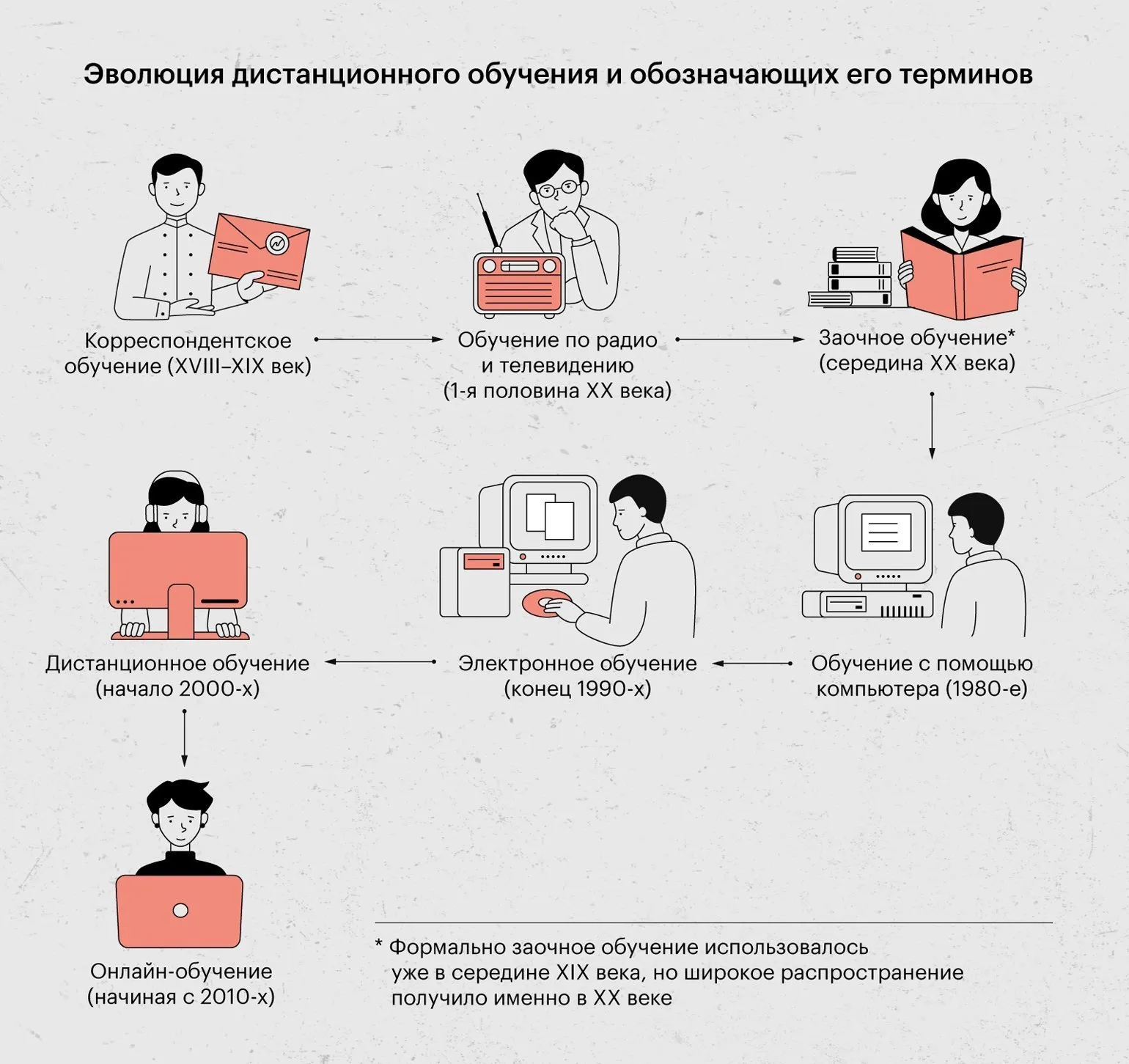
Throughout history, people have faced the need for distance learning, regardless of classrooms and lecture halls. In the 19th century, the solution to this problem was the use of mail: educational materials were sent to students, allowing them to study at home. Distance education became an important tool for those who were unable to attend classes in a traditional format. With the development of technology, distance learning has undergone significant changes, opening new horizons for the educational process.
In the first half of the 20th century, radio replaced traditional mail, especially in remote areas such as parts of Australia. In these places, students received educational materials and lessons via radio waves, facilitating access to knowledge and information in a context of limited communication.
Correspondence education at universities is gradually becoming increasingly popular. In this format, the main educational process takes place remotely, with students attending the institution only for final lectures or exams. This approach allows students to combine study with work and other commitments, making education more accessible to a wider audience.
The spread of computers in the 1980s significantly simplified the learning process, allowing people to study without leaving their familiar environment. Teachers and trainers were able to effectively "package" their knowledge. The introduction of CD-ROMs made information sharing more accessible: it became possible to create presentations, record educational materials, and record courses on disks. This period was significant for the development of computer-based learning and distance education, opening new horizons for learning and self-development.
In 1999, the term e-learning was introduced. This term was proposed by American educational technology expert Elliott Macy. E-learning encompasses the learning process using various technologies, including software and Internet resources. Since then, e-learning has become an important part of the educational process, allowing students to gain knowledge in a convenient format and at their own pace.
In the early 2000s, the first versions of distance learning systems known as LMS (Learning Management Systems) entered the market, as well as courses developed according to SCORM (Shareable Content Object Reference Model) standards. By the 2010s, massive open online courses (MOOCs) gained widespread popularity, marking a new stage in the development of education. Although the concept of online learning began to take shape back in the 1990s, it was during this period that it received its active development and recognition. Online learning has become an accessible and convenient solution for students and professionals seeking development and professional development.

Also explore:
Bookshelf: E-Learning, by Michael Allen
Book Michael Allen's "E-Learning" is an essential resource for e-learning professionals. He shares practical methods and strategies for developing effective learning programs. Allen emphasizes the need to create interactive and engaging content that meets learners' needs. He discusses modern technologies used in e-learning and their impact on the learning process. This book will be useful for both beginners and experienced education professionals looking to improve the quality of their courses and programs.
How are e-learning and EdTech related?
The term "e-learning" has been around for over 20 years, and during this time, a variety of digital tools have emerged in the education sector, including online platforms, services, and applications, as well as virtual reality (VR) and augmented reality (AR) technologies. As a result, a new term has emerged: EdTech, derived from the words "Education" and "Tech." Education has undergone large-scale digitalization, similar to processes occurring in other areas of human activity. The COVID-19 pandemic has significantly accelerated this process, forcing educational institutions to adapt to new conditions and implement innovative approaches to learning. The term EdTech does not have a single definition in the educational community. Some experts view it exclusively as digital technologies designed for educational purposes and the market for their developers. Others understand EdTech to be the learning process carried out using digital technologies, including the entire online education market. In practice, this term covers a wide range of concepts related to e-learning. EdTech has become synonymous with innovative approaches in education, combining technologies and teaching methods to improve the effectiveness of the educational process. What is an educational environment and what types are there? What are learning tools and what types are there? Get a higher education online? That's fiction, not education! Or not?
Online tutor
It doesn't matter what you teach - English, CrossFit, yoga, vocals, or culinary arts. Everything you previously taught in schools, studios, and offices can now be taught online. Promote your knowledge and skills and earn money from anywhere in the world.
Learn more