Contents:

Learn: The Profession of Methodologist from Scratch to PRO
Learn More
Edutainment and game practice specialist, scriptwriter and executive director of the creative association #Shashniki. We develop and conduct camp programs for children and teenagers based on the Edutainment concept, which combines learning and entertainment. Our goal is Create engaging and educational events that promote the development of skills and knowledge in young people.

Trainer, methodologist, and expert in communication and personal effectiveness. Head of educational programs at the creative association #Shashniki. Provides development of skills necessary for successful communication and increased personal productivity. Specializes in creating effective educational programs aimed at improving interaction and achieving personal goals.
Edutainment is a unique approach that combines learning and entertainment. While the concept of "learning" is fairly clear, "entertainment" in English covers a broader range of meanings than in Russian. In Russian, entertainment is primarily associated with pleasure and good humor, while in the English context, entertainment includes not only pleasure but also interest and the ability to maintain attention. This approach makes the learning process more engaging and effective by combining educational elements with interesting content, which promotes better information absorption and increased motivation among learners. Edutainment is becoming an important tool in modern educational practices, allowing learning to be tailored to the needs and interests of the audience.
Gamification is the use of game elements that stimulate motivation to perform non-game actions. This approach is widely used in online courses, where students earn "currency" for successfully completing stages or tasks. Accumulated currency can be exchanged for prizes, adding an element of competitive excitement. Furthermore, gamification is actively used in educational programs built on the concept of edutainment, increasing student engagement and interest. This makes the learning process more interactive and engaging, which in turn improves learning.
Game-based pedagogy is a teaching method based on the use of games in the educational process. In this approach, games incorporate educational elements, making learning more engaging and effective. Edutainment programs can be built on the principles of game-based pedagogy, but their primary focus is entertainment rather than the gameplay. It is important to note that in game-based pedagogy, entertainment is not always the priority, as games can be not only entertaining but also complex, requiring a serious approach and in-depth analysis. Thus, game-based pedagogy combines educational and gaming elements, creating unique opportunities for developing skills and knowledge.
Elements of game-based pedagogy, gamification, and other methods can significantly enrich a program within the edutainment concept. However, they can also be used independently of this approach, which expands their capabilities and application in educational processes. The use of such elements helps increase participant engagement and interest, making learning more effective and engaging.
Abroadly, this term usually refers to a category of media content, including educational films, television and radio programs, as well as computer programs and services that contain entertainment elements.
The term edutainment was first coined by Walt Disney in 1954 to describe a series of nature documentaries called True-Life Adventures. In 1974, British zoologist Robert Heyman applied the term to National Geographic programs. Edutainment combines educational and entertainment elements, making it an effective tool for teaching and engaging in various topics. This approach is widely used in modern media, allowing viewers not only to be entertained but also to gain new knowledge.
When video-based learning was just beginning to develop, it wasn't as popular as it is today. It was perceived as something unusual and surprising: "We're watching TV in class!" Video in education has become an important tool for diversifying the learning process and making it more interactive. With the development of technology and the availability of video content, video-based learning is becoming a standard in educational institutions, helping students better absorb material and develop skills.
Nowadays, video content has become commonplace and no longer surprises audiences. However, the basic principle remains unchanged—a combination of education and entertainment. Modern edutainment programs incorporate new entertainment elements, making them more engaging and effective for viewers. A prime example of an edutainment program presented in a television format is "Sesame Street." In this program, animated characters teach children the basics of reading and counting, as well as introduce them to colors and other important concepts. Workbooks featuring these characters were developed to complement the television program. This program not only helps children prepare for school but also further develop their skills in elementary school. Edutainment thus becomes an effective tool for learning and entertainment, allowing children to acquire new knowledge in a fun way. The KidZania educational and entertainment center is a shining example of a modern approach to children's education. At this center, children have the opportunity to try their hand at various professions, which helps develop their soft skills. The atmosphere is as realistic as possible: the child dresses up as a doctor or firefighter, and a real expert in the field is nearby. A corresponding atmosphere is created, making the learning process engaging and educational. KidZania not only develops professional skills but also fosters critical thinking, communication skills, and self-confidence in children. Education is the foundation for creating edutainment programs. The primary focus is on educational value, and it is first necessary to determine what participants should learn and how we will evaluate their results. These questions serve as a starting point for developing new programs or updating existing ones. Entertainment in this context is seen as a tool that helps attract participants' attention and deepen their engagement in the educational process. Sometimes the opposite situation occurs. For example, a recreational camp where children come for recreation decides to introduce an educational component into its program. In this case, the training is adapted to the camp's existing recreational activities. The essence of edutainment is that even such deliberate addition of educational elements can appear natural and harmonious, enriching children's overall experience. Edutainment plays a key role in the learning process, especially for young children, who often have difficulty concentrating. They quickly lose interest, especially if the material requires repetition or seems complex. However, the effectiveness of edutainment extends to adult learners as well. The main goal of edutainment is to overcome these difficulties, engage participants through playfulness, and create an engaging learning atmosphere. Provided that the edutainment program is carefully designed, engagement occurs naturally and productively, promoting better assimilation of the material and increasing motivation for learning. The game metaphor, including the game world and plot, is an important aspect of learning. It promotes a better understanding of the educational material and opens new horizons for perception. For example, in a program dedicated to the development of emotional intelligence, a plot in which participants must save a character using empathy could be used. This approach not only makes the learning process more engaging but also helps reinforce acquired knowledge through practical application in a game-like format.
This problem is indeed relevant. For example, a user may become "hooked" on a gamified language learning app and initially demonstrate high activity. However, if they lack an intrinsic incentive to learn the language, motivation based on game elements will only last for a limited time. It's important to note that to achieve long-term results in language learning, gamification must be combined with intrinsic motivation and user commitment. This will not only maintain interest in learning but also significantly improve the effectiveness of the process.
Edutainment is not the only tool for learning. It is also important to develop intrinsic motivation. An effective approach in this context can be the concept of self-directed learning proposed by Gerald Grow. This concept assumes that the student moves from dependence to self-direction, gradually taking a more active part in their educational process. It is important to create conditions in which the student can independently determine their goals and methods for achieving knowledge, which contributes to deeper and more meaningful learning.
Grow identifies four stages of the learning process: dependence, interest, involvement, and self-direction. The use of edutainment is especially important in the first two stages. When a person does not understand why they need to study, edutainment helps convey the meaning of learning by adding an emotional component and involving inspiring and supportive characters in the story. This approach effectively motivates and promotes interest in the learning process.
At the stage of developing interest in learning, sufficient motivation for independent study may be lacking. In this case, entertainment elements become an important support. They help immerse students in the process, engage them, and foster learning habits. Incorporating game mechanics and engaging content into the educational process can significantly increase engagement and improve learning outcomes.
When students are actively engaged in the learning process, the entertainment element becomes less noticeable. However, when they begin to tire, edutainment elements can again play a role as additional motivation. In this context, maintaining a balance between educational content and entertainment aspects is key. This not only helps maintain student interest but also promotes more effective learning.
Self-directed participants, goal-oriented and motivated to learn, may feel irritated by entertainment components. For them, acquiring knowledge is paramount, and any unnecessary elements distract from the main goal.
In lectures on the introduction of gamification into the educational process, experts note that the dynamics of participant engagement change throughout the course of the course. At the beginning of a course, students experience a high level of interest due to entertaining elements, which leads to increased engagement. However, over time, these elements can become habitual, and participant engagement begins to wane. Therefore, it is advisable to introduce gamification in educational programs in a phased manner: at the start of training, a significant game component is used, which then gradually decreases, and then is reinvigorated. This approach helps maintain participant interest and motivation until the final educational goal is achieved, ensuring effective learning.
It is important to distinguish between primary education, such as school, and additional education. It is difficult for teachers to create educational programs based on edutainment, as it requires significant time and energy. However, edutainment elements can be integrated into individual lessons, which helps make learning more engaging and effective. Edutainment helps increase student interest in the learning process and improves learning. Incorporating game elements and interactive tasks into lessons can significantly increase student motivation and make learning more dynamic.
In continuing education, the depth of an edutainment program is determined by its duration, target audience, educational objectives, and available resources. Given the appropriate demand and sufficient resources, it is possible to create a comprehensive and in-depth edutainment program. This approach effectively combines entertainment and learning, which promotes better assimilation of the material and increases participant interest.
In the programs developed and implemented as part of the #Shashniki project, the level of immersion in the topic varies depending on the client's needs. This includes both in-depth analysis of the topic and a basic introduction to a set of skills, allowing training participants to put these skills into practice through assignments. Edutainment, as a teaching method, attracts and engages participants, fostering their interest in the topic. Later, they will be able to independently deepen their knowledge and apply their acquired skills in everyday life.
Adults also enjoy playing games, and using entertainment to engage them is an effective approach. It's important not to overdo it with game metaphors and to choose entertainment that genuinely interests adults and can capture their attention early on. Over time, the focus will shift to learning, allowing for a deeper immersion in the material being studied.
Edutainment plays an important role in corporate training, especially when training is initiated by management. In such cases, employees often experience low personal motivation, which can negatively impact learning. Using edutainment methods helps make the learning process more engaging and engaging. This promotes employee interest and engagement, which in turn improves learning outcomes and contributes to the development of corporate culture. Edutainment allows you to transform traditional training methods into more interactive and effective formats, which is especially important in a rapidly changing market.
If employees are passionate about a particular TV series, this can be used in training programs. Incorporating characters and humor from the series will make the learning process more engaging and engaging. The connection between the events of the series and the training topic promotes better retention of information, even if it was not initially of interest. This approach not only increases employee motivation but also improves material absorption, which ultimately increases the effectiveness of training.
There are many different methods, and we are constantly adding new tools to our arsenal. Some are related to gamification, others are related to gameplay, and some are difficult to classify.
The essence of the entertainment component of an edutainment program lies in the use of a game metaphor. Within this metaphor, a carefully crafted game world is created, which may include elements such as a space station, a scientific laboratory, and other unique locations. A key aspect is the presence of characters and a compelling storyline unfolding within this world. This combination allows for not only entertainment but also education, making the learning process more engaging and interactive.
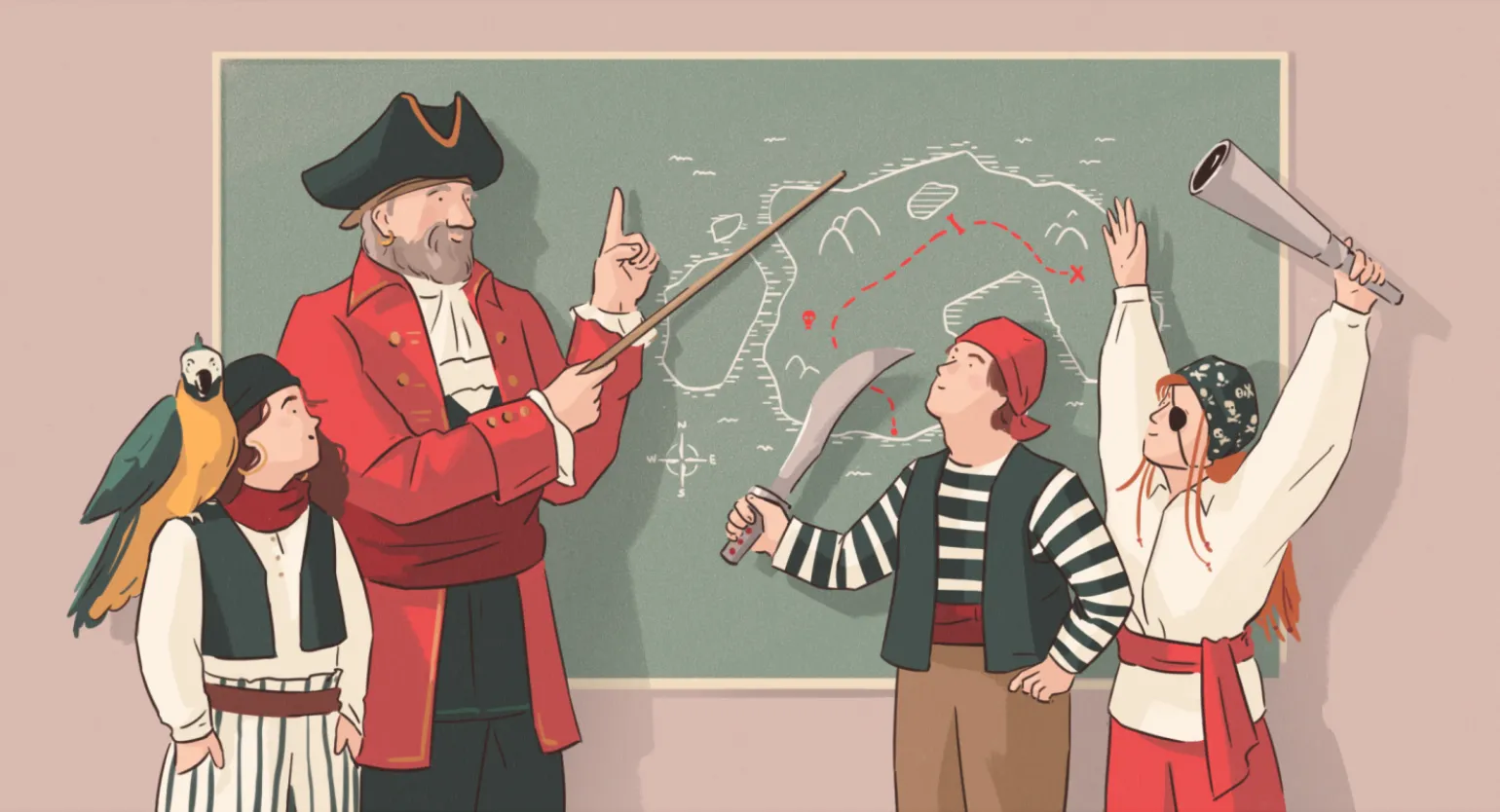
Important elements of the edutainment concept play a key role in creating an engaging educational experience. One such element is the image of the presenter or organizer. For example, in a lesson on the history of the War of 1812, the presenter might take on the role of Napoleon, and their appearance, speech, and body language should match this image. Preliminary immersion of participants in the program topic is also crucial and can be achieved through a welcome box with thematic content, a video invitation, or a letter. The atmosphere of the space in which the lesson takes place should be in harmony with the theme of the edutainment program and the educational goals. This design should encourage participants to become more immersed in the learning process, for example, by imagining themselves on a real rocket heading to aliens to practice their communication skills.
Gamification often utilizes in-game currency, which allows users to purchase various goods, such as merchandise or in-game items. Points are also used, which cannot be spent but contribute to a user's level or rank, as is implemented in video games. This creates the opportunity to create rankings and leaderboards, highlighting participants' achievements and motivating their activity. Gamification thus becomes an effective tool for increasing user engagement and motivation.
Challenges are tasks within a specific concept, for completing which participants can earn rewards. Such activities often utilize interactive objects that can be interacted with, thereby obtaining useful information. For example, these could be robots or voice assistants providing users with the necessary data and interactive experiences.
The traditions formed by participants during the program are an important aspect. No program is complete without a role-playing element, which includes a special thesaurus. In the context of the edutainment camp concept, the traditional roles of "counselors" and "teachers" are absent. Instead, designations such as "scientists," "astronauts," "laboratory assistants," and others are used, defining a specific narrative and the participants' functions. Each title not only defines a role but also creates a corresponding image, making the learning process more engaging and interactive.
The main approach in modern teaching methods is active methods, which place the participant at the center of the educational process. In this context, the student becomes an active researcher, independently acquiring knowledge through practical experience. The role of the teacher is to support, direct, and correct the learning process, which promotes deeper assimilation of information and the development of critical thinking. Active learning methods foster an interactive environment where each participant can take initiative and develop their skills.
Various teaching methods can be used, such as role-playing, project-based learning, and case studies. Video viewing and discussion, debates and discussions, brainstorming sessions, and hands-on assignments are also effective tools. Art techniques, experiments, and mind mapping can be an important addition to these methods, promoting a deeper understanding of the material and developing critical thinking.
Active learning methods integrate successfully with edutainment, making them particularly effective for engaging participants who may be less interested. Unlike traditional lectures, these methods help create an interactive atmosphere that promotes deeper learning and increased motivation.
You can't include 15 active methods in a row in a program and expect participants to be delighted. It is important to remember that the opportunity to sit and listen is an integral part of the educational process. Providing participants with time to rest is also crucial. A balance between active engagement and time for reflection promotes more effective learning.
Learn more about education by subscribing to our Telegram channel. Here you will find current news, useful tips, and interesting materials related to educational trends and innovations. Don't miss the opportunity to stay up to date with the latest developments in the field of education. Subscribe to our channel and stay in touch!
Also explore:
- Bookshelf: "Learning through Entertainment"
- How to quickly and affordably implement gamification in education
- 4 scenario tricks that will be useful for online course methodologists
- How schools and universities organize a zombie apocalypse
- "There are no mistakes in a real game": an interview with an expert in game pedagogy
Edutainment is a unique approach that combines learning and entertainment. While the term "education" implies the process of imparting knowledge, the word "entertainment" in English encompasses a broader range of meanings than its Russian counterpart. We associate entertainment with fun and pleasant emotions, while in English, "entertainment" encompasses not only pleasure but also the ability to hold the audience's interest and attention. Edutainment is becoming an important tool in the educational process, making learning more engaging and effective, which facilitates better information absorption. Gamification is the use of game elements to increase motivation for non-game activities. It is widely used in online courses, where students are awarded virtual currency for completing stages or tasks. This currency can be exchanged for prizes, creating additional interest in learning. Furthermore, competitions with prizes for winners can be organized during the learning process, adding an element of excitement and engagement. Gamification is also actively used in educational programs based on the concept of edutainment, where learning is combined with entertainment, which promotes more effective information absorption.
Game-based pedagogy is based on learning through play, where game activity includes educational elements. Edutainment programs can be built on the principles of game-based pedagogy, but their primary focus is entertainment, not the game itself. In game-based pedagogy, entertainment is not a mandatory component, as games can be serious and require in-depth analysis, making them more complex and purposeful.
Elements of game-based pedagogy, gamification, and other methods can be part of a program within the edutainment concept. However, they can also be applied independently of this approach.
Abroadly, this term is typically used to refer to media content that includes educational films, television programs, radio programs, as well as computer programs and services with an entertainment element. This content combines information and entertainment, making it appealing to a wide audience.
The term "edutainment" was first coined by Walt Disney in 1954 to describe a series of nature documentaries called True-Life Adventures. In 1974, British zoologist Robert Heyman applied the term to National Geographic programs. Edutainment, as a synthesis of education and entertainment, has become an important tool in popularizing knowledge about nature and the world around us. This approach allows for the presentation of information in an engaging and accessible way, which promotes better assimilation of the material by viewers.
At that time, video-based learning was not as popular as it is today. It was perceived as something unusual: "We're watching TV in class!" Video learning was just beginning to become a part of the educational process, opening up new opportunities for information comprehension and student engagement. Today, video content has become commonplace, and it's hard to impress anyone with it. However, the core principle remains unchanged—a combination of education and entertainment. Modern edutainment programs feature new entertainment elements that make the learning process more engaging and engaging. This helps retain the audience's attention and promotes better information absorption. A classic example of an edutainment program in a television format is Sesame Street. In this program, cartoon characters teach children the basics of reading and counting, as well as introduce them to colors and other important concepts. Workbooks featuring the characters were developed to complement the television program, allowing children not only to prepare for school but also to develop in elementary school. The program effectively combines entertainment and education, making the learning process engaging and accessible to young viewers.
A striking modern example of offline entertainment is the KidZania educational and entertainment center. In this unique space, children can try their hand at various professions, which helps develop their soft skills. Everything is organized as realistically as possible: the child dons a costume, for example, of a doctor or firefighter, surrounded by a real expert from the relevant field, and a corresponding atmosphere is created. This approach not only engages children but also helps them understand the world of professions, developing skills that will be useful in the future.
Learning is a key aspect in creating an edutainment program. The foundation of such a program is educational value. It is important to determine what exactly participants need to learn and how the effectiveness of the learning will be assessed. These questions become the starting point when developing a new program or modifying an existing one. The entertainment element serves as a tool for capturing participants' interest and deepening their involvement in the educational process.
In some cases, the opposite occurs. A recreational camp where children come for recreation decides to introduce an educational component into its program. In this case, the learning is adapted to the camp's existing recreational activities. The advantage of edutainment is that even such an integrated addition can appear natural and harmonious. An effective combination of education and entertainment promotes better assimilation of the material and makes the learning process more engaging for children.
Of course, I will help you revise the text. Please provide the original text to be corrected.
Edutainment effectively promotes engagement in the learning process. This is especially important for young children, who often have difficulty concentrating in classes. They quickly become bored if they have to repeat information or perform complex tasks. However, the principles of edutainment are also applicable to adults, helping them overcome similar difficulties. The primary goal of edutainment is to remove barriers, engage learners with the gameplay environment, and immerse them more deeply in the educational process. A well-designed edutainment program ensures natural engagement, making learning more interactive and engaging.
It's important to note that the game metaphor, including the game world and storyline, is closely linked to the learning process. A game-based story fosters a better understanding of the learning material and reveals additional aspects. For example, in a program focused on developing emotional intelligence, the plot might focus on a character's salvation through empathy. Thus, the use of game content not only makes learning more engaging but also deepens understanding of key concepts.
The problem is real: users often become addicted to gamified applications, such as language learning platforms. Initially, they may demonstrate high activity and a desire to learn. However, if they lack an internal incentive to learn a language, motivation based on game elements loses its effectiveness over time. To achieve sustainable learning progress, it's important to develop intrinsic motivation that will sustain interest in language learning even after the play period ends. Edutainment alone does not ensure deep and long-term learning, so it's also important to develop intrinsic motivation. One approach that can help with this is Gerald Grow's concept of self-directed learning. This concept suggests that learners gradually move from dependent learning to independent activity, taking an increasingly active role in the learning process. This approach not only promotes skill development but also fosters responsibility for their own learning, which ultimately leads to more effective results. Grow identifies four stages of learning: dependence, interest, engagement, and self-direction. Edutainment is especially important during the first two stages. If a person doesn't understand why they need to learn, edutainment helps convey the meaning and importance of the process. We add an emotional component and create a story in which characters inspire and support the learner, which promotes better perception of information and motivation to learn.
During the engagement stage, many may lack sufficient motivation for independent learning. In this case, entertainment elements play a crucial role, as they immerse users in the process and help create an engaging atmosphere. Such elements not only contribute to the formation of learning habits but also make it more attractive and effective. The use of games, interactive tasks, and creative approaches helps maintain attention and stimulates the desire to explore new topics.
When students are fully engaged and active in the learning process, the entertainment element becomes less noticeable. However, in moments of fatigue, edutainment can serve as a source of additional motivation. Therefore, finding the right balance between learning and entertainment is a key aspect of an effective educational process.
Self-directed participants, goal-oriented people who are intrinsically motivated to learn, may find entertainment elements irritating. They prioritize acquiring knowledge, and anything that distracts from this process is perceived as unnecessary. Therefore, educational programs for such people need to be designed with a focus on the content and practical value of the material, minimizing entertainment.
In lectures on integrating gamification into the educational process, experts note that the dynamics of participant engagement change over the course of the course. Initially, students enjoy game and entertainment elements, which leads to increased engagement. However, over time, these elements can lose their appeal, and participant activity declines. To maintain interest, game components in curricula are often introduced in waves: at the beginning of the course, an intense game element is introduced, then its intensity is reduced, and then intensified again. This approach continues until the primary educational goal is achieved.
An important aspect of the educational process is the separation of primary and secondary education. In the case of primary education, such as school, it is difficult for teachers to develop all educational programs in an edutainment format due to the significant time and labor costs. However, introducing edutainment elements into individual lessons can significantly increase student interest and engagement. This will create a more dynamic and engaging learning environment, promoting better knowledge acquisition.
In continuing education, the depth of an edutainment program is determined by its duration, target audience, educational goals, and available resources. Given the demand and sufficient resources, it is possible to develop a comprehensive and in-depth edutainment training program. This approach effectively combines education and entertainment, which promotes better learning and increased participant engagement.
In programs designed for training in checkers, the level of immersion in the topic varies depending on the client's needs. We can deepen the training, providing participants with deeper knowledge and skills, or limit ourselves to a basic introduction to the necessary skills. It is important that during the training, participants not only master the theory but also apply what they have learned in practice through various tasks. Edutainment makes the learning process engaging and promotes participant engagement, which in turn encourages them to explore the topic independently and apply new skills in real-life situations. Adults also enjoy playing games, and using entertainment elements can be an effective way to engage them in learning. It's important to choose the right game metaphors and entertainment elements that are interesting and appealing to this audience so they can become engaged early on. Gradually, the focus shifts to learning, leading to a deeper understanding of the material. Using such methods not only makes the learning process more engaging but also promotes better information retention. Edutainment is becoming an important tool in corporate training, especially when training is initiated by management. In such cases, employees may experience low personal motivation, making traditional methods less effective. Edutainment, by combining entertainment and learning, helps increase interest in training programs and improve retention. This not only helps increase employee engagement but also improves the overall effectiveness of corporate training, ultimately leading to improved productivity and the achievement of business goals.
If employees are interested in a particular TV series, you can use references to its plot in your training program. Characters and jokes from the series will make the training process more engaging and help increase engagement. The connection between the events of the series and the training topic promotes better retention of information, even if there is no initial interest. Using popular cultural elements in training not only entertains but also facilitates the assimilation of the material, which contributes to a more effective learning process.
We have a wide range of tools in our arsenal, and we are constantly adding new ones. Among them are gamification elements, game-based tools, and a number of other methods that are difficult to classify. These diverse approaches allow you to effectively engage with your audience and increase user engagement.
The key element of the entertainment component of an edutainment program is the game metaphor. It involves a carefully designed game world, which could represent, for example, a space station or a science laboratory. Important aspects of this world are the characters and the story unfolding within it. Edutainment programs use game elements to create engaging and educational experiences, effectively conveying knowledge and skills in an interesting and accessible manner. Several key aspects support the edutainment concept. The presenter or organizer plays a central role in this process. For example, during a lesson on the War of 1812, the presenter might adopt the persona of Napoleon. Their appearance, speech, and body language should match the chosen persona. Participants also need to be immersed in the program's theme during the introduction or ordering process. This can be achieved through welcome boxes with thematic content, video invitations, and welcome emails. The atmosphere of the space also plays an important role: the design should correspond to the theme of the edutainment program and the educational goals, creating an environment where participants can believe that, for example, to practice communication skills, they are on a real rocket flying to aliens. This approach promotes deeper participant engagement and improves the effectiveness of learning.
Gamification often uses elements such as in-game currency. It is used to purchase merchandise or in-game items. Unlike currency, there are also points that are not spent but accumulated, allowing participants to increase their levels or ranks, similar to video games. This creates the opportunity to create ratings and leaderboards, highlighting participants' achievements. The use of such gamification elements helps increase user engagement and motivation.
Challenges are tasks in which participants can earn rewards for completing certain tasks. These tasks are often used to increase engagement and motivation. An important part of interactive elements are objects with which users can interact, thereby obtaining valuable information. For example, these could be robots or voice assistants that provide participants with necessary data or assist them in completing tasks. Interactive objects not only make the process more engaging but also promote better information absorption.
The traditions that develop among participants during the program play a key role. Each program includes a role-playing element, which is represented by a special thesaurus. For example, the edutainment camp concept does not include the traditional "counselors" and "teachers." Instead, terms such as "scientists," "astronauts," "laboratory technicians," and others are used, creating a unique atmosphere. Each title within the plot defines its function and creates a corresponding image, which facilitates deeper involvement of participants in the learning and interaction process.
The educational process emphasizes active learning methods in which the participant acts as the subject. This means that the student independently acquires knowledge through various experiences. The role of the teacher is to support, direct, and correct this process. Active learning methods promote deep understanding of material and develop critical thinking, making them effective for achieving educational goals. Various methods can be used in the educational process, such as role-playing, project-based learning, case analysis, video viewing and discussion, debates, and discussions. Brainstorming sessions and hands-on assignments are also effective. Art techniques, experiments, and mind mapping are often used to promote deeper understanding of the material and develop critical thinking. These approaches help create an active learning environment that encourages student engagement and skill improvement. Active learning methods integrate well with edutainment and are effective even for low-interest participants who would otherwise be disengaged from traditional lectures. These approaches help maintain attention, increase engagement, and promote better learning. Using interactive elements in the learning process makes it more engaging and helps create a positive atmosphere, which in turn increases the effectiveness of training activities.
You can't include 15 active methods in a row and expect participants to be delighted. It's important to remember that the opportunity to sit and listen is a key element of the educational process. Furthermore, allowing participants time to rest and recuperate also plays a significant role in successful learning. The balance between active methods and pauses contributes to a deeper understanding and better perception of information.
The profession of Methodologist from scratch to PRO
You will improve your skills in developing curricula for online and offline courses. Master modern teaching practices, structure your experience, and become a more sought-after specialist.
Find out more