
Contents:

Learn: The Profession of Methodologist from Scratch to PRO
Find out more
- Educational analytics and educational product consultant,
- author of the Telegram channel "Education That We Deserve",
- curator of the "Education" community at Yandex.Q,
- ex-Content Director at Skyeng,
- ex-CBDO Skypro.
What is the audience for professional education?
Despite the differences between universities, online course platforms, and private colleges, they have one thing in common: they all target the same audience. Understanding potential clients is key to successfully promoting educational services. Analyzing student interests and needs enables the development of more effective curricula and marketing strategies, thereby enhancing the competitiveness of educational institutions.
The main category of low-income individuals in Russia includes those who earn relatively little. According to a study conducted by the insurance company Rosgosstrakh Life and the scientific and technical center Perspektiva, 70% of Russians earn up to 25,000 rubles per month. Moreover, 45% of them have an income below 15,000 rubles. This circumstance significantly limits their ability to pay for university and online school tuition, which in turn impacts the quality of their education and professional growth.
According to a survey conducted by the recruiting service SuperJob in 2021, only 40% of Russians work in their university field. This clearly demonstrates that many graduates are dissatisfied with their education and its practical application. A 2019 Rosstat sample study shows that 31% of students who graduated from universities between 2016 and 2018 are not working in their field. A HSE report titled "Higher Education Graduates in the Russian Labor Market: Trends and Challenges" confirms that successful employment is directly linked to the quality of the education received. These facts underscore the importance of choosing appropriate educational programs and aligning them with labor market demands. The situation in secondary vocational education remains alarming. According to Rosstat data, 43% of college graduates and approximately 50% of vocational school graduates are unable to find employment in their field. This indicates that many of these individuals did not gain the knowledge and skills they expected from their education. Perhaps they realized that their chosen profession does not match their interests or does not provide the desired level of income.

The Russian labor market is in an interesting situation. According to a survey conducted by Rabota.ru and the SberUslugi service, 47% of Russians considered changing their profession in 2021. Additionally, the Rabota.ru study showed that 67% of respondents are seeking a new profession. These data indicate a growing interest in professional development and career changes among Russians, demonstrating the dynamics of the labor market and the need to adapt to new conditions.
It is believed that approximately 80% of applicants do not make an informed choice of the university to which they will study. Many of them enroll for reasons other than just gaining knowledge. The reasons for this are varied: some seek higher education under societal pressure, which insists that without a degree it is impossible to succeed in life. Others choose a university to avoid military service, and some simply want to please their parents. This underscores the importance of taking a conscious approach to choosing an educational institution and understanding the real motivations behind the admissions decision.
About 20% of applicants choose a university based on their Unified State Exam (USE) scores. This is confirmed by a 2019-2020 HSE study. Among the factors influencing their choice of university, 18% of respondents cited the institution's proximity to home, while another 18% noted the ease of admission. Furthermore, 13% of respondents reported that they were admitted to the university that accepted them.
A 2021 Postupi Online study found that only 20-34% of graduates understand which educational profiles are related to their chosen major, indicating a lack of understanding of future career opportunities. Furthermore, only 45% of respondents claim to make their choice of major independently, without parental influence. These data highlight the importance of informing students about the opportunities and prospects of their education, which can significantly improve their career choice and preparation for their future careers.
By the time they graduate, they've typically invested about five years in education. During this time, they may try out various jobs and realize that their chosen specialty doesn't align with their interests and career goals.

Rework the text, but stay on-topic. Don't add anything extra. Adjust the text for SEO and feel free to add content. Don't add emoticons or extra characters. Don't add sections like 1. 2. 3. and *. Simply provide blank text.
Read also:
Russian universities play an important role in the education and development of young people. They provide students not only with knowledge in various fields but also shape their personality and social skills. At higher education institutions, young people have the opportunity to develop critical thinking, participate in scientific research and practical projects. Universities also create conditions for communication and exchange of experience, which contributes to the formation of professional networks and career advancement. Thus, Russian universities are becoming an important platform for the development of future specialists and active citizens of society.
Even those who have successfully chosen their career path need additional education. According to The Future of Jobs Report 2020, by 2025, 50% of workers worldwide will need retraining or upgrading their skills. This underscores the importance of continuous professional development and adaptation to changes in the labor market. In a rapidly changing environment of technology and employer demands, updating skills is becoming a key factor for career success.
Why are online courses for vocational training so popular?
Last year, the Russian education system experienced a significant milestone: for the first time in three decades, the number of students choosing secondary vocational education equaled the number of those entering universities. This shift in student preferences highlights a growing interest in practical skills and in-demand professions, which could significantly impact the country's labor market.
Economic realities have a significant impact on the standard of living. Unfortunately, there is a trend toward increasing poverty, leading to a decline in absolute incomes. In these conditions, it is crucial to enter the job market as quickly as possible to provide yourself and your family with the necessary resources.
Analyzing the financial reports of EdTech companies such as Skillbox, Netology, and Yandex.Practicum, one can see that their revenues over the past year exceed the budgets of all major universities on the Forbes list. This indicates that the number of students seeking courses to quickly master professions and improve their qualifications significantly exceeds the number of students enrolled in leading Russian universities. This trend underscores the growing interest in online education and its demand in the labor market.
Universities do not offer additional benefits such as military deferments or state-funded places, yet demand for their services remains high. This demonstrates that they effectively understand and meet the needs of their target audience. They have an attractive and relevant product offered at a reasonable price and with convenient payment terms.

The revenue of major Russian EdTech companies is showing steady growth. According to the EdTech rating from Smart Ranking and RBC Trends, Skillbox's revenue increased by 62% last year, while Yandex.Practicum demonstrated impressive growth of four and a half times. Skysmart also reported fourfold growth, while Skyeng's revenue remained flat. Overall, the e-learning market has expanded by at least one and a half times, demonstrating growing interest in online education and its opportunities.
Online universities and schools attract students with the opportunity to quickly change careers, which is often unavailable at traditional universities. According to SkillFactory, about half of these educational platforms' clients are seeking a career change. They want to avoid spending four years studying and start earning money in just six to nine months. A Yandex Praktikum study confirms this trend: 77% of respondents intend to change their career, find a new job, and improve their competencies. Online education is becoming a convenient and effective way to quickly master the skills needed for a successful career in today's environment.
There is a category of people who choose education solely for personal development. They seek to expand their knowledge and acquire new skills. It's important to consider these needs when addressing audience demands. Learning for yourself allows you to not only improve your level of education, but also develop critical thinking, which, in turn, opens up new horizons and opportunities in life.

Reworked text:
Read Also:
10 Key Online Education Trends According to EdTech Leaders
Online education continues to evolve, and EdTech experts identify several key trends that will shape the future of learning. The first is the integration of artificial intelligence into educational platforms. This allows for personalized learning, adapting it to the individual needs of each student.
The second important trend is the growing popularity of micro-courses and short-term learning programs. They allow students to gain knowledge in a short time and provide flexibility for students who combine study with work.
The third trend is the use of virtual and augmented reality. These technologies make learning more interactive and engaging, which contributes to better assimilation of the material.
In addition, interest in data-driven learning is growing. Platforms are beginning to actively use analytics to identify student weaknesses and optimize the educational process.
Equally important is the development of social functions in online education. The student-teacher community is becoming a vital part of learning, facilitating the exchange of experiences and knowledge.
Mobile apps have also made education more accessible. Students can now study anytime and anywhere, significantly expanding their learning opportunities.
Finally, an important trend is the emphasis on soft skills such as creativity, critical thinking, and communication. These skills are becoming increasingly in demand in the labor market and require attention from educational institutions.
Thus, online education continues to evolve, and these trends will help shape more effective and adaptive approaches to learning in the future.
What do universities offer students and what do online courses offer?
In 2021, more than half of Russian university graduates, or 53%, expected a starting salary in the range of 25,000 to 50,000 rubles. Among students who have not yet completed their studies, this figure is 42%. These data are based on a survey conducted by the ANO "Russia - Land of Opportunity". The expectations of graduates and students concern not only the level of salary, but also the general situation on the labor market, which emphasizes the importance of analyzing the professional prospects for young people.
This difference, in my opinion, can be explained quite simply: graduates become more reserved when faced with real labor market conditions. The sooner they begin to interact with this reality, the more adapted and prepared they become for successful employment. It is important that young professionals have the opportunity to gain practical experience and understand employer requirements, which will help them integrate more easily into the professional environment.
A study by the Higher School of Economics found that female graduates expect salaries 40% lower than their male counterparts. This gap in salary expectations is also exacerbated if the graduate's parents do not have a higher education: in this case, their expectations are 20% lower than those of those whose families have university degrees. These data highlight the importance of education and its impact on career prospects, especially for women.
Finding work for Russian university graduates is becoming increasingly difficult. According to a SuperJob survey, more than 80% of graduates face difficulties finding employment after completing their studies. The main problems are a lack of both experience and suitable vacancies. The HSE report "Higher Education Graduates in the Russian Labor Market: Trends and Challenges" notes that 31% of those who completed a bachelor's degree in 2018 had not found a job by the fall of 2021, while this figure is 24% for specialist degree graduates. These data highlight the urgency of the employment problem for young people and the need for more effective measures by educational institutions and employers.
According to a previous HSE study, the results show that:
- every fourth graduate performs work that does not require higher education;
- about 30% work outside their specialty.
The new HSE study reveals a significant dissonance between the requirements of higher education, labor market demands, and student expectations. In some cases, employers' priorities are completely at odds with what universities consider relevant and important. This highlights the need to revise educational programs to ensure they meet real market needs and prepare students for modern challenges.
Customer focus is a key skill in today's labor market. According to rankings, it ranks second among the most important cross-professional competencies. However, for educational institutions, this skill ranks twelfth, and for students, eleventh. It is important to understand that developing customer focus contributes to successful adaptation to the labor market and increases the competitiveness of both graduates and educational institutions.
Universities fail to provide students with the necessary knowledge, leading to a shortage of qualified specialists in the labor market. As a result, graduates face difficulties finding employment and are unable to quickly launch their careers. This creates a gap between educational institutions and employers' requirements.

Reworked text:
Study additional materials:
In the education market, an employer loses its significance if it does not provide Decent wages. In today's world, wages are a key factor determining an employer's attractiveness to qualified specialists. Without competitive wages, employers risk failing to attract and retain the best teachers and staff. Therefore, adequate compensation becomes an essential component of a successful educational organization, contributing to the quality of education and the development of the learning process. The situation with EdTech is different. I analyzed employment data from Yandex.Practicum, Elbrus Bootcamp, and Skypro as part of the ISA program, using research conducted by the HSE Institute of Education. These data are available for study and are of interest for analyzing the effectiveness of educational programs in the field of technology.
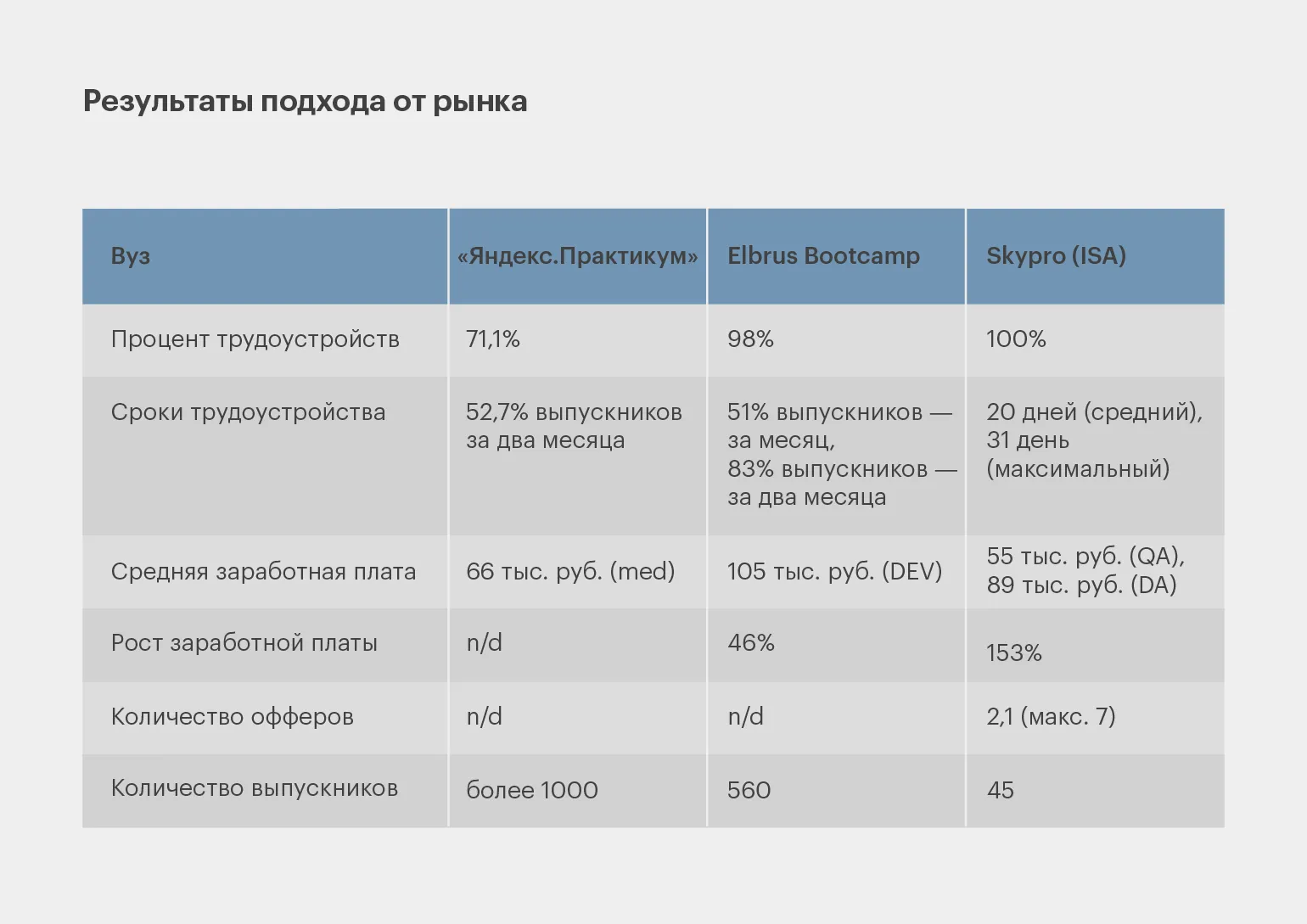
Each school has its own employment rates, but they are significantly higher than those of universities. For example, 71.1% of Yandex.Practicum graduates find employment, while at Elbrus Bootcamp this figure reaches 98%, and at Skypro it's almost 100%. Employment occurs quickly—on average, within a month. Graduates of online universities typically find jobs in their field, which is a significant advantage for their career advancement.
Online school graduates are currently few in number, numbering in the thousands. However, as volumes increase, such rates will be difficult to maintain. Nevertheless, I am confident it is possible. In EdTech, the focus should be on product quality and user satisfaction, as this is key to forming sustainable business plans for the future.
Comparing the salaries of online course graduates and those from traditional universities is indeed difficult, as their professions and fields of work differ. However, it's worth paying attention to the salary growth rate. For example, at Skypro, this rate is 1.64. This means that someone who studies IT, whether a miner, a store clerk, or a plumber, on average increases their salary by 1.6 times after completing the course. Thus, online learning can significantly improve financial prospects and career opportunities.

Learn more about our content.
EdTech Development: A Threat to Universities? Expert Opinion
The educational technology (EdTech) sector is rapidly evolving, raising questions about the future of traditional universities. Many experts believe that online education and digital platforms can change the educational landscape by offering more accessible and flexible learning options.
On the one hand, EdTech provides students with the opportunity to acquire knowledge in a format convenient for them, which may lead to a decrease in the popularity of traditional universities. On the other hand, universities can adapt by integrating new technologies into the educational process and offering blended learning.
Experts emphasize the importance of not only monitoring the development of EdTech but also actively leveraging its benefits to improve the quality of education. Ultimately, the future of universities will depend on their ability to adapt to change and implement innovations in learning.
EdTech is actively studying how to create effective educational programs, determining what and why should be taught, as well as what competencies are in demand in the labor market. To achieve this goal, extensive qualitative and quantitative research is conducted to analyze demand and its changes. These efforts result in the development of training courses that meet the current requirements of employers and enable students to compete successfully in the labor market. Graduates have the opportunity to enter the labor market more quickly and start earning money while gaining practical experience. This avoids a situation where a new workplace tells them, "It's great that you have a degree, but forget everything you learned. We'll teach you what's really important." Thus, relevant skills and knowledge acquired during education become a significant advantage for a successful career. A survey conducted by the online service "Rabota.ru" revealed interesting trends among Russians regarding higher education and its impact on career success. 35% of respondents believe that higher education is not a prerequisite for career success, while 10% of them believe that education is not important at all. Additionally, 6% of respondents believe that a degree is worth getting "just in case," while 20% believe that having one can be important, but does not play a decisive role in their professional life. Only 39% of survey participants are convinced that higher education is truly necessary for a successful career. These results highlight the changing perception of the role of education in modern society and its importance for career advancement.
Will EdTech and Universities Join Forces?
Every year, we see an increasing overlap in the target audiences of higher education institutions and online schools offering modern professions. This trend is likely to continue, especially given that EdTech is actively developing joint programs with universities. Universities have the opportunity to offer their audience, while online schools provide high-quality pedagogical design and a clear connection between education and labor market requirements. Such collaboration can increase the competitiveness of both educational institutions and online platforms, contributing to more effective training of specialists in demand in today's environment.
It is important for modern school graduates to carefully consider the field in which they plan to build their career. Having a degree can play a significant role in the beginning of a professional path, ensuring higher income from the very beginning. However, it is worth considering that in some fields a degree may be unnecessary, in which case it is reasonable to consider alternative development options.
Reading is an important part of our lives. It promotes the development of thinking, broadens horizons, and enriches knowledge. Books, articles, and other sources of information allow us to better understand the world around us and find solutions to various problems. Regular reading improves writing and communication skills, and increases literacy. Don't miss the opportunity to deepen your knowledge and develop critical thinking through reading.
- Not all degrees are created equal. Where university graduates work and what are their salaries?
- After school - to college. Is this option beneficial in terms of employment?
- Is a higher education diploma necessary for a successful career now?
- Why higher education cannot be purely applied
- The leaders of the EdTech market in the segment of additional vocational education have become known
The profession of Methodologist from scratch to PRO
You will improve your skills in developing curricula for online and offline courses. You will master modern teaching practices, structure your experience, and become a more sought-after specialist.
Find out more