
Contents:

Learn: The Profession of Methodologist from Scratch to PRO
Learn MoreThe debate about approaches to the educational process in education continues endlessly. Given the significant changes in the education system over the past decades, these debates have become increasingly relevant. Which approach is more effective: giving students freedom of choice or strictly following a curriculum? Should students' natural curiosity be nurtured or acknowledged as rare? These questions require in-depth analysis and discussion, as the choice of approach determines not only the quality of education but also the development of future generations.
British researchers Sam Sims and John Jerrim conducted an analysis to determine which approach—traditional or progressive—is more effective. Their work is based on a longitudinal study of education in Germany. The study aimed to evaluate the impact of different teaching methods on student learning outcomes and development.
The researchers analyzed the data to find answers to four key questions.
- Does traditional teaching methods result in faster learning for students?
- Does this method result in more uniform learning among students than progressive teaching methods?
- Which method is better at engaging students in learning?
- Do students develop metacognitive skills faster when teachers use progressive teaching methods?
The researchers published a paper, "Traditional versus Progressive Teaching: Empirical Evidence on an Old Debate," which presents the findings of their work. The paper examines key aspects of traditional and progressive teaching methods and their impact on the educational process. The authors analyze empirical evidence supporting the effectiveness of various teaching methods and draw conclusions about how these approaches can be integrated to improve the quality of education. The article makes an important contribution to the debate about best practices in pedagogy and may be useful for teachers, educational institutions, and researchers interested in modern teaching methods.
How the Traditional Approach Differs from the Progressive Approach
In a webinar dedicated to the study, Sam Sims compared the two approaches, presenting the results in a table. Each item in the table is named to indicate how close the approach is to the ideas of a particular author.
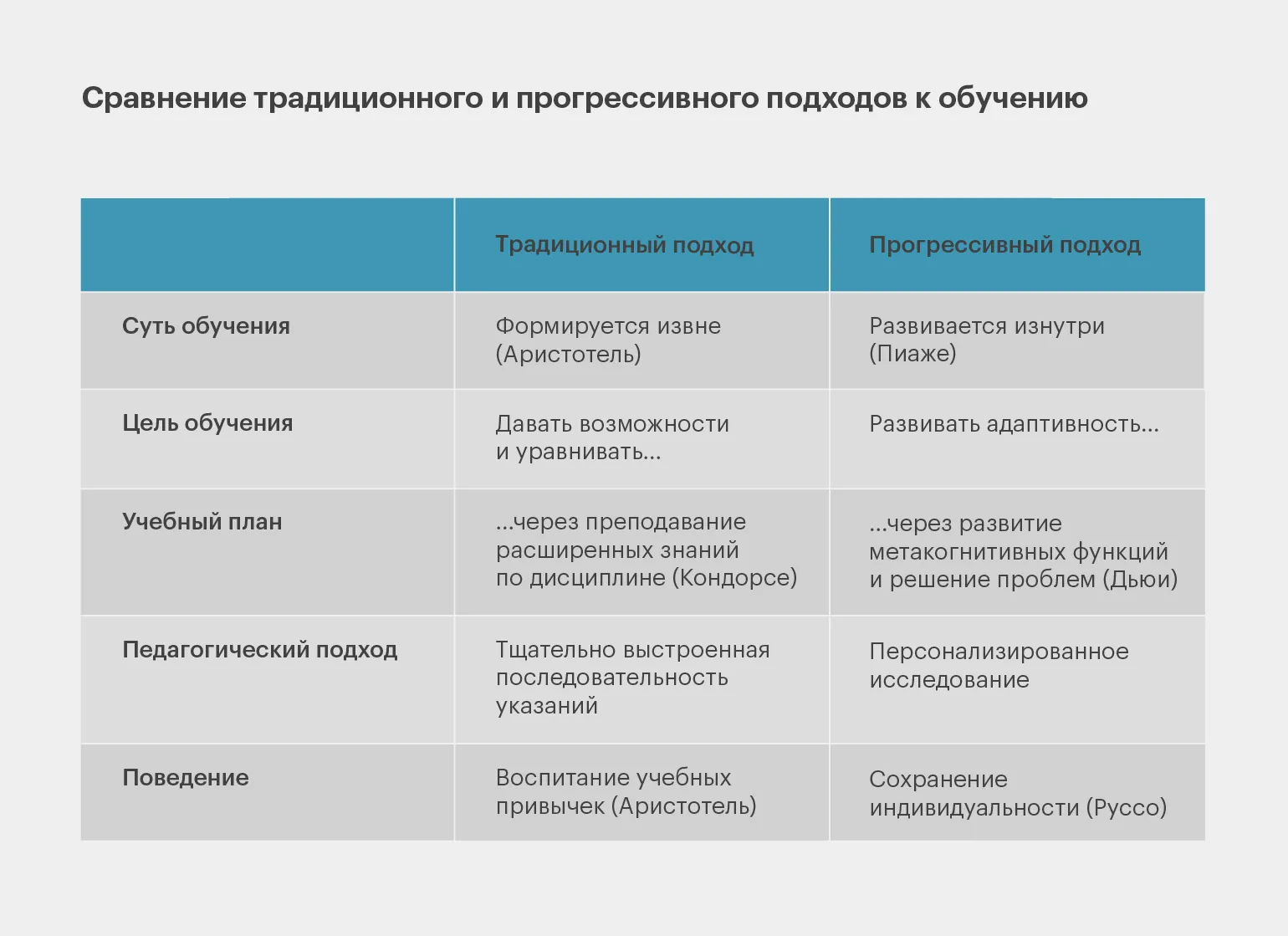
Researchers distinguish two main approaches: traditional and progressive. The traditional approach is based on established methods and principles that have been used for many years. It emphasizes time-tested practices and is often focused on stability and consistency. The progressive approach, in contrast, is characterized by flexibility and innovation, striving to adapt to new conditions and challenges. It involves the use of modern technologies and methods, as well as an emphasis on experimentation and research. Understanding these approaches helps to better navigate changes in various fields of activity and contributes to more effective decision-making.
- Traditional approach to teaching.
The educational model is based on the concept proposed by the famous American psychologist John Dewey, according to which education is "shaping from the outside." Children, lacking sufficient experience, motivation, and understanding of how to develop independently, need the guidance of a teacher. It is the teacher who determines the optimal structure of the learning process and chooses what information should be conveyed at a given time. Proponents of the traditional approach believe that knowledge should be provided to children in a standardized form and volume. Thus, the teacher is at the center of the learning process, and the process itself is organized, clearly structured, and universal.
Traditional teachers often draw on the principles of cognitivism. To optimize the learning process, many of them turn to cognitive load theory. This theory suggests that material should be presented in a logical sequence and in measured amounts. This approach allows for the most effective consolidation of information in students' long-term memory while avoiding overload. Lessons based on these principles are characterized by minimizing distractions and emphasizing clear instructions and explanations. This promotes a deeper understanding of the material and improved learning outcomes.
- Progressive Approach to Teaching.
The progressive approach to education is based on the concept that the true driving force of the educational process lies within each person. Everyone has an innate curiosity and a desire for knowledge, and it is in developing these that educators see their primary task. Teachers do not simply impart knowledge; they support and guide their students, creating the conditions for their independent learning and exploration. This approach fosters active and proactive individuals, ready to think independently and solve problems. Teachers who adopt a constructivist approach believe that knowledge is developed not passively, but actively, based on students' personal experiences. In today's environment, transmitting large amounts of information is losing its relevance, as it quickly becomes outdated. Therefore, progressive educators emphasize metacognition and skills that will be useful to students in the future. Therefore, they often choose project-based learning as an effective model for their classes. This approach promotes the development of critical thinking and practical skills, which makes learning more relevant and meaningful for students.
Revised text:
Please note the following materials:
Main theories Learning theories include behaviorism, cognitivism, and constructivism.
Behaviorism focuses on observable behavior and argues that learning occurs through interaction with the environment. This theory emphasizes stimulation and response, which allows for the formation of certain skills and habits. Behaviorism is applicable in a variety of fields, including educational programs and training.
Cognitive learning views learning as an active process of information processing. Unlike behaviorism, this theory emphasizes the importance of internal mental processes such as perception, memory, and thinking. Cognitive learning theories emphasize how learners process and store information, which contributes to a deeper understanding of the material.
Constructivism, in turn, emphasizes that knowledge is created by learners based on their experiences and interactions with the world around them. This theory emphasizes students' active participation in the learning process, where they can build their own knowledge through experience, collaboration, and reflection.
All three theories play a key role in pedagogy and help to form effective teaching methods suitable for various educational contexts. Understanding these theories allows teachers to develop more effective teaching strategies and take into account the individual characteristics of students.
How the study was conducted
Sam Sims and John Jerrim analyzed data from secondary school students and teachers as part of the long-term National Educational Panel Study, which has been conducted in Germany since 2009. The purpose of this study is to identify and describe the educational trajectories that accompany a person throughout their life. This study provides valuable information on how educational processes influence the personal and professional development of individuals, which can be useful for the formation of effective educational strategies and policies.
The study involves about 60,000 people of various ages, including schoolchildren and teachers. British researchers focused on a group of secondary school students aged 11–14, as their data reflects not only their academic performance but also the teaching methods used. Ultimately, the scientists analyzed information on 1,223 students and their teachers' responses. This data may provide valuable insights into the impact of educational approaches on student achievement.
The researchers conducted their analysis, focusing on various aspects of their topic. They examined key factors that influence the development and dynamics of the subject under study. The study identified key trends and patterns, and analyzed the results obtained in different settings. These findings may have a significant impact on further research and the practical application of the acquired knowledge. The researchers' work opens new horizons for in-depth study and understanding of current issues in this field.
- The results of tests in mathematics and German (that is, native language) for the fifth, seventh, and ninth grades - and thanks to the structure of the National Educational Panel Study, scientists were able to measure the "absolute growth" of students in different waves of the study. This was necessary in order to assess the actual success of the students.
- Questionnaires that children completed in the sixth and ninth grades. They concerned, again, German (for example, it was necessary to rate the statement "It is important for me to be well acquainted with the German language and literature") and mathematics ("I am ready to spend my free time studying mathematics"). Using this data, the researchers assessed interest in learning.
- The results of tests on metacognitive knowledge of sixth-graders and ninth-graders.
- The results of surveys of German and mathematics teachers, in which they indicated the extent to which they agreed with this or that statement. Statements were selected for their reflection of teachers' approaches to different learning styles (e.g., "It's better when the teacher, not the student, decides what needs to be done").
What the researchers found
The study results were unexpected in some respects. The researchers identified the following key points:
Result number one is a key aspect that requires special attention. In this context, it is important to emphasize that achieving the first result can become the basis for further progress. This stage is often considered the starting point on which the further development of the project depends. A comprehensive approach to analyzing and evaluating result number one will help identify its strengths and weaknesses, as well as identify areas for optimization. Success at this stage can significantly facilitate the achievement of subsequent goals and objectives. Therefore, pay due attention to every detail to maximize the effectiveness and efficiency of your project.
This finding may surprise many: proponents of progressive pedagogy seem to place the development of children's interests at the center of the learning process. It would be logical to assume that they are better at maintaining this interest than traditional educators. However, in practice, the situation may be different. It is important to consider which methods and approaches are truly effective in stimulating student interest, as well as how traditional and progressive approaches can complement each other in the educational process.

Research shows that teachers who use a traditional approach to teaching control the process of student assimilation by determining the order and method of presentation of information. This method allows for a gradual and engaging introduction of new knowledge, creating an intriguing effect. Students who receive a certain amount of information feel a desire to know what will happen next, which contributes to their engagement in the learning process and improves assimilation of the material.
Sam Sims and John Jerrim did not find a connection between the progressive approach of teachers and student interest in learning. However, they put forward an important hypothesis: progressive teaching methods may temporarily captivate students, but traditional approaches contribute to the formation of a sustainable interest in learning over the long term.
Result #2 represents an important stage in the process of achieving the set goals. It demonstrates how to properly organize work and effectively allocate resources. Analysis of the results allows us to identify strengths and weaknesses, which contributes to further development and improvement of processes. It is important to consider the data obtained during the study to optimize future actions and improve overall performance. Finding #2 serves as a basis for making informed decisions and planning strategies aimed at achieving success.
Proponents of the traditional educational approach claim that students learn material faster and with the same quality in a traditional learning environment. However, evidence shows that this is not always true. This calls into question the cognitive load theory, which is often used by defenders of the classical method. Research in this area points to contradictions with the existing data. Scientists caution that it is premature to draw definitive conclusions, as cognitive load theory covers and explains many specific phenomena. However, the authors of the current study did not analyze how these phenomena affect educational outcomes. Therefore, it would be wrong to conclude that this theory is completely inconsistent. There are various factors that influence learning effectiveness, and they are worth further study for a deeper understanding of educational processes.
Our findings on student achievement open new perspectives in the discussion of traditional and progressive teaching methods. Empirical evidence from cognitive science does not provide sufficient grounds for the widespread use of the traditional educational approach. In other words, the effectiveness of the traditional method in accelerating and uniformly assimilating educational material remains unproven.
Result #3 represents an important step in achieving the set goals. Its analysis allows us to identify strengths and weaknesses, as well as determine the key factors influencing success. At this stage, it is important to consider not only quantitative indicators but also qualitative aspects that can significantly impact the final result. Result #3 serves as the basis for further steps, allowing us to adjust the strategy and optimize processes. Effective use of the obtained data contributes to improving overall effectiveness and achieving the intended goals.
Research did not reveal a positive correlation between adherence to progressive learning and the development of general metacognitive skills in students. This may indicate that the use of progressive teaching methods does not always lead to an improvement in metacognitive abilities, which play a key role in learning and self-development. Further research is needed to better understand the impact of different approaches on the development of metacognitive skills in the educational process.
The authors of the study note that their results refute the arguments of progressives about the importance of independent research for the development of more complex thinking skills. In particular, they found a weak negative correlation between the preference for traditional teaching methods and students' metacognitive abilities. This highlights the need to reconsider teaching approaches and emphasize the development of critical thinking through a variety of methods.
Sam Sims and John Jerrim emphasize that the results obtained cannot be considered absolutely precise. However, they are generally consistent with the findings of other studies. For example, one such study found that metacognition training is more effective in the context of supplementary learning activities than during the main educational program.
Research suggests that progressive assertions that metacognitive skills develop through students' independent inquiry may not be entirely accurate. In our study, we were the first to directly test the relationship between pedagogical approaches and the development of metacognitive skills in students. The findings are largely consistent with those of other studies in this area, confirming the importance of teachers' roles in developing these skills.
What conclusions did the researchers reach?
Sam Sims and John Jerrim emphasize the importance of critically analyzing the research results. Firstly, the data on which their findings are based was collected in only one country, and this does not guarantee that similar trends are observed in other regions. Secondly, the study's methodology has its limitations: teachers' inclinations toward certain approaches were determined using a questionnaire. However, if a teacher demonstrates support for a progressive approach in a survey, this does not necessarily indicate that they actually use the corresponding methods in the classroom. Thus, it is important to consider the context and additional factors influencing educational practices.
The authors of the study argue that the findings illustrate the futility of debates between representatives of different educational approaches. These discussions distract attention from truly significant issues in education and are not beneficial to either children or the educational process as a whole.
The researchers concluded that teachers should focus on deeper and more specific discussions of teaching approaches. This will help them improve the quality of instruction and better tailor their methods to students' needs. More detailed debates about teaching methods will allow teachers to exchange experiences and find optimal solutions for various educational situations.
Read also:
- What is the best way to teach: first give the theory, then the task, or vice versa?
- What teaching style helps develop critical thinking?
- Not a chocolate bar, but a director-screenwriter: how changing the roles of the teacher will help motivate schoolchildren.
- What is pedagogical design and who is a pedagogical designer?
Profession Methodologist from scratch to PRO
You will improve your skills in developing curricula for online and offline courses. Master modern pedagogical practices, structure your experience and become a more sought-after specialist.
Find out more