
Contents:
- What data is the study based on?
- How leading universities differ from the rest?
- What was revealed about the earnings of graduates from different universities?
- Why the dependence of graduate income on university status is a problem?
- What else is known about the income of university graduates with different statuses?
- What else is known about the relationship between the difficulty of entering a university and the income of graduates?
- How to increase the return on higher education?

Learn: The Profession of Methodologist from Beginner to Advanced
Learn MoreEvery admissions campaign observes a consistent trend: the most intense competition arises not for all university positions, but for positions at leading and prestigious universities. The passing scores at such institutions differ significantly from those at lesser-known universities. To confirm this information, it is enough to review the data from the Monitoring of the Quality of Admission to Universities, comparing the average scores of applicants for the same fields of study. Let's consider, for example, one of the most in-demand fields – jurisprudence. In 2022, the average passing score at RANEPA and MGIMO was 96, while at Kurgan State University it was 71, and at a number of universities it was even lower. This is because Olympiad winners and 100-point scorers from across the country are actively "storming" for places at leading universities, while applicants often choose regional universities as a last resort. This gap in competition and passing scores underscores the importance of choosing a university for your future career and educational path. Is the significance of a diploma really limited to its prestige? In fact, this is not the only aspect. Research conducted by economist Ilya Prakhov of the Higher School of Economics shows that graduates from prestigious universities tend to earn higher salaries. In his article in the International Journal of Educational Development, Prakhov analyzes which diplomas increase the chances of earning higher incomes. In this text, we will consider the key findings of his study and compare them with data from other sources.
What data is the study based on?
This material presents the findings of the longitudinal study "Trajectories in Education and Career" (TEC). This study provides unique data on the paths people take in the process of obtaining an education and building a career. The results of the project will help to better understand the influence of educational and professional trajectories on the further development of an individual and its success in various fields of activity.
A longitudinal study is a method in which the same sample is studied over a certain period of time. The TEC project involves almost 4,900 people who were eighth-graders in 2011 and took part in the international TIMSS study. This approach allows us to track changes and trends in participants' educational outcomes and behavior over time, making it a valuable tool for analyzing the dynamics of educational processes.
Since 2011, TIMSS sample participants have been surveyed annually, collecting data on their educational experiences, including school, college, and university studies, as well as information on employment and career events. While it is not always possible to obtain responses from the entire initial sample, the percentage of participants agreeing to participate in follow-up surveys remains quite high. In 2020, 77% of participants responded to the latest survey, confirming the interest and engagement of respondents. This data helps us better understand trends in education and employment, and identify key factors influencing career advancement.

The text can be reformulated and optimized for SEO as follows:
«We recommend that you familiarize yourself with additional information on this topic.»
The new book, "Educational and Career Trajectories of Graduates of Russian Universities," is a relevant study analyzing the professional paths chosen by graduates of higher education institutions in Russia. This book covers key aspects of education and career, exploring how acquired knowledge and skills influence employment and career advancement. The publication will be useful for both students and education specialists, as well as employers interested in understanding trends in the labor market. Understanding the career trajectories of graduates will become an important tool for optimizing educational programs and increasing their compliance with the requirements of the modern market.
How leading universities differ from the rest
Despite opinions about a decline in interest in higher education, demand for it remains high in Russia. According to the annual monitoring of the education economy, 77% of parents of students of various ages want their children to receive higher education. However, researchers point to problems with accessibility at this level of education, even though the number of state-funded places remains significant.
A young person's ability to enroll in a prestigious university for their desired major is largely determined by their family's social status. Many applicants are forced to choose lesser-known universities and those programs with more state-funded places. This means they often choose programs with higher chances of admission rather than those they truly enjoy studying. Thus, social factors can significantly limit young people's academic ambitions and educational choices.
Leading universities distinguish themselves from other educational institutions by their high level of education, which attracts the most talented applicants. The quality of education at public universities is not always uniform. The main factor influencing this is funding. It influences many aspects, including the quality of teaching, access to modern resources, and research opportunities. Therefore, applicants strive to enroll in those universities that can guarantee them a high level of academic preparation and prospects for further development.

Find out more:
Quality management in higher education is a key aspect that influences student learning outcomes. It is important to understand that the quality of the educational process is directly related to its content, teaching methods, and assessment system. Educational institutions must actively work to improve curricula, implement modern technologies, and create a comfortable learning environment.
Effective quality management includes regular assessment and analysis of educational practices, as well as student feedback. Transparency in the education quality assessment process helps identify problem areas and develop strategies to address them. It is also important to involve faculty, students, and employers in this process to ensure all opinions and needs are taken into account.
Thus, quality management in higher education requires a systematic approach and continuous improvement, which ultimately impacts student success and their readiness for professional work.
In his article, Ilya Prakhov analyzes why public universities in Russia differ in their status and importance. This difference has deep historical roots that influence the current perception and ranking of educational institutions. It's important to understand that factors determining the "weight" of universities include not only their history but also the quality of education, research achievements, and interactions with industry. Prakhov's article provides valuable insights into how these aspects shape the face of higher education in Russia.
In the 1990s, the quality of higher education in Russia deteriorated significantly. This occurred as a result of the near-complete cessation of state funding for universities, which made work in this field low-paying and less prestigious. Leading universities experienced a faculty shortage, striving to maintain their image, but regional state universities faced even greater difficulties. Limited resources and a lack of opportunities for faculty led to a decline in the standard of education at these institutions. The situation required urgent measures to restore the quality of higher education in the country.
Since the late 2000s, Russia has seen an increase in public funding for higher education. Several state projects aimed at supporting and developing universities have been implemented. However, the distribution of funds is uneven and depends on the status of the educational institution. This reinforces the division of Russian universities into leading ones, which have special status, and other educational institutions. Uneven funding creates additional tension in the higher education system, which requires attention from government agencies.
In 2006, several universities merged, resulting in the creation of the first federal university – Siberian University. In 2008, the National Research University (NRU) support program was launched, granting universities special status. In 2013, the state project "5-100" was launched, aimed at bringing at least five Russian universities into the top 100 international rankings. Over the years of the project's implementation, 21 Russian universities have participated, many of which were also part of the NRU development program. This indicates that the same educational institutions were developing within the framework of both projects. It should be noted that the funding amounts for Project 5-100 participants varied significantly, reaching from 292 million to over 4 billion rubles.
The state does not ignore the problems of regional universities, but the level of support remains insufficient. In 2015, a program to create flagship universities was launched, which provides universities with a special status and additional opportunities for development. However, the financial subsidies under this program are significantly inferior to those allocated to national research universities and Project 5-100 participants. Some universities included in this program received only methodological assistance without the necessary funding. This creates an unequal playing field for the development of educational institutions in the regions and limits their potential.
Over the past 20-25 years, only a limited number of Russian universities have had the opportunity to attract highly qualified faculty and improve the educational environment, which requires financial investment. It is precisely those universities that have managed to secure such resources that are now able to attract the most prepared and talented applicants. This creates a gap between higher education institutions capable of providing high-quality education and those that lack the necessary resources for development. The uneven distribution of statuses among universities can lead to differences in the incomes of their graduates. In his study, Ilya Prakhov analyzed the incomes of graduates from universities with special status, which admit students with high GPAs, and compared them with the incomes of graduates from universities without status, which admit applicants with lower GPAs. This analysis helps us identify the impact of the educational level and status of the university on the financial prospects of graduates.

The study includes all members of the Association of Leading Universities as universities with special status. This association includes both national research and federal universities. Among them, prominent are Russia's oldest universities, such as Moscow State University (MSU) and Saint Petersburg State University (SPbSU). The association also includes major educational institutions, including the Russian Presidential Academy of National Economy and Public Administration (RANEPA) and the Financial University under the Government of the Russian Federation.
In addition, the university's ranking was taken into account, based on the results of monitoring the quality of admission, which involves analyzing the average Unified State Exam score of applicants.

Please note the following materials:
University Admission: Interesting Facts About Fee-Based Tuition for Humanities Students
Higher education is an important milestone in the lives of many students. However, in recent years, there has been a trend for humanities majors to be offered on a fee-based basis. This is due to several factors. Firstly, humanities majors such as philology, history, or sociology are often less in demand in the labor market than technical majors. Secondly, universities strive to offset tuition costs and maintain the quality of educational services, which leads to the introduction of fee-based tuition.
It is interesting to note that the number of students choosing humanities majors continues to grow, despite the fee-based form of tuition. This indicates that many applicants are willing to invest in their education, understanding its value for their future careers. Understanding these trends allows one to better navigate the higher education system and make informed choices.
What was revealed about the earnings of graduates from different universities
Ilya Prakhov developed 18 statistical models to analyze the factors influencing the salaries of university graduates. Each model took into account a different number of factors that play a significant role in the economic return on education among participants in the "Trajectories in Education and Profession" study. This study provides a deeper understanding of which aspects of education and training most influence graduates' income levels, which may be useful for both students and educational institutions.
- The basic models include only the graduate's status as a university graduate, the average Unified State Exam (USE) score of first-year students entering that university, the respondent's gender, and their work experience during their studies.
- The most complex models also assess the respondent's field of study, family characteristics (income, mother's education level, number of books in the house), as well as the status of the school the graduate previously attended, and their personal Unified State Exam (USE) score in Russian.
The survey recorded the participants' salaries, which made it possible to assess the influence of various factors on their salaries. The analysis results show that data may vary across models, but some factors remain significant in all 18 calculations. This indicates their key role. The main factors influencing salary levels are presented below.
- Difficulty of admission to a university, or its selectivity. Simply put, the higher the average Unified State Exam score of those admitted to a particular university, the higher the salary of its graduates. Each point in the "average first-year student score" indicator increased graduate income by 2%.
- Special status of the university (especially a national research university). Different types of special status provide an average 15% increase in graduate salaries. Specifically, the status of a national research university (NRU) increases graduate income by an average of 22% (there are 29 such universities in the country), and participation in the "5-100" project by 17%. However, the status of a federal university, in all models, conversely, decreased graduate salaries - from 3 to 15%. As the study's author suggested, the reason may be that such universities were created in regions by merging universities, without regard for the quality of education within them.
- High parental income and attending a specialized school—each of these factors increases salaries by an average of 10%.
Women, on average, earn a third less than men, indicating a problem of gender inequality rather than educational differences. Research shows that graduates in certain professional fields, such as teaching and agriculture, also receive below-average salaries. Graduates in medical specialties have particularly low incomes, with earnings 13–19% below average. Ilya Prakhov notes that this may be due to the lengthy training of medical professionals: at the time of the survey, many of them were just beginning their careers and held entry-level positions, which, accordingly, affected their earnings. It is important to address these issues to achieve a more equitable income distribution and improve working conditions for all professionals.

Optimize your knowledge and skills by studying relevant materials and resources on the topic. It is important to stay up to date with the latest trends and innovations. Regularly reading specialized articles and blogs will help deepen your understanding and broaden your horizons in your field. Subscribe to updates and stay up-to-date with new publications to stay up-to-date with important information and expert advice.
"You're going to have a baby": What barriers hinder women in engineering and IT?
In today's world, despite active efforts to promote gender equality, women continue to face various barriers that hinder their advancement in fields such as engineering and information technology. One of the main reasons is persistent role stereotyping, where women are traditionally considered more suited to caring for families and children than technical professions. These preconceived notions often lead girls to doubt their abilities and potential careers in STEM fields.
Furthermore, a lack of role models and mentoring support also plays a significant role. Girls often fail to see successful women in engineering and IT, which hinders their identification with the field and reduces their motivation to learn and develop in these fields. Educational institutions and companies must actively work to create inclusive environments where women can feel confident and supported.
Another barrier is the lack of programs aimed at attracting girls to technical fields. Initiatives that foster an early interest in science and technology, such as programming clubs or science clubs, are needed.
Changing corporate culture is also an important step in removing barriers. Employers should implement policies that promote equality and diversity to create a more attractive environment for women.
Thus, to increase the number of women in engineering and IT, it is necessary to overcome stereotypes, create support and opportunities for girls, and change corporate approaches to diversity.
Why the Dependence of Graduate Income on University Status is a Problem
The study's results show that a higher-quality and possibly more complex education, requiring significant effort and ability, is associated with higher graduate income. However, this assertion ignores important factors influencing admission to prestigious universities. An applicant's chances of successful admission depend not only on their abilities but also on their family's resources. Ilya Prakhov's calculations support this point of view: when considering all influencing factors, it becomes clear that a graduate's salary level is more influenced by their previous environment, including parental income and the status of the school, than by the university itself.
The introduction of the Unified State Exam (USE) has indeed helped reduce regional inequality in the admissions process to higher education institutions in Russia, as admission rules to all universities across the country are now standardized. However, despite this, the problem of socioeconomic inequality remains relevant. Different segments of the population still face different opportunities and resources for exam preparation and admission to educational institutions. Thus, although the USE has equalized some aspects of the admissions process, it does not address the deeper social and economic differences that affect access to quality education.
Research shows that children from families with low incomes and parental education are more likely to choose secondary vocational education over higher education. Even if they demonstrate good academic results in school, parents may doubt their ability to attend university and may not support their ambitions. This may be due to a lack of information about higher education opportunities or a lack of role models among friends and family. An important step in addressing this issue is raising parents' awareness of the prospects of higher education and the support programs available to their children. The Olympiad track, which allows schoolchildren to enter universities without exams thanks to winning Olympiads, also creates inequality in the education system. Participation in Olympiads requires extensive preparation and often includes special training camps, which entails additional travel and tuition costs. Not all schools provide adequate preparation for such competitions, and many students are forced to resort to tutoring. This widens the gap between those who can afford extracurricular activities and those who cannot.
In practice, the situation is as follows: the chances of successfully passing the Unified State Exam or winning an Olympiad and entering a prestigious university remain higher for people from educated and affluent urban families. As a result, graduates of such universities have greater employment opportunities in high-paying positions. This vicious circle perpetuates inequality. Thus, education does not always fulfill its function of social mobility.

Read also:
Academic failure is often associated with factors such as educational inequality and educational poverty. These phenomena have a significant impact on the quality of education available to children from different social backgrounds. Educational inequality manifests itself in differences in access to resources, quality of teaching, and parental support. Educational poverty, in turn, encompasses not only a lack of financial resources but also the absence of the necessary conditions for successful learning, such as access to educational materials and modern technologies. These factors create barriers for students, leading to a decrease in their academic performance and limiting opportunities for further development. Addressing the problem of academic failure requires a comprehensive approach aimed at eliminating educational inequality and creating a level playing field for all children.
What else is known about the incomes of university graduates with different statuses
In 2022, the HSE Labor Market Research Laboratory published a report on the employment of university graduates. This study used data from the annual monitoring of Rostrud, which covers graduates of all educational institutions in Russia. An analysis of the obtained data revealed that graduates from prestigious universities have higher salaries than those from lesser-known institutions. This finding underscores the importance of choosing an educational institution for a graduate's future career and financial well-being.
This report focuses on national research universities, including the participants of the "5-100" project, as well as Lomonosov Moscow State University. It should be noted that data for St. Petersburg State University was unavailable at the time of the monitoring.
As of the end of 2021, the average salary of bachelor's degree graduates from these universities reached 71,900 rubles. This is 37% higher than the national average of 52,400 rubles. These data highlight the high competitiveness and demand for specialists graduating from these educational institutions in the labor market.
No significant differences from the average educational level were found at federal and flagship universities.
The recruiting service SuperJob regularly analyzes the salaries of graduates from various universities. According to data on graduates from 2016 to 2021, there are significant differences in income depending on the chosen field of activity.
- In the IT field, the highest average salaries - in the range from 180 to 260 thousand rubles - were received (in ascending order of income) by graduates of St. Petersburg State University, HSE University, MEPhI, Bauman Moscow State Technical University, ITMO University, Lomonosov Moscow State University and MIPT.
- In the field of economics and finance, the most - from 120 to 150 thousand rubles - were earned by graduates of the Financial University, RANEPA, Moscow State University, HSE University and MGIMO.
- And in the field of jurisprudence, the highest salaries - in the range from 110 to 150 thousand rubles - were received by recent graduates of the Kutafin Moscow State Law Academy, the Financial University, HSE, St. Petersburg State University, Moscow State University, and MGIMO.
Universities in Moscow and St. Petersburg dominate the top positions in various rankings of higher education institutions. Most of them are members of the Association of Leading Universities and enjoy unique statuses that highlight their high quality of education and research. This demonstrates the concentration of educational resources and scientific potential in these two large Russian cities.
What else is known about the relationship between the difficulty of entering a university and graduate incomes
In the first issue of the journal "Education Issues" for 2023, the authors of the HSE report on graduate employment presented an in-depth study on the relationship between the quality of education at universities and graduate incomes. Education quality was assessed based on the average Unified State Exam score with which first-year students enter educational institutions. The data for the analysis was obtained from monitoring the quality of the admissions campaign to universities. As a result of the study, the authors identified four types of educational programs, which allows for a more accurate assessment of the influence of factors on the success of graduates in the labor market.
- those for which the average USE score is low (less than 64) upon admission;
- programs with an "average" average USE score (65-74);
- programs with a good score (75-84);
- programs with a high score (85 or more).
Average scores were calculated based on aggregated groups of training areas and specialties.
The study analyzed data from 2019 bachelor's and specialist's degree graduates who decided not to continue their studies in master's and doctoral programs, but began working. Information on the salaries of these graduates was collected at the end of 2021. At that time, 70% of the 282 thousand graduates were officially employed, while informal employment was not taken into account in the employment monitoring. The majority of graduates enrolled in programs that accept students with scores in the 65–74 range. Data shows that a significant proportion of graduates successfully integrated into the labor market, highlighting the importance of practical training and preparation for professional work. Research shows that the average salary of graduates of educational programs is directly related to their Unified State Exam (USE) scores upon admission. In 2021, graduates of programs that accept applicants with high scores earned twice as much as their colleagues studying in less competitive programs. This fact emphasizes the importance of choosing a curriculum and level of preparation upon entering a university and can serve as a significant factor in shaping the career prospects of graduates.
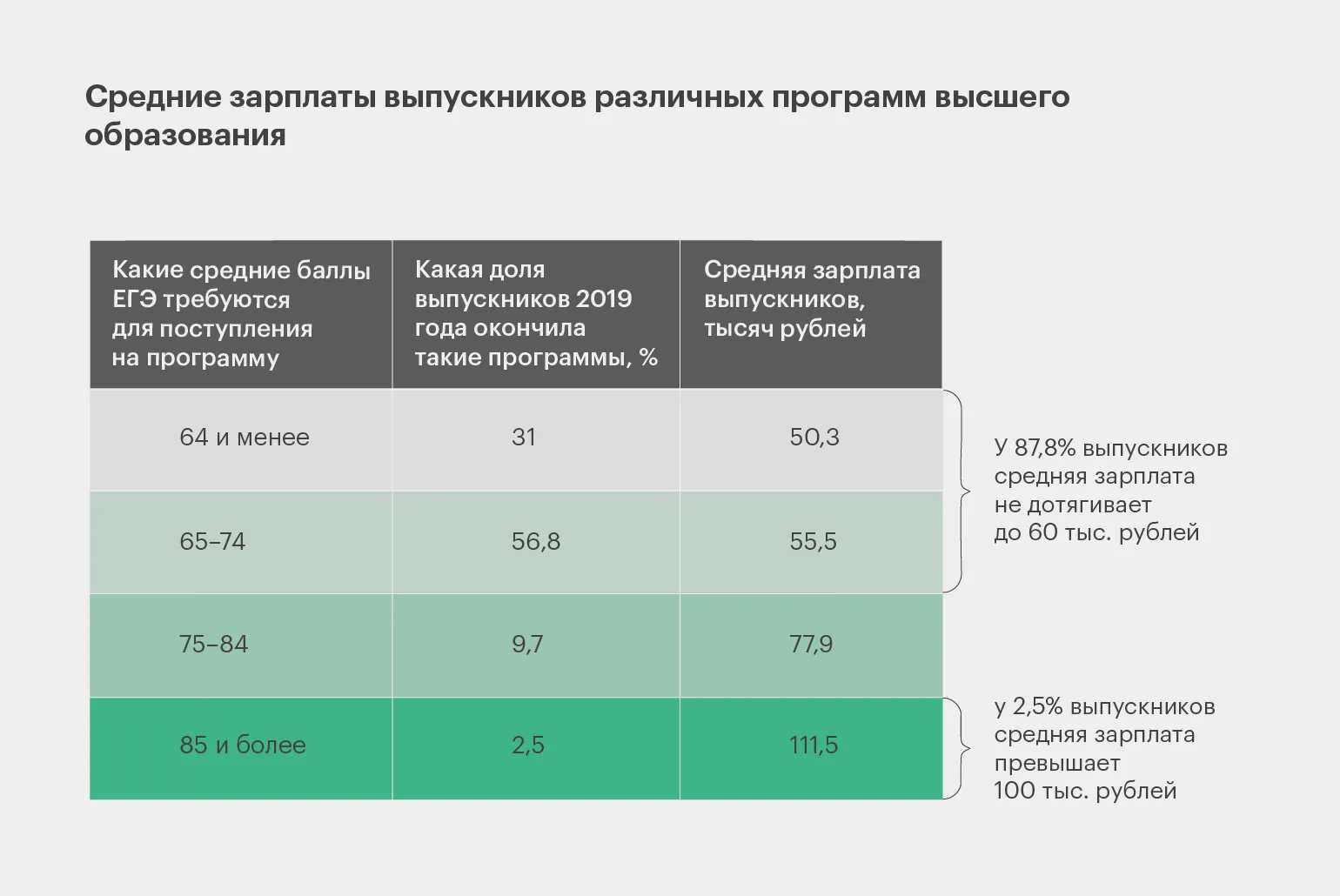
In certain fields of study, the difference in graduate income is significantly more noticeable. For example, graduates of highly selective programs in mathematics and computer science earned an average of 202 thousand rubles, while those who completed less competitive programs received only 52 thousand rubles. Thus, the income difference reaches almost four times. This emphasizes the importance of choosing an educational program and its competitiveness in the labor market.
The authors of the study noted that male graduates tend to have higher incomes. Furthermore, having an honors degree contributes to higher wages.
When analyzing data on admissions to higher education institutions, it is important to consider that, although the authors used information from various programs, these findings are applicable to all universities. Competition for programs at individual universities certainly varies, which affects admission scores. However, leading universities with special status are typically selective institutions. This means that all programs at these universities are highly competitive, attracting applicants with high or satisfactory average Unified State Exam scores. Data from the Admission Quality Monitoring study confirms this trend. In contrast, at universities without special status or other competitive advantages, average scores for admission to popular and less popular programs can vary significantly, which is also worth considering when choosing an educational institution.
The report on graduate employment and a new article prepared by authors from the Labor Market Research Laboratory emphasize that differences in graduate income do not always indicate uneven educational quality at universities. There are other factors that influence graduates' financial outcomes that are not directly related to the educational process. These aspects may include the regional economic situation, the demand for specialties in the labor market, and the personal qualities of graduates. Thus, for a more complete understanding of the situation, it is necessary to take into account the complex socio-economic conditions that affect the employment and income of graduates.

Most prestigious Universities are located in capitals and large cities, where average salaries are significantly higher. A degree from a reputable institution is more likely to attract employers and can be a decisive factor in finding a job. Social factors also play a role: many applicants choose leading universities not only for the high quality of their education but also for the opportunity to establish useful contacts. These factors highlight the differences in the value of a degree from a regular university and a degree from a prestigious university.
How to Increase the Return on Higher Education
Researchers propose various approaches to addressing income inequality. These strategies include tax reforms, raising the minimum wage, and improving access to education. Additionally, there is an emphasis on the need to create jobs and support entrepreneurship, which can contribute to a more equal distribution of income in society. It is important that the proposed measures be aimed at long-term improvement of the economic situation and reducing the gap between rich and poor. Ilya Prakhov's article emphasizes that a person's educational and career trajectory is shaped not by a single decision, but by many factors. This is a long-term process, and the foundations of inequality can be laid at various stages. School choice is an important aspect: does the child go to an ordinary school or a strong school? Does they have access to extracurricular activities and participation in academic competitions? The key decision after 9th grade is whether to continue education in high school or enroll in college. The role of parents is also critical: do they encourage their child to pursue higher education and help them choose prestigious universities? How is preparation for final exams conducted? What criteria are used to select a university and major? How actively is the child involved in the educational process? Support for at-risk students, such as those from disadvantaged families or those with parents without a college education, is necessary at all these stages. This assistance could have a significant impact on their future and reduce educational inequality.
The researcher emphasizes the importance of state support for the majority of higher education institutions in the country, and not just those that belong to certain categories. In this context, the authors of an article in the journal "Problems of Education" come to the opposite conclusion, emphasizing the need to select and support only individual universities.
Experts emphasize that investments should be directed toward universities that provide high-quality education, as this type of education generates significant economic returns. This applies not only to government investment but also to family funding for their children's education. Fee-based education at institutions with low admission requirements and an easy learning process is unlikely to justify the costs. This approach to choosing a university is key to achieving a successful career and improving your standard of living.
Learn more about education by subscribing to our Telegram channel. We share relevant information, new trends, and helpful tips. Don't miss the opportunity to stay informed!
Read also:
- Do you need a higher education diploma for a successful career now?
- It has become known to what extent expectations from university education differ from reality
- Quote of the week: if an education in the form of a diploma is required, Russians choose the humanities
- Demand for higher education in Russia has hit a ceiling, according to HSE economists
The Profession of Methodologist from Scratch to PRO
You will improve your skills in developing curricula for online and offline courses. You will master modern pedagogical practices, structure your experience and become a more sought-after specialist.
Find out more