Contents:
What does a trader do?
A trader is a specialist who buys and sells financial instruments (assets) in the stock, currency, commodity, money, futures and over-the-counter markets to generate profit. It ensures liquidity and the efficient functioning of global economies. It makes decisions on the purchase and sale of assets at the optimal time, based on the analysis of market indicators, news, and its own forecasts. Such assets are:
- currency pairs;
- stock indices;
- futures;
- company shares;
- oil, gas, grain, metals and other goods;
- cryptocurrencies.
A trader's duties and responsibilities may vary depending on their specialization and the type of market they operate in. But in general, they include the following:
- Trading and Trade Execution. A trader monitors market conditions, buys and sells assets.
- Data Analysis and Market Monitoring. Analyzes the market and gathers information to identify trading opportunities. Monitors price changes, trading volume, and other factors affecting the market. The trader uses technical and fundamental analysis to predict future price movements.
- Strategy Development. A trader develops trading strategies based on their own market analysis and investment goals. They determine entry and exit points (the most successful moments for trades), and place automatically executed orders (trade commands) to limit losses and lock in profits.
- Risk Management.Controls and manages the risks associated with trading. Takes measures to protect against losses using various methods: from portfolio diversification (dividing into several independent investment schemes or trading different assets) to the use of pending orders.
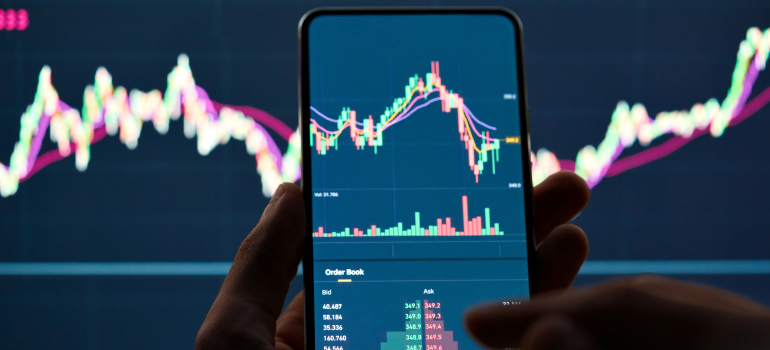
The process of making trading decisions is based on various factors. Some traders rely on technical analysis, studying charts and the patterns on them to determine optimal entry and exit points. Others use fundamental analysis, studying financial statements, company news, and macroeconomic data to predict changes in asset prices. Many investors combine both approaches to gain a more complete understanding of the market.
In today's financial industry, they all have access to advanced technology and trading platforms. Automated systems and algorithms are also widely used to conclude transactions without the participation of the player - based on a set of rules and conditions.

Learn how to create a financial model of a business and analyze a budget in the Financial Analyst course.
Learn MoreClassification of Market Players
Market players can be divided into several categories, each trading using different strategies and over different time horizons. They can be classified as follows:
- Day Traders. Open and close positions within a single trading day. They seek to profit from the volatility (edit:of an asset. They often use various technical indicators and graphical analysis to make decisions.
- Investment traders.They engage in long-term investments in financial markets. They analyze fundamental data: company earnings reports, macroeconomic indicators, and geopolitical events. To determine the value of assets and make long-term investment decisions.
- Arbitrage traders.They look for differences in the prices of the same asset in different markets or financial instruments. They seek to make a profit by exploiting these differences and making simultaneous purchases and sales. Such traders often profit from the difference in prices between futures (a contract that obligates parties to fulfill its terms in the future, such as delivering a commodity at a fixed price) and real assets, or use statistical models to identify market inefficiencies. Scalpers. These are traders who open and close positions very quickly, usually within seconds or minutes. They look for the slightest changes in prices and try to profit from momentary market movements. In their work, scalpers rely on software that allows them to work in real time with minimal delays.
- Position traders.They open positions based on long-term market trends and hold them for an extended period: from several weeks to months or even years. They seek to profit from large price movements and avoid short-term fluctuations.
And this is far from a complete list. There are investors who specialize in cryptocurrency markets, options, and investment funds. Each market player uses different strategies to achieve their goals. The effectiveness of strategies depends on the skills, knowledge, and experience of traders, the analytical tools they use, as well as market, macroeconomic, and other factors, including the type of asset chosen.
What tools does a trader use in his work?
Trading is the process of buying and selling exchange-traded and over-the-counter assets to profit from changes in their prices. The technical aspects of this process include the use of a variety of tools and software that help better analyze the market situation.

Here are a few key points without which successful trading is simply impossible:
- Trading platforms.There are many of them, and they are designed to provide players with access to brokerage services. The most popular of them are MetaTrader, TradingView, Bloomberg Terminal, Interactive Brokers, but there are others. Platforms allow you to perform trading operations, display charts, provide access to market data, and other functions.
- Market Analysis Software.There are many tools that help analyze markets and find trading opportunities. This can include technical analysis, algorithmic trading, strategy automation, and more. Traders most often use programs such as TradeStation, Amibroker, and MetaStock.
- Technical indicators. These are the result of mathematical calculations based on the price and volume of selected financial instruments. Indicators help analyze market dynamics and predict future price changes. Popular technical indicators: moving averages and MACD, stochastic oscillator, relative strength index, Bollinger bands.
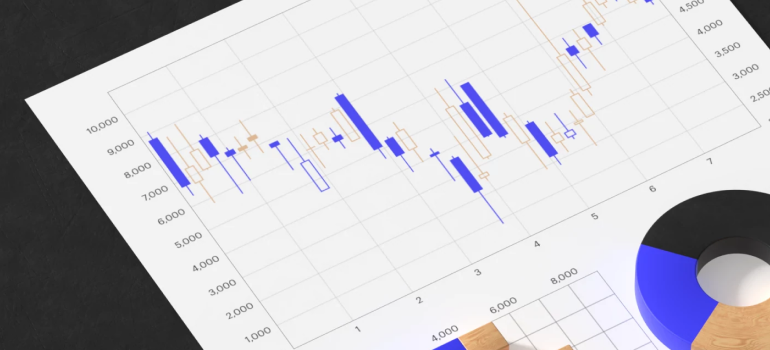
- Charts. Visual display of price data of trading assets. There are several types of charts: lines, candles and bars. All of them help analyze price patterns (repeating figures), trends, and support/resistance levels. This helps make decisions about entering into trades.
- Support and resistance levels.Key price levels on charts that influence the price movement of financial instruments. Investors use these levels to determine possible points when it is most profitable to buy and sell the selected asset.
- Stop-loss and take-profit.Pending orders are risk management tools in trading. Stop-loss sets the level at which an open position is automatically closed to limit losses. Take-profit allows you to lock in profits by closing a position when a certain level is reached.
These are just some of the tools investors use. They also have access to various strategies, fundamental analysis, sometimes insider information, and other methods that help them make the right and profitable decisions.
Soft and hard skills
Success in trading depends on a combination of various skills and qualities - from personal to specialized technical skills.
We talk about soft skills that will help you develop in trading:
- Analytical skills.To understand and evaluate financial data, analyze charts and technical indicators. This helps make informed decisions based on fundamental and technical analysis.
- Risk management.Proper risk management helps reduce losses and preserve capital in the long term.
- Psychological stability.Trading is often a stressful and emotionally demanding process. Successful players have psychological stability and the ability to remain calm and collected even during market turmoil. They know how to control their emotions, avoid emotional reactions to losses and do not allow them to influence decision-making.
- Ability to adapt to new conditions.The financial instruments market is constantly changing, and a successful player must quickly adapt to new conditions and trends. A professional always monitors news and events that may affect the market and is ready to change strategies and plans in accordance with new circumstances.
- Communication skills.The ability to clearly and distinctly express your thoughts, understanding of market terminology and the ability to communicate effectively with other participants help build mutually beneficial relationships and obtain information from other players.
In any economic activity, responsibility, an analytical mindset, communication skills, quick reaction and stress resistance are important. As for hard skills, for effective trading you need:
- Know and understand trading and analytical software.
- Be able to use graphical analysis tools.
- Understand how trading indicators and signals work.
- Know the basics of algorithmic trading.
A trader should also be familiar with the main financial instruments and understand the relationship between them, when their prices fall and when they rise.
How to become a trader
If you've decided to try your hand at trading, you'll need to go through several stages.
- Education.To work for a broker or investment fund, you need to confirm your qualifications and market knowledge. Although higher education is not a mandatory requirement, it will be a plus during interviews. To trade on the stock exchange independently, it is enough to study the basics of financial economics, stock trading, and analysis. It's worth noting that no university specifically teaches the trader profession—specialized educational courses and self-study will help.
- Study and Practice. Read books, articles, and blogs from experienced traders. Apply the knowledge you gain in practice using demo accounts (edit:analogous to a real trading account with a virtual deposit for training and honing your trading skills) on trading platforms.
- Participate in courses and seminars.There are specialized courses and intensives that help you learn trading from scratch. This is useful for immersing yourself in the practical aspects of trading and exchanging experiences with other participants.
- Gain experience.Start small: use small amounts for trading, gradually increasing your experience and level. Then, you can consider working as an assistant or assistant to a trader-analyst. This will provide a good foundation for further trading on the exchange.
Keep in mind that trading is not a profession where you can achieve success without preparation. Beginners who decide to try their luck often spend their entire deposit within the first few days, because they don't see the logic in market movements. Therefore, training is necessary, as in all other areas.
How much do people earn in the markets?
It is impossible to say exactly how much you can earn from trading. Income depends on many factors: the trader's skill level, the chosen broker and its platform, the size of the capital, the strategy, and the current market situation.
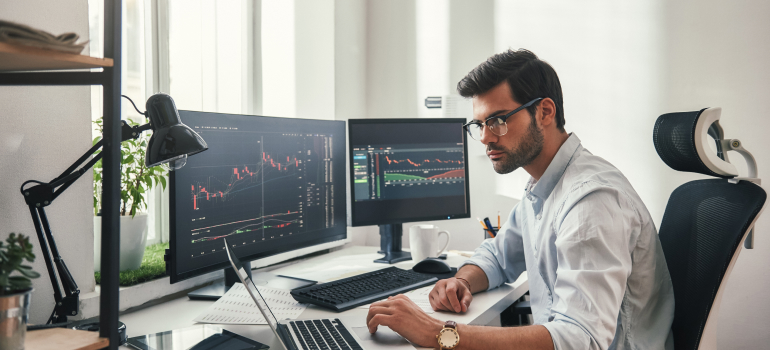
In general, the profession offers good prospects and opportunities for achieving a good income, where an "average" trader can earn around $100-500 in just one day. With the development of technology, including remote and cloud technologies, trading has become more accessible to a wider audience. Many people become independent traders, working from home or office, and also join trading companies.
It's not hard to find a job with this profession. Belarus is looking for traders, analysts, and arbitrageurs. Moreover, according to rabota.by, salaries start from 1,800–2,000 Belarusian rubles excluding bonuses. The earning potential in trading is unlimited, but it is also associated with high risk. Some achieve large profits, while others can lose significant amounts. It is important to understand that this is an active and competitive field where not everyone achieves high results. Therefore, before deciding to trade on the stock exchange, it is important to thoroughly research this area, gain a quality education and practical experience.
What is worth studying on your own
Traders play a vital role in the modern financial industry, providing market liquidity and making decisions that can have long-term consequences. This profession requires professional skills, knowledge, and analytical abilities. However, it also offers opportunities for financial success.
If you are interested in trading, you can continue to study this topic on your own. A good place to start is:
- John Murphy's book "Technical Analysis of the Futures Markets."
- Tradingview.com — with the largest community and powerful tools for technical analysis.
- The Investing.com website is the main resource for the world's financial players.
Master the profession of "Trading" with Skillbox
You will learn how to trade in financial markets and manage risks. Create your own trading strategy and be able to make informed trades.
Remove access